Embracing the Melodrama Part II #6: Berkeley Square (dir by Frank Lloyd)


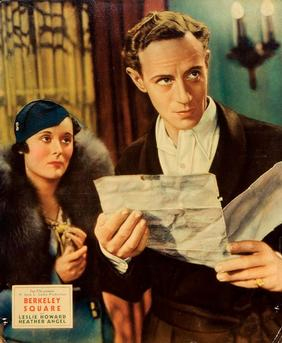
Berkeley_Square_(1933,_Lobby_Card)For today’s final entry in Embracing the Melodrama Part II, we take a look at the 1933 film, Berkeley Square.

Berkeley Square opens in 1784.  An American named Peter Sandish (Leslie Howard) has come from New York to England.  Stopping off at an inn, he explains that he’s on his way to London.  He has distant relations who live in a mansion located in Berkeley Square and it’s been arranged that Peter is going to marry his cousin, Kate Pettigrew (Valerie Taylor).  As Standish talks, he’s interrupted by another man who excitedly announces that a Frenchman has flown across the English Channel in something called a “balloon.”

“It’s beginning,” Peter says, “A new age of speed and innovation…”

Suddenly, the film jumps forward over a hundred years.  In 1933, Standish’s descendant — also named Peter and also played by Leslie Howard — has inherited the family’s old house at Berkeley Square.  He’s spent several days locked away in the mansion, obsessively reading the first Peter’s diary and refusing to see his fiancée, Marjorie (Betty Lawford).

It turns out that Peter — much like Owen Wilson in Midnight in Paris — is frustrated with the modern world and desperately wants to live in the past.  He believes that if he continues to stay in the house, he will eventually be transported back to 1784.  When a friend points out that, even if time travel was possible, Peter would end up changing the past, Peter explains that he’s memorized the first Peter’s diary and, therefore, he knows everything that he needs to say and do.

And then, one night, Peter suddenly does find himself in 1784.  Having taken his ancestor’s place, he meets the Pettigrews, makes plans to marry Kate, and attempts to adapt to 18th century London society.

Unfortunately, this turns out to be not as easy as he thought.  Despite his best efforts, Peter keeps using 1930s slang and alluding to events that will happen in the future.  At first, he explains away his habit of using modern phrases by saying that he’s using common New York expressions.  However, the increasingly suspicious Kate takes a list of Peter’s phrases to the U.S. Ambassador (who is none other than future President John Adams) and is informed that nobody in New York speaks that way.  As well, Peter’s insistence on regular bathing is viewed as odd by the members of upper class London society.  (“I heard he used three buckets of water,” someone accusingly whispers.)  Soon, Kate is convinced that Peter has been possessed by a demon.

An even bigger problem for Peter is that he’s not in love with Kate.  Instead, he’s fallen in love with Kate’s headstrong younger sister, Helen (Heather Angel).  When Helen discovers that Peter is from the future, Peter is forced to decide whether to continue to stay among the “living ghosts” or whether to return to his own time.

Berkeley Square shows on up on TCM fairly frequently and I absolutely love it.  To a certain extent, of course, this is because I’m a secret history nerd and there’s a part of me that will always wish that I could travel in time and experience the past firsthand.  (That said, after watching Berkeley Square, I don’t think I could handle 18th century hygiene.  Agck!)  But the main reason that I love Berkeley Square is because I love a good romance.  And this is such a romantic film!  Heather Angel and Leslie Howard have a really sweet and likable chemistry and, with his performance here, Howard shows why he would be the perfect choice to play the earnest, well-meaning, and ultimately tragic Ashley Wilkes in Gone With The Wind.

Keep an eye out for Berkeley Square.  You won’t be sorry.

Embracing the Melodrama Part II #5: Damaged Lives (dir by Edgar G. Ulmer)


220px-Damaged_Lives_FilmPoster

First released in 1933, Damaged Lives is a prototypical example of the social issue exploitation film.  These were films that managed to escape the wrath of the censor by claiming to be an “educational” film that was specifically made to tell the public about a pressing social problem.  As a result, audiences could go to a movie like Damaged Lives and see all of the innuendo (and occasionally even a hint of forbidden nudity) that were censored out of mainstream films.  In return, the audience would have to spend five minutes or so listening to an authority figure talk about the dangers of juvenile delinquency, drug use, unplanned pregnancy, or venereal disease.

Damaged Lives deals with syphilis.  Young executive Donald Bradley (Lyman Williams) has been dating Joan (Diane Sinclair) for a long time but she is hesitant to get married.  This, despite the fact that she tells her best girlfriend that “I want a baby more than anything else in the world!” and, since this film is from 1933, good girls were apparently not allowed to have sex until getting married.

“Time for you two to get married!” another friend announces.

“What difference does it make?” Joan asks.

“A lot!” comes the reply.

“We should have been married a long time ago!” a bitter Donald exclaims.

Anyway, while waiting for Joan to finally be ready for marriage, Donald meets Elsie (Charlotte Merriam) and discovers that while good girls don’t have sex, bad girls do.  And they give you syphilis!  Unfortunately, Donald does not find out about the syphilis until after he and Joan have finally gotten married and Elsie has committed suicide.

What comes next?  Scandal, of course!  Suddenly, newsboys are screaming, “Extra!  Extra!” and everyone in town knows that Elsie had syphilis.  Donald doesn’t want to tell Joan that he slept with Elsie but then he’s taken on a tour through a hospital that’s full of people suffering from syphilis.  We’re told that the first two people who Donald meets are “innocent.”  They contracted syphilis accidentally, one by simply smoking a pipe after it had been used by an infected person.  Then Donald sees a man who is in the final stages of illness.

“He got it from a streetwalker!” a doctor barks out, “NOT SO INNOCENT!”

When Joan finds out that both she and Donald have been exposed and that she may have to wait to have a baby, she promptly makes plans to kill all of them…

It may not be obvious from the description above but Damaged Lives is actually rather subdued when compared to some other educational exploitation films.  This is no Reefer Madness.  In fact, the film’s final scenes — which involve Joan plotting a permanent end to her troubles — have a tragic sort of grandeur to them.  Damaged Lives is hardly an overlooked masterpiece but, as far as these type of films go, it’s not bad.

Interestingly enough, Damaged Lives was the first film to be directed by the legendary low-budget filmmaker Edgar G. Ulmer.  (Ulmer first came to Hollywood to work on F.W. Murnau’s Sunrise.)  Ulmer went on to direct such classic B-movies as The Black Cat, Detour, and The Man From Planet X.

You can watch Damaged Lives below!


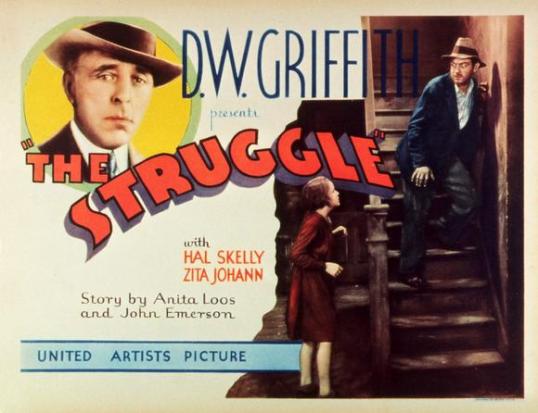
Embracing the Melodrama Part II #4: The Struggle (dir by D.W. Griffith)


The Struggle

Like a lot of the films directed by cinematic pioneer D.W. Griffith, the 1931 film The Struggle is currently available on Netflix.  As a result of his direction of the film Birth of the A Nation, Griffith is a controversial historical figure but it cannot be denied that he was one of the most ambitious, talented, and innovative of the silent filmmakers.  Unfortunately, like a lot of the great figures of silent film, he did not survive the transition to sound.  Griffith directed two sound films.  Abraham Lincoln is overly theatrical while The Struggle … well, bleh.

The Struggle tells the story of a married couple whose marriage is threatened by the husband’s alcoholism.  Florrie (Zita Johann) only agrees to marry Jimmie (Hal Skelly) on the condition that he stop drinking.  And, for several years, Jimmie doesn’t touch a drop of liquor.  But, under pressure at work and struggling to support his family, Jimmie finally breaks down, steps into a speakeasy (this film was made during prohibition), and has a drink.  Soon, Jimmie is a full-blown alcoholic, wandering the streets of New York while little school children shout, “He’s a beggin’ bum!” at him.  Will Jimmie’s life be turned around as the result of hearing a sermon the radio?  Or will he just keep drinking himself to death?

This was the last film on which Griffith was credited as being director.  (Reportedly, he was an uncredited co-director on San Francisco.)  It’s obviously a heart-felt work but, outside of the harrowing shot-on-location scenes of the unshaven Jimmie stumbling down the streets of the Bronx, the film is too overly theatrical and the performances are too stiff and unconvincing to really work.  Griffith was still a visual stylist but, watching The Struggle, it’s obvious that he never learned how to work with speaking actors.  As well, dialogue that would have worked on a title card came across as being over-the-top and preachy when actually uttered aloud.

That said, The Struggle has some interesting historic value, especially for those of us who tend to take the Libertarian point of view when it comes to the war on drugs.  The Struggle opens with a scene that is set at a garden party in 1911.  We listen to various conversations being held at each table.  Two people debate whether the Biograph Girl is named Mary Pickford or Mary Packard.  A man declares that Woodrow Wilson will never be President because he’s a college professor.  (This is all the 1931 equivalent of that scene in Titanic where Billy Zane says that a painting was done by “Somebody Picasso.  I’m sure nothing will ever become of him….”)  Suddenly, scandal hits the garden party as it’s discovered that a woman has had too much to drink and is now drunk.  Everyone at the party, on their own, shuns the woman and she is properly shamed.

The film jumps forward to 1923.  Prohibition is now the law of the land and we find ourselves in a speakeasy.  The thing that we immediately notice is that there are a lot more people in the speakeasy than were at that garden party and every single one of them is drunk.  And, since liquor in now illegal, it’s no longer being bought from safe and trustworthy sources.  Instead, it’s now being brewed in a back room.  One bootlegger holds up a bottle of prohibition liquor and announces it to be poison before then sending it out to be drunk by the Jimmies of the world.

The film’s point, of course, is that community is a lot better when it comes to policing itself than the government is.  The Struggle may not be a great film but it certainly has the right message.

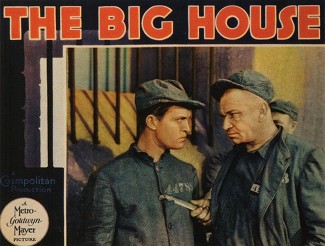
Embracing the Melodrama Part II #3: The Big House (dir by George Hill)


The_Big_House_film_poster

The 1930 Best Picture nominee The Big House opens with a black Model T car slowly pulling up to the front of a large and imposing prison.  Handcuffed in the back seat of the car is a handsome, nervous-looking young man named Kent (Robert Montgomery).  Kent is led into the prison where he is forced to hand over all of his possessions to a grim-looking guard.  We find out that Kent has been convicted of manslaughter, the result of hitting someone while driving drunk.  For the next ten years, this prison (which, we’re told, was designed to house 1,800 but actually holds 3,000) will be Kent’s home.

Kent finds himself sharing a cell with two lifers.  Butch (Wallace Beery) is a coolly manipulative sociopath who alternatively counsels and abuses Kent.  Meanwhile, Morgan (Chester Morris) tries to protect Kent and even helps him get his cigarettes back from Butch.  These three prisoners represent the three faces of prison: Butch is the unrepentant criminal who is actually more at home in prison than in the “real” world.  Morgan is the former criminal who has changed his ways but who is apparently destined to spend the rest of his life paying for his poor decisions.  And Kent is the young man who has to decide if he’s going to be like Butch or if he’s going to be like Morgan.  The Big House makes the still-relevant argument that the American prison system is more likely to turn Kents into Butches than into Morgans.

When the film began, I assumed that Kent would be the main character but actually, he’s secondary to most of the action.  From the moment he first shows up, Kent is not particularly sympathetic and he becomes steadily less likable as the film progresses.  Instead, the film is more focused on the always-scheming Butch and the regretful Morgan.  While Morgan makes plans to escape from captivity and ends up falling in love with Kent’s sister (Leila Hyams), Butch spends his time plotting ways to take over the prison.  For his performance as Butch, Wallace Beery won an Oscar but, seen today, it’s obvious that the film’s heart and soul belongs to Chester Morris’s Morgan.

Like a lot of films from the period, The Big House feels undeniably creaky when viewed through modern eyes.  The Big House was made at a time when Hollywood was still trying to make the transition from silent to sound films.  As such, the film’s pacing is slower than what contemporary audiences are used to and a few of the performances are undeniably theatrical.  I can honestly say that I’m never been more aware of how much I take for granted nonstop background music than when I watch a movie from the early 30s.

That said, once you’ve adapted to the different aesthetic, The Big House holds up fairly well.  Director George Hill films the prison like a town in a German expressionist horror film and Chester Morris’s performance remains sympathetic and compelling.  If the plot seems familiar, it’s important to remember that The Big House is the film first introduced a lot of the clichés that we now take for granted.

The film’s best moments are the ones that deal not with Kent, Butch, and Morgan but instead just the ones that show hordes of prisoners — all anonymous and forgotten men — going about their daily life.  It’s during those scenes that you realize just how many people have been crammed into one tiny space and why that makes it impossible for prison to reform the Kents of the world.

Gandhi once said that the true value of any society can be determined by how that society treats its prisoners and The Big House certainly makes that case.

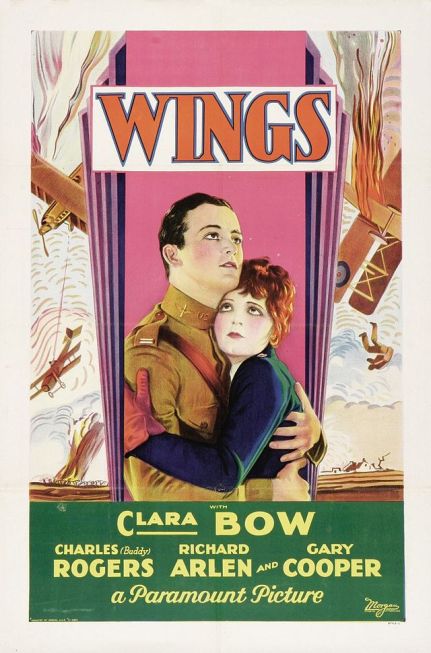
Embracing the Melodrama, Part II: Wings (dir by William Wellman)


Wings

As I mentioned in my previous review, Sunrise may have won the 1927 Oscar for Unique and Artistic Production but the official winner of the first Academy Award for Best Picture was the silent World War I romantic melodrama, Wings.  Wings is one of those films that doesn’t seem to get much respect from contemporary critics, many of whom are quick to dismiss the film as being corny and clichéd.  It’s not unusual to see Wings cited as being the first example of the Academy honoring the wrong film.

Wings tells the story of David Armstrong (Richard Arlen) and Jack Powell (Charles “Buddy” Rogers), who both live in the same small town and who are both in love with the pretty but self-centered Sylvia (Jobyna Ralston).  Sylvia, meanwhile, is in love with the wealthy David but, when Jack asks for a picture of her, she gives him one that she had been planning to eventually give to David.  Meanwhile, Mary (Clara Bow), who is literally the girl next door, pines for Jack.

When World War I breaks out, both Jack and David join the Air Force.  At first they’re rivals but, under the pressure of combat and the threat of constant death, they become friends.  When David flies, he has a tiny teddy bear to bring him luck.  Jack, meanwhile, has Sylvia’s picture.  Meanwhile, their tentmate — Cadet White (Gary Cooper) — insists that he doesn’t need any good luck charms and promptly suffers the consequences for upsetting God.

Meanwhile, Mary has joined the war effort and is driving an ambulance around Europe.  Will Mary ever be able to convince Jack that they belong together?  Will David ever catch the legendary German pilot, Kessler?  Perhaps most importantly, will this new bromance be able to survive both war and the charms of Clara Bow?  And finally, will anyone be surprised when all of this leads to a tragic conclusion with an ironic twist?

Wings has got such a bad reputation and is so frequently dismissed as being the first case of the Academy picking spectacle over quality that I was actually shocked when I watched it and discovered that Wings is actually a pretty good movie.  Yes, it is totally predictable.  Every possible war film cliche can be found in Wings.  (From the minute that handsome and confident Gary Cooper announced that he didn’t need any lucky charms, I knew he was doomed.)  And yes, the film does run long and it does feature a totally out-of-place subplot involving a character played by someone named El Brendel (who was apparently a popular comedian at the time).  This is all true but, still, Wings works when taken on its own terms.

Here’s the thing with Wings: the aerial footage is still impressive (all the more so for being filmed without the benefit of CGI) and both Charles “Buddy” Rogers and Richard Arlen are handsome and appealing in a 1927 silent film sort of way.  In fact, the entire film is appealing in a 1927 silent film sort of way.  This is a time capsule, one that shows what films were like in the 20s and, as a result of the combat scenes, also provides a hint of what lay in the future for the film industry.  Most importantly, Wings features Clara Bow, who has been my silent film girl crush ever since I first saw It.  Whether she’s attempting to flirt with the clueless Rogers or hiding underneath her ambulance and shouting curses at the Germans flying above her, Clara brings a lot of life to every scene in which she appears.

If you’re a film historian, Wings is one of those films that you simply have to see and, fortunately for you, it’s actually better than you may have been led to think.

It’s currently available on Netflix.

http://www.youtube.com/watch?v=EqOqXj2biG0


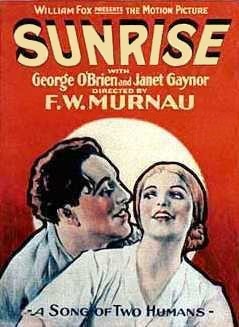
Embracing the Melodrama, Part II: Sunrise (dir by F.W. Murnau)


Sunrise_vintage

Last year, I published 60 film reviews under the heading of Embracing the Melodrama.  Embracing the Melodrama was one of the first review series that I had ever done and I had so much fun doing it that I figured, “Why not try it again?”

In other words, welcome to Embracing the Melodrama, Part II!

Over the next three weeks, I will posting, in chronological order, 128 reviews of films that embrace the melodrama.  As before, these reviews will be in chronological order and they will include everything from Oscar winners to grindhouse exploitation to made-for-television dramas.  It should be fun!

And, considering that we’re talking about 128 reviews here, it should at least help me make a dent in my goal to see every single movie that has ever been made.

Let’s start things off by taking a quick look at the 1927 silent film, Sunrise.  Directed by German expressionist F.W. Murnau, Sunrise is widely considered to be one of the greatest films ever made and for once, popular opinion is correct.  The film tells a simple story.  The Woman From The City (Margaret Livingston) takes a vacation out in the country.  (We know she’s dangerous because she wears black lingerie.)  She stands outside of a farmhouse and whistles.  Soon, the Man (George O’Brien) steps out of the farmhouse and joins the Woman.  Inside the farmhouse, the Wife (Janet Gaynor) can only dream of what life was like when she and the Man first fell in love.

The Man and the Woman meet at the edge of the lake and kiss as the moon shines down on them.  They’re having an affair, though the film — in its dream-like way — leaves it ambiguous as to just how long the affair has been going on.  (Indeed, the film almost seems to suggest that The Woman has sprung from the Man’s subconscious, a creation of his darkest desires.)  The Woman wants the Man to murder his wife and come back to the city with her.  At first, the Man refuses but, as the Woman talks to him, he starts to visualize the city.  And, make no mistake about it — the city that the man visualizes is a scary place that resembles the dreamworld of The Cabinet of Dr. Caligari.  But, at the same time, it’s also a lot more fun than the farm.

Now, you may be wondering why this familiar sounding tale is considered to be one of the best films of all time.  The story itself is simple and deliberately allegorical.  The film is less about the story and more about how Murnau tells it.  Murnau fills the screen with hauntingly surreal images that are both beautiful and frightening at the same time.  When the title cards appear on-screen, the lettering literally fades in and out and adds to the entire movie’s dream-like feel.  Watch the scene below where the Woman first suggests killing the Wife and the Man visualizes the city:

Infatuated with the Woman, the Man plans to drown the Wife but, at the last minute, has a change of heart.  The Wife, however, flees to the city herself.  The Man follows her and attempts to win back her love.  The city itself changes when the Man and the Wife are in it together.  What seemed dark and threatening under the influence of the Woman is now revealed to be fun and vibrant.  The film transforms from being an early example of film noir to being a screwball comedy.

How many other films can you think of that feature both a murderous femme fatale and a drunk pig?

And yet, as much joy as the Man and the Wife find in the city, both the farm and the Woman await their eventual return.  And there’s a storm coming…

Interestingly enough, at the first Oscar ceremony, two awards were given for Best Picture of the year.  The first award — for Outstanding Production — went to Wings, a big budget action spectacular about World War I.  The other award — for Unique And Artistic Presentation — went to Sunrise.  I’ve read a lot of speculation about which film the Academy meant to name the best of the year but, to me, it’s fairly obvious that the Academy meant for Outstanding Production to honor the year’s big blockbusters while Unique and Artistic Presentation would honor the “art” films.

And, to be honest, I think that, way back in 1928, the Academy had the right idea.  Why should they only give out one award for best picture, as if all films can be judged by only one standard?  Why not give out separate awards for the best comedy or the best thriller or the best film made for a certain amount of money?  Why not bring back the Oscar for Unique and Artistic Presentation?

For whatever reason, the Academy discontinued the Unique and Artistic Presentation Award after the 1st ceremony and, in the future, only one film would be named best of the year.  Since Outstanding Production eventually become known as Best Picture, Wings has been immortalized as the first film to win best picture.

And, nothing against Wings, but the Academy would have been smarter to have gone with Sunrise.  Certainly, it would have won them the respect of future film students.

You can watch Sunrise below!

http://www.youtube.com/watch?v=GnLVMREVA6M

America, Tommy Wiseau, and Rifftrax


“America is the best country in the world.” — Tommy Wiseau

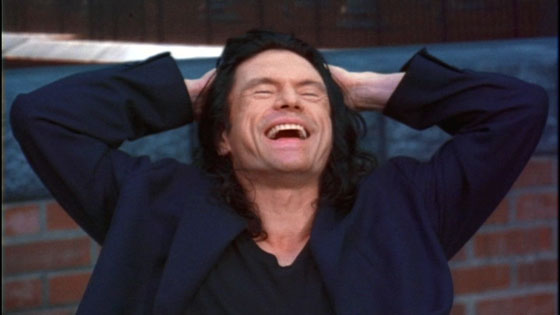
the-room-12

Tommy Wiseau in The Room

Recently, I had the chance to speak with Tommy Wiseau, the director of the cult hit, The Room and the man behind the online series, The Neighbors.

In a perfect world, everyone would get to spend 30 minutes talking to Tommy Wiseau.  For someone who has watched The Room over a hundred times, it was at first overwhelming to hear that famous accent and that equally famous chuckle over the telephone.  Once you start talking to Tommy, it is hard not to get caught up in his energy and his enthusiasm.

During our conversation, Tommy frequently returned to the theme that, as he put it, “America is the best country in the world.”  Both The Room and Tommy Wiseau are American success stories.  Along with writing and directing The Room, Wiseau also starred as Johnny, a banker who lives with and loves his “future wife” Lisa (Juliette Danielle).  What he does not know is that Lisa is having an affair with Johnny’s best friend, Mark (Greg Sestero).  Meanwhile, Johnny’s ward, Denny, is stalked by a drug dealer, Lisa’s friend tries to find enough privacy to make out with her boyfriend, a guy that nobody has seen before suddenly shows up towards the end of the film and somehow knows about everything that has been going on, Mark nearly tosses a man off a rooftop, and Johnny and his friends spend a lot of time playing football while wearing tuxedos.

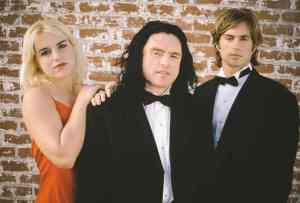
Juliette Danielle, Tommy Wiseau, and Greg Sestero in The Room

Juliette Danielle, Tommy Wiseau, and Greg Sestero in The Room

When The Room was first released in 2003, it played in two theaters and it easily could have gone the way of many other forgotten independent films.  However, through word of mouth, people started to discover The Room and now, in the tradition of The Rocky Horror Picture Show, The Room has become a midnight movie success.  Fans come to showings dressed like their favorite characters, repeat the film’s dialogue, talk back to the characters, and throw plastic spoons at the screen.  (Go to a showing and you will understand.)  Co-star Greg Sestero has written a book, The Disaster Artist, about the making of The Room.  (When I asked Wiseau how accurate he felt the book was, he replied, “40%, no more than that.”  He also told me that, despite what some people in the media may be claiming, reports that he was no longer talking to Greg Sestero were totally incorrect.)  I was first introduced to The Room by Lisa Marie (not to be mistaken for Lisa, Johnny’s future wife) and we have both lost track of how many midnight showing we have attended at the Inwood Theater.

As The Room has become better known, so has Tommy Wiseau.  When I asked him if he found all of the fame to be overwhelming, Wiseau told me, “Not overwhelming. Because it’s fun.  You have to believe in what you want to create.”

TribecaWiseau has another reason to be excited, because the guys from Rifftrax will soon be bringing The Room to a whole new audience.  Rifftrax will be hosting a showing and live commentary at the Tribeca Film Festival on April 17th and then Rifftrax Live: The Room will screen in 700 theaters across the United States and Canada on May 6th and May 12th.  

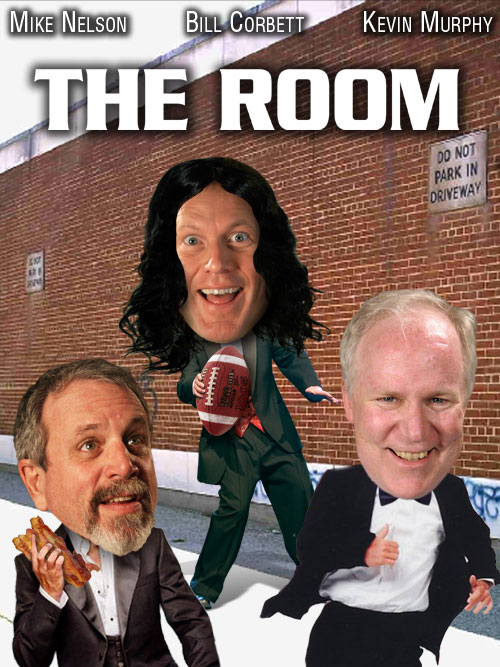
The Rifftrax guys are Mike Nelson, Bill Corbett, and Kevin Murphy.  They  are probably best known for their previous work on Mystery Science Theater 3000.  In many ways, MST 3K is as much of an American success story as The Room.  If you grew up in the 90s, it is likely that MST 3K shaped the way that you viewed everything from culture to politics to entertainment to whether or not it was okay to talk during a movie.  Rifftrax presenting The Room feels like the perfect marriage of two phenomenons of American pop culture.

Joe Don Baker in happier times

Joe Don Baker in happier times

There are a few famous stories of actors and filmmakers who did not appreciate having their films screened by the MST 3K guys.  On the DVD for MST 3K‘s take on Time Chasers, Mike Nelson mentions that the film’s producers had a party to view the show and that some of them did not take the ribbing as well as others.  The internet is full of rumors that actor Joe Don Baker is still angry over what was said about his performances in Mitchell and Fatal Justice.

However, Tommy Wiseau is encouraging everyone to see Rifftrax Live: The Room.  When I asked him how he felt about Rifftrax, he replied, “They’re very nice people.”  He went on to explain that he’s very excited and enthusiastic about the Rifftrax presentation of The Room and he’s looking forward to a whole new audience discovering the film.

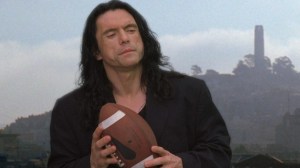
Tommy Wiseau and football in The Room

Tommy Wiseau and football in The Room

Wiseau is also hoping that people will continue to discover The Neighbors, his online series that is currently available on Hulu.  When I asked him what had inspired The Neighbors, he replied that it was based on a true life. In regard to one character who is obsessed with a chicken, Wiseau explained, “My aunt used to have a chicken.”  He went on to explain that, like the characters in The Neighbors, “We are all human, we are all multicultural.”

We also talked about Wiseau’s first film, the documentary Homeless in America.  Tommy Wiseau really impressed me with the obvious passion that he felt for the topic.  “I wanted to know about what was happening,” he explained as to why he had made the documentary, adding that not all of the homeless are mentally ill and they not all of them are criminals.  “You cannot eliminate the homeless,” he said.  Homeless in America can be ordered from Amazon.

Orson Welles in Citizen Kane

Orson Welles in Citizen Kane

When asked what movies he would recommend that aspiring filmmakers should watch, Wiseau immediately said, “Citizen Kane.”  “Citizen Kane isn’t cookie cutter from Hollywood,” he explained.  “If Hollywood had made The Room, it would be a totally different story.”  Tommy also suggested watching Giant and “Clint Eastwood movies.”

As for the future, James Franco is currently working on an adaptation of Sestero’s The Disaster Artist but Wiseau can not talk about the production.  However, he did say about Franco, “He likes James Dean, I like James Dean.”  Wiseau is looking forward to more filmmaking.  He’s currently working on a new film called Foreclosure and, in June, there will be four more episodes of The Neighbors on Hulu.

And, of course, Rifftrax Live: The Room will be in 700 theaters on May 6th and May 12th.

I asked Wiseau if there was anything he would like to say to his fans.

“Yes,” he said, “You can laugh, you can cry, you can express yourself, but please don’t hurt each other.”

Those are words to live by.

Want to find out more about The Room and buy some Tommy Wiseau merchandise?  Click here!

Want to find out more about the showing of The Room at Tribeca and how to purchase tickets?  Click here!

Want to find out more about how to purchase tickets for the May 6th and May 12th showings of Rifftrax Live: The Room?  Click here!

Want to watch Tommy Wiseau’s The Neighbors?  Click here!

Want to order Tommy Wiseau’s documentary, Homeless in America?  Click here!

TheRoomWeb2

(Thank you, Tommy Wiseau, for taking the time to talk to us!)

Here! It’s a Gift!


PCAS

Here’s the new trailer for The Gift, in which it appears that Jason Bateman and Rebecca Hall end up getting stalked by some guy named Gordo.  This could be good or it could be bad, it’s hard to tell from the trailer.

On the one hand, the story looks rather generic and predictable and has a Boy Next Door feel to it.  (“Oh!  A first edition!“)  It looks like it would be a fun Lifetime movie but maybe not quite as memorable when seen on the big screen.

But Jason Bateman, Rebecca Hall, and Joel Edgerton!  Seriously, that’s a great cast!

I’m going to see it just to see if I can finally bring myself to forgive Bateman for being so mean to Juno.