What Lisa and the Snarkalecs Watched Last #88: Ghost Shark (directed by Griff Furst)


Last night, before going on vacation, I watched the SyFy original movie, Ghost Shark.

Why Was I Watching It?

Every Saturday night, I watch and live tweet a SyFy movie with the Snarkalecs.  Last night, we watched Ghost Shark.  Seeing as Ghost Shark was going to be my last SyFy film to watch before going on vacation, I knew that both the film and the snarkiness would have to keep me satisfied for the next two weeks.  Fortunately, both Ghost Shark and the Snarkalecs came through brilliantly!

What Was It About?

One of my huge problems with Sharknado is that, despite the title, there really wasn’t much tornado action.  However, Ghost Shark lives up to its title.  It’s called Ghost Shark and, by God, that’s what it’s about!

In short, a shark is killed by a bunch of rednecks who look like they’ve wandered over from an unaired episode of Duck Dynasty.  However, the shark comes back and, as you might guess, it’s looking for vengeance.  As a ghost, the shark has the ability to manifest itself out of any body of water and soon, it’s popping up in toilets, swimming pools, sinks, water slides, and an open fire hydrant.  (As the film’s brilliant tagline put it — “If you get wet, you die.”  Seriously, I would be so dead.)  It’s up to Ava (Mackenzie Rosman) and the town drunk (Richard Moll) to figure out how to stop the Ghost Shark!

What Worked?

Even if I hadn’t known beforehand, I would have guessed that Griff Furst had directed Ghost Shark.  Of all the directors who regularly direct films for the SyFy network, Furst is one of the best.  Along with making good use of his trademark Louisiana locations, Furst also knows how to maintain the perfect balance of excitement and humor.

It should also be noted that Ghost Shark is one of the few films where you really can’t predict who is going to survive and who is going to end up as sharkbait.  One reason why the ghost shark is an effective monster is because he will literally eat anyone, even characters who — in other films — would automatically be spared of any danger.

On a personal note, I have to say that the Snarkalecs were on fire last night.  Kelly Thul, in particular, earned a spot in the hall of fame for commenting, about two characters who had just gotten the upper halves of their bodies chomped off by the ghost shark, “They’re waisted!”

What Did Not Work?

It all worked.  Seriously, this was the best SyFy film since End of the World.  And, in case you were curious, it’s a hundred times better than Sharknado.

“Oh my God!” Just Like Me Moments

At one point, one future victim said, “It’s too hot to be a virgin” and if I had a dollar for every time I’ve used those exact same words, I would be one rich redhead.

Also, I related to the scene where the sprinklers go off in the local museum and end up soaking every character there.  Museums always get me wet too.  What can I say?  I love history.

Lessons Learned

Sometimes, it’s better just to stay dry.

6 Trailers From Vacation Girl


PCAS

Hi!  I may be on vacation but the trailer kitties have still been hard at work, putting together another edition of Lisa Marie’s Favorite Grindhouse and Exploitation Film Trailers.

Let’s see what they’ve got for us this week.

1) Raiders of the Living Dead (1986)

2) Phase IV (1974)

3) Hellgate (1989)

4) Beyond Evil (1980)

5) Terrorgram (1988)

6) Ticks (1993)

What do you think, Trailer Kitty?

cat cuteness

Dance Scenes I Love: Money From Cabaret


When I decided that I was going to post a series of dance scenes that I love, I knew I’d have to include at least one scene from Cabaret.

But which scene?

Bob Fosse’s 1972 film is a treasure trove for those of us who love dance.

In the end, I went with Money because it’s true.

Money does make the world go around.

Film Review: You’re Next (dir by Adam Wingard)


If Luis Buñuel had ever made a slasher film, it would probably have been a lot like You’re Next.

You’re Next tells the story of the ill-fated Davison clan.  Paul (Rob Moran) has recently retired from his job as a defense contractor and now, he and his wife, Aubrey (Barbara Crampton) are looking forward to celebrating their anniversary at their isolated vacation home.  Soon after they arrive at the house, Aubrey is convinced that she can hear someone else in the house.  However, since the frail Aubrey is obviously emotionally unstable, Paul dismisses her concerns.

Over the course of the day, Paul and Aubrey’s children arrive at the house.  Though, in the best tradition of all troubled families, the Davisons attempt to maintain a facade of peace and harmony, it quickly becomes clear that each member of the family is dealing with his or her own issues and petty jealousies.

For instance, oldest son Drake (Joe Swanberg) obviously feels that he’s superior to his siblings.  His wife, Kelly (Margaret Laney), is just as obviously unhappy with their marriage.

Crispian (A.J. Bowen) is a neurotic academic who is struggling financially and is viewed as being a weakling by the rest of his family.  His girlfriend, Erin (Sharni Vinson) has a secret in her past that will become unexpectedly important as the day progresses.

Daughter Aimee (played by Amy Seimetz, who was so good earlier this year in Upstream Color) tries so hard to be cheerful that you know that she has to be secretly be on the verge of having a nervous breakdown.  Her boyfriend, Tariq (Ti West), is a struggling filmmaker who is scandalized to discover that Drake prefers to watch commercials as opposed to documentaries.

Finally, there’s the youngest son, Felix (Nicholas Tucci).  Felix appears to be the most well-adjusted of all of the Davison children but his quiet girlfriend Zee (Wendy Glenn) is a different story.

Once the family has gathered together for the anniversary dinner, the bickering begins.  What the family don’t realize is that a group of men (all of whom wear animal masks) have previously slaughtered the neighbors and have now surrounded the Davison house.  The bickering is interrupted by a brutal attack that leaves one dead, one seriously injured, and the rest of the family fighting for their lives.

You’re Next starts out as an effective but rather standard home invasion film (think of The Strangers or even Michael Haneke’s Funny Games) but the film features two twists which set it apart.

The first twist is that Erin turns out to be as effective and determined a killer as the men laying siege to the house.  I’ve sat through a lot of horror movies and I love movies where women get to kick ass and I can tell you, without fear of contradiction, that there’s probably no other horror heroine who kicks as much ass as Erin.  As played by Sharni Vinson, Erin is destined to become an iconic character in the history of horror.

youre-next-sharni-vinson

The other twist is one that I can’t tell you about because it’s this twist that literally turns the entire film upside down.  What I can tell you is that this twist forces you to reconsider everything that you’ve seen up until that point.  Most impressively, director Adam Wingard reveals this twist to us long before he reveals it to the film’s characters.  As such, just when the viewer is getting used to the idea of You’re Next being just another home invasion film, a whole new element of suspense is added to the story.

Some reviewers have referred to You’re Next as being a comedy.  I disagree, if just because the film’s violence is too brutal and the gore is too graphic for this film to be considered anything other than primarily a horror film.  That said, there is a strain of dark humor that runs through the film and occasionally provides a much needed relief from the nonstop tension onscreen.  A good deal of the film’s humor comes from just how incredibly screwed-up the Davison family is, even before they find themselves under attack.  This is a family of people who, even while they’re trying to plot their escape from the house, can not resist getting into argument about who can run the fastest.

Ultimately, You’re Next works as both a brutally effective horror film and as a satirical portrait of an All-American family that’s secretly so dysfunctional that — even if they weren’t being attacked by masked men with crossbows — they probably would have eventually ended up killing each other anyway.  It’s a genre film that manages to transcend the rules of genre even while embracing them.  In a year that, so far, has been dominated by surprisingly intelligent and effective horror films, You’re Next is one of the best.

youre-next-movie-image-05

An Appreciation of It


Annex - Bow, Clara (IT)_01

(Spoilers below)

If I could be any character from a silent film, I would want to be Betty Lou Spence, the heroine of the classic 1927 film, It.

As played by the beautiful Clara Bow, Betty has It.  What is It, you may ask?  That’s the question that this film sets out to answer.  The movie starts out with a title card that read, “That quality possessed by some which draws all others with its magnetic force. With ‘It’ you win all men if you are a woman and all women if you are a man. ‘It’ can be a quality of the mind as well as a physical attraction.”  Throughout the film, every man who sets his eyes on Betty automatically says that she has “it.”   Though the film never explicitly says so, it’s pretty obvious that “It” is a combination of sensuality, intelligence, and inner strength.

It is sex.

And yes, since she’s played by Clara Bow, Betty Lou Spencer definitely has ‘it’ and she knows what to do with it as well.

However, one thing that Betty doesn’t have is a lot of money.  Instead, she’s a proud and poor shopgirl who sets her sights on her wealthy and handsome employer, Cyrus Waltham (played by Antonio Moreno).  Realizing that the uptight Cyrus will never notice her while at work, Betty accepts a date with Cyrus’s irresponsible best friend Monty (William Austin).  Knowing that Cyrus and his girlfriend will also be there, Betty asks Monty to take her to a fancy restaurant.  While Monty orders their food, Betty stares shocked at the high prices on the menu.  Why just the appetizers cost $2.00!

Ah, 1927.

Eventually, Betty does manage to get Cyrus’s attention.  After spending a day slumming with her down on Coney Island, Cyrus attempts to kiss Betty.  Betty responds by slapping him and telling him, “So, you’re one of those minute men — the minute you meet a girl, you think you can kiss her!”

The next day, things get a bit more complicated when Betty discovers that two social workers have shown up at the apartment of her best friend, Molly (Priscilla Bonner).  Molly is a single mother and the social workers have shown up to take away her baby.  Betty boldly steps forward, claiming that she is the baby’s true mother and that, since she has a job, the social works have no reason to take away her baby.

One of the snooty social workers (who, needless to say, does not have it) stares down here nose at Betty and asks, “And where is your husband?”

Betty stares straight back at her and replies, “That’s none of your business.”

Seriously, nobody tells Betty Lou Spence what to do.

Since this movie was made in 1927, everyone is scandalized.  Cyrus, obviously miffed that he couldn’t even get a kiss from an unwed mother, dumps her.  Betty responds by quitting her job.  A title card informs us that Betty may have needed the money but her pride was far more important to her.  What makes this movie unique, especially when compared to even some contemporary films, is that Betty is not punished for putting her pride before money or romance.  Instead, the film celebrates her independence.

The rest of the film deals with her getting her own brand of vengeance on Cyrus.  In the end, Betty gets her man but she gets him on her own terms.  Again, take a minute to consider that this film, made nearly 90 years ago, not only features a liberated woman but celebrates her as well.

After this film, Clara Bow became known as the “It Girl,” and it’s easy to see why.  In the role of Betty Lou Spence, Bow epitomizes the perfect combination of outward sensuality and inward strength.  Whether she’s sarcastically telling off a rude customer, defending her best friend, or saving the life of her romantic rival, Clara Bow epitomizes both sex and independence.  In the end, she pursues her man not out of obligation but out of desire.  When she does find her happy ending, she finds it on her own terms.

Those of us in 2013 have a lot to learn from the It Girl of 1927.

Dance Scenes That I Love: Anna Karenina


Hi everyone!

Starting today, I am officially on vacation!

However, though I’ll be away for two weeks, I’m not going to let that stop me from sharing my thoughts here on the Shattered Lens.  What can I say?  I love film, I love this site, and, most importantly, I love our readers.

Now, if you know me, you know that I also love to dance.

So, I figured, why not combine my greatest loves?  For then next two weeks, I will be sharing a special set of scenes that I love.  These are some of my favorite dance scenes.

I’d like to start things off by sharing a scene from my favorite film of 2012.  This deliriously romantic dance scene comes from Joe Wright’s brilliant adaptation of Anna Karenina and features Keira Knightley and Aaron Taylor-Johnson.

Enjoy!


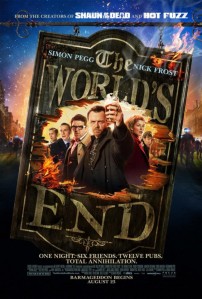
Quick Review: The World’s End (dir. by Edgar Wright)


the_worlds_end_12-620x918A strange thing happened on the way to seeing The World’s End. With the audience seated for the film, we all watched as the credits began. When I saw that Constantin Film was involved, I thought to myself, “Wait, wasn’t Edgar Wright’s films mostly Working Title Productions? This is different.” Turns out the movie that started playing was The Mortal Instruments, the result of which had a few moviegoers groaning and actively talking about the film. Someone actually cried out “It’s the King of the North!” after seeing Lena Headey and her co-star who barely resembled Robb Stark. After about 5 minutes of this, the film was shut down, the reel replaced and The World’s End was ready to begin.

The World’s End marks the final film in Edgar Wright’s Cornetto Flavors Trilogy. The Cornetto (which look like King Cones here in the states) was something of a joke in Shawn of the Dead with the color red, and then had a return appearance in Hot Fuzz with the color blue. The World’s End has a connection with green when it comes to Cornettos.

The film reunites Wright with Simon Pegg and Nick Frost, and in a twist from the previous films together, it’s Pegg whose character is the over the top one with Frost as the straight man. I’ll admit that I walked in this actually expecting the opposite, and found myself chuckling when it didn’t turn out that way.  Surrounded by a cast made up of Wright regulars like Paddy Considine (Hot Fuzz, The Bourne Ultimatum) and Martin Freeman (Love Actually, The Hobbit), along with some new faces in Pierce Brosnan and Rosamund Pike, there isn’t a cast member that feels out of place here. Even when the story feels like it’s about to lull, there’s some weird quip or moment that invoked a laugh or chuckle in the audience.

The World’s End is the story of Gary King (Pegg), who as a teen growing up in small town, dared to do the impossible with his friends. The plan was to make a run to 12 different pubs in the town, have a pint of beer in each one, leading up to the final pub called The World’s End. In the initial attempt, they managed to get about 3/4ths of the way through before getting so smashed that they had to bail out. Time passes, as it always does and the old gang has grown up, moved on to different lifestyles and in some cases, built families. King, on the other hand, is very much stuck in his own time period spending the bulk of his time reliving his glory days. He’s that guy that talks about his High School Football days as if  they were yesterday, some 20 odd years later. This is a running theme through the film – the notion that being caught up in nostalgia is not as great as it ever appears, and that being too nostalgic – living too much in the past –  could possibly suggest that one isn’t appreciating what they have right now, nor are they looking forward to anything. Sometimes, you just can’t go home…or can you?

King decides to get his friends together for one last run on The Golden Mile. As they go from pub to pub, they go over various events in their lives and start to notice (in true Wright fashion) that something really weird seems to be going on in the town. As things begin to unravel, they come to find that actually are in real danger and need to get past all of their issues if they’ll get through it. Just like Shaun of the Dead and Hot Fuzz, the second half of film becomes something of a horror thriller with comedy throughout. Elements of The Thing and Invasion of the Body Snatchers become noticeable as the team tries to survive. That’s pretty much it. Take the recent This is the End, add a few beers and a tighter script and you have The World’s End. The first half of the movie may seem slow, but it does pick up, and pick up well.

Pegg and Frost are the grounding forces to The World’s End. Their performances (particularly Pegg’s) are what keeps it all afloat when it seems like the story might unravel. If the film suffers from any problems, is that it’s something of a downshift for Wright compared to Scott Pilgrim vs. The World. There are a number of action moments in The World’s End, but at the same time, they don’t quite have the umph factor of Wright’s other films. By the time you reach the end, you may actually find yourself scratching your head over what you’ve seen, but then again, the ending of Shaun of the Dead didn’t quite make sense to me either. Not saying that it could have all been better (as I may see it again before the weekend is out), it’s just different.

Overall, The World’s End is a fun ride into the past of a series of characters that will remind you to focus on the present, and laugh while doing so. It’s a fitting close to these films, even if it isn’t the sharpest film in the set (for me that remains Hot Fuzz). If only they served beers at the movie theatres, that would be perfect.

Ten Years #29: Therion


Decade of last.fm scrobbling countdown:
39. Therion (1,059 plays)
Top track (81 plays): The Siren of the Woods, from Theli (1997)
Featured track: Vanaheim, from Secret of the Runes (2001)

Therion is an interesting animal in the world of metal. In a lot of ways, Christofer Johnsson’s brainchild derives from forms of music that don’t much suit me. The harsher vocals are firmly rooted in his death metal origins, the guitar riffs and drumming waver between metal and a softer “hard rock” sound, and 80s-inspired over the top solos flourish throughout the discography. Yet all of these typical turn-offs for me shake their negative connotations and merge rather seamlessly with Johnsson’s greater operatic vision. For the majority of Therion’s 26 year history, Johnsson has been forging his own unique path through the world of theatrical rock by infusing fairly typical stylistic norms with outstanding song writing. I can’t help but fear at times that Therion may descend to the quality of another boring Trans-Siberian Orchestra, but they never do. Across 15 studio albums, Johnsson continually manages to find compelling new ways to make the peculiar marriage of rock and opera somehow work.

I’ll admit to not being a huge Therion fan. The vast majority of the 1000+ listens that render them my 29th most-listened-to band of the past decade came in 2003 and 2004, when the individual elements of their sound were still a bit novel to me. I never did get around to picking up Sitra Ahra or Les Fleurs du Mal. But I’ve heard enough to confidently state that Johnsson is one of the finest song-writers to seriously approach the possibilities of combining rock with classical styles. Secret of the Runes is my personal favorite album in his discography. There, I think Johnsson really let the opera be heavy in its own right; it’s frequently more intense and driving than the traditional metal instrumentation accompanying it.

AMV of the Day: Star x Crossed (Romeo x Juliet)


RomeoXJuliet

The latest “AMV of the Day” is from an anime adaptation of one of the Bard’s most beloved work: Romeo and Juliet. There was an earlier chosen AMV from awhile back that also used this anime adaptation and one I consider a big favorite. Well, I found another well-made AMV using this same series and this time instead of taking the symphonic metal route for choice in music the video goes old-school 80’s rock ballad.

“Star x Crossed” combines both Romeo x Juliet and the classic Roxette rock ballad from the 80’s, “Listen To Your Heart”, to great effect. The song itself actually fits in perfectly with the anime which takes the star-crossed couple of the title in a fantasy setting. The series combines romance, drama and action in equal amounts. In fact, I would guess that the anime version of Juliet is less damsel-in-distress and lover-in-waiting and more an equal or surpasses Romeo in both character development and skill.

The video itself shows scenes of Juliet not just as the object of Romeo’s affection, but also someone who can hold her own in a fight. Plus, she’s a redhead which should make Lisa Marie happy as long as she doesn’t start trying to do sword-fighting like the character in the video.

The video’s creator is sinycatarina and it’s been an eye-opener finding her work in the AMV scene. This creator is very good and I’ve already marked another of her video’s for a future installment.

Anime: Romeo x Juliet

Song: “Listen To Your Heart” by Roxette

Creator: sinycatarina

Past AMVs of the Day

Ten Years #30: The Smashing Pumpkins


Decade of last.fm scrobbling countdown:
30. The Smashing Pumpkins (1,058 plays)
Top track (36 plays): I of the Mourning, from Machina: The Machines of God (2000)

2000 might have been one of the most optimistic years in American history. Bill Clinton was still president, the massive corporate effort to overcome a Y2K electronic doomsday scenario had succeeded impressively, the medical field was speeding towards a glimmering utopian future of nanobots and stem cell technology, and we had just wrapped up the Kosovo conflict to conclude a rare decade characterized more by sincere humanitarian intervention than by capitalist imperialism. Though we would soon plummet back to the social and political stone age in successive waves of decadence, this naive teenager’s outlook on the future was a dreamy ideal of progress. If there was trouble in the air, I never felt it. Whatever concerns the future might bring were fundamentally tied to it, not to the here and now.

Every Smashing Pumpkins album struck me in a fairly unique way. Each Siamese Dream track seemed like an overwhelming independent entity; I would get hung up on a song like “Rocket” and listen to it over and over again for days before moving on to the next. Mellon Collie and the Infinite Sadness I enjoyed more as a collective, basking in the roller coaster romp from ecstasy to sadness to rage that characterized juxtapositions like “Thru the Eyes of Ruby”, “Stumbleine”, and “x.y.u.” Adore kind of washed over me as a kid, and while I appreciate it more today, I will never quite get over the absence of Jimmy Chamberlin.

On Machina: The Machines of God, I think the vision of an album really overtook the band. Each song felt like a part of the collective to a greater degree than ever before. The highs and lows were all subdued. There was more total sound encompassing everything, while the edges of the heaviest tracks were dulled–while “We Only Come Out At Night” and “Tales of a Scorched Earth” certainly belong together as elements of a greater emotional road trip, “With Every Light” and “Heavy Metal Machines” were substantially closer in their musical approach and production. If Mellon Collie was a pendulum swinging violently between beauty and aggression, Machina rocked gently and subtly around its zen point. I fell in love with it even more than with Mellon Collie or Siamese Dream–a feat I did not think possible.

It might go against the popular grain to speak of Machina as the best Pumpkins album–of “I of the Mourning” and “Age of Innocence” as their best songs or “Stand Inside Your Love” as their best single. But these are definitely my favorites. I felt a perfect connection between the overall vibe of this album and my outlook on the world in 2000. “I of the Mourning” captured it perfectly for me–a positive cultivation of a sense of longing framed not by some mournful acoustic guitar but by that encompassing futuristic dream that characterizes the sound of Machina from start to finish.

Perhaps the stars just all aligned in the right place and time. Machina seems more like a personal testament to the band’s experiences together leading up to their impending break-up than a commentary on the state of the world. “Age of Innocence” functioned in retrospect as a clear final farewell. But it was a positive farewell, looking brightly to the uncertain future, and as such it seemed to coalesce with our passage into a new millennium. The 21st century promised, falsely as it turned out, to be a little less compulsive than the last, and I think Corgan likewise saw himself waving farewell to an endearing yet tumultuous phase in his life. I’ll leave you with that closing song:

We dismiss the back roads
and ride these streets unafraid
resort to scraping paint
from our bones unashamed

no more the eye upon you
no more the simple man

desolation yes, hesitation no
as you might have guessed, all is never shown
desolation yes, hesitation no

and in my prayers I dream alone
a silent speech to deaf ears:
If you want love, you must be love
but if you bleed love, you will die loved

no more the lie upon you
cast in stone the autumn shade

desolation yes, hesitation no
as you might have sensed, we won’t make it home
desolation yes, hesitation no

before the rites of spring
come to mean all things
a little taste of what may come
a mere glimpse of what has gone

cause for the moment we are free
we seek to bind our release
too young to die, too rich to care
too fucked to swear that I was there

desolation yes, hesitation no
as you might have guessed, we won’t make it home
desolation yes, hesitation no