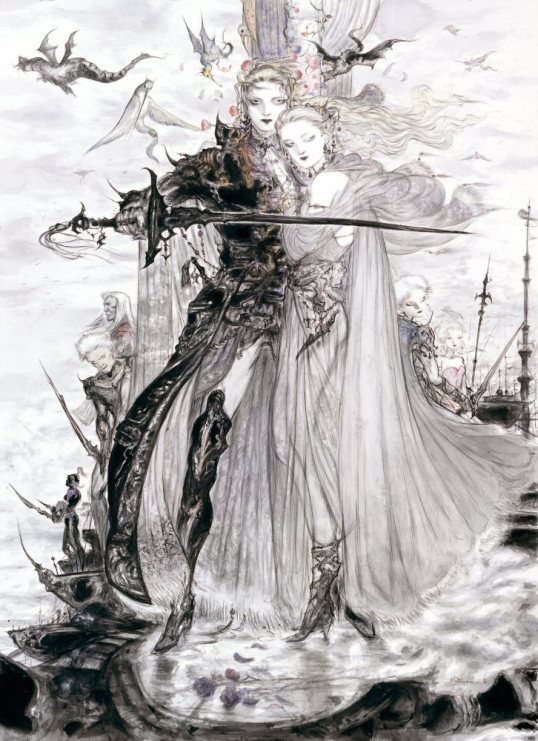
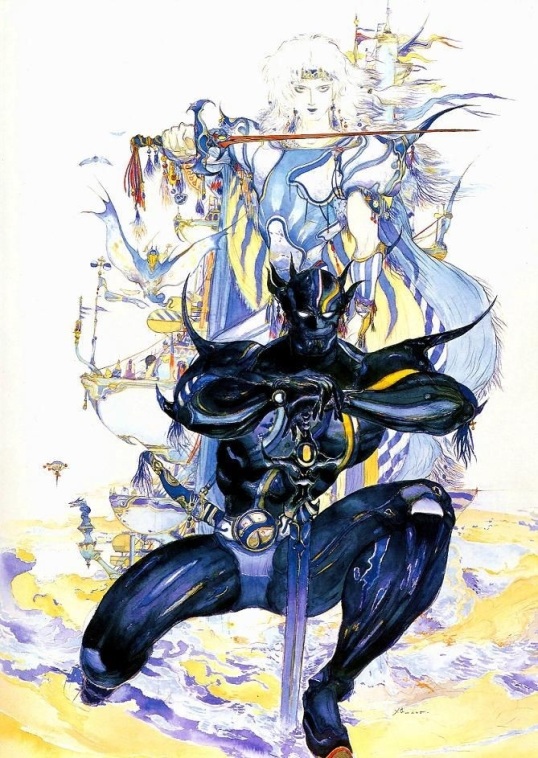
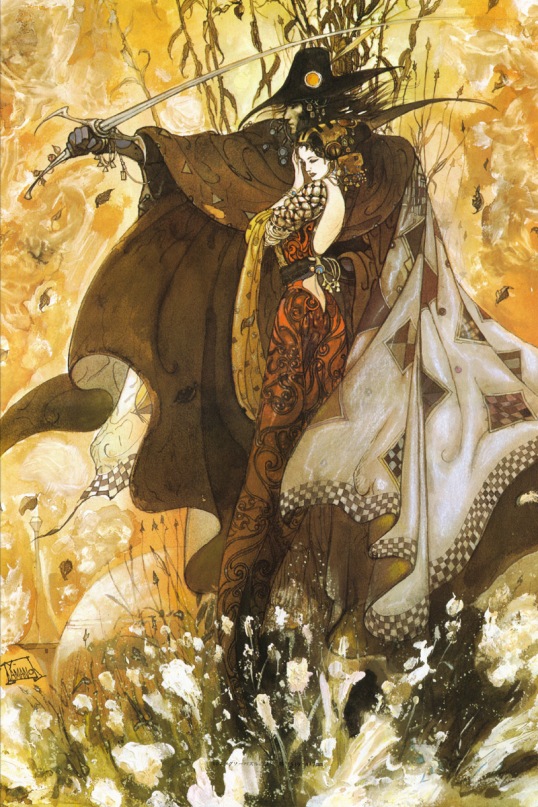
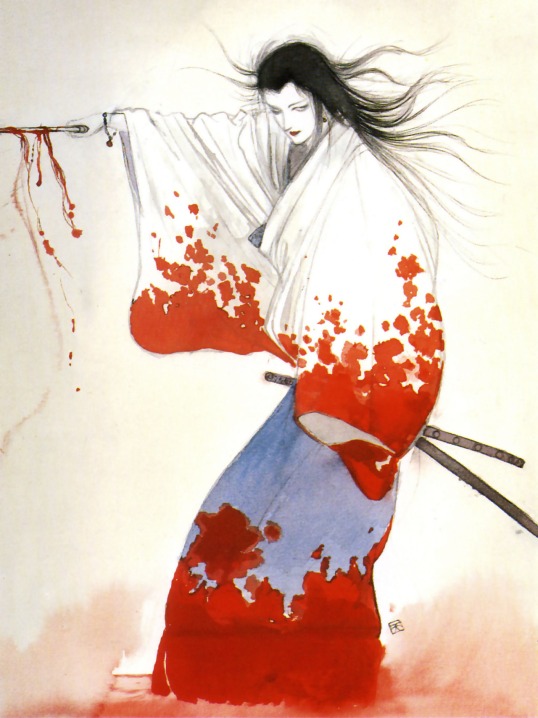
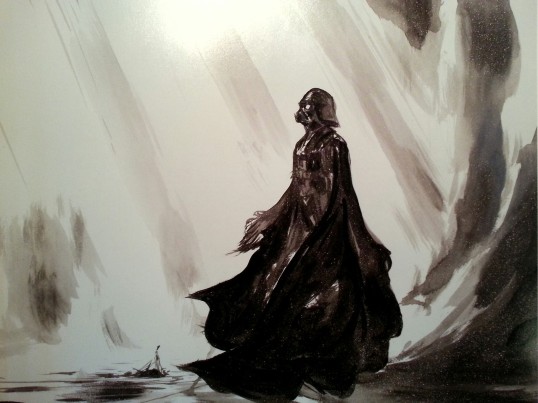
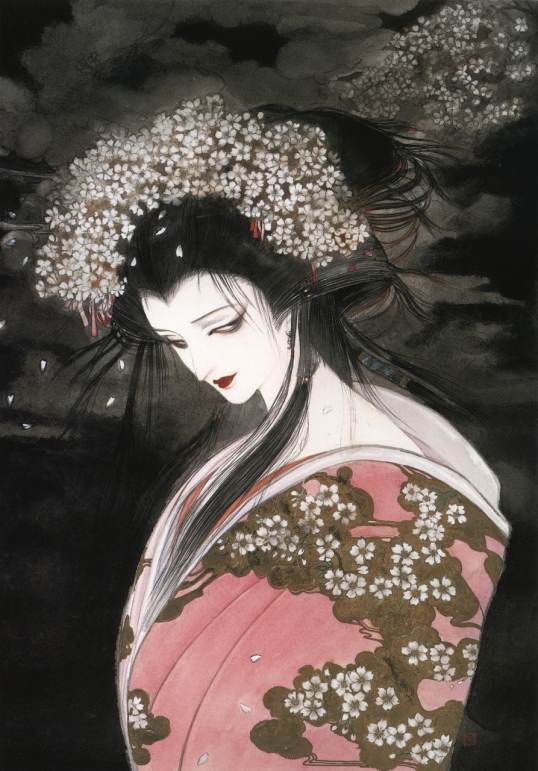
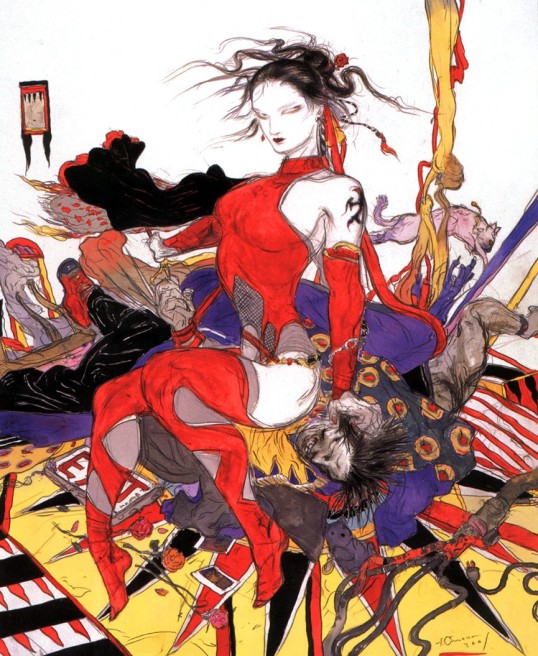
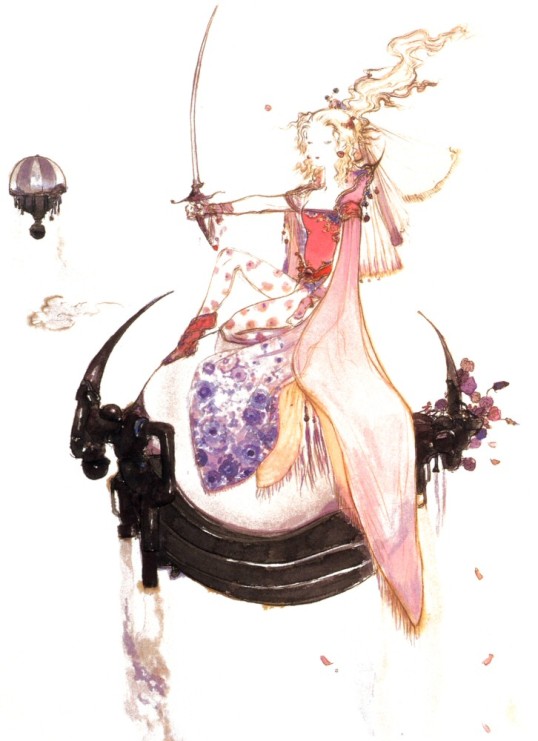
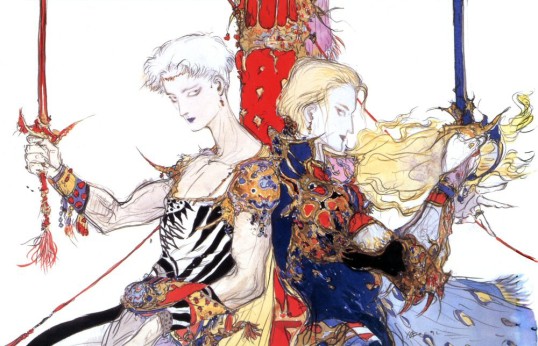
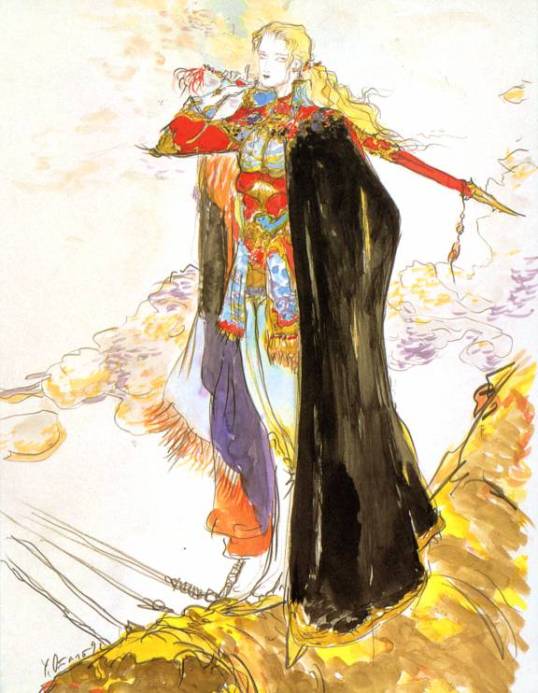
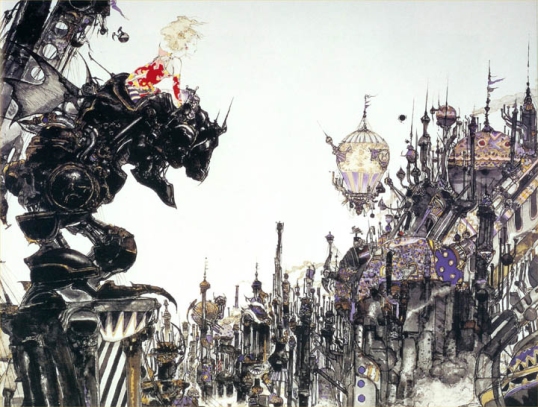
Yoshitaka Amano, born 1952 in Shizuka, Japan, is one of Japan’s most-renowned artists and illustrators. He also began his career as a character designer for early anime shows like Speed Racer, Gatchaman and Tekkaman. He would continue to build on his portfolio of unique character designs for anime, video game franchises and Japanese pop culture art.
Amano-san has pointed out Western artists such as comic book artist Neal Adams as an inspiration in his own style which when combined with his knowledge and appreciation of the classic Japanese hard woodblock printing known as Ukiyo-e would lead to one of the most unique character styles in mainstream pop-culture.
Yet, Amano-san will forever be known for and continues to be popular for his work in helping design the characters for the the video game rpg franchise known the world over as Final Fantasy.
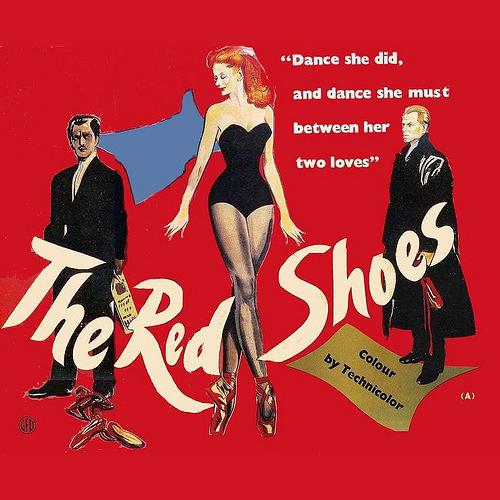
I’ve spent the last two weeks sharing with you some of my favorite cinematic dance scenes. I hope you’ve enjoyed them. While this particular series of scenes that I love is ending with this last entry, I do hope to share some more in the future. For now, what better way to end this series of dance scenes that I love than with the ballet from the classic 1948 film, The Red Shoes?
A House Is Not A Home, a film directed by Christopher Douglas-Olen Ray and produced by and starring one of my favorite actors, the great Gerald Webb, is having its world premiere tonight at the Burbank International Film Festival!
I have to admit that I’m not a huge Western fan. In fact, I can probably count the number of westerns that I’ve actually enjoyed on one hand. However, at the same time, those westerns that I did enjoy also happen to be some of my favorite films of all time. When done poorly, a western can be nearly unwatchable. When done right, however, nothing beats a good western.
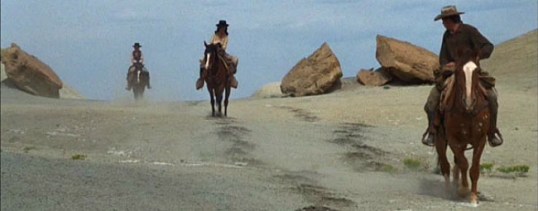
Case in point: 1966’s The Shooting.
The Shooting tells the story of Willett Gashade (played by Warren Oates), a former bounty hunter who now makes his living a miner. At the start of the film, he returns to his camp after being gone for several days. At the camp, he discovers one man dead, one man missing, and one sole survivor, the good-natured by simple-minded Coley (Will Hutchins). The panicky Coley explains that the camp was attacked by an unseen gunman and says that it was because the missing man had apparently ridden down “a man and a little person” in a nearby town. How any of this relates to the rest of the film is open to interpretation.
For that matter, the entire film is open to interpretation. That’s one reason why I love it.
The next day, an unnamed, black-clad woman (Millie Perkins) appears at the camp. She hires Gashade and Coley to lead her to a town that lies some distance away, on the other side of an inhospitable desert. Gashade is suspicious of the haughty woman but the far more trusting Coley takes a liking to her immediately.
As Gashade and Coley lead the Woman across the desert, there are hints both obvious and subtle that all is not as it seems. The Woman, at one point, demands to be led in the wrong direction. At another point, the woman suddenly shoots and kills her horse. Eventually, the three of them are joined by Billy Spears (played by a young but already sardonic Jack Nicholson), a well-dressed gunman whose sinister smile does little to hide an obvious sadistic streak and who takes a cruel enjoyment out of taunting and bullying Coley. It all leads to a shockingly violent and deliberately enigmatic conclusion that raises more questions than it answers.
As directed by Monte Hellman (one of the best directors of the 60s and 70s), the film is less concerned with conforming to the rigid expectations of the western genre and, instead, uses the genre as a way to explore the American culture of violence. With its cynical dialogue and its stark imagery of a harsh journey through a seemingly endless desert, it’s little surprise that The Shooting is considered to be an existential western.
Fortunately, The Shooting contains a quartet of fine performances that hold the viewer’s interest, even when the story runs the risk of becoming incoherent. Millie Perkins, who made her film debut playing the title role in 1959’s The Diary of Anne Frank, brings an air of genuine menace to the role of the Woman while Will Hutchins provides the movie with a much-needed heart. The main appeal of the film, of course, is to see two iconic actors performing opposite each other and neither Warren Oates nor Jack Nicholson disappoints. Of the two, Nicholson (who co-produced the film with Hellman) has the showier role and he is obviously having a lot of fun playing such an unrepentant villain. Meanwhile, Warren Oates comes across like a hard-boiled film noir hero who has somehow found himself trapped in a western.
Needless to say, with its deliberately obscure storyline and its refusal to provide a traditional conclusion, The Shooting is not a movie for everyone. However, for those willing to take a chance, The Shooting can be a very rewarding film.
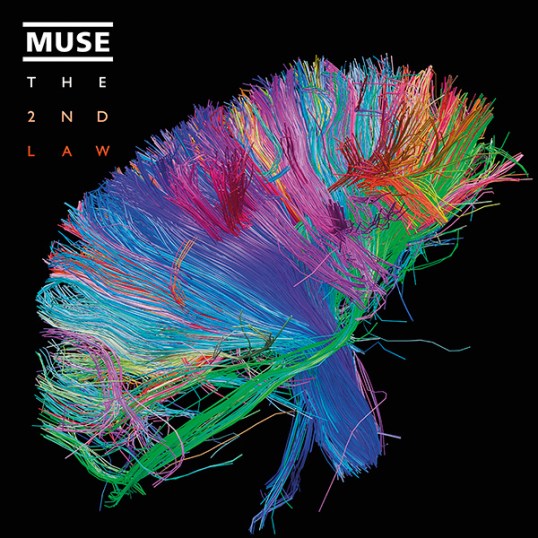
This song is one of my favorite of 2013 and it helped make this summer’s World War Z more entertaining than what many was predicting. This was a film that was considered dead on arrival before it was even out, but it persevered and the decision to use “Isolated System” by Muse as the film’s opening theme was genius.
This video is an excellent piano cover by YouTube user xSymbiose. As someone who has had some piano training I can assure doubters that this cover was and is authentic and not a well-done fake. It’s easy enough to overlay the original song over a video and try to sync-up as perfectly as possible the song with the piano playing. This time around this wasn’t the case.
The playing by xSymbiose is not just precise but almost matches the original song’s tempo. There’s really only a few seconds difference between this cover and the original song’s running time.
Everytime I see piano covers executed nigh-perfectly as this one makes me wish I had continued with my piano lessons. For now I will just live vicariously through those whose skills far surpasses my own. I have our very own Leonard Wilson to thank for finding this little gem.
Here’s the trailer for the remake of Robocop, which appears to be full of all sorts of PG-13-rated mayhem. Personally, just from the look of him, I would have called him Rubber Cop. But that’s just me.
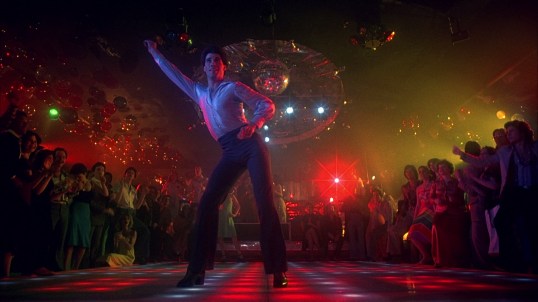
There’s no way that you can post a series of classic dance sequences without including at least one scene from Saturday Night Fever. Even though this scene is nearly 40 years old, it still perfectly captures the excitement and the promise and the pure exhilaration of spending a night out dancing.
That said, I still don’t understand how anyone could mistake John Travolta for Al Pacino.
When we talk about the pioneers of silent film, we usually end up talking about men like D.W. Griffith, Rex Ingram, Fritz Lang, Cecil B. DeMille, Charles Chaplin, and William Desmond Taylor. And it is true that these men were essential to creating the language through which future filmmakers would tell stories of their own.
However, for every important silent filmmaker who continues to be celebrated, there are hundreds of just as important directors who are no longer remembered. When you combine the tendency of the public to automatically dismiss any film made before the advent of sound with the fact that many of the best silent films are now lost films, it’s both understandable and unfortunate that several pioneering directors have been forgotten.
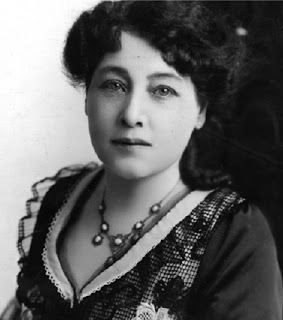
Alice Guy-Blaché may be a forgotten director but, in her way, she is just as important to the development of film as Griffith and DeMille. The French-born Alice Guy directed her first film in 1896, when she was only 23 years old. She is considered, by most film historians, to be the first female director and she was also one of the first directors to experiment with ways to use film to tell a narrative story. (Narrative is something that we now take for granted but, when the movies were still in their infancy as an art form, the idea of using the techniques of filmmaking to tell a story was truly revolutionary.)
Alice Guy married Herbert Blaché in 1907 and moved with him to the United States. It was here that she made the majority of her films. She eventually founded the New York-based Solax Company, which was the largest film studio in pre-Hollywood America. As of this writing, she remains the first and only woman to have owned her own film studio.
Below, you’ll find Alice Guy Blaché’s 1912 film, Fallen Leaves. With a running time of 11 minutes, Fallen Leaves tells the story of a young woman stricken with tuberculosis and her younger sister’s desperate attempts to save her life. This is one of my favorite silent films because it is just such an incredibly emotional and sweet-natured story. Tears come to my eyes whenever I see the little sister starting to gather up her leaves. So, put on some properly dramatic music and enjoy Fallen Leaves.



 Through the Shattered Lens