Since I previously shared two of my favorite scenes from The Brady Bunch Movie, I figured that today I would share one of my favorite scenes from 1996’s A Very Brady Sequel. In this scene, the Brady kids abduct Tim Matheson and force him to take part in an elaborate musical number.
While I try to review just about every film I see, there are times when I don’t get to review a film as soon as I would like. Fortunately, in this age of Netflix, DVDs, and Blu-ray, it’s never too late to review a film! I saw the following four films earlier this year. These reviews are a little late but here they are.
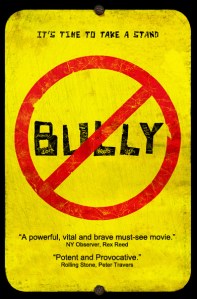
1) Bully (directed by Lee Hirsch)
This documentary, which follows and tells the story of several bullied teenagers over the course of one year, has the best of intentions and it’s definitely effective as far as making you dislike bullies and feel sorry for their victims. That said, did anyone really like bullies before this film was released?
Bully got a lot of attention when it was released earlier this year and a lot of people (who should have known better) said that the film itself was a solution to the problem of bullying. I doubt that this film (or anything else, for that matter) will solve the issue of bullying but it is a well-made look at what kids do whenever adults aren’t watching (and, sad to say, sometimes when they are).
One problem I did have with this film is that it chooses to limit itself to schools in small towns and rural communities, which gives the whole enterprise something of an elitist feel. Are there no bullies up north?
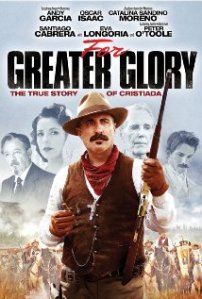
2) For Greater Glory (directed by Dean Wright)
For Greater Glory is a dramatization of the bizarrely obscure period of Mexican history known as the Cristero War. In 1920s, Mexican President Plutarco Elias Calles (played in this film by Ruben Blades) started a violent and relentless crackdown on the country’s Catholic faithful. Churches were burned, priests and nuns were murdered by supporters of the government, and eventually Catholic peasants rose up in violent rebellion. The Cristero War lasted from 1926 until 1929, eventually ending with a truce that was brokered by the U.S. Ambassador to Mexico, Dwight Morrow (played by Bruce Greenwood).
For Greater Glory set box office records in Mexico but it received some pretty negative reviews from American film critics. To a certain extent, the negative reviews are not surprising. The film is long, frequently heavy-handed and melodramatic and it’s also unapologetically pro-Catholic in its storytelling. (Roger Ebert, who never seems to get tired of apologizing for having been born into a Catholic family, was especially critical of that aspect of the film.)
With all that in mind, I still enjoyed For Greater Glory. It’s a well-made and ultimately rather moving film (though I imagine some parts of the film might be a bit confusing if you don’t have at least a little bit of a Catholic background) and it features excellent performances from Andy Garcia and Oscar Isaac as two of the rebel leaders. In many ways, For Greater Glory feels like a throwback to the epic films of the past and that’s not necessarily a bad thing.
3) Sound of My Voice (directed by Zat Batmanglij)
Like last year’s Another Earth, Sound of My Voice is a science fiction film that stars and was co-written by Brit Marling. The difference between the two is that Another Earth was a pretentious mess while Sound of My Voice is an effectively creepy little film that puts story and atmosphere above trite pronouncements about the state of existence.
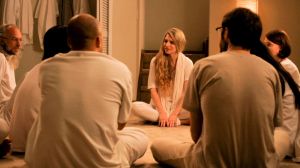
Brit Marling plays a mysterious woman who claims to have been sent from the future. She has a devoted cult of followers who spend their nights sitting on the floor around her, listening to her talk about the horrors waiting for them in the future. Two journalists go undercover and infiltrate her cult, hoping to expose her as a fraud.
Sound Of My Voice keeps the viewer guessing as to whether or not Marling is who she says she is and the film’s ending, while not a total surprise, is still effective enough to inspire debate after the end credits roll. As opposed to Another Earth, Marling gives an actual performance here and is both creepy and sympathetic at the same time.
4) To Rome With Love (directed by Woody Allen)
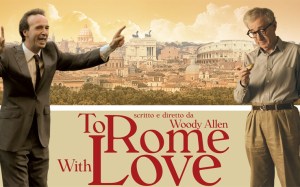
Woody Allen’s follow-up to Midnight in Paris, To Rome With Love tells four separate stories that all take place in Rome. Despite the fact that the cast features everyone from Alec Baldwin to Roberto Begnini to Penelope Cruz to Ellen Page, the true star of the film is the city of Rome. I spent the summer after I graduated high school in Italy and this film brought back a lot of good memories.
Unfortunately, the film’s four stories are pretty uneven and the film’s frequent transitions from story to story are pretty awkward. The worst story features Alec Baldwin meeting his younger self (played by Jesse Eisenberg) and trying to prevent him from falling in love with a neurotic actress (Ellen Page). The film’s best story is a satiric fable about an ordinary man (played, in an excellent performance, by Roberto Begnini) who wakes up one day to discover that he’s the most famous man in Italy.
The film doesn’t really work but I still loved to getting to see Rome once again.
Down here in Texas, we love our legends and the Phantom Killer is one of the most haunting. In 1946, as American soldiers were returning from World War II and the country was looking forward to a future of peace and prosperity, an unknown killer stalked the moonlit streets of my former hometown of Texarkana, Texas. (Technically, of course, Texarkana is located in both Texas and Arkansas. In Texas, it’s usually assumed that the killer had to be from the Arkansas half of the town.) From February until May, he attacked 8 people and killed 5 of them. He stalked lovers who were parking at night and those that survived said that he hid his face underneath a white mask. Despite the best efforts of both the Texas Rangers and the Texarkana police, the Phantom Killer was never captured and his reign of violence ended just as mysteriously as it began.
(My personal theory is that he ended up moving to California where he later became the Zodiac killer because, seriously, the two cases are so disturbingly similar. Eventually, he left California and moved to Ohio and, living under a false name, he killed himself in 2002. )
When you read the facts of the Phantom Killer’s murder spree (not to mention all of the rumors and urban legends that have sprung up around the case), the main thing that jumps out at you is just how much it all truly does sound like a low-budget horror film. Therefore, it’s not surprising to discover that, in 1976, the case served as the basis for just that. What is surprising is just how effective The Town The Dreaded Sundown is.
The film was directed by Charles B. Pierce, an independent filmmaker who was based in Arkansas. Pierce had previously directed The Legend of Boggy Creek, a “documentary” that was about the mysterious Bigfoot-like creature who is rumored to live in Fouke, Arkansas. (Fouke, incidentally, is a town that my family briefly called home though none of us ever saw or heard any Bigfoots wandering about.) Using the money that he made off of the Boggy Creek film, Pierce wrote, directed, and produced The Town The Dreaded Sundown.
Using the same technique that made The Legend of Boggy Creek such a success, Pierce filmed The Town That Dreaded Sundown on location in Texarkana and, along with established actors like Ben Johnson, Andrew Prine, and Tina Louise Dawn Welles, Pierce cast the film with local citizens. When seen on screen, it’s obvious that these citizens are not professional actors. However, what they may lack in talent they make up for authenticity. (If nothing else, The Town That Dreaded Sundown is a rare Texas-set film in that it doesn’t feature any yankees butchering the dialect.) The fact that the film is narrated by a grim-sounding narrator only adds to the film’s documentary-like feel.
Admittedly, the film does take some liberties with the story of the Phantom Killer but what’s important is that it’s accurate when it matters. The film gets the basic facts correct and even the most outlandish of embellishments (such as a scene where the killer uses a trombone to kill one of his victims) don’t detract from the film’s power to frighten and disturb. If nothing else, these feel like the type of details that one might spontaneously mention while telling an old ghost story. Unlike a lot of “true crime” films, The Town The Dreaded Sundown never devotes too much time to trying to figure out the killer’s motives or drop hints as to his identity. Instead, the film emphasizes the fact that the Phantom Killer could never be understood and was never stopped. He simply existed, a malevolent force of evil. This makes the film far more effective than it would have been if Pierce had spent the movie trying to explain that which can not be explained.
Unfortunately, The Town That Dreaded Sundown has never been released on DVD but it does show up occasionally on TCM. Keep an eye out for it!
VGM Entry 57: Snatcher (part 2)
(Thanks to Tish at FFShrine for the banner)
Needless to say, when a game is released in six formats over a span of eight years the list of credits gets pretty wild. If we take Wikipedia’s unsourced credit synopsis for every Snatcher release mingled into one, it would appear that Akira Yamaoka, Keizou Nakamura, Masanori Adachi, Kazuhito Imai, and Masanori Ouchi are responsible for the score. But let’s not do that.
Konami’s ost releases generally only credit the Kukeiha Club as a collective, so that’s of no real help. Thanks to Snatcher‘s devout fan base though, a video of the end credits is available on youtube for every version of this game. They struck me as a bit suspect in so far as every version except the PC-Engine was in English, when only the Sega CD version was officially translated. But I do get the feeling–I’m sure plenty of people could easily confirm or deny–that a lot of games in Japan for whatever reason have English credits.
In any case, the PC-8801 ending credits are perhaps the most thorough I’ve ever seen in a game, and whether their English (Engrish really) is a fan translation or the authentic original, I do think it would be nice to provide a transcript. This is the track by track credits as listed in the two-part youtube video posted by AFX6502, condensed to save some space. Most tracks were listed with two names: one in quotations and one in parenthesis.
Compositions by M. Ikariko:
“Prologue Demo” (Bio Hazard Snatcher)
“Title Telop” (Evil Ripple)
“Pursuer Part1” (Creeping Silence)
“Pursuer Part3” (Pleasure of Tension)
“Pursuer Part4” (Endless Pursue)
“Katrine Part1” (Innocent Girl)
“Katrine Part2” (Theme of Katrine)
“Bath Room” (Virulent Smile)
“Joy Division” (Decadance Beat)
“Blow Up Tricycle”
“Mortuary Part1” (Morg)
“Restoration”
“Search Light” (Spreading Diehard)
“Credits”
“Game Over” (Lement for The Death)
Compositions by M. Shirakawa:
“Team Logo” (Slave to Metal)
“Jaime” (Theme of Jaime)
“Outer Heaven2” (Theme of Izabel)
“Title Part1” (Theme of JUNKER)
“Title Part2” (Theme of Randam)
“Title Part3” (Faded Memories)
“Title Part5” (Peace of Mind)
“Action” (Danger Dance…and Justice for all)
“Epirogue” (Beyond Sorrows)
Compositions by S. Fukami:
“Theme of Opening” (Twilight of Neo Kobe City)
“Outer Heaven1” (The Entrance to Hell)
“Goodbye Randam” (Eternal Promise)
“Requiem” (For Harry)
Compositions by S. Masuda:
“Pursuer Part2” (Criminal Omen)
“Pursuer Part5” (Follow up the Scent)
“Wrong Answer” (Axia)
“Transform Risa” (Virtual Image)
Compositions by M. Izumi:
“Ending 1” (Master of Puppets Among The Disease)
“Theme of Ending” (We Have to Struggle for Our Future Against Our Doubt)
Compositions by M. Adachi:
“Theme of Metal Gear” (Theme of Tara)
-remix from “Metal Gear” RC_750 1987-
Joint composition by I. Mizutani and M. Ikariko:
“Snatcher Title” (Squeak!!)
Composition by Pear Point:
“Jingle Bell” (Jingle Bell 2042)
So there you have it. Originally, Masahiro Ikariko composed 16 of the tracks, the rather elusive M. Shirakawa composed 9, and the remaining 13 were composed by a combination of Masanori Adachi, Seiichi Fukami, Mutsuhiko Izumi, Iku Mizutani, and another virtually anonymous figure, S. Masuda. Ikariko, Shirakawa, Fukami, and Masuda are given clear precedence over Adachi, Izumi, and Mizutani in the credits, and must have comprised the main music team. (While the credits to the original MSX version of Metal Gear are likewise confusing and Adachi is not listed where I looked, I have to assume he wrote the original song, “Theme of Tara”, upon which the Snatcher tune is based and had no direct involvement here.) We don’t even know M. Shirakawa and S. Masuda’s full names. Isn’t that something?
The PC-8801 credits tell us quite a bit more about Snatcher‘s music than simply the track-by-track credits. For instance, chief editors Hideo Kojima and Naoki Matsui named the songs. Iku Mizutani did the sound effects, and Masahiro Ikariko and Kazuhiko Uehara “arranged” the music–a credit Konami clearly distinguishes from composition.
The MSX2 credits are included in the PC-8801 version, so there’s no ambiguity on this front. Masahiro Ikariko and Kazuhiko Uehara made the MSX2 arrangements (with the exceptions of “Theme of Metal Gear”, converted by Uehara and Mizutani, and “Jingle Bell”, converted by Ikariko, Uehara, and Shirakawa).
The PC-Engine credits are in Japanese, and in the mess of a hundred open Firefox tabs I’ve lost track of the url to the translation I found, but I did copy it down:
It’s kind of weird to me that Shirakawa, who wrote a quarter of the music in the game, is not included here, but perhaps he and Masuda had left Konami and were erased from memory. Or perhaps Ikariko, Fukami, and Izumi returned to write additional material, but based on the songs I’ve heard, I get the impression that the list of original compositions for the PC-Engine version is quite short. Based on how the PC-8801’s credits were worded, I am lead to believe the PC-Engine arrangement was Kazuki Muraoka’s baby, with Motoaki Furukawa filling in the few added original tracks, however Furukawa has referred to himself as being “in charge of the BGM” for the PC-Engine port. Whether he meant merely the new compositions or the arrangements of the originals is beyond me.
The PC-Engine version and future releases included a revamped intro scene, for which I’ve provided the Sega CD take in spite of its awful voice acting, so that you can hear it in English. “One Night in Neo Kobe”, the song beginning at 2:55 in this video, was one of the new PC-Engine additions written by Motoaki Furukawa (he also confirmed composition of “Tears and Stains”, which must be “Tear-Stained Eyes“), and it remains one of the most famous songs of the game.
The Sega CD port was the first major departure from Ikariko and company’s original score. The credits here, which I’ve derived directly from the English version of the game, are pretty vague:
This list is kind of strange, because it was the Sega CD port’s arrangement that made it so drastically distinct from the first three versions. The songs were still based on the originals, but in a manner akin to Rob Hubbard and Tim Follin’s liberal port adaptations (consider the C64 ports of Commando and Bionic Commando respectively, for example). The credits clearly refer to the Sega CD arrangement, and Masanori Adachi must have been directly involved this time around. Even so, some of the tracks, “One Night in Neo Kobe”, aren’t even arrangements, but rather the exact same songs appearing on the PC-Engine. It’s pretty odd that Motoaki Furukawa and Kazuki Muraoka are restricted to a “Special Thanks” mention at the end of the credit roll.
Also, the distinction between “Sound Design” and “Sound Programmer” is completely obscure here. Konami don’t even bother with distinguishing between music and sound effects. Some of the ‘sound design team’ credits may have almost no real involvement in the music. Keizou Nakamura is credited specifically for SFX in a later version of the game, suggesting that that was his role here as well, and someone claiming to have spoken with Akira Yamaoka says he had little to no involvement in the project.
At this point in time technology may have advanced to the point where “programmer” did not as a rule imply “arranger”, and it’s possible that Osamu Kasai and Akira Souji’s contributions comprised a technical task which made the audio possible but did not affect what it actually sounded like. Never mind my uneducated speculation though; suffice to say the Sega CD port is a grey area dividing the old Snatcher compositions from the new.
Most PSX/Sega Saturn Snatcher songs were in fact new compositions entirely distinct from the originals. “The Morgue” is an example in which the changes are pretty rewarding. I think they definitely improve the whole ‘surrounded by rotting corpses’ atmosphere, whether that is actually the appropriate atmosphere for the scene in context or not. It does little to compensate for the outrageous censorship rules Sony inherited from Nintendo, but whatever. Here are the credits for both:
PSX: Sound System Programmer:
Noritada ‘Nor’ Matukawa Sound Mixer:
God Adachi Music Composer/Arranger/Performer:
KIDA-Sun SFX:
Hiroe Noguchi Guest composers:
Hiroshi Tamawari
Akira Yamaoka
Kosuke Soeda Guest Performer:
Tappy Original Score Composers:
Kazuki Muraoka
Motoaki Furukawa
Saturn: Sound Programmer:
Akiropito Sound Mixer:
Masanori Adachi
Music Composer/Arranger/Performer:
KIDA Sun
Syouichirou Hirata SFX:
Keizou Nakamura Guest composers:
Akira Yamaoka
Hiroshi Tamawari
Guest Performer:
Tappy Original score composers:
Kazuki Muraoka
Motoaki Furukawa
Akira Yamaoka
Hiroshi Tamawari
KIDA Sun
If you’re curious about the aliases here, “Akiropito” is Akira Souji, “God Adachi” is Masanori Adachi, “Tappy” is Tappi Iwase, and I couldn’t find the slightest clue for identifying “KIDA-Sun”. This makes for an odd discussion, as “KIDA-Sun” appears to be the most responsible party for the PSX and Saturn soundtracks. It’s also rather strange that Akira Yamaoka, Hiroshi Tamawari, and KIDA-Sun are listed as original score composers on the Saturn but not on the PSX, as to the best of my knowledge the Saturn used the exact same songs, making only minor (but always for the better) changes throughout. I don’t know that this change to the credits indicates a real change though: Akira Yamaoka and Hiroshi Tamawari are listed as ‘guest composers” in both versions, and a guest composer is still a composer, so it might all boil down to redundancy. In that case, we need only ask what became of Kosuke Soeda.
So basically, our credits look like this:
PC-8801 and MSX2
Composition: Masahiro Ikariko (16), M. Shirakawa (9), Seiichi Fukami (4), S. Masuda (4), Mutsuhiko Izumi (2), Iku Mizutani (1), Masanori Adachi (1)
Arrangement: Masahiro Ikariko, Kazuhiko Uehara
PC-Engine
Composition: Primarily the original 1988 staff, with additions (probably) limited to Kazuki Muraoka and Motoaki Furukawa
Arrangement: Kazuki Muraoka
Sega CD
Sound staff: Keizou Nakamura, Masanori Adachi, Kazuhito Imai, Masanori Ouchi, Akira Yamaoka
Sound Programmer: Osamu Kasai, Akira Souji
Released in 1933, Gabriel Over The White House is an unapologetic work of propaganda. It tells the story of President Judson Hammond (Walter Huston), a likable but unimpressive political hack who seems to be blissfully unconcerned with the fact that, as the film begins, the country is mired in an economic depression, crime is out of control (largely as the result of the prohibition of alcohol), and the world is teetering on the edge of another world war.
As the result of a suspicious car crash, Hammond spends several days in a coma. When Hammond finally wakes up, he is a changed man. Not only is he personally more aggressive but he now sometimes seems to be listening to a voice that only he can hear. His secretaries even catch Hammond apparently talking to himself. A lot of people would probably suggest that this indicates that Hammond may be going crazy but, in this film, they instead speculate that perhaps he’s talking to (and taking his orders from) the angel who is responsible for bringing him out his coma. “Gabriel over the White House,” as one of them puts it.
Whether as a result of divine guidance or his own personal psychosis, Hammond quickly sets out to solve the country’s problems by setting himself up as a dictator. He declares martial law, dissolves Congress, and announces that, from now on, all laws will be made by him. Instead of legalizing alcohol, he announces that only the government will be allowed to sell it and he deals with poverty by redistributing everyone else’s money. He also starts a new national police force that arrests any and all dissenters. These dissenters are charged with treason and tried by a military tribunal. Those found guilty are immediately executed. While delivering one guilty verdict, Judge Franchot Tone takes the time to praise President Hammond for suspending all legal rights.
Here’s the thing that makes this film so different and disturbing. The movie is totally and completely on the side of President Hammond. Walter Huston plays the role with a Lincolnesque sort of gravity and the film’s supporting cast spends most of their time assuring us that things have never been better than they are under Judson Hammond’s dictatorship. In short, this is an American film that says that what the country needs is a dictator who will unite the country by blaming every problem on one group of scapegoats and execute anyone who shows the slightest hint of dissent.
(Even more interestingly, Gabriel Over The White House premiered the same year that Adolf Hitler came to power in Germany.)
This being an election year, it’s tempting to try to draw some sort of parallel between Gabriel Over The White House’s pro-dictatorship message and our own current political situation. That’s especially true for someone, like me, who naturally distrusts any type of authority. And I have to admit that, as I watched the film, I did find myself comparing the fictional President Hammond to both a certain real-life president and a certain presidential candidate who, like their cinematic counterpart, often seems to be rather smug in their belief in their own moral superiority.
But, to be honest, it’s difficult for me to compare Gabriel Over The White House to our current situation because Gabriel Over The White House is so heavy-handed and just so weird that it’s difficult to take seriously. It’s not so much the idea that a President would become a dictator as much as it’s the fact that, with the exception of a few millionaires and a few bootleggers, nobody else in the film seems to be too concerned about this. This is a propaganda film. There’s no room for ambiguity and that lack of ambiguity makes it difficult to take the film seriously as anything other than just wish-fulfillment on that part of elitists who are sick of having to deal with the opinions of those outside of their social circle.
Even while advocating the type dictatorship that would soon be epitomized by the likes of Hitler, Mussolini, and Stalin, Gabriel Over The White House was one of the many pacifist-themed films that were released between the two world wars. We’ve grown so used to the idea of the world being perpetually at war that it’s easy to forget that, long ago, the world was actually so horrified by the first World War that a lot of very serious, powerful, and intelligent people dedicated themselves to trying to figure out a way to ensure that there would never be another one. Just as films today are obsessed with environmentalism, the films of this earlier period were obsessed with world peace. While some films advocated world government and many attempted to recreate the horrors of World War I as the ultimate deterrent, Gabriel Over The White House might be unique as one of the only American films to suggest that world peace could best be achieved by dictatorship.
(It’s interesting to compare these old pacifist films — even vaguely disturbing ones like Gabriel Over The White House — to the current political climate in the United States, where our leaders brag about personally choosing who to kill from week to week.)
As I stated at the start of this review, Gabriel Over The White House is a strange film. In fact, it’s one of the strangest films I’ve ever seen. It’s also an invaluable resource for anyone who is fascinated with history. It’s a true look into the psyche of a proud nation that’s confidence had been shaken by the twin calamities of war and economic depression. Watching a film like this, which seems so desperate to try to convince us that not only can the world’s problems be solved but that they can be solved by following a set of very specific steps, it’s a little easier to understand how desperate and shaken people can give up their freedom to a dictator who seems to say all the right things.
Gabriel Over The White House is not the easiest film to see put it pops up on TCM occasionally. (That’s how I saw it.) It’s a film so strange that it simply has to be seen.
So here we are, after seven posts setting up background, detail, etc., and we’re finally ready to begin exploring the (admittedly skeletal) plot structure I have in place for our new Detroit-filmed, more-emphasis-on-the-detective-and-heroic-aspects-of-the-character Bat-trilogy, which we’re (tentatively, at any rate) simply titling, in succession, Batman I, Batman II, and Batman III.
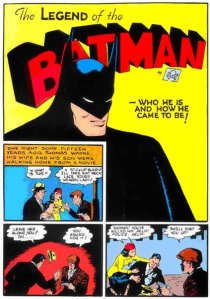
But first a word about that classic “Legend Of The Batman” panel “by” Bob Kane reproduced above. Like all the classic early Bat-stories, it was drawn by Kane, but the story and all the concepts behind it are the work of comics writer Bill Finger, who Kane conspired with DC management with to completely screw out of his co-creator’s claim to the Batman character. If you want to know how complete and thorough-going was finger’s contribution to the Caped Crusader, consider not only that by most reputable accounts he created Gotham City, The Joker, and Robin, but that when Kane first approached Finger with his idea for a new comics character, he called him — I shit you not — “Birdman,” and wanted him to dress as, no surprise, a bird of some sort. That whole bat idea? It was all Finger’s. And for all his troubles he died dead broke, buried in an unmarked grave, while Kane went on to make millions, and DC billions, off his ideas. So it’s to the immortal, yet criminally unsung, memory of Bill Finger that I dedicate my own admittedly completely unsolicited and sure-to-be-unread-by-anyone-who-could-ever-do-anything-about-them ideas here. Unlike Warners, DC, and Bob Kane himself, at least I have the decency to admit from the outset that none of the work I’m doing here would be possible without the truly mighty imaginings of the late, great Bill Finger. He is the giant the rest of us stand on the shoulders of.
All that aside, fear not, as we’ve already established we’re still talking about a “soft” reboot here that doesn’t concentrate itself terribly heavily on Batman’s origins, although the story does take place early in his career. I just thought for a visual accompaniment to the text here we may as well begin at the character’s beginnings — but fear not, the overall “plan,” such as it is, to “play down” the origin aspects of the story remains in place. And so, without any further ado, here’s how I think I’d begin the initial pre-credits sequence of our hypothetical Batman I —
We’re on the set of a daytime news/chat-type show called “Gotham City Today” or somesuch, with two presenters, one male and one female. The female presenter launches into the top news stories from overnight, the first being that the so-called “Bat vigilante” has stuck again, this time delivering the sixth of seven of Gotham’s most notorious reputed “crime lords” into police custody, along with incriminating computer files that should , in theory, give new district attorney Harvey dent more than enough ammunition to prosecute the guy. Speculation is rampant as to the identity of the “Bat-vigilante,” with most wondering whether or not he’s either a surce within the police department itself or a member of some computer-hacking collective a la “Anonymous,” so complete and thorough are the dossiers he’s been handing over along with the crooks themselves.
The anchorwoman’s male counterpart then cuts in with something along the lines of “but one menace he’s been unable to deliver over to the law is the notorious cat-burglar who’s been prowling Gotham’s rooftops at night, cleaning out the safes of one penthouse apartment after another. She apparently struck again last evening, looting the residence of our own station owner of well over one million dollars in cash, jewelry, and other valuables, leaving only her trademark claw-scratch on one of the paintings in his home.”
Back to the female anchor who assures audiences that both the bat-vigilante and the cat-burglar are priorities two and three of new police commissioner Jim Gordon and the aforementioned DA Harvey Dent, right behind the city’s sole remaining crime kingpin, one Vincent Lucchesi (apologies to any and all Italian readers for making the head mobster in town of Italain origin, I’m just not creative enough to come up with anything better, I honestly mean no offense), before segueing into something along the lines of ” — and on a lighter note, all of Gotham is abuzz with the imminent return home on Friday of our city’s most fortunate son, and certain to be most eligible bachelor, Bruce Wane, after twelve years spent abroad. Where all has he been and what’s he been doing? Why is he coming home now? And what are his plans for the future? We’re pleased to say that all that and more will be discussed when yours truly sits down with Mr. Wayne for an exclusive interview here on Gotham City Today next Monday morning.”
And with that little “teaser” in place, we roll our opening credits —
Hopefully that should whet your appetites to keep reading every bit as much as it will whet the audience’s to find out exactly what’s going on here, so I’ll leave it at that for now, but rest assured, I’ll be back tomorrow with more, and all should hopefully become apparent!
For the past few days, I’ve been sharing some of my favorite scenes from two of my favorite movies from the 90s — The Brady Bunch Sequel (1995) and A Very Brady Sequel (1996). I’m sure that some people would say that devoting that much time to two films that spoof a terrible show is a bit excessive.
But you know what?
Excess is underrated.
Before I close the book on this celebration of the Brady Bunch films, I wanted to share one more scene that I love. In this scene from A Very Brady Sequel, the Bradys remind us that flying should be fun!
At the risk of sounding like every other girl who has ever sat in a corner of Starbucks and spent a few hours writing emo poetry in her Hello Kitty notebook, I love the Beat Generation. I’ve read all of Jack Kerouac’s novels, Allen Ginsberg’s poems, and William S. Burroughs’ cut-ups. I’ve even tried to listen to the music of the Fugs and I just recently finished reading the very first Beat novel, John Clellon Holmes’ Go. It was my interest in the Beats that led to me discovering Chappaqua.
Originally filmed in 1966 and released a year later, Chappaqua was produced, written, and directed by Conrad Rooks. The son of the president of Avon, Rooks had a lot of money and a lot of addictions. In 1962, Rooks checked into a European clinic where he detoxed and claimed to have been cured of his drug dependency through something called “sleep therapy.” Chappaqua is based on his experiences both as a drug addict and a patient and, since Rooks was something of a hanger-on in the American underground art scene, the final film featured cameos from such counterculture figures as Allen Ginsberg and William S. Burroughs.
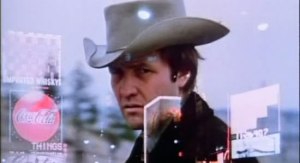
In the film, Rooks plays himself, a young man who is usually seen wandering aimlessly from one location to another. The film is edited in such a way that you’re never quite sure where Rooks is going to be from one scene to another. Most famously, the film’s opening features Rooks wandering across the countryside of Nebraska while images (and sounds) of New York’s 42nd Street are superimposed over his face. Later on in the film, Rooks will just as abruptly turn up walking through the streets of India and meditating with a random guru. Rooks, it quickly becomes apparent, is a man with no true home, a wanderer who seems to randomly alternate between being lost and being on a mission.
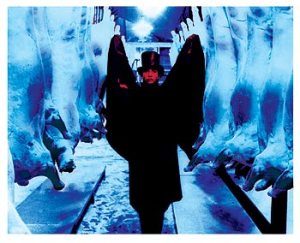
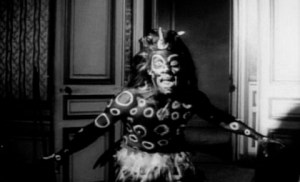
For most of the film, however, Rooks is in a small clinic outside of France. Along with telling his doctor (played by Jean-Louis Barrault) about how he came to be addicted to drugs and alcohol, Rooks goes through withdrawal and has the surreal hallucinations that dominate the majority of the film. During one hallucination, Rooks sees himself as a gangster gunning down a midget in a parking garage. Then, suddenly, Rooks is no longer a gangster and instead, he’s a vampire speaking in an over-pronounced Transylvanian accent. A druid appears and does a jig in the middle of the Stonehenge and a witch doctor shows up and starts to dance through the halls of the clinic. Throughout it all, Rooks is haunted by the image of a stunningly beautiful woman (Paula Pritchett) in a white dress, kneeling by a placid lake. Observing all of this is the menacing figure of Opium Jones (played by William S. Burroughs), who continually encourages Rooks to stay on drugs and who may, or may not, be a figment of Rooks’ imagination.
How to explain the odd (and occasionally frustrating) charm of Chappaqua. This is truly a pretentious mess of a movie, full of symbolism that is both obvious and willfully obscure. However, there’s a strange charm to the film’s pretension. The film may not make much sense but it’s never incoherent. Largely thanks to cinematographer Robert Frank, the visuals of the film are so strong and striking that they often provide the narrative drive that the film would otherwise lack. Chappaqua is, ultimately, just a fascinating film to watch.
My main reason for enjoying and recommending Chappaqua, is that the film truly is a time capsule. Both the film’s strengths and its flaws can be linked back to the fact that it was made in 1966. It’s a true cultural artifact and, therefore, it is a must-see for anyone who is interested in either the Beats or the counter-culture that was indirectly descended from them.
VGM Entry 56: Snatcher (part 1)
(Thanks to Tish at FFShrine for the banner)
At this point I think it’s safe to talk about Snatcher. Snatcher has quite a long history. Konami first released it on the PC-8801 in November 1988, following this up with an MSX2 port the following month. In 1992 it found its way to the PC-Engine, and in 1994 it got its first English translation via the Sega Mega-CD. It would go on to appear on the Playstation in February 1996 and the Sega Saturn in March before all was said and done.
Snatcher was a cyberpunk visual novel, which isn’t the sort of thing North American and European gamers are particularly familiar with. It also featured some graphic violence, partial nudity, and cultural references, which didn’t jive well with North America’s outrageous censorship and copyright laws. All of these factors contributed to the long delay of an English port, and it’s quite remarkable that Konami ended up making one at all. The market was not in fact ready for it, and Jeremy Blaustein, who oversaw the localization, admitted that the game “only sold a couple thousand units”. He provided the legitimate argument that this resulted from Konami’s decision to release a game on the rapidly tanking Sega CD, not any shortcomings of the game itself. Snatcher remained popular in Japan however, and by the sixth and final release in March 1996 it also boasted six different variations on the main soundtrack.
What’s great for our purposes is that liquidpolicenaut on youtube already did all the legwork for comparing them. In some cases, such as “Decadence Beat (Joy Division)”, the original PC-8801 and MSX2 versions survive every port on into the Sega Saturn, but more often the songs get replaced for the Sega CD or Playstation and retain their new forms the rest of the way.
It’s by no means immediately obvious which take on this song is best. As songs by themselves, displaced from any game, the MSX2 version stands out the most to me, but the comments by actual fans of the game seem to denounce the MSX2 version as out of touch with the atmosphere of the scene. “Joy Division” (censored to “Plato’s Cavern” for the US Sega CD port) was Snatcher‘s general store chain. As a cyberpunk game, it naturally ought to be a little bit sleazy, but since I never played it personally I can’t say just how far that should go. The Sega CD version sounds like a porn shop, and the PSX version sounds like the score to what the Sega CD store is selling. The Sega Saturn take, despite being practically identical to the PSX take in construction, comes off quite tasteful due to better quality instrument samples. The potential complaint, of course, is that it’s too tasteful to be wholly appropriate.
If the PC-8801 take is a bit too funky and the PC-Engine a bit too weird, I’m left with the MSX2 take. It has a very technological feel to it. This is music for the sort of store I’d go to to buy my cybernetic crack injection kits for sure. The visual helps it out too; the store clerk looks a lot more seedy and a lot less evil on the MSX2 and PC-8801 than in the other takes, and the emphasis on grey (the PC-8801 has a brown floor) makes the whole place seem a little metalic–a little more futuristic. Oh the MSX2 take wins for me hands-down. But I’m listening to this with nothing but a song, a single image, and a general idea of cyberpunk to go on. I never played the game. Maybe the MSX2’s atmosphere, while consistent in audio and imagery, is totally out of place in it. One of the great benefits of Snatcher and liquidpolicenaut’s comparison videos is to bring these finer aesthetic considerations to mind.
I mentioned that “Joy Division” was renamed “Plato’s Cavern” on the Sega CD. It’s one of many censorship issues that forced minor changes in detail as new ports were made. The left-hand mask on the wall behind the store clerk on the MSX2 and PC-8801 was Predator, and it vanishes starting with the PC Engine. Amazing what petty things billionaires will file lawsuits over…
The censorship on “Pursuer Part 4 (Endless Pursue)” is a little more obvious. (Supposedly the dog was twitching, still alive on the original versions, and this was removed before they took out the image altogether.) Musically, this is another instance where the same song was maintained for all six versions of the game. Here the differences aren’t nearly as extreme, either. Again the Playstation take comes off the worst to my ears, and this time the Saturn’s improved sound does not sufficiently redeem it–at least if this is meant to be the fairly tense, down to the wire scene that the track title and early versions imply.
I can’t think of any context in which the PSX and Saturn versions might sound appropriate to be quite honest. The PSX take kicks off like some progy jazz piece that completely fails to acknowledge any sort of distress, or anything remotely unsettling (we’re still staring at a dog with its guts spilled out mind you, even if it’s censored). The bass drum beat is made no less obnoxious in the Saturn version by actually sounding like a bass drum, and its pace is totally out of touch with the melody. No, the PSX and Saturn versions are bad–no getting around that.
If you go back to the MSX2 take, you’ll find that it’s far more imaginative anyway. Variations in the intensity of the drum beats give it a dimension lacking in the last two versions. The higher-pitched notes behind the main melody in the PC-8801 introduction carry the song much more effectively than their MSX2 equivalent, emphasizing the pace of events, and the variations in percussion intensity are retained, but the main melody is just a bit too clean. The MSX2 take has a more hollow, raspy sound. I suppose I would characterize the MSX2 and PC Engine versions as prioritizing an element of danger, while urgency dominates the PC-8801 and Sega CD takes.
I could go on like this for every track, but I fancy it’s already gotten old. Tomorrow I’ll tackle who exactly wrote it all.
Earlier this month, I finally found the time to see Extremely Loud and Incredibly Close, the critically reviled “prestige” picture that was the center of a minor scandal when it received an Academy Award nomination for best picture back in January.
That nomination, by the way, is the only reason that I made a point of DVRing the film when I saw that it was going to be on HBO. I had already been turned off by the film’s trailer and the subject matter (a little kid trying to make sense of 9-11 by wandering around New York with a mute old man) seemed like the sort of thing that could only have been made effective by a Roberto Rossellini or a Vittorio De Sica. Say what you will about director Stephen Daldry (and I think that both Billy Elliott and The Reader are excellent films), he’s not an Italian neorealist. Extremely Loud and Incredibly Close seemed like just the film to bring out his worst instincts as a filmmaker.
Having now finally seen the film, I am sorry to say that my initial instincts were correct. Extremely Loud and Incredibly Close is the type of film that gives a bad name to good intentions. This is the type of film that you watch and you know that you should be touched by the subject matter but it just all feels so forced, heavy-handed, and ultimately quite empty.
The film tells the story of Oskar (played by Thomas Horn), a brilliant child who is also a bit abrasive and neurotic. At one point, Oskar says that he’s been tested for Asperger syndrome but that the tests were “inconclusive.” What’s interesting about this is that in the book that this film is based on, the possibility that Oskar might be autistic is never stated or even hinted at. Instead, he’s just an abrasive kid and, to be honest, the film’s decision to make Oskar autistic feels less like characterization and more like narrative laziness. It’s hard not to feel that the filmmakers introduced autism as a way to avoid dealing with the fact that Oskar (especially as played by Thomas Horn) is perhaps one of the most abrasive and annoying characters in film history.
Oskar’s life falls apart when his father, Thomas (Tom Hanks), is killed on 9-11. He obsessively listens to the final 6 messages that his father left on the family’s answering machine, even while he hides those messages from his mother (Sandra Bullock).
A year later, Oskar is exploring his father’s closet and finds a vase that has an envelope in it. Inside the envelope is a key and written on the envelope is the word “Black.” Convinced that the key is a final message from his father, Oskar looks up the address of every single person in New York whose last name is Black and sets about tracking each one of them down and demanding to know if they knew his father. Eventually, he’s joined in his quest by a sad-eyed mute (Max Von Sydow) who lives with Oskar’s grandmother.
Extremely Loud and Incredibly Close is based on a novel and the film’s central idea — that Oskar’s quest is his way of trying to make some sort of sense out of the September 11th terrorist attacks — is one that works better as a literary metaphor than as an actual story. While Oskar’s quest might seem poignant on paper, it becomes narcissistic and rather insensitive when seen on film. You find yourself wondering why so many New Yorkers are willing to let this obnoxious and rather annoying little brat into the homes, especially when he usually responds to their hospitality by being rude and condescending.
(In the film’s defense, it does try to address that very issue at the end of the movie but it does so in a way that just doesn’t seem that plausible.)
Ultimately, the film feels like a rather crass exploitation of a true-life tragedy and it’s made even more offensive by Daldry’s heavy-handed approach to the material. This is the type of material that needed more than a hint of realism and instead, Daldry seems to feel that it’s necessary to manipulate us into thinking that 9-11 was a national trauma (as if we didn’t already know that). The all-star approach that Daldry takes to casting his story also serves to undermine the film’s message. At moments when you should be wrapped up in the unfolding melodrama, you find yourself saying, “Hey, it’s John Goodman! There’s Viola Davis! Oh look! Jeffrey Wright!” Extremely Loud and Incredibly Close ultimately feels less like a film about a national trauma and more like a slick Towering Inferno-style disaster flick.
The film’s one saving grace is Max Von Sydow, who dominates this entire film without saying a word or even having that much screen time. One wishes that Daldry had told his 9-11 story through Von Sydow’s sad eyes and just left the kid at home.


 Through the Shattered Lens