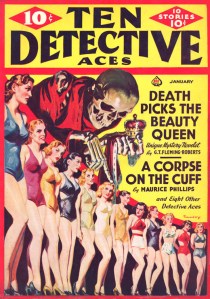
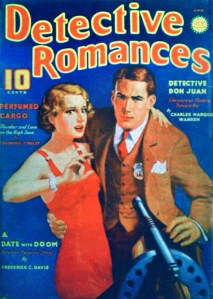
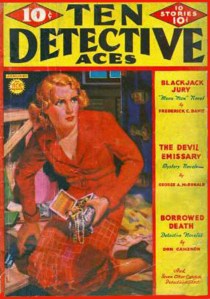
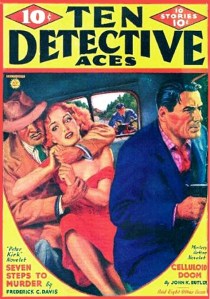
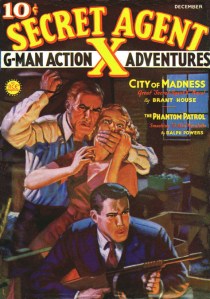
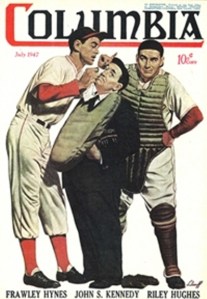
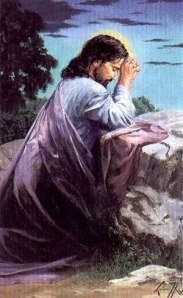
William Luberoff had no formal training but he was one of the most prolific illustrators of the pulp era. He began his career doing covers and illustrations for magazines such as Climax, Secret Agent X, and Saga and he also designed over 60 cover for Columbia, one of America’s top Catholic-interest magazines. He retired from the magazine market in the 1960s and devoted himself to doing religious paintings. While I was researching him for this post, I came across many of his paintings that I remembered first seeing in catechism class. Luberoff’s painting Baseball can be seen in the Baseball Hall Of Fame.
One of the films for 2012 that’s seen by many as a major player in the end of the year Awards season. Steven Spielberg’s long-delayed and gestating historical drama about Abraham Lincoln will finally make it onto the big-screen this early November. Spielberg had initially chosen Liam Neeson to play the 16th President of these United States but as the project continued to get delayed he backed out and in comes Daniel Day-Lewis to take on a very difficult role.
Lincolnis based off of Doris Kearns Goodwin’s biography of the 16th President, Team of Rivals: The Political Genius of Abraham Lincoln. With Tony Kushner tasked with finally hashing out a final draft of the screenplay the film finally went into production in 2009. The cast is an ensemble led by Day-Lewis that includes several past Academy Award and Emmy winners like Tommy Lee Jones, Sally Field and Hal Holbrook with other acting luminaries like Joseph Gordon-Levitt, Walton Goggins, David Straithairn, Jared Harris and Jackie Earle Haley.
The first trailer finally arrived today, September 13, 2012, during a Google+ hangout with Spielberg and Gordon-Levitt and reaction to the trailer seems to range from “give Daniel Day-Lewis the Oscar already” to “an Oscar-bait if there was ever one”. No matter where one sat in their reaction to this trailer it will be interesting to see if Spielberg will come out with a film that doesn’t come off as maudlin and manipulative, but deliver a film that explores and tries to explain why Lincoln became such a beloved President in his time despite making so many unpopular decisions and sitting through the worst era of American history (Civil War) and decades since his death.
Here’s to hoping that the film is less like Amistadand more like Schindler’s Listin terms of tone and narrative. We know why Lincoln is seen as the greatest President we ever had. What we want to know is the why’s.
Lincoln arrives in the theaters this November 9, 2012.
VGM Entry 46: Konami in ’91
(Thanks to Tish at FFShrine for the banner)
It was to be expected that Nobuo Uematsu and Koji Kondo would make magic on the Super Nintendo. Plenty of other composers did as well at an early stage. Konami in particular launched a number of impressive titles in 1991, and I think I’ll take a moment to showcase three of them.
Super Castlevania IV was composed by Masanori Adachi and Taro Kudo, both of whom remain rather obscure figures in the game music industry. There was actually a false rumor going around that Masanori Adachi died during the 1994 Sega Mega-CD port of Snatcher. In a sort of ‘meet the staff’ easter egg (in which Adachi also participated), Kudo jokingly wrote “Rest in peace, Mr. Adachi!” Credits to his name are so few that this has been taken literally by many, but it would make his future compositions quite a miraculous feat.
Super Castlevania IV marks a major reconception of the series’ sound, which will not be completely apparent in these opening tracks. Skip ahead a bit, to “The Chandeliers” (4:29) and “Secret Room” (6:35) for instance, and you will get a much better feel for the degree of diversity introduced in Adachi and Kudo’s new vision. At times the game embraces its classical roots to the fullest. They take full advantage of the SNES’s capacity for authentic piano, organ, and string sounds to cut out all the rock filler, when the situation calls for it. The album still has plenty of contemporary drumming, but it doesn’t feel quite as rock driven as the NES games, much to its benefit in my opinion. Rock would still infuse plenty of new compositions, but the SNES allowed a lot more room for diversity. I think Adachi and Kudo accomplish the most when they go for the straight classical sound, as on “The Chandeliers”, but they make a commendable effort to explore a large variety of styles appropriate for different elements of gameplay.
The first three tracks in this mix are of course the classic series staples “Vampire Killer” (1:05), “Bloody Tears” (0:00), and “Beginning” (1:50), from Castlevanias I, II, and III respectively. It’s certainly nice to hear the old familiar songs in an improved medium, and they did a fairly good job with them (though I do think this version of “Bloody Tears” could use some work–they play it too safe with the main melody and drum track for the addition of the flute and heavier percussion at the end to accomplish its desired effect), but what I think is more significant is that these three songs don’t stand out as anything really above and beyond the rest of the score. On the Nintendo they were exceptional, and familiarity is definitely a plus, but I honestly like a lot of Adachi and Kudo’s original compositions just as much.
If you’ve been keeping up with my posts, you should be thoroughly familiar with Ganbare Goemon by now. If you haven’t been, you probably don’t know what I’m talking about. Six years and six sequels after the launch of the series, a Ganbare Goemon game finally made it to North America. The port, retitled The Legend of the Mystical Ninja, didn’t launch until 1992, but the Japanese Ganbare Goemon: Yukihime Kyuushutsu Emaki from which it derives came out in 1991. Though well in keeping with the traditions of the series, The Legend of the Mystical Ninja was something of a musical novelty for western gamers.
Its composers were somewhat obscure. I could find very little on either Kazuhiko Uehara or Harumi Ueko, and though Ueko continues to appear in soundtrack credits up to the present day (mostly under the peculiar alias Jimmy Weckl), Uehara seems to all but vanish after a brief career in the early 1990s. It’s a shame, if the two in collaboration were capable of producing this kind of quality. But Uehara may also be a Yoshihiro Sakaguchi type–a sound programmer confusingly credited with a few other artists’ original compositions. I’ve seen him specified as the programmer in certain liner notes, and it would also explain the occasional credit he receives for what was I believe Mutsuhiko Izumi’s Turtles in Time score. But again, I don’t know just how extensively sound programmers were involved in composition. So this might be the work of Harumi Ueko, or he and Uehara might both have played fairly equal roles.
The Legend of the Mystical Ninja presents an oriental score, as you can tell, and I think it does a delightful job of it. If it is reasonable to expect more out of a SNES title than improvements on the same old NES sounds, then perhaps a little more situational diversity was in order. The light-hearted and adventurous style can only capture so many moods. But what it does well–create a sense of light-hearted adventure–it does exceptionally well. It’s the hoaky town and shop themes that prevent The Legend of the Mystical Ninja from being a consistently excellent soundtrack. The music written for the field of combat is all spectacular.
0:36. That is where you’ll want to skip to if you can’t handle some classic 90s cheese. A year before it became known to most of us as Teenage Mutant Ninja Turtles IV, Konami released this game to the arcade under its SNES port’s subtitle, Turtles in Time. I was pretty shocked to find this, actually. Konami’s original Teenage Mutant Ninja Turtles (that is, confusingly, Teenage Mutant Ninja Turtles II: The Arcade Game on the NES) and X-Men were by far my two favorite arcade games as a kid. I had no idea Turtles in Time even existed as such. Anyway, Mutsuhiko Izumi did the hard-rocking soundtrack. The music is largely the same in both games, and while nostalgia leads me to favor the SNES version, the arcade original is probably just a slight bit better–but only slightly, and this is debatable.
For instance, if you skip to 3:38 in the arcade mix and 2:43 in the SNES version–“Bury My Shell At Wounded Knee” if memory serves me–you’ll find a major disparity between the drum tracks. Turtles in Times‘s percussion is essentially indistinguishable from a real drum set. Turtles IV can’t compete there, but it does its best to compensate with some pretty wild sound effects and a really bizzare distorted bass. These features throughout the game grant the SNES port a unique and immediately identifiable sound all of its own. In some cases this paid off to such an extent that the port sounds slightly better than the original. Such is, I think, the case for the Super Shredder fight music.
I am lead to believe that Kazuhiko Uehara or Harumi Ueko, the same names associated with The Legend of the Mystical Ninja, were responsible for Turtles in Time‘s SNES port, and if so 1991-1992 was a pretty successful period for the both of them. Turtles IV is an outstanding and fairly faithful adaptation, recreating the original sound where technology allows and inventively maintaining the spirit of the original where it does not.
I can’t say I’ve heard too many instances, at a time when port soundtracks were necessarily different, of an original game soundtrack and a port both being equally exceptional. It worked out this time, compliments of Mutsuhiko Izumi, Kazuhiko Uehara, and Harumi Ueko.
….
Oh yeah, that brief nightmare at the start of the arcade version sampler? That was from the Turtles’ 1990 “Coming Out of Their Shells” tour. What
Nearly every film fan that I know is excited about the fact that the trailer for Steven Spielberg’s Lincoln is going to be available for viewing today. Everyone, that is, but me. To me, Lincoln sounds like yet another big-budget, self-conscious prestige film that was primarily made to win awards (and considering just how weak this year has been so far, it may very well do that). Lincoln sounds like a film that people will respect but never actually enjoy.
Add to that, this is an election year and I know I’m not looking forward to having to listen to all the toadsuckers comparing their particular candidate to Daniel Day-Lewis as Abraham Lincoln. Seriously, it’s going to get tedious.
(That said, I seriously hope that I’m wrong because I’m a lover of both film and history. It’s not the film’s subject matter that concerns me as much as it’s the deafening hype that surrounds the film and demands that I love it before I even see it.)
As soon as the trailer for Lincoln is available on YouTube, either myself or another Shattered Lens will undoubtedly share it on this site. For now, however, I’m going to share another recently released trailer for another film about politics.
If Atlas Shrugged, Part 2 is anything like the first film in the trilogy, it’ll be the type of trashy, low-budget fun that always manages to annoy the usual gang of complacent critical elitists. If nothing else, it should be interesting to see just how overwrought the reaction (both pro and con) will be to this particular film.
It’s quit an early Thursday morning and I just thought to pick a brief but very interesting piece of AMV as the latest “AMV of the Day”.
It’s actually called a MAD video. A type of fan-made video very popular in Japan where fans take an audio clip from a favorite anime (or even a non-anime) and splice it together with piece of music and try to match the dialogue with the beats and tempo of the song. This particular MAD is by creator called fillin and take the comedic way the Bakemonogatari character of Mayoi Hachikuji always stutters the name of the series’ lead in Araragi.
The song used is the Moogle’s Theme from the Final Fantasy V soundtrack. The video pretty much works perfectly as Mayoi’s stuttering of Araragi’s name matches the tempo and melody of the song perfectly. One thing that’s clear is that this video is quite addictive to watch since it loops and plays again once it finishes. I think I watched and listened to it for almost an hour straight and would’ve continued longer if sleep hadn’t called.






 Through the Shattered Lens