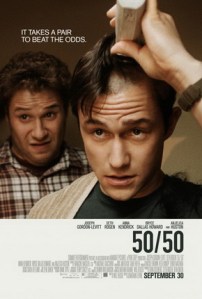
This is the worst review I’ll ever write. I’ll admit to that up front. This is a highly biased review.
I recently underwent a colonoscopy for what doctors refer to as “excessive bleeding”, which your body isn’t really supposed to do. Part of this also involves a biopsy of tissue to determine if it’s cancerous. I’m still due to find out what was found (because I’ve been dancing around going back as much as I have writing this review), but there’s a sense of dread in knowing that your life can change with just a few sentences from a doctor. That, coupled with the knowledge that my mom underwent chemo for Lung Cancer and a friend who’s also living with it made 50/50 a hard film to sit through at some points.
I saw the movie on Friday Night, and literally spent the entire weekend with my laptop on my lap with Scrivener open, trying to get this written. The only reason it’s happening now is because I started admitting why I didn’t and wrote a paragraph. If I stop now, this is going to be another Sucker Punch, a film I was going to review when it came out, but refrained from doing so because it hit a little too close to home.
I walked into 50/50 expecting a heavy handed story along the lines of either the last half of Beaches or My Life with Michael Keaton. After all, the story deals with Cancer, which we all know is very serious. I actually left the film glancing at the movie schedule, looking to find out how soon the next showing was. It was a little later than I hoped, so I headed home. If it were any earlier, I would have gone right back. I laughed so much that I might have scared a few of the people sitting in the back of the theatre, and was thankful for the extra tissues I took with me when I cried.
Based on a true story of the film’s writer, Will Reiser, 50/50 is the story of Adam Lerner (Joseph Gordon-Levitt), who goes through life making all the right choices. He eats right, jogs regularly and crosses when the walk sign is clear. He loves his girlfriend (played by Bryce Dallas Howard), and his best friend Kyle (played by Seth Rogen) helps him laugh through it all. After experiencing some pain in his back, he heads to the doctor, only to discover that he has developed a rare form of Cancer. The actual moment of awareness when he’s told is done so well that I had to bite my lip. Once you know the truth of things, you can’t return to a state where you “don’t” know, and I’ll admit that shook me.
The greatest part I loved about 50/50 was that it was more a story about the Support Groups that keep us afloat than it was about the problem of the illness itself. There are just some things in the world that you shouldn’t go through alone. Each person in Adam’s circle had a different reaction to what was occurring, but Seth Rogen’s character was by far the best, choosing to not allow Adam to wallow too much in what was happening to him.
Adam is assigned a therapist in the form of Kate McKay (Anna Kendrick), who tries to get him to relax and explain how he’s feeling, to which in most cases, he’d say “I’m fine.” It’s amazing how quickly and easily we can say that phrase to deflect every other emotion we may be feeling, and the writing in this film was good enough to play on that angle as well. His mother (Angelica Houston) wants to help her son a little too much, but Mothers can be that way, I suppose.
Just because this happens to be a story about illness doesn’t mean that it has to be non stop gloom and doom. There were a number of scenes that were laugh out loud funny, particularly those with Rogen. It’s Gordon-Levitt, however, who really carries the film. He does a great job here, and it’s a shame with the weekend over that it seems the film won’t overshadow either The Lion King or A Dolphin’s Tale. It would be interesting if the film has enough legs to last over the next few weeks. It definitely deserves a viewing.
Werewolf horror films have not enjoyed the same prolific output as zombie or vampire cinema in recent decades. While the undead and bloodsuckers dominate both mainstream and indie horror, lycanthropes remain relatively underrepresented. In the last ten to fifteen years, the number of truly memorable werewolf films is small enough to count on one hand, suggesting that the subgenre is persistently niche despite the creature’s long-standing place in horror folklore. This scarcity makes standout entries even more notable, and among those, two titles remain touchstones for modern audiences: Neil Marshall’s gritty low-budget Dog Soldiers (2002) and the Canadian cult classic Ginger Snaps (2000), which preceded Marshall’s work by two years.
Ginger Snaps is as much a coming-of-age drama as it is a horror film, weaving werewolf mythology into a biting exploration of adolescence, sisterhood, and female identity. Set in a seemingly quiet Canadian suburb, the story follows sisters Ginger and Brigitte Fitzgerald, misfits bound by their shared cynicism, morbid sense of humor, and disdain for high school conformity. Isolated from their peers, they find comfort in their own dark, goth-influenced world, preferring late-night cemetery photography to pep rallies or social gatherings. Their bond is strong, but it faces a severe test one fateful night.
While walking home together, the sisters encounter something in the darkness—an unseen, feral creature that lunges, attacking Ginger with brutal force. The animal’s bite leaves a wound that begins to heal at an unnatural speed, and soon, strange transformations begin to manifest. At first, these changes seem physical—accelerated hair growth, heightened senses, and an insatiable appetite—but as time passes, her personality shifts as well. Ginger grows more assertive, sexually confident, and rebellious, traits that make her magnetic to others yet alienate her from her once inseparable sister.
Director John Fawcett and screenwriter Karen Walton craft the lycanthropy metaphor with unusual clarity: the werewolf curse mirrors puberty’s upheaval. Much like films inspired by the “body horror” sensibilities of David Cronenberg, Ginger Snaps draws unsettling power from portraying transformation as both horrifying and intoxicating. This duality captures adolescence’s contradictions—its liberating confidence and its destabilizing volatility—while reframing the traditional werewolf narrative to center on female experience. For Ginger, the physical metamorphosis coincides with new social dominance, a rejection of her former outsider identity, and an embrace of raw, animalistic freedom. For Brigitte, these same changes signify danger, loss, and the unraveling of the relationship she once relied upon.
The narrative excels in balancing its supernatural premise with human emotional stakes. While a less thoughtful script could have leaned entirely on gore and special effects, Ginger Snaps roots its horror in character dynamics. Walton’s writing, although sometimes heavy-handed in its metaphors, is remarkably strong for a film produced on a modest budget. Themes of loyalty, femininity, sexuality, and transformation run parallel to the literal werewolf plot, creating layers of meaning. This thematic richness ensures that the story resonates beyond its horror trappings, inviting audience discussion in a way that pure creature features often do not.
Central to this success are the performances. Katharine Isabelle embodies Ginger with feral charm, adeptly shifting from sardonic teenager to predatory seductress. Her portrayal never loses sight of the character’s humanity, even as the animal side takes over. Emily Perkins delivers an equally strong performance as Brigitte; her quiet, introverted resolve becomes the emotional anchor of the film, providing a moral counterbalance to Ginger’s volatility. Together, they create a convincing sisterly dynamic where love is tested by fear, jealousy, and survival.
Even the supporting cast contributes meaningfully, with Mimi Rogers standing out as Pamela Fitzgerald, the sisters’ well-intentioned but oblivious mother. Rogers resists the temptation to overplay the role for comic relief, giving Pamela a genuine warmth that contrasts the darkness overtaking her daughters’ lives. This restraint keeps the film grounded, preventing it from becoming camp and ensuring its humor arises naturally from character interactions rather than exaggerated antics.
Visually, Ginger Snaps sidesteps the glossy look of higher-budget Hollywood horror, opting instead for the muted realism of suburban streets and dimly lit interiors. This aesthetic choice enhances the film’s authenticity, making the supernatural intrusion feel more jarring. The creature effects, while limited by budget, are used sparingly and effectively; rather than relying on endless transformation sequences, the filmmakers allow viewers’ imaginations to fill in the most disturbing details. This restraint mirrors the approach of Dog Soldiers, demonstrating that practical effects and atmospheric tension often outshine CGI spectacle.
The film’s release trajectory reflects its cult status. Premiering at the 2000 Toronto International Film Festival, Ginger Snaps did not achieve immediate mainstream attention. Instead, it found its audience gradually, through word of mouth and home video rentals. Horror fans discovered it over time, drawn to its unconventional blend of teenage angst and supernatural dread. In the years since, it has earned a devoted following and spawned two sequels—Ginger Snaps 2: Unleashed (2004) and Ginger Snaps Back: The Beginning (2004)—that expanded the lore while retaining the core themes of the original.
Part of the film’s enduring appeal is that it approaches werewolf mythology with fresh eyes. Traditionally, cinematic werewolves are framed around male protagonists, their curse tied to aggression, uncontrollable rage, or forbidden lust in a way that reflects masculine fears and desires. By centering two teenage girls and equating lycanthropy with female sexuality and transformation, Ginger Snaps subverts these tropes, adding complexity to a genre often dominated by male perspectives. The werewolf becomes a vehicle for exploring how society reacts to—and attempts to control—the emergence of female autonomy.
Dark humor plays an important role as well. The Fitzgerald sisters’ sardonic wit is woven throughout, providing moments of levity even as events grow increasingly grim. These comedic beats arise out of their personalities, underscoring their outsider status and emotional coping mechanisms. The humor and horror work in tandem, preventing the film from collapsing into bleakness while maintaining its bite.
Thematically, Ginger Snaps joins a short list of werewolf films that transcend their genre trappings, akin to An American Werewolf in London (1981) or The Company of Wolves (1984). It invites analysis not just for its scares but for what those scares signify: the fear of change, the allure of liberation, and the strain placed on human bonds by transformation—be it supernatural or psychological. In this respect, it aligns with Cronenberg’s The Fly, where bodily change becomes the central metaphor for loss and evolution.
Two decades later, the film remains a touchstone for horror fans advocating for more diverse and conceptually rich werewolf stories. Its success highlights that the subgenre’s scarcity is not due to audience disinterest but perhaps to a lack of filmmakers willing to innovate beyond conventional “monster hunt” templates. As the horror landscape continues to evolve, Ginger Snaps offers a blueprint for blending creature mythology with compelling character drama, ensuring that lycanthropes can be as emotionally resonant as their undead or vampiric cousins.
For viewers wondering why werewolf cinema lags behind zombie apocalypses and vampire sagas, Ginger Snaps provides an answer: when the subgenre is approached with thematic depth, sharp performances, and genuine character stakes, it can be every bit as compelling—and perhaps even more relatable—than its supernatural peers. In weaving together dark humor, horror, and adolescence’s raw turbulence, the film stands as a rare entry that deserves both its cult following and its place in the broader horror canon.
As I try to put into words my reaction to the new film Dream House, one phrase comes to mind:
Bleh.
Dream House is about this guy played by Daniel Craig who we’re told, at the start of the film, is a writer. He’s moved out to his “Dream House” out in the middle of one of those cinematic suburban communities. He shares his dream house with his wife Libby (Rachel Weisz) and his two little girls. However, things aren’t quite what they seem. The girls keep seeing a shadowy figure watching them. Teenagers keep performing Satanic rituals in the basement. Craig’s neighbor looks just like Naomi Watts. Oh no! Has he been sucked into Mulholland Drive!?
No, not quite. Instead, he’s just found himself trapped in a painfully slow movie that takes itself and it’s half-baked plot way too seriously. This film is being advertised as if it’s a horror movie but there’s nothing scary about it and it’s almost as if the film itself is refusing to lower itself to providing us with any “cheap” thrills. The film instead is a mystery but it’s one of those mysteries where we discover the solution not through any artfully placed clues but instead by random characters showing up and having flashbacks.
There’s a big twist about 80 minutes into this 99 minute film and, as a reviewer, I know that it would not be right for me to spoil that twist. Fortunately, however, Morgan Creek Productions decided to include that twist in the film’s trailer so, if you want to know, here you go:
Again, it takes this film 80 minutes to reach the twist that the trailer reveals after 1 minutes and 17 seconds. So, as a result, you spend the first 80 minutes going, “Okay, we know…” Once the twist is revealed, there’s only 18 minutes to wrap up the film’s plot and this is done in the clumsiest way imaginable.
Now, one reason for this might be that the film’s producers reportedly clashed with director Jim Sheridan and eventually took the film away from him. Sheridan, Craig, and Watts have all refused to do any promotion for the film and have publicly stated that they hate the version that has been released. I don’t know. My natural impulse has always been to side with the artists as opposed to the corporate people. After all, we’ve all heard about what happened to Erich Von Stroheim’s original cut of Greed and about what Terry Gilliam went through with Brazil. Still, it’s hard to look at the assembled footage and see any hint that this film could have been anything more than the film that’s currently playing at your local theater.
When I told Arleigh about my feelings towards Dream House, he asked me if I felt it was the “worst one of the year.” I wouldn’t go quite that far. Dream House is forgettable but it’s not as pompous as The Conspirator or as insulting as Straw Dogs.
I just found out that Jaakko Hittavainen Lemmetty left Korpiklaani last month. According to the band’s official statement, “his personal health issues made the constant touring and recording impossible.” That might come as no surprise, considering Korpiklaani are one of the most prolific bands on the market. During his tenure they managed to release seven albums in nine years, and in 2010 alone they performed live approximately 100 times. I know I certainly wouldn’t be able to keep up.
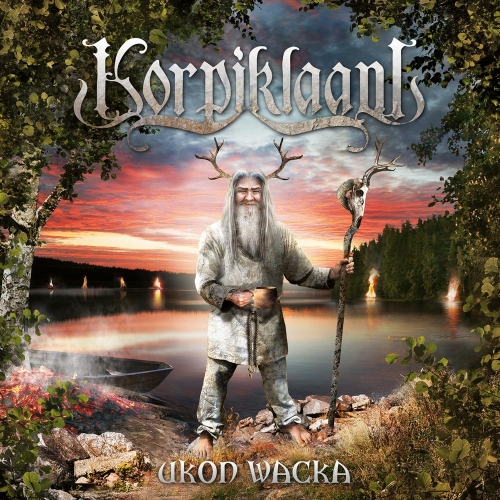
His departure lends a sort of heightened significance to Ukon Wacka. Hittavainen might not have been their frontman, but he was responsible for all violins and woodwinds on all seven albums. In other words, half of what really made Korpiklaani folk metal is gone, and however well his replacement, Teemu Eerola, fills the void, their next album is bound to be different. Ukon Wacka might be the last of its kind.
Change is a pretty foreign concept to Korpiklaani, both in their sound and in their line-up. That is a point I’ve always appreciated about them. If it’s not broke, why fix it?
Louhen Yhdeksäs Poika
Ukon Wacka is no different. As always, the album makes no attempt at an introduction. It just kicks off from the get-go as quintessential Korpiklaani. Jonne Järvelä goes on rolling out incomprehensible lines at a break neck pace to a constant melody of accordion and violin, brought to life by standard metal instrumentation that’s designed to accent the folk, not compete with it. Throw in an awesome violin solo towards the end, and you’ve got a song that’s entirely unique to the band and entirely to form with everything else they’ve written. The stylistic monotony is hardly a fault, what with nearly all of their 80+ songs accomplishing a distinct and addictive melody. I probably get more Korpiklaani songs stuck in my head than any other band out there; I just might be at a loss to put a name or album to them.
Tequila
One of many long-standing traditions Ukon Wacka upholds is the booze track. Not that every song isn’t designed for copious consumption, there’s always been at least one song that requires no knowledge of Finnish to convey its lyrics. With Wooden Pints on Spirit of the Forest, Beer Beer on Voice of Wilderness, Happy Little Boozer on Tales Along This Road, Let’s Drink on Tervaskanto, Vodka on Karkelo, and now Tequila, Korven Kuningas remains the only album that doesn’t really fit that mold. And like all of those others, Tequila stands out as one of the album’s most memorable songs.
Surma
When it comes to closing songs, the band has been a little more diverse in their selection. But, aside from on Tales Along This Road, they’ve always seemed to save their most reflective or otherwise inspiring song for the end. Surma might not match Karkelo’s Kohmelo or Tervaskanto’s Nordic Feast, but it’s certainly the high point of Ukon Wacka as far as I’m concerned.
There’s not much I can say about the album really, because it sounds just like all of their others. I suppose Korpiklaani might be regarded as a bit shallow, at least in so far as most of their songs, especially in the absence of any understanding of the predominantly Finnish lyrics, are just fun and fairly thoughtless numbers about partying and getting drunk. But there’s also a sort of authenticity to that which renders them significantly more enduring than comparable acts like Finntroll. While I don’t think any particular Korpiklaani album holds a candle to Nattfödd or even Nifelvind, in the long run I always end up listening to them more. A lot of folk bands that don’t take themselves very seriously can only really be appreciated in their own right. Korpiklaani, on the other hand, extend beyond themselves, presenting a sort of continuity. I can’t really speak of them imitating or incorporating Finnish folk because, much like Irish punk and metal bands, they’re more the modern continuation of a long-standing tradition than an attempt to resuscitate it. I’ve never seen them live (they’re about to kick off a North American tour with Arkona that I might give in to a five hour drive across the state for), but I imagine their show incites a lot more dancing than headbanging, if you know what I mean. Authentic folk really implies community participation, and that’s the sort of thing Korpiklaani cater to, on Ukon Wacka as strongly as on anything else.
 This is the worst review I’ll ever write. I’ll admit to that up front. This is a highly biased review.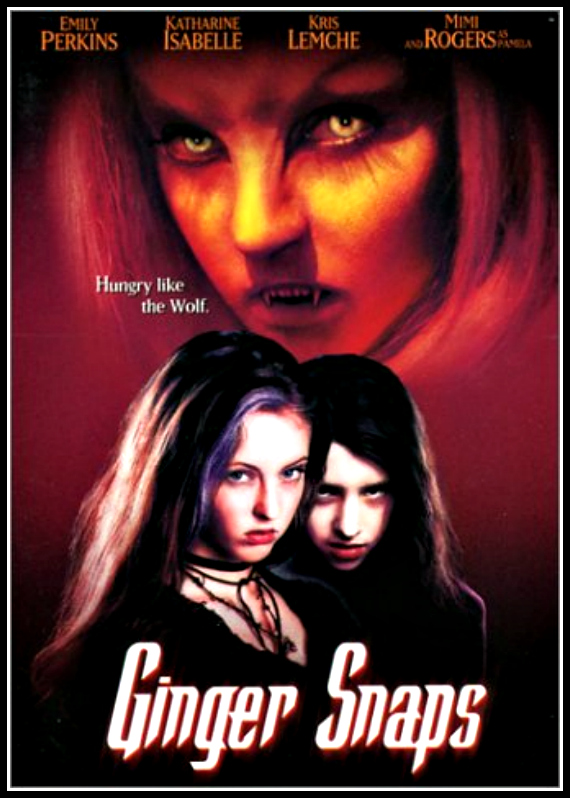
 Through the Shattered Lens