Thousand Years of Dreams Day 22: Bright Rain


For Day 22 we get to experience another remembered dream-memory from Kaim, but this time around the innocent sounding title of “Bright Rain” gives way to something much darker.

Like most of Kaim’s dream-memories, this one uses the theme of war to give some insight to the eternal warrior’s personality. It’s through Kaim’s reminiscing that we get to know how he views how certain groups, states and nations find the excuse to wage war on their neighbors. Whether it’s to continue feeding one’s greed or to gain more power, the reasons always ends up with one powerful nation warring against it’s weaker and poorer neighbors.

We see this illustrated in a most tragic way through the innocence of a young boy who believes the bright rain to be something extraordinary and magical. The brutal truth of the matter is that it’s neither of those things, but instead the ever-widening circle of war dragging in more and more parties until the reason for why the war began has been lost to the devastation and death all-around.

There’s a saying that the first casualty of war is the truth. But going by this tale of “Bright Rain” I believe the first casualty of war is innocence.

Bright Rain

“The bright rain is going to start soon.” The boy says, pointing out to sea.

“The bright rain?” Kaim asks him.

“Uh-huh. It happens every night, way out there.” he says with a carefree smile.

“It’s so pretty!”

“Bright rain, huh?”

“Yeah. I want you to watch it with me tonight. It’s really pretty.”

The boy has never once left the island in the ten years since his birth.

The island is small and poor, and the only ways to make a living there are fishing from dugout boats and gathering forest fruits. One monotonous day follows another, the islanders waking at dawn and sleeping beneath the star-filled sky. The boy does not yet realize that this is the greatest happiness of all.

The boy begins speaking to Kaim, who turns to look in his direction.

Hunkered down on the beach in the moonlight, the boy in profile glows like a chocolate sculpture.

“Over there, where the bright rain falls, is a great, big island, right? I know all about it. That island is way bigger than this one and way more stuff goes on there and it’s just full of shiny things and pretty things and food that’s way better than I can even imagine, right? Don’t worry, I know all about it”

Kaim says nothing but gives the boy pained smile.

Beyond the horizon lies a big island, indeed – a vast continent. Kaim was there until four days ago. Then, rocked in the hold of a freighter for three days and nights, he crossed the sea to this island.

“I know about it, but I’ve never seen it.” the boy says, his voice dropping.

He hangs his head, diverting the moonlight from his face. His chocolate skin melts into the darkness.

“Would you like to go there?” Kaim asks.

“Sure I would.” the boy replies without hesitation. “All the kids here want to.”

“Everybody leaves the island, I suppose.”

“Sure they do! Boys and girls both. As soon as they’re old enough to work, they go to the ‘other country.’ Me, too, in another five years… I’ll be ready in three years. Then I’ll take the boat that you came here on and go to the other country and work hard and eat tons of yummy things.”

The boy raises his face again.

Locked on the ocean, his eyes are shining.

They are eyes full of hopes and dreams.

But they know nothing of the ‘other country’. He can never know a thing about it as long as he stays here.

Not one of the young people who crossed the sea, their eyes shining like the boy’s with hopes and dreams, ever came back.

“Of course not.” the boy would say. “The other country is so much more fun, there’s no point in coming back!”

The boy believes in the happiness awaiting him in the other country. about which he knows nothing.

Only when they leave the island do the brown-skinned people here learn that their skin is a different color from that of the people in the other country.

That the language of the island is of no use in the other country.

That the people of the other country look on the islanders with cold eyes.

That the only way for them to meet people with the same brown skin, the same language, and the same birthplace is to head for the island people’s ghetto in town.

The first words the boy was certain to learn in the other country’s language would be the ones the people of the other country used for people like him; illegal alien.

By the time he learned it, he would be tumbling down the hill in the ghetto.

The boy gallops away from the beach and returns a few minutes later with an overflowing armload of fruit. He says they grow where the wind from the ocean meets the wind from the mountains.

“They’re at their best on nights when the moon is full. Go ahead – have a taste.”

He wipes a piece of fruit against his worn-out shirt and hands it to Kaim.

“What do you call this?” Kaim asks.

“You’re going to laugh, they pinned such a fancy name on it: ‘Grain of Happiness’.”

“That’s a nice name.”

Kaim bites into a Grain of Happiness. It is shaped like an apple from the other country. But it is some two sizes smaller and just that much more packed with juicy sweetness.

“This is great.” Kaim says.

“You really like it? I’m glad.” the boy says with smile, but he is soon hanging his head again and sighing.

“I like them a lot too.” the boy says, “but I bet the other country has all kinds of stuff that’s way better than this, right?”

Kaim does not answer him but takes another bite of a Grain of Happiness.

The boy is right: there are lots of foods in the other country far more delicious than these Grains of Happiness.

Or, more precisely, there were.

Now, however, the other country has been transformed into a battlefield.

The war started six months ago.

That was when the boy began seeing the ‘bright rain’ every night.

The prosperity of the “other country” is extreme. The most glittering happiness is available there to anyone with enough money, and money is available there without restriction to anyone with enough power.

Might makes right.

Wealth makes goodness.

Those who are neither mighty nor wealthy obtain right and goodness by finding others who are both weaker and poorer than themselves and ridiculing, despising and persecuting them.

The island people, whose language and skin color are different from those in the other country, are seen as the other country’s shadow.

This is not a shadow, however, that forms because there is light.

The very existence of the shadow is what makes the light all the brighter.

This is the only way that inhabitants of the other country know how to think about things.

Eventually, however, strength reaches a saturation point, wealth that has run its course begins to stagnate, and expansion is the only course left open.

Desires can only be fulfilled through a continual bloating.

In order for the other country to remain strong and for the wealthy to stay wealthy, the leaders of the other country made war on a neighboring country.

“Any minute now.” the boy says, looking out to sea again with a carefree laugh.

“The bright rain is going to fall, way out over the sea.”

The war was supposed to have ended quickly. Everyone in the other country believed that with overwhelming wealth and strength, it would be easy for them to bring the neighboring country to its knees.

To be sure, at first war went according to plan. The occupied areas grew each day, and the entire populace of the other country became drunk with victory.

One after another, however, the surrounding countries took the side of the neighboring country. Which was only natural. For if the neighboring country fell, they themselves might be the other country’s next target.

The other country’s entire diplomatic strategy failed. Which was only natural. For no country on earth will make friends with a country that only knows how to flaunt its wealth and power.

An allied force was organized around the neighboring country. Together, the surrounding countries sought to encircle and seal off the other country.

From that point on, the war entered stalemate. Limited battle zones saw troops advancing and retreating again and again, in the course of which the other country’s wealth and power was consumed little by little. Disgust for war began to spread among the populace, and to obliterate that mood, the military circulated false propaganda:

The military situation is developeng in our favor.

Our army has again crushed the enemy’s troops.

The truth was that the occupied territories were being recaptured one after another, and the allied forces now were crossing the border to strike inside the other country’s territory.

I’n response to foolhardy attack by the enemy, our resolute fighting men launched a counterattack, annihilating their forces.

The day for our victory song is upon us.

Stopping war was out of the question. Admitting defeat was out of the question. The people had believed that wealth and power would enable them to rule everything, but now they knew the terror of having lost both.

The allied forces were joined by a powerful supporter. A mighty empire that wielded authority over the northern part of the continent joined the battle as if to say, “Let us finish job for you,” crushing the other country once and for all.

But the powerful empire was not satisfied just to destroy one upstart nation. It turned its overwhelming military might upon the allied forces. As it had so many times in its history, it seized the opportunity of its clash with the surrounding countries in order to further expand its own power.

Having lost its leaders and turned into a wasteland as far as the eye could see, the other country now became the new battlefield.

Outnumbered, the allied army hired mercenaries from other continents.

Kaim was one of those.

For many days he participated in losing battles in which there was no way to tell which side was fighting for the right.

After seeing his mercenary unit wiped out, Kaim headed for the harbor.

The boy’s island has maintained a position of neutrality in the war. It is simply too small to do otherwise. It lacks the war-making capacity to participate in battle, and it possesses no wealth to attract the attention of the countries engaged in the fighting.

But Kaim knows what will happen.

When the battle lines expand, this island will become valuable as a military foothold. One side or the other will occupy the island and it will do one of two things; it will construct a base, or it will reduce the entire island to ashes, thus preventing the enemy from using it as a military foothold. Nor is this a matter of the distant future. At the latest, it will happen a few weeks from now, and perhaps as soon as two or three days…

Kaim has come to island to convey this message.

To tell the people that as many of them as possible should board tomorrow morning’s regular ferry to the nearby island.

He wants them to start by sending away the children.

He wants never again to witness the spectacle of young lives being crushed like bugs.

“Oh, look! There it goes” the boy cries out happily, pointing toward the horizon.

“The bright rain!”

Far out to sea, a white glow suffuses the night sky. The powerful empire has begun its night bombing.

The boy has no idea what the bright rain really is. He can watch with sparkling eyes and murmur, “It’s so pretty, so pretty…”

To be sure, viewed from afar, the bright rain is genuinely beautiful, like a million shooting stars crossing the sky all at once.

But only when viewed from afar.

A dull thud resounds from the sky.

Another dull thud, and another and another.

“Thunder? Oh, no, if it rains we can’t go out fishing tomorrow.” the boy says with a smile and a shrug.

He’s such a friendly little fellow, thinks Kaim.

The boy had seen him on the shore and spoken to him without hesitation.

“Are you a traveller?” he had asked, and went on speaking to him like an old friend.

Kaim wants children like this to be the first aboard tomorrow’s ferry.

“I’m going home now.” says the boy. “What are you going to do?”

“Oh, I guess I’ll take a nap under a tree.”

“You can sleep in our barn. Why don’t you spend the night there?”

“Thanks,” Kaim says. “But I want to watch the ocean a little longer. Tomorrow, I thought, I’d like you to show me around.”

“I get it. You want to see the head of the village. I know a shortcut through the woods – right over there.” Kaim is hoping to convince the village head to evacuate the island. If they act right away, they can make it. They can save a lot of the islanders.

But…

As the boy stands, sweeping the sand from the seat of his pants, he looks questioningly at the sky.

“Funny.” he says, “It sounds kind of different from thunder.”

The dull thuds keep coming without a break.

Little by little, they draw closer.

Kaim jerks his head up and yells at the boy, “The woods! Run to the woods!”

“Wha…?”

“Hurry!”

His voice is drowned out by the deafening roar of the machine guns.

The bright rain has started.

The island has been made a target far sooner than Kaim had imagined.

“Hurry!” Kaim yells, grabbing the boy’s hand.

The woods are the boy’s only hope.

“Hey, wait a minute!” the boy shouts, shaking free of Kaim’s grip and looking up at the sky.

“It’s the bright rain! It’s falling here now, too! Wow! Oh, wow!”

All but dancing for joy, the boy gallops down the beach – until he is bathed from head to toe in the bright rain.

A single night of bombing is all it takes to reduce the island to ashes.

Never realizing the value of the happiness they possessed, never even knowing that such happiness has been snatched away from them in one night’s passing, the people who filled the island with their lives until evening are gone in the morning, all dead except one: the immortal Kaim.

On the beach at dawn, the only sound is that of the waves.

Again today, no doubt, urban warfare will decimate the city streets, and tonight the bright rain will pour down on the town again.

The boy who called the rain beautiful will never again open his eyes wide with wonder.

Kaim lays the boy’s corpse in a small dugout canoe that survived the flames.

He places a ripe “Grain of Happiness” on the boy’s chest and folds his arm over it, hoping that it will sate his thirst on the long road to heaven.

He sets the dugout in the water and nudges it toward the open sea.

Caught by the receding tide, rocketed by the waves, the boat glides far out from the shore.

Such a friendly little fellow, the boy smiles even in death. Perhaps it is the one gift the gods were able to bestow on him.

The boy is setting out on a journey.

May it never take him to that other country, Kaim begs.

Or any other country, for that matter.

Kaim knows; there is no place forever free of that bright rain.

Because he knows this, he sheds tears for the boy.

The rain falls in his heart: cold, sad, silent rain.

Emptied of bombs, the sky is maddeningly blue, wide and beautiful.

End

 

The Greatest Thing Ever To Show Up On YouTube


Believe it or not, I can occasionally be a little bit moody.  Sometimes, I simply get a frown on my face and not even all the Italian horror films in the world can turn that frown into a smile.  I’m like a lot of people in that I’ve always had to battle that creeping depression and I hate that feeling.

Luckily, whenever I start to feel sad, I go to YouTube and I watch the greatest viral video of all time.  Now, I know that some people will always debate whether or not a 3-minute viral video deserves to be considered entertainment in the same way as a 2-hour film and a 22-episode season of a well-written television series.  I can see both sides of the argument but ultimately, it comes down to the one thing.  The video below never fails to make me feel happy.

Without further ado, here’s my favorite YouTube video of all time: Noisy Kittens Waiting For Dinner!

By the way, I know that most people seem to like the jumpy kitten the best but I think they’re all adorable.  The little quiet orange one is just simply to die for.

Understanding World Golf Ranking and Event Rating Values


Over the past two years, golf has become my favorite spectator sport. I have never played it. I can’t tell you the difference between an iron and a wedge. I definitely can’t tell from a player’s swing whether the ball’s more likely to land on the green or in the woods somewhere. I suppose I’m approaching the sport completely backwards from the vast majority of people who take interest in it.

No, I have zero technical knowledge of golf. When I was growing up my family watched the Masters every year, and my best efforts to ignore it amounted to all I ever experienced of the game prior to two years ago. Then, maybe for tradition’s sake, maybe as a complete fluke, I actually tuned in and paid attention to all four rounds of the Masters in 2010. I had no idea who Phil Mickelson and Lee Westwood were, but watching them battle for the win turned out to excite and entertain me as much as any football or hockey game I’d witnessed. The U.S. Open came and went before I ever realized that there were four big tournaments each year, and then the British Open finally hooked me for good.

I haven’t missed a day of the four majors since, but it was the players that dragged me in–the confidence, determination, ease under pressure, and extraordinary patience it took to compete in a major tournament. McIlory’s triumphal return after choking in the Masters, Clarke’s late-career comeback in the face of personal tragedy, Westwood’s ability to stay cool despite having come just short of victory so many times, that aura of greatness that surrounds Tom Watson everywhere he goes–that’s why I fell in love with golf. I’m only slowly learning how it all works after the fact. The physical techniques don’t interest me that much, but it’s time I started to get a feel for what professional golf consists of beyond the four majors.

I figured the logical place to start would be the official world golf rankings, but the data provided there looks pretty wild at first glance. Take Luke Donald, the current top-ranked player in the world. I know relatively little about the guy–he hasn’t stood out enough in the majors I’ve watched for me to really take notice of him. But he’s number one by a pretty big margin. The data, which can be found here, looks like this:

Pt.s Avg.: 10.41
Tot. Pts.: 551.71
# of Evts.: 53
Pts. Lost 2009/10: -181.07
Pts. Gained 2011: 422.21

The gist of it is pretty simple. You gain points based on your performance in events. Donald has 551.71 points over the course of 53 events, making his average points per event 10.41. This is the number by which he is ranked.

Simple enough. The other two columns are what threw me for a loop, and my confusion turned out to be well justified after reading more about the calculation process. No math is going to get you from the Pts. Lost and the Pts. Gained columns to the Tot. Pts. column; They aren’t directly relevant statistics. Here’s what’s really going on:

The # of Evts. column is the total number of events a player has participated in which can award points in the past two years from the current week. That is, not in the past two seasons, but in the past 104 weeks. Points from events diminish over time beginning with the 14th week, in order to give higher precedence to current performance. So let’s say you win the Masters. That’s worth 100 points. For 13 weeks, those 100 points will be included in your Tot. Pts., from which your average is derived. On the 14th week they begin to diminish. So 104 weeks minus 13, that means, as I understand it, for the next 91 weeks you will lose about 1.1 points from your total, until the value of that Masters win eventually reaches 0.

The Pts. Lost 2009/10 column is an oddly worded category, since you can lose points earned in 2011 as well. It should (and elsewhere does) read Pts. Lost 2011. It really means points lost due to diminishing values in the 14 through 104th weeks as of the start of the 2011 season. With that in mind, if Luke Donald has 551.71 points right now, gained 422.21 this season and lost 181.07, he must have ended the 2010 season with 310.57 points. And that he did. So this column is a mildly abstract way of tracking a player’s improvement between seasons. The result is a chart that simultaneously measures success over a 104 week period and performance in the two most recent calendar years.

Of course, the ultimate ranking is derived by dividing total points by the number of tournaments participated in, and this opens a whole new string of questions. In order to rank at all, a player has to have participated in 40 tournaments in the past 104 weeks. The maximum number of tournaments is in the process of changing, but by January 1st will be 52. That is, once you’ve competed in your 53rd tournament in 104 weeks, the results of your earliest tournament in that timespan will be dropped. It’s the minimum of 40 that intrigues me though. It begs the question of qualification for recognized events.

Let me shift focus to Tiger Woods. Currently ranked 44th, his world ranking stats are:

Pt.s Avg.: 3.03
Tot. Pts.: 121.02
# of Evts.: 40
Pts. Lost 2009/10: -239.66
Pts. Gained 2011: 45.42

If you watched the PGA Championship, you can’t have missed the commentary on Woods. By failing to make the cut, he dropped out of the top 125 points leaders for the 2011 season, and that is the qualification standards for the FedEx Cup. This cup consists of four tournaments and is currently underway. Since Woods can’t compete, did in 2010, and currently sits at 40 events, I gather that a week from yesterday he will cease to be a ranked golfer.

Digging into the consequences of that, I found that the standards to compete in an average tournament aren’t so high once you’ve got tour membership. Tiger Woods, as I understand the qualification process, is already a lifetime member of the PGA Tour. With the exception of a few tournaments with specific demands, like those of the FedEx Cup, I’m pretty sure a PGA Tour member is eligible to enter any tournament in the rotation, with the available slots going in the order of priority listed here. In other words, whatever all Woods’ fall has cost him, it’s not going to prevent him from playing with the other pros if he wants to.

In the process of verifying that, I found some other links of interest. Phil Bundy, a middle-aged fellow on a mission to play on the PGA Tour, wrote up some informative articles on 5 ways to become a member of the PGA Tour and How to qualify for a PGA Tour event without a membership. They answered a lot of my residual questions.

I’m still a little thrown off, because pgatour.com’s official list of active members includes a number of names not on the exemption chart I just linked. To this I found no clear answer, but it might just be that the active list isn’t as up to date as the exemption list.

At any rate, my last questions return to the topic at hand. Sure, players gain points by performing well in tournaments, but how many options do they have, and what exactly determines how many points a tournament can provide? The second, third, and fourth ranked players in the world aren’t even on the PGA Tour, so there’s got to be a lot more to it than that. A quick glance across wikipedia will show you just how extensive the opportunities for ranked matches can be. The PGA Tour alone includes 49 events this year, and while it might be the most prestigious tour, it is still only one of twelve from which a golfer can earn points. The European Tour stands almost equal in its number of matches and potential rating values, followed by the Japan Golf Tour and PGA Tour of Australasia, then the Sunshine Tour (South Africa), Asian Tour, and Nationwide Tour (USA), then the Challenge Tour (Europe), and lastly the Canadian Tour, OneAsia Tour, Tour de las Américas, and Korean Tour. Not all are quite so large, and each has its own method for attaining membership, but generally speaking there are a lot more opportunities out there to participate in matches that factor into the World Golf Ranking than I’d thought.

The last bit of math we have to do to figure out exactly how players move up the ranks–how many points a particular tournament can award–involves Total Rating Values. I googled this term and golf and got 8 results, so perhaps there is a more common phrase used than the official one, but all you really need to understand it is the pretty thorough breakdown provided on the Official World Golf Rankings website. This looks pretty complex at a glance, but it’s actually really straight forward, and while you might need a calculator and a lot of free time to figure out how the points will break down for a given tournament, the necessary data is all quite accessible.

The most important thing to note on this chart is that Total Rating Values and Ranking Points are completely different sets of numbers. A tournament’s Total Rating Value determines which Ranking Points column it will fall into. If a tournament has a rating value of 35, for example, the winner will earn 14 ranking points, second place will earn 8.4, and so on. There is a minimum column for each Tour and Premier Event, but theoretically any tournament willing to open its doors to the top 200 players in the world can have a Rating Value of 925, and if the top 30 in the world all happen to be part of that Home Tour–were they all, for example, PGA Tour members in a PGA Tour event–the tournament would have a Rating Value of 1000. A 1000 Rated tournament is thus entirely possible but completely unrealistic.

The World and Home Tour Event Rating Values listed on the bottom of the first page are what give you the tournament’s rating value. As you can see by the breakdown, each tournament’s Rating Value goes up based on the number of high ranking pros participating. The top ranked player in the world, just by participating, adds 45 points to an event’s Rating Value. If the event is on that player’s home tour, the second smaller chart’s value is added on top of it. So Luke Donald adds 53 rating value to any European Tour event he attends. The effect this has on how many actual ranking points are awarded to each position diminishes the higher up the Rating Value gets. For example, adding 32 rating value points to an event that would otherwise have zero (if say, a Canadian reached world #3), would bump the ranking points awarded to the winner from 6 to 14, whereas in an event that would otherwise have a 556 rating value, adding 32 makes no difference at all.

Here are some other examples in case it’s not clear. Even though a Canadian Tour event can have a minimum Rating Value of 0, if Luke Donald was eligible and willing to participate it would be bumped into the 41-50 bracket. If Westwood joined him it would already be up to the 76-90 bracket. So if that was it–Donald, Westwood, no one else but players under 200 in the world rankings–the winner would take home 22 ranking points. This is the number that’s divided by a player’s number of tournaments to create their average, the final determiner of their world rank. If, on the other hand, not enough high ranking player participated to bump the tournament out of that 0-5 column, the winner would take home 6 (so long as we’re still talking a Canadian Tour event.) If it was a PGA Tour event and the entire world top 200 decided to sit out, the winner would still gain 24.

Note that an event’s Rating Value always starts at 0, not at the minimum. The minimum only comes into effect if the combined total of all world rank-derived Event and Home Tour Rating Values of participants fails to exceed it. (Thus if Donald and Westwood were the only players in the top 200 in a European Tour event, its rating value would not be the minimum (91) plus 97. It would be just 97. These minimum values come more into play in “Alternative” events. An Alternative event takes place at the same time as a Regular event, designed for players who couldn’t get into the Regular. An Alternative event’s Rating Value is cut in half, so the minimum pretty much always kicks in.

The big exceptions to these (and thus the most important matches of the year ranking points-wise) are the four majors and the Players Tournament. The majors each have a fixed value of points awarded by position independent of Rating Value, and the Players’ minimum is set to the maximum possible–the 906 to 1000 column, making its point distribution likewise fixed.

This might all sound like a bunch of useless detail to you, but I’ve had an interesting time figuring it all out. It’s nice in any sport to see a big list of numbers and be able to tell what it all means, and golf rankings are a bit less straight forward than the fantasy football stats I’m used to reading. It’s taught me a couple of other things too: that the Players is decidedly the fifth most important tournament of the year, and that if you’re really wondering how important a given tournament will be for the World Golf Rankings, you just have to look at who all’s playing in it.

Well, there you have it.

Thousand Years of Dreams Day 21: Seth’s Dream Part 2


Day 21 brings us the second part of “Seth’s Dream” and while this particular dream-memory has more to do with unlocking part of the mystery that is the immortal fate of Seth and Kaim it still continues the theme and subject of prisons of solitudes we make for ourselves began with Part 1.

This remembered dream by Seth works best when paired with playing the game. Of all the 33 dreams created for Lost Odyssey these two remain the weakest in terms of emotional impact just for the fact that they’re more game plot related than stand-alones.

Seth’s Dream Part 2

I know you probably hate me now Aneira.

Or perhaps, as the descendant of the noble white-winged clan, you harbour no such vulgar emotion as hatred.

Kind and gentle as you are, perhaps you have forgiven me. Perhaps you have accepted what I did, and now you pity me for being trapped in the prison of solitude again.

But still, good, kind Aneira, I insist on making one last, selfish request:

Please hate me.

Please hate me for eternity.

If I know that you hate me, I can remain connected to you.

If I know that you have not forgiven me, the pain of that will enable me to feel you close to me.

Are you laughing at my convoluted reasoning?

Then let me say it more simply.

I am lonely.

I fear eternal solitude.

That fear has been with me ever since I killed you with my own two hands…

Nine hundred years have passed since we first met.

In the conventional way, I took a husband. Even more conventionally, I gave birth to a son.

Soon after naming the baby “Sed”, my husband died in an epidemic. At his bedside, of course, I cursed the fate that would not let me die.

Had you not been with me, Aneira, I would never have been able to find the strength to raise Sed by myself.

You said to me, “There is no greater joy than for a child to be born and to grow up healthy.”

Fitting words from you, sole survivor of the winged clan!

You also said to me, “You will be all right, Seth. You are no longer alone. Now you have Sed. You will never be alone as long as he is with you.”

I nodded to you in tearful recognition of the truth of your words, and you went on with some embarrassment:

“Leave Sed to me, I will train him to be a full-fledged man of the sea. If anyone should dare to threaten him, I will protect him with my life.”

How kind you were, Aneira!

How truly kind!

Even now I can recall the carefree smile on your face when you were playing with Sed.

He was such a frail little boy, but you steeled your heart to train him sternly, and on those days when he had cried himself to sleep, I often caught you in profile, watching him in sleep, your face sutured with ineffable gentleness.

How glad I am, Aneira, that fate brought us together!

In my long, long, endlessly long life, I can declare without hesitation that you were my finest companion.

So why, Aneira, did events play out the way they did?

To this day, I have no idea why.

Do you know?

Did you know why those things were happening to you?

This is what I would like to know.

All the more so because I can no longer learn the answer. I desperately want to know it

It happened thirty years ago.

I said goodbye to you and Sed, and made my way to the Tower of Mirrors.

For the memory had come back to me: the mission on which I had come to this world; The task I had been sent here to accomplish and the reason I possessed: memories of a thousand years spent in this world.

I was a pirate who prized freedom above all. And what I enjoyed most of all was living widely on open sea. Exactly why I was so drawth to freedom, I myself did not know.

But, that was when I learned: deep in the heart of one who desire freedom lays the pain of freedom denied.

It was you, Aneira, who first taught me the expression “prison of solitude”.

And it was true: I was trapped in a prison of solitude.

Not simply, however, because I was confined in a cave on a desert island. For me, being in this world was itself a prison of solitude.

When I came to realize this, I headed for the Tower of Mirrors in order to return to the world I had come from.

Nourished by my thousand years of memories…memories of having lived in this world…I would return to the world where I belonged.

In the Tower of Mirrors, he was waiting…Gongora, the man with who I was supposed to return to my original world.

I had no way to knowing, however, that this was a trap that Gongora had set for me.

I can never forget how he stood there, spread legged and defiant, before the Tower of Mirrors, laughing that arrogant laugh of his. My stomach turns when I recoil his hateful face, and my flesh creeps when I think of his cunning, fearsome trap.

Gongora had no intention of returning to our former world. Instead, he hatched a fiendish plot to make himself ruler of this world, and anyone who resisted him, he crushed without mercy.

I was one of those who stood in his way.

As soon I learned of his evil design, I flew back to my pirate ship.

Of course, such a monster could not be satisfied with merely waiting for me there.

Knowing him…

I felt a terrible foreboding.

“Sed! Aneira!” I screamed as I leaped into the ship.

In the next second, I was with a gasp that my foreboding had been correct.

Both Sed and you where there, Aneira, on the deck.

Sed lay bleeding.

And you

When you became aware of me and slowly turned in my direction, you had a strange gleam in you eyes.

And there was something in your mouth.

I was Sed’s leg. You had ripped it from his body.

All sound faded.

Sed lay there in a sea of blood, his leg torn off, trying to cry out to me.

I couldn’t hear a thing.

I could read in his sorrow filled eyes, however, his plea: “Don’t blame Aneira! It’s not his fault!”

I’m sure I must have said something.

“What happened?” or perhaps “How did this happen?” or “Calm down, Aneira.” Or “Be strong, Sed.”

But Then again, I may have simply screamed, too rattled to produce coherent words.

In any case, I could not hear my own voice.

You were glaring at me, Aneira. Your eyes shone horribly.

You were no longer the Aneira I knew. You had been possessed by some wholly other being.

Why, Aneira, why?

You spit out Sed’s leg and let it drop onto the deck.

And then you came after me.

Sed’s voice broke the silence when he shouted, “Stop!”

Was he screaming at you, Aneira, or at me to stop?

The whole scene became enveloped in a white light.

When I regained consciousness, I was lying on the deck.

As I slowly opened my eyes and raised myself, I realized that my sword was gone. I had only an empty scabbard at my waist.

I looked around with a shock, and there you were, Aneira, lying on your back.

My sword had been plunged into your chest and stood there like a grave marker.

“Aneira!” I screamed and ran over to you.

I started shaking you, but your eyes were shut tight, and there was no sign they would ever open again.

I shouted at you to wake, to come back to me.

Then I shouted to Sed, “Hurry, Sed! Come here, Aneira is…”

But there was no reply from Sed. Having lost so much blood, he was unconscious.

If only you had been merely unconscious, Aneira!

If only you had been badly wounded but alive!

If only you could have started breathing again!

But my sword had done its job to horrifying perfection. It had pierced your chest exactly where it needed to in order to take your life.

I stared at your corpse uncomprehendingly.

O, Aneira, lone survivor of the proud white-winged clan!

Tell me…please tell me…what happened?

Was I the one who killed you?

I sense someone approaching from behind.

I turned to find Gongora staring at me, expressionless.

“You killed him,” he sad softly, his voice devoid of emotion.

I shook my head, winding.

“No. . .”

My voice was hoarse, trembling. . .

Gongora went on, as if slowly pressing his words into my ears.

“It was you. You killed him.”

“No! I would never do such a thing!”

The trembling of my voice spread to my entire body. To think that I might have killed you,  Aneira, with my own hands…that could never be! This was what I wanted to believe, but the reality before me was shattering such hopes.

Gongora threw back his head in contemptuous laughter, all but proclaiming his victory over me.

“You see now, Seth, what you have done…killed the one you most loved. You are on your way back to the prison of solitude!”

Again he laughed aloud.

And he was still laughing as he left the deck, this man who, knowing I could never die, set a trap for me that was crueller than death itself.

I collapsed where I stood.

Looking up at the sky, I felt the tears pouring down my face…tears of blood.

Again I was plunged into eternal solitude, never to be released from it by death.

Gongora succeeded in locking my heart in darkness again, sealing in my memories with it.

I wept uncontrollably.

I screamed until it all but ripped my throat to shreds.

If my heart…my mind and soul…were something lodged inside my chest, I would have torn it out.

Help me, Aneira! Help me!

Eddie Murphy?


As I’ve mentioned in the past, I don’t follow football, baseball, or any other sport created by putting something random before the word “ball.”  Why would I ever need sports when I’ve got the Oscars?  A few nights ago, I found myself asking Arleigh just what exactly was meant by all this talk of “fantasy football.”  Seriously, I assumed that it was some sort of football team made up of hobbits, elves, and talking Narnia animals.  Turns out I was wrong but it also turns out that whereas some of you have got your fantasy football drafts, I’ve got my fantasy Oscar season.  And you know what?  My fantasy Oscars always turn out to be a lot more interesting than the real Oscars.

But, ultimately, it’s the real Oscars that matter and, as we enter the Fall, the real Oscar season is heating up.  Not only are the self-styled Oscar contenders lining up to be released but the pieces of the eventual ceremony are starting to come together as well.

Each year, one of the most important pieces of the ceremony is the announcement of just who exactly will be hosting the big event.  Last year, James Franco and Anne Hathaway were announced as hosts and we all know how that eventually went.  Perhaps that’s why the producer of the upcoming show, hack director Brett Ratner, has decided to go the opposite direction.  Rather than picking someone who represents the future of Hollywood, he has instead picked someone who very much represents the past. 

The host of the 84th Academy Awards will be Eddie Murphy.

Perhaps not coincidentally, Eddie Murphy is also appearing in Ratner’s upcoming film, Tower Heist.  (By the way, I’ve already predicted that Tower Heist is going to suck just on the basis of the trailer.  Hopefully, I’ll be wrong because, quite frankly, it makes me happy when Ben Stiller gets to appear in a good film.  But seriously — even the title is lazy.)

I can’t really say for sure how I feel about Eddie Murphy as host of the Oscars because, to be honest, I really haven’t seen that many of his films.  I thought he was kinda good in Dreamgirls but otherwise, Eddie Murphy has always come across as being … well, the term that comes to mind is “washed up.”

Personally, I’m a part of the minority who feels that Anne Hathaway and James Franco weren’t half as bad as everyone seems to think.  Hathaway, I felt was likable and goofy and Franco — well, I kinda sorta like James Franco.  The fact that the two of them were so ill-suited for their hosting duties brought a very nice sort of unpredictable vibe to the show.  You never knew if James Franco was going to suddenly chop his arm off on-camera. 

Say what you will about Eddie Murphy, I know he’s not going to chop off his arm on live TV.

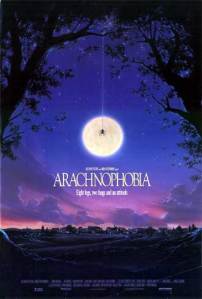
Quick Movie Review: Arachnophobia (dir. by Frank Marshall)


When I was a kid, my grandmother used to keep this clear shower curtain of a large black web, complete with a big red spider on it. It scared me so bad that I was actually more willing to brave the darkness of the basement bathroom than to have to deal with that monstrosity in the well-lit one. Between that, my brother’s EC comics and the original “The Fly” with Vincent Price, it’s how I developed Arachnophobia. It’s a fight or flight reflex that occurs when anything spider related appears. It seems fitting that as I’m writing this from a location that’s full of Black Widows, Arachnophobia is the topic for this review.

Arachnophobia marked the first directing attempt by Frank Marshall, long time producer of many of Steven Spielberg’s films. The film turned out to be a success when released, and manages to feature one the greatest Human vs. Tarantula battles ever filmed.

Although the film has some horror elements, it’s kind of hard to classify Arachnophobia as an actual horror film, despite the deaths that are in the film. There are some humorous moments (particularly from John Goodman), and the scares don’t come too often. For anyone who’s bothered by spiders, though, there are a number of jumpy moments that occur without being excessively gory. The story is a little misleading. It starts in Venezuela, South America, where a deadly tarantula manages to sneak its way on board a trip back to California. You’d think that from here, the Tarantula would end up finding another Tarantula, and thus pull a Kingdom of the Spiders with a whole town full of spiders. The writers, however, end up making a mistake in having a Tarantula mate with a common house spider, thus breeding dozens of other smaller spiders.

That’s like a Tiger trying to mate with a house cat. I’m not exactly sure if that’s even possible, but I’m getting off track. This actually ends up helping the story because now the town has to deal with all of these smaller spiders that are easy to hide around. I always considered that to be pretty effective.

Jeff Daniels character, Dr. Ross Jennings suffers from Arachnophobia in the worst way. Moving to the town of Canaima with his family, he trades the big city for a more relaxed, rural setting. Of course, it’s a happy ideal situation until various deaths start happening around town. Eventually, he and the authorities come to realize just how bad things really are. John Goodman’s character was an interesting touch as a funny exterminator, but really wasn’t used as much as he could have in this film. Then again, when he does tend to steal the scenes he’s in. Arachnophobia has a number of other supporting actors, but the film mainly belongs to Daniels, Goodman and the the spiders.

Chris Walas, who won an Oscar for his effects and make up work in The Fly helped to create some of the more mechanical spiders and close-ups when necessary. While you can tell where you’re dealing with real tarantulas and their synthetic counterparts, he did a great job in getting the fear factor out there, especially during the final standoff of the film. Without giving much away, the last 20 minutes of the movie are brilliant in that the final battle is much more than the simple “find it and squash it” scenario from Kingdom of the Spiders. It’s almost a violent chess match.

Arachnophobia is a treat. It may not be the best film about spiders in general, but if you do suffer from the condition or know someone who does, it definitely worth seeing, just to jump and squirm now and then. It’s much better than knowing there are real Black Widows to contend with.

Thousand Years of Dreams Day 20: The Story of Old Man Greo


I think the best thing I can say about Day 20’s dream-memory, “The Story of Old Man Greo”, is that it’s the bookend to my favorite and most emotional dream-memory which began this series: “Hanna’s Departure”.

It’s the tale of an old shoemaker. One whose shoes are renowned far afield. It’s a story of Old Man Greo whose fate in not being able to travel himself had given him the focus to make the implements to allow those going on their own journeys to do so in comfort and in a pair of well-crafted, thick-soled shoes. From the onset of the story it seems like it’s just a simple tale of a cobbler, but as one reads or watches the dream to it’s conclusion one can see how “The Story of Old Man Greo” matches and bookend’s Hanna’s own story.

Both stories tell of individuals who don’t let their infirmities dampen their spirit. They might not have been able to travel the world themselves, but in their own ways they have through others. If there were ever two dream-memories to evoke the biggest emotional response it would be these two and that surprising thing is that they both do so without being manipulative. Both Old Man Greo’s and Hanna’s stories retain that earnest virtue which can dampen the eyes of the most cynical in us all.

The Story of Old Man Greo

Old Man Greo was known as the best shoemaker in the country.

His shoes were light as leather and tough as steel. They were also expensive– three times higher than anything else on the market. People who did not know his reputation were so shocked to hear what he charged they would say:

“The old man must be making his shoes for his own amusement!”

Of course, this was not the case. He had become a craftsman’s apprentice at a tender age, and whenever he learned one master’s skills he would move on to more talented shoemakers. Before he knew it, he found himself making shoes for the grandchildren of his earliest customers.

Greo was such a skilled craftsman, he could make any kind of shoe the customer ordered, but he was best at, and most enjoyed making, thick-soled traveling shoes.

All his customers agreed. “Once you’ve traveled in Old Man Greo’s shoes, you can’t wear anybody else’s.”

Some would say. “You know what it’s like to wear his shoes? You don’t get tired the same way. You just want to keep walking– as long and as far as you can. You almost hate to get where you’re going.”

True craftsman that he was though, Old Man Greo rarely talked to his customers, and he could be downright unfriendly. Complimented on his work, he wouldn’t so much as smile. Instead, he would put another piece of tanned leather on his wooden shoe last and start hammering away.

The only time the old fellow would crack even the slightest smile was when a customer visited his workshop to place an order.

Not that he was ever thrilled to get an order. What he most enjoyed was when a customer brought him a pair of shoes that had outlived its usefulness. He would stare lovingly at the worn-down soles and the disintegrating uppers, and he would actually talk to them!

“You’ve done some good traveling, I see…”

His regular customers would never dispose of their old shoes themselves because they knew how much he enjoyed this. Neither would they do anything so foolish as to clean the shoes before handing them over to the old man. He wanted them straight from the road–covered with dirt, oil-stained, and stinking of sweat.

“These fellows are my stand-ins.” he would say, choosing an honored place for them in his storehouse.

“They take my place on the road, you know. They’ve done their job. I hate to throw them away just because they’re no good anymore.”

Proud craftsman though he was, Old Man Greo never wore his own shoes.

He couldn’t have worn them even if he had wanted to.

His legs were gone from the knees down.

A terrible illness had attacked his bones when he was very young, and the legs had been amputated to save his life.

The old man had lived his long life in a wheelchair. He had never once left his native village.

This was what he meant when he said that his shoes did the traveling for him.

“Haven’t seen you for a while.”

Old Man Greo says without looking up from his work as Kaim steps across the threshold. His back is toward the door, but he can tell from the sound of the footsteps when a regular customer has entered his shop.

“You crossed the desert?”

The sound tells him how worn down the shoes are, and where they have been. Old Man Greo is a craftsman of the first order.

“It was a terrible trip.”

Kaim says with a grim smile, setting on a chair in the corner of the shop. When old Greo is in the final stages of shoemaking, almost nothing can make him stop work, as all his regular customers know.

“Were my shoes any good on this one?”

“They were great! I couldn’t have done it with anyone else’s.”

“That’s good.”

The old man doesn’t sound the least bit pleased, which is to be expected.

Greo is especially curt when he is working. If Kaim wants to see the old man smile, he will have to wait a little until he hands Greo his old shoes during a work break.

“Here to order new ones?”

“Uh-huh.”

“Where to this time?”

“Up north, most likely.”

“Ocean? Mountains?”

“Probably walking along the shore.”

“To fight?”

“Probably.”

Old Man Greo signals his understanding with a quick nod. He says nothing for awhile.

The only sound in the workshop comes from Greo’s wooden mallet.

Kaim is moved to hear it. Like old times.

He has ordered any number of shoes here. Even before the old man took over the shop.

Kaim is one of Old Man Greo’s oldest customers. In other words, he is one of the few who have survived repeated journeys.

Swinging his mallet and speaking in short snatches, the old man tells Kaim about the deaths of some of his regular customers. Some fell ill and died on the road. Others lost their lives in accidents. And not a few were killed in battle…

“It’s hard when only the shoes come back.”

Kaim nods in silence.

“One young fellow died a few weeks ago. He was wearing the first pair of shoes I ever made for him. The soles were hardly worn at all.”

“Tell me about him.”

“You know, you hear it all the time. Leaves his home town, wants to live someplace exciting, parents try to stop him but he goes anyway.”

“I’m surprised he could afford shoes from you.”

“The parents bought them. Sad, isn’t it? They give their boy all this love and care, and he’s barely out of childhood when he says he’s going to leave home. They finally give up and decide to let him go. They figure they can at least give him a pair of my shoes as a going-away present. Less than a month later he comes back as a corpse. I don’t know parents nowadays, they spoil their kids rotten. It’s so damned stupid,” Greo snarls.

Kaim knows that the old man’s feelings go deeper than that. Old Man Greo is the kind of craftsman who would rush to make new shoes for the funeral of a sad young man who had breathed his last while his dream was only half-finished. He would pit them on the young man’s feet in the coffin and pray that he would be able to go all the way on this final journey.

Greo falls silent again and wields his mallet.

Kaim notices how bent and shriveled the old man has become.

He has known him a long, long time. Those days will be ending soon enough, Kaim thinks with an ache in his chest.

Old Greo finally reaches a point in his work where he can turn and face his customer.

“It’s good to have you back, Kaim.”

His face is covered with wrinkles. Kaim realizes anew how old he has become.

“Where did you say you were traveling?”

“The desert.”
“Right. I think you told me that before.”

Kaim shakes his head. The old man seems to lose his powers of concentration when he isn’t working, and his memory is shaky sometimes.

Little by little–but unmistakably–old Greo is spending more time drifting in the space between dream and reality. People grow old and die. The truth of this all-too-obvious destiny strikes Kaim with special force whenever he completes a long journey.

“So, you survived this one, too, I see.”

Kaim looks at him with a strained smile.

“Have you forgotten? I can’t die.”

“Oh, I guess I knew that…”

“And I never get old. I look just like I did the first time you met me, don’t I?”

The old man looks momentarily stunned. “Oh, I guess I knew that, too…” he says, nodding uncertainly.

“Sure, you were a kid then. You had just had that sickness and lost your legs and were crying all day long.”

“That’s right… I remember…”

“You used to call me Big Brother Kaim and play with my old shoes. Do you remember?”

“Yes, of course.”

Greo speaks with certainty now. Either the fog has cleared or the distant memory has come back with special clarity because it comes from so long ago.

“The soles were worn down, there were holes here and there, and they had a sour stink of mud and sweat.

To other people, they must have looked like plain old shoes ready for the garbage, but to me they were a treasure.

I remember running my finger through the coat of road dust that covered them and trying to imagine where they had been. I enjoyed them so much! I really enjoyed them!”

Kaim’s shoes were what got old Greo started as a shoemaker.

“It was all thanks to you, Kaim. If I hadn’t met you, I would have spent my life cursing my fate. Instead, I’ve been happy. I’m happy now. Even if I can’t leave this workshop, my sons can travel for me. I’ve had a happy life.”

He pauses. “Well, now, will you listen to me talking up a storm!” Greo says with an embarrassed smile. He extends a thick hand to Kaim.

“All right now, give me my sons,” he says, and Kaim hands him the worn-out old shoes he has brought with him.

The old man strokes them fondly and says with a sigh. “You’ve been through many a battle.”

“I was a mercenary, too, for a time.”

“I know that,” says Greo. “I can smell the blood.

All the shoes that travel with you are like this.”

“Are you angry?”

“Not at all. I’m just glad you came back from this latest trip in one piece.”

“I’ll be leaving again as soon as you make me new ones.”
“Another once of those trips? To war?”

“Uh-huh…”

“And when that journey ends, you’ll leave on another one?”

“Probably…”

“How long can you keep it up?”

Kaim’s only answer is a grim smile. Forever. This is not a word to speak lightly in the presence of someone who has lived what little time he has to the fullest.

“Oh, well, never mind,” the old man says, turning his back on Kaim to continue his work.

“Wait three days. You can leave the morning of the fourth day.”

“That will be fine.”

“When will me meet next after that?”

“Two years, maybe. Three? It could be a little longer.”

“Really? Well, then, this could be the last pair of shoes I ever make for you.”

Kaim believes it will be. The old man is not likely to last three more years. Kaim fervently wishes it were not so, but wishing by itself can do nothing.

Only those who possess eternal life know that this is precisely why the time a person lives is so irreplaceably precious.

“Say, Kaim…”

“What’s that?”

“Mind if I make a second pair of shoes out of the same piece of leather to match your new ones?”

They will be for himself, he explains, to be placed in his coffin for his life’s final journey.

“I’d like that,” answers Kaim. The old man swings his mallet instead of thanking him. The sound is far sadder and lonelier than usual.

“Come to think of it, though, Kaim, be sure to come back to this town even after I’m dead. Offer up your old shoes at my grave.”

“I will.”

“I’d like to say I’ll be going to heaven a step ahead of you and waiting for you there, but in your case it doesn’t work.”

“No, unfortunately.”

“What’s it like, an endless journey? Happy? Unhappy?”

“Probably unhappy.” Kaim replies, but his voice is drowned out in the rising sound of Greo’s mallet until it is lost even to his own ears.

Old man Greo reached the end of his full span of years soon after Kaim’s visit to his shop.

Because Greo had no family, his grave in the cemetery at the edge of town was cared for by his many sons. In accordance with his wishes, his regular customers offered up their old shoes at his grave.

Kaim’s shoes were among them.

The words inscribed on his gravestone were chosen by Greo himself.

He explained his choice to Kaim this way: “I would say the words to each new pair of shoes before I handed them to the customer. I always said them to the customer, too. I never once had the experience, though, of hearing someone say the words to me.

That’s why I want them on my gravestone.

These are the words I want to be seen off with on my journey to heaven.”

Several decades flow by.

Not only Old Man Greo but all the customers who knew him have long since departed the world.

The only one who still comes to pay his respects is Kaim.

He no longer wears shoes that were crafted by the old man. Like the life of man, the life of a pair of shoes cannot be eternal.

Still, Kaim comes to the town at the beginning of every journey, touching his forehead to the ground at the old man’s grave.

The gravestone is covered with moss, but the words engraved on it, strangely enough, are still clearly legible.

“May your journey be a good one!”

These were the words the old man always spoke.

Coming from his mouth they could be brusque, but they were always charged with feeling.
End

Lisa Marie Reflects on Soul Surfer (dir. by Sean McNamara)


As I was writing up my review of Shark Night 3D, I found myself thinking about Soul Surfer, another film that came out earlier this year and also featured a character losing an arm to a shark.  Oddly enough, both Shark Night and Soul Surfer feature supporting performances from former American Idol contestants.  (Carrie Underwood has a small supporting role in Soul Surfer.)  Beyond that, however, the two films couldn’t be any more different.

Soul Surfer is based on the true story of Bethany Hamilton, a surfer who, back in 2003, lost her arm to a shark.  I can still remember when this happened because, despite the fact that I live in one of the most land-locked parts of the country, it really, really freaked me out.  I have a morbid fear of somehow losing a limb whether by shark attack, car accident, or Jigsaw Killer.  (I guess, in my case, car accident would be the most likely possibility.)  I couldn’t help but look at the endless footage of a seemingly cheerful Hamilton being interviewed without wondering how I would react if the same thing happened to me.  Would I be able to stay as positive as Hamilton? I hope I could but, to be honest, I probably wouldn’t.

That’s one reason why I avoided seeing Soul Surfer when it was first released to theaters and instead only saw it once it showed up On Demand and I was looking for a movie to watch before bedtime.  Once I actually saw it, I was surprised to discover that Soul Surfer is an effective (if predictable) film that is occasionally even touching.

The film opens with some truly beautiful scenes set in Hawaii and rather quickly establishes Bethany Hamilton (played here by AnnaSophia Robb) as a normal teenage girl who just happens to be a very talented surfer.  Hamilton loses her arm about thirty minutes in and the rest of the film is devoted to her struggle to come to terms with both the loss of her arm and her newfound fame.  The film ends with Hamilton’s triumphant return to competetive surfing and, in its undeniably sincere and old-fashioned way, it makes for an undeniably touching moment.  Robb is likable as Hamilton though the film’s true heart and soul is provided by Dennis Quaid and Helen Hunt.  They play Hamilton’s parents and both of them prove they are capable of making even the most mawkish of lines effective.

Soul Surfer was popular with audiences but got slammed by critics who complained that the film was 1) predictable and 2) far too manipulative.  I would say that these critics are missing the point and their criticism has more to do with their own need to show off their cynical credentials than anything they may have actually seen on-screen. 

Yes, Soul Surfer is emotionally manipulative and yes, the film is predictable but so what?  

The important thing is that the film works.  

That’s a lot more than you can say for the much more cynical Shark Night 3D.

Film Review: Shark Night 3D (dir. by David Ellis)


If nothing else, the new film Shark Night 3D has an appropriate title.  The movie takes place over the course of one night, there are a few sharks, and it’s all presented in 3D.  If only the rest of the film worked as well.

Basically, the film is about this college student named Sara (played by Sara Paxton) who invites all of her college friends to Louisiana for the weekend and basically gets them all killed.  Among Sara’s friends are geeky-but-cute Nick (Dustin Milligan), geeky-but-not-so-cute Gordon (Joel David Moore, who was also in Avatar), token black guy Malik (Sinqua Walls), Malik’s girlfriend Maya (Alyssa Diaz), Beth (American Idol runner-up Katherine McPhee) who we know is doomed because she has both tattoos and big boobs, and Blake (Chris Zylka), who possesses no personality but he does have a really nice ass.  Seriously.  Unfortunately, Sara forgets to tell them that her psycho ex-boyfriend Dennis (Chris Carmack) is waiting for her, along with his redneck buddy Red (Josh Leonard). 

There’s also a lot of sharks swimming around this lake and, since this is a 3D movie, these sharks are capable of jumping out of the water like dolphins and snatching people out of boats and off of docks.  Seriously, these are some talented sharks.  Malik gets his arm bitten off and it’s pretty much all downhill from there.  Malik is talented too because, even after he gets his arm bitten off, he’s still capable of grabbing a harpoon and standing out in the middle of the lake, bleeding as he taunts the sharks.  Now, as ludicrous as this sounds, it’s probably the film’s best moment.  It’s certainly one of the only truly grindhouse moments in this film.  At the very least, it suggests a self-awareness that is lacking from the rest of the film. 

Shark Night 3D sucks.  There, I said it.  I feel a little bad about saying that because, obviously, you can’t judge Shark Night 3D by the same standard that you would judge a film like 8 1/2 or The Rules of the Game.  As I watched the end credits roll, I wondered if maybe I was being too hard on this film.  After all, a lot of the dialogue was so bad that the intention behind it had to have been satiric?  Right?  Was I just being unfair?  So, mentally, I compared Shark Night 3D to last year’s Piranha 3D and I quickly realized that I wasn’t being unfair.  Shark Night 3D sucks. 

The cast is uniformly bland, the plot is silly without ever being enjoyable, and — worst of all — the sharks are boring.  Remember how the killer fish in Piranha 3D managed to be both ludicrous and scary?  Remember how they each seemed to have their own little diabolic personality?  It made you root for the piranhas and, as a result, you didn’t mind the fact that they were eating cardboard characters.  However, the sharks in Shark Night just look like CGI sharks.  Remember how the piranhas were literally everywhere in Piranha 3D?  In Shark Night, the sharks just pop up randomly whenever the film’s engine starts to run out of gas. 

I think the ultimate verdict I can pass on Shark Night is this: I am usually a total aquaphobe.  Seriously, I can’t swim.  I don’t do boats.  I don’t do water parks.  When my family went to Hawaii, I spent a lot of time walking on the beach in my bikini but you better believe I ran like the wind whenever I saw the tide coming for me.  Over Labor Day weekend, I spent a while wading in the shallow end of my uncle’s pool and my family was literally amazed that I didn’t freak out.  So was I, for that matter.  (Yay me!)

And yet, as I watched Shark Night — which was all about people going into the water and dying terrible deaths — not once did I cover my eyes.

Not once.

Lisa Marie Invites You On A Trip To The Moon (dir. by Georges Melies)


As we wait for me to find the strength to actually review some of the movies I’ve seen recently, why not pass the time with a classic film that came out 109 years ago?

Directed and written by Georges Melies, A Trip to The Moon is often cited as the first sci-fi film and the image of the capsule crashing into the eye of the man in the moon is one of the most iconic in film history.  Seen today, the film seems both charmingly innocent and remarkably ahead of its time. 

For me, it always takes a minute or two to adjust to the aesthetic of early films.  We’ve grown so used to all the editing tricks that modern filmmakers use to tell their stories that these old silent films, with their lack of dramatic camera movement and obvious theatrical origins, often take some effort to get used to.  Still, the effort is often worth it.

Here then is Georges Melies 1902 science fiction epic, A Trip To The Moon.