Review: Game of Thrones Ep. 02 “The Kingsroad”


With Arleigh being away in Boston this weekend, I’ve agreed to attempt to review the second episode of Game Of Thrones, The Kingsroad.  I say attempt because, unlike Arleigh and a lot of our regular readers, I am totally and completely unfamiliar with the books that this show is based on. 

In other words, up until last week, I was a virgin, at least as far as Game of Thrones was concerned.  And while I’m happy to say that losing my Game of Thrones virginity was actually a lot more enjoyable than losing my actual virginity,  it still left me, in many ways, just as confused.  Who are all these people? I wondered as I watched the 1st episode.  Other thoughts that I can remember off the top of my head: Awww…cute little wolves!  Wait, is he the king?  My red hair is prettier than hers.  What the Hell’s going on?  Hey, it’s that guy!  Huh?  Peter Dinklage for the win!  What?  Huh?  Oh shit, that kid’s going to leave a mess when he lands! 

Unlike those of you who have read the books, I came into Game of Thrones with absolutely no tools to help me keep everything straight.  But yet, through a combination of surprisingly sincere performances, intriguing plot twists, and hot guys acting like men, the show held my interest to enough of an extent that I decided to come this week and get confused all over again.

So, what about this latest episode?  Well, looking at it from the point of view of someone who is still learning this show’s language, I think The Kingsroad was the perfect follow-up.  After the somewhat frantic pilot episode, Kingsroad slowed the story down a bit and instead devoted most of its time to allowing us to get to know the characters and filling in a lot of backstory.  If the first episode concentrated on making the character watchable, this episode concentrates on making the characters into human beings with all the individual quirks, flaws, and strengths that go along with being human.  The pilot told us why we should watch.  This episode gave us some clues as to why we should care.

After seeing tonight’s episode, there’s still a lot that I don’t understand but I understand enough to know that Joffrey’s a little punk and Tyrion — Tyrion just flat out rocks.  (Though, and this is how much of freaking newbie I really am, I originally called him Tyrone throughout this entire review.)

Below are ten other somewhat random thoughts inspired by watching the second episode of Games of Thrones.

1) If I came away with anything from tonight’s episode, it’s that I really need to get myself one of those dire wolves.  Over the course of this latest episode, I saw one wolf rip open an assassin’s throat while another one attacked that hateful little brat Joffrey.  I mean, I love my cat but the only person he’s willing to attack is me.  As long as he gets fed, he doesn’t care if I live or die.

2) But then there was that heart breaking moment when Nedd had to kill Sansa’s dire wolf.  I have to admit that I was cringing when I first saw Nedd holding that blade and that I kinda breathed a sigh of relief when I realize that they weren’t actually going to show it happen.  But then that pathetic yelp erupted on the soundtrack and it just left me heartbroken.

3) Which is why I can now say that I will probably never dislike another character as intensely as I now dislike Joffrey.  In retrospect, the most satisfying part of this episode was watching Tyrion slap Joffrey around at the beginning.

4) And speaking of Tyrion, Peter Dinklage kicks so much serious ass that I don’t even know where to start in praising his performance.  His big scene here (outside of slapping around Joffrey) was when he explained to Jon that, if he was a peasant, he would have been left in the forest to die.  He delivered the line with the perfect combination of cynicism, weariness, and dark humor.  It’s too early to say for sure but I may have found someone to fill the Josh Halloway-shaped void in my heart that was created when Lost ended.

5) I have to say that Sansa, with her refusal to stand-up for her younger sister and her reference to the wounded Joffrey as her “poor prince,” is not doing her fellow redheads proud.  Of course, I’m sure some of it has to do with the fact that she’s kind of overshadowed by her far cooler baby sister. I guess that has to be difficult to deal with.  Next chance I get, I’ll ask my older sisters about it to find out for sure. 🙂

6) The majority of this episode’s actual “plot” centered around Bran who was last seen getting kicked out of a very high window.  Shockingly enough, he’s still alive but he spends most of the show in a coma.  To be honest, there was only one false moment for me in this episode and it came when Catelyn found that hair at the “scene of the crime.”  I mean, what’s she going to do with it?  Call in David Caruso and have him take it back to Miami to be analyzed?  Still, I enjoyed the look on the faces of both Cersei and Jaime when they heard that Bran was alive.

7) One thing that I am greatly enjoying about this show is the way that the personal and the political mix throughout the story.  For all the plotting and talk of strategy, most of the show’s past and future conflict appears to be largely the result of wounded pride, jealousy, insecurity, and miscommunication.  Just like in real life and that, I think, is why this show will survive and why I will continue to watch it even if I am never 100% sure just what exactly is really going on.

8 ) I’m actually enjoying the fact that Game of Thrones takes a bit of effort to follow.  It was actually a pretty wise choice on the show’s producers’ part to just jump right into the action.  It makes the show feel real and relatable.  It allows even those of us who haven’t read the books to enjoy it.

9) So, did all you guys out there enjoy watching Daenerys learning how to pleasure her scary giant of a husband?  It’s okay if you did because I did and I’m a card-carrying Ms. 45 feminist.  Fact of the matter is that, once you get through all of the  usual “quality television” arguments, the main appeal of HBO is that its quality television with frequent frontal nudity.  (That’s why me and Erin used to secretly watch Oz when we were younger.)  And Daenerys’ demand that Drogo at least look at her face while using her — well, who couldn’t relate to that?

10) Finally, I have to mention that this show has got to have one of the best opening credit sequences ever!  Seriously,  that majestic yet ominous music  playing over images of a civilization being created, it’s a wonderful combination and definitely one that I hope to see for many more weeks to come.
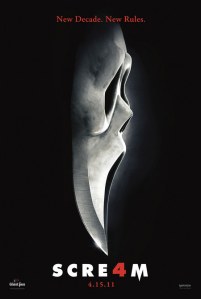
Film Review: Scream 4 (dir. by Wes Craven)


Before I start, note that Scream 4 is also referred to as Scre4m. While this is true and cool in a hacking/cyberpunk sort of way, I refuse to call it that as it just erodes my writing ability (which is rough enough as it is). I keep that up by the end of the year, everything I write will have numbers in it.

Compared to some of his earlier attempts, Scream 4 is pretty much a triumph for Wes Craven. With Kevin Williamson’s help, they manage to take the fourth part of a story and turn it into something remarkably enjoyable and surprising. The audience at my showing loved the way it started and ended. Although it retreads some of the older themes of the series, it does so in a way that almost makes fun of itself and the genre it’s a part of. Since it’s not taking itself too seriously, the audience doesn’t have to either.

Scream 4 basically brings what’s left of the remaining cast back to the tale. The Arquette’s (Courtney Cox and David) have returned as Gail Weathers-Riley and Sheriff Dewey Riley, respectively. Neve Campbell returns to form after a long hiatus, and really, it’s almost as if none of them ever left. The film starts off in a way where it pays homage to the original Drew Barrymore opening while still managing to keep it fresh. Cameos by Anna Paquin and Kristen Bell help to move that along.

After the events of the last three films (ten years of time in the movie), Sidney Prescott (Campbell) has managed to put her life back together by writing a novel about being a survivor. Thanks to Gail’s book on the Woodsboro murders and the multiple “Stab” movies that were created for them, the town has become famous for something it really shouldn’t be. Ghostface masks are a dime a dozen now, yearly Stab marathons are all the rage and the town kind of looks at it all like Crystal Lake – people died there, sure, but it’s just so much to say “I was there!”.

Sidney’s fame did little for her niece, Jill (Emma Roberts) and her friends, Kirby (a short hairdo wearing Hayden Panettiere) and Olivia (Marielle Jaffe). Having to grow up as a relative to the most famous person in town means everyone has something to ask her about Sidney when she returns to Woodsboro on her book tour. The younger trio keep their distance from Sidney as they consider her trouble. After all, all these deaths seem to occur when she’s around or has something to do with her. However, when a new rash of murders start when Sidney arrives, everyone has something to worry about. What follows is a bloodbath in typical Scream fashion, and as always, just about everyone is a suspect.

The Positives:

– Conspiracy Theory

What worked for me in Scream 4 was the conspiracy aspect. Williamson paints a picture that basically says “Here’s your cast. Any one of them could be the killer. Can you figure out who?”. The misdirection isn’t on a Harry Potter like level, but it does serve a purpose here. By the time everything was brought out, I found myself nodding and smiling. It’s actually worth it to ride out the movie to get to the big reveal. Without giving anything away, both that reveal and the story behind it was damn near excellent.

-Sidney as Ripley

Another good thing about the film is that Sidney is pretty much a powerhouse here. She takes on the Ghostface without too much fear. So much so that it sometimes seems like she’s like a Jason Bourne type character. It’s nice that she’s able to hold her own, though after 3 films, you’d expect the character to probably do that.

– Remembering the Original

Another element that proved useful was the homages to the original Scream films. There are a few scenes that even if you only watched the Original Scream, you’ll recognize them instantly. Some serious recognition goes to Panettiere’s Kirby, who at one point spits out the name of nearly 30 horror films in the space of a minute. All in all, it might seem like rehashing, but the context they were set up in were enough to warrant a whispered “Wow” from me. Maybe I’m just easily impressed. Craven also managed to bring back Roger L. Jackson (Mojo Jojo from The Powerpuff Girls) as the voice of the Ghostface Killer. So much fun to hear his voice again after all these years. That was definitely a plus.

The Negatives:

Not a lot of Bodies Hitting the Floor.

If Scream 4 suffers from any problems, it’s that there really isn’t that much of a body count. Granted, I wasn’t expecting anything like Dead Alive or Dawn of the Dead, but as slasher films go, it’s pretty light on the numbers, and as always, most of the people who are dispatched are done well, but I left the theatre wondering if there weren’t just a few more people who could have been taken out. That, and outside of the main players, I didn’t really care about the rest of the cast. They were pretty much cannon fodder for Ghostface.

– The Rules have Changed, but aren’t Exactly Enforced

While the movie seemed to be big on changing what the rules for how horror movies go, they weren’t really mind-blowing. In some ways, it seemed it was useful, but perhaps it would have been better to simply say that there were no rules and leave it at that. The rules here didn’t seem as enforced as the first film. Anything kind of goes.

Overall, Scream 4 is a fun ride, and quite possibly the best entry in the series since the first Scream. It peppers original elements with a few new ideas. It’s not all perfect and there some moments that are over the top, but in the end, it’s refreshing when compared to the 2nd and 3rd parts of the series.

Scenes I Love: Dead Alive


Sometimes, you watch a movie and there’s a line that will jump out at you so brightly that you have to stand up and take notice. You carry it with you and find that even if it didn’t mean to be, it just comes across as cool or funny. My family watches tons of movies, so at any given time you can make the room smile by screaming something sudden like “They cut the power?! How could they cut the power man? They’re animals!!”

I give you the awesomeness that is Peter Jackson’s Dead Alive. In this scene, which was both shocking and funny, a priest takes offense to zombies causing trouble in the cemetery behind his church. I laugh every time I think of this. Enjoy.

12 Trailers For Easter


Hi there, Happy Easter!  Because it’s the holidays and I happen to love Easter (bunny rabbits! — yay!), I’m going to do a special double-sized edition of Lisa Marie’s Favorite Grindhouse and Exploitation Trailers.

1) Teen-age Gang Debs (1966)

Let’s start things off with a little old school grindhouse.  I like this trailer because I used to be a teen-age gang deb.

2) The Cheerleaders (1973)

In the 60s, there were gang debs and in the 70s, there were cheerleaders.  And there were an awful lot of movies about cheerleaders that apparently were a lot more sordid than Bring It On

3) The Swinging Cheerleaders (1974)

They’re not just cheerleaders — they’re swinging cheerleaders!  Believe it or not, this was directed by the same Jack Hill who directed Switchblade Sisters and countless Pam Grier films.

4) The Pom Pom Girls (1976)

Eventually, filmmakers ran out different adjectives to place before the word “Cheerleaders.”  And that is how this movie ended up being called The Pom Pom Girls.

5) Cheerleaders Wild Weekend (1978)

When aren’t cheerleaders having a wild weekend?

6) Debbie Does Dallas (1978)

Needless to say, this is the edited version of this particular’s film’s trailer.  If I ever get a chance to watch Debbie Does Dallas, I’ll have to because I live in Dallas.  And if Debbie thinks she’s going to do Dallas better than I do Dallas, she might want to jump off that dream train.  Just saying…

(By the way, I know that there’s a small group of you out there who probably think I’m just using this post an excuse to kid my sister Erin about her high school cheerleading days.  Perish the thought!  In fact, to prove my good intentions, the next 6 trailers will be, in absolutely no way, related to cheerleading.)

7) Two-Moon Junction (1988)

I’m including this trailer specifically for one of our regular and loyal readers.  He knows who he is and here’s hoping he’s having himself a good weekend.

8 ) The Naked Bunyip (1970)

I’ve never seen this film, I just came across it while I was specifically looking up trashy cheerleader-centric trailers on YouTube.  It appears to be an Australian mondo film.

9) Black Samson (1974)

A part of me is really curious to see this film just to see if it’s actually based on the bible story.

10) The Thing With Two Heads (1972)

Film looks terrible but I love that tagline: “It seemed like a good idea at the time!”  I have a feeling that’s what Ray Milland spent all of 1973 telling himself.

11) Capone (1975)

This was on the Fox Movie Channel earlier this week and I actually set the DVR for it.  Ben Gazzara chews the scenery of Al Capone and then a really young Sylvester Stallone pops up as Frank Nitti.  This is one of those 70s mafia films that tries to be The Godfather, just with less running time and a smaller budget.  It’s kinda boring, to be honest.

12) Cannibal Girls (1973)

And finally…

Happy Easter!

Film Review: Insidious (dir. by James Wan)


I wasn’t expecting much from Insidious, the new horror film that’s recieved a surprising amount of critical acclaim over the past month.  After all, the film is the product of a collaboration between the makers of Saw and Parnormal Activity, two of the most overrated horror films ever.  Add to that, the movie is rated PG-13 and the lesson I took away from seeing The Roommate earlier this year was that PG-13 dooms horror.  Insidious might be the proverbial exception that proves the rule.

As with all good horror films, Insidious starts with a deceptively simple premise.  Patrick Wilson and Rose Byrne play a married couple whose marriage is thrown into choas when their oldest son slips into what appears to be a coma.  After three months of being in the hosptial, their son is moved back into their house where he spends his days lying in bed, hooked up to ominous medical equipment. 

(Speaking for myself, there is no more disturbing sound than the sound of heart monitor, because for every beep, there’s that moment of deafening silence between beeps.  The film’s director James Wan knows this too because he makes brilliant use of sound in this film.)

While Wilson deals with things by finding excuses to stay late at work, Byrne is soon seeing shadowy figures running through the house and hearing voices coming from empty rooms.  Even as Wilson continues to insist that its just her imagination (that’s something all men seem to have in common — they never ask for direction and they always refuse to accept that the house is haunted), Byrne becomes more and more convinced that its not.  Eventually, with a help of an eccentric psychic (well-played by Lin Shaye), Wilson and Byrne are forced to confront the evil forces that have taken control of their lives.

Let’s get the most important thing out of the way first.

Insidious is one scary movie.  It’s scarier than any movie rated PG-13 has any right to be.  It scared me when I was sitting in the theater watching it and, even more importantly, it’s still scary a day later.

Let me set the scene for you.  As I sit here writing this, it is nearly 3 in the morning.  I live in a two-story house that is full of random cold spot and which, for some reason, never seems to be totally lit even with all the lights on.  My friends are with their families for Easter.  My sister Erin is currently in Arlington, visiting with our other sister, Melissa.  I’m in this house alone with only my overactive imagination keeping me company.  Oh, did I mention that, because of some foundation issues, this house tends to randomly creak?

About two hours ago, I had just taken a shower and I was sitting, wrapped in a towel and a blow dryer, on the edge of my bed.  I have this antique floor  mirror that sits a few feet in front of my bed and I was about to start drying my hair when it suddenly occured to me — what if I looked at the mirror and I suddenly saw a dark shadow — like the ones in Insidious — sitting on the bed directly behind me?

And yes, I knew that was a silly thought just like I know, despite what the Insidious might tell us, there’s no such thing as ghosts and demons.  I knew that if I rasied my head, I would not see anything but isolated, vulnerable little me reflected in the mirror.

But, God help me, I could not bring myself to look.  Because, even though I knew that there was 99.9% chance that nothing would be sitting behind me, I knew that there was 0.1.% chance that something would be.  I sat there, almost paralyzed with my heart pounding so hard I could almost hear it.  I realized I was starting to breathe faster, knowing that if there was something there, it was there with me at that exact moment, siting behind me, waiting to strike…

Finally, realizing that I was on the verge of giving myself a very real panic attack over a very unreal possibility, I forced myself to look up at the reflection in the mirror.

A dark shadow was sitting directly behind me.

And I screamed and jumped off that bed so quickly that I’m amazed I actually managed to stay on my feet.  I swung around, cluthing that blow dryer like a weapon, prepared to do whatever…

Nobody was sitting on the bed. 

Slowly, I creeped across the room.  Cautiously, I stuck a foot underneath my bed to feel if anything was hiding underneath it.  I opened the closests and pushed my clothes to the side to confirm that nobody was hiding behind them. 

Finally, after I somehow found the courage to sit back down on the bed, I realized that there had indeed been a shadow behind me and that shadow, because of the angle of the lights in my room, had been mine.

That’s the type of film Insidious is.  It’s the type of film that uses the simple things that scare us — the unexplainable noises, the things that you sometimes think you see out of the corner of your eye — to creates a truly macabre experience that sicks with you.  At its best, its a truly creepy film that works its way into your imagination through a perfect combination of atmosphere and paranoia.  One reason why the haunted house genre has remained such a dependable horror set up is because it perfectly reflects one of our most basic fears — the fear of having no control, of knowing that there is no place to hide, that the forces of chaos and evil can even get to us in the sanctuary of our own homes.  Especially during its first half, Insidious exploits this fear perfectly.  James Wan’s camera prowls through the otherwise unremarkable suburban home like a creature possessed and you find yourself spotting shadowy figures and sudden movements in every frame that flickers before your eyes.  Wan makes remarkably good use of sound here.  I realize that sound of silence may be an oxymoron but if silence can make a sound, then director Wan manages to capture it in Insidious.

A lot of critics and filmgoers have been rather critical of the film’s second half and it is true that the second half if remarkably different from the first.  If the first half finds Wan concentrating on atmopshere then the second half concentrates on shock and, as a result, it feels a lot more conventional. During the 2nd half of them, we learn just what exactly is happening and why and unfortunately, no possible solution could hope to compete with the sense of dread that the first part of the movie generated.  That doesn’t mean that the second half of the movie isn’t well-executed.  It is.  It’s just not as surprising as the first half.

(However, there is one scene in that 2nd half — a red-skinned demon cheerfully sharpening his finger nails — that is just so bizarre and disturbing that it borders on genius.)

Now, I will admit (POSSIBLE SPOILER COMING UP DEPENDING ON HOW ANAL YOU ARE) that I was not a huge fan of the film’s ending.  It’s not that the ending didn’t work or that it wasn’t well-exectued.  It’s just that it’s the same type of ending that we’ve come to expect from all horror films, the type of thing that used to be considered a twist but now is just a cliche.

Still, ending aside, Insidious is an effective, little horror film.  While it is true that the film rather liberally borrows from a lot of previous horror films (most blatantly from Poltergiest, Mario Bava’s Shock, an Australian film called Patrick, and an excellent Canadian shocker called The Changeling), Wan still takes all of those familiar elements and molds them into a genuinely scary experience.

Scenes I Love: Taxi Driver


Everyone always talks about the “You talkin’ to me” scene or the final shoot out at the end but, for me personally, the scene that I always look forward to whenever I see Taxi Driver is the scene where demented cabbie Travis Bickle (Robert De Niro) buys an arsenal from the friendly and sleazy Andy (Steven Prince).  I’ve always felt that Taxi Driver was meant to be more a comedy than anything else and this scene manages to be funny and disturbing at the same time.

Apparently, Prince was a former heroin addict-turned-personal assistant to director Martin Scorsese.  His appearance here is proof of how the right actor in the right part in the right scene can totally dominate even with only 3 minutes of screen time.

Film Review: Win Win (dir. by Thomas McCarthy)


When I watched the pilot episode of Game Of Thrones, I got very excited when I saw that Thomas McCarthy was credited as the director.  Now, McCarthy isn’t a household name but chances are, you’ve seen him.  He played the plagiarist journalist in the final season of The Wire.  He was John Cusack’s romantic rival in 2012.  He was nominated for an Academy Award for co-writing the Pixar film Up.  However, McCarthy has received most of his critical acclaim as the director of low-key, character dramas like The Station Agent and The Visitor.  I have to admit that I was shocked to see McCarthy’s name linked to Game of Thrones because, with the exception of Peter Dinklage, it appeared to have nothing in common with his previous films.  Well, turns out that I wasn’t the only one who thought that because apparently, despite McCarthy being credited as the director, the majority of the pilot was actually reshot (quite well) by Tim Van Patten.

So, you might not be seeing Thomas McCarthy’s work on television but fortunately, you can still catch it in the movie theaters.  McCarthy’s latest film is a surprisingly poignant comedy called Win Win.

InWin Win, Mike (played by Paul Giamatti) is an attorney who works and lives in small New Jersey town.  Mike is married to Jackie (Amy Ryan), owns a big house, helps to coach the high school’s mediocre wrestling team, and can’t pay his bills.  Rather than let his family know that he’s on the verge of going broke, Mike instead becomes the legal guardian of one of his clients, the increasingly senile Leo (Burt Young).  In return to acting as Leo’s guardian, Mike receives a payment.  He also promises to take care of Leo so that Leo doesn’t have to enter a nursing home.  However, since Mike is played by Paul Giamatti, it doesn’t come as much of a shock that Mike promptly moves Leo out of his home and into the nursing home.  Leo, however, is too senile to understand that he’s being taken advantage of and all of Mike’s second thoughts disappear as soon as he gets the first check.

However, things get complicated once Leo’s delinquent grandson Kyle (Alex Shaffer) shows up looking for his grandfather.  Mike takes Kyle to see Leo and soon finds out that Kyle’s mother (and Leo’s daughter) Jill (Melanie Lynesky) is currently in drug rehab and Kyle has nowhere to go.  Reluctantly, he and Jackie agree to allow Kyle to stay with their family until his mother gets out of rehab.

While Kyle, at first, seems to just be an inarticulate drop out, he quickly reveals to himself to actually be a very intelligent (if very angry) young man.  Even better, from Mike’s point-of-view, Kyle is a former wrestling champion.  Mike arranges for Kyle to enroll in the local high school and join the wrestling team.  With Kyle now on the team, they actually start to win matches.  Suddenly, everything is starting to look up for Mike.  He’s a town hero, Jackie starts to bond with Kyle, and Leo remains unaware of how Mike is taking advantage of him.

And then, Kyle’s mom shows up and everything pretty much goes to Hell.

Win Win is the latest entry in the genre of film known as Paul Giamatti Has A MidLife Crisis.  The fact that the film remains interesting despite being the thousandth time that we’ve seen Giamatti have a midlife crisis is a tribute to both McCarthy’s intelligent script and Giamatti’s excellent lead performance.  Giamatti could play these roles in his sleep and the fact that he doesn’t is what makes him such a consistently interesting character actor.  Giamatti gets strong support from Shaffer and especially Ryan.  However, my favorite performance in the film came from Bobby Cannavale, who plays Giamatti’s loyal if somewhat dull-witted best friend.  Cannavale shows that you can give a very smart performance playing dumb and hopefully, his performance here well lead to greater things for him.

Now, I have to admit — I know nothing about wrestling.  Actually, I know less than nothing about wrestling.  And, to be honest, I really don’t care if I ever know anything about it.  Yet this film, which centered around wrestling, held my attention because McCarthy, as a director, uses the wrestling story to portray something universal.  His direction here is never flashy nor is it technically perfect.  (To be honest, I counted three appearances by the boom mic.)  McCarthy isn’t a polished director but that lack of polish works to this film’s advantage.  He may not have been the right director for Game of Thrones but he was obviously just what Win Win needed.

Song of the Day: Still Alive from Portal (by Jonathan Coulton and Ellen McClain)


The latest “song of the day” comes in just in time to show that my major bout with the cold/flu last week and this weekend hasn’t taken me out. It’s also a proper choice with the release of Portal 2, Valve’s sequel to their very popular puzzle-shooter Portal. What better way to send me off to Anime Boston this weekend but with the very geeky and otaku anthem of “Still Alive”.

“Still Alive” is the end credits song which plays once the player has completed Portal. The voice who sings the song (written by songwriter Jonathan Coulton) is one Ellen McClain and she is suppose to be the AI-computer GLaDOS lamenting the player’s success and escape. The song became as big of a hit with gamers as the game it was part of. Pretty much a whole cottage industry of all things geek-culture sprung up around this song. Shirts were made, youtube videos of varying quality using the song were uploaded and comic book, gaming and anime convention goers worldwide adopted the song as their unofficial anthem.

The song is pretty cute and catchy. The way the lyrics were sung with such sweetness by singer Ellen McClain makes it such a happy ditty. But when stepping back from singing along one really has to look at the lyrics and see how dark and twisted “Still Alive” truly was and still is. And on that note, catch you allafter Anime Boston.

Still Alive

This was a triumph
I’m making a note here
HUGE SUCCESS
It’s hard to overstate my satisfaction
Aperture Science

we do what we must because we can
for the good of all of us except for the ones who are dead
but there’s no sense crying over every mistake
you just keep on trying until you run out of cake
and the science gets done and you make a neat gun
for the people who are still alive

I’m not even angry
I’m being so sincere right now
even though you broke my heart and killed me
and torn into pieces
and threw every piece into a fire
as they burned it hurt because I was so happy for you!
Now these points of data make a wonderful line
and we’re out of beta, we’re releasing on time
so I’m glad I got burned
Think of all the things we learned for the people that are still alive

go ahead and leave me
I think I prefer to stay inside
maybe you’ll find someone else to help you
maybe black mesa
that was a joke, haha, fat chance
anyway this cake is great, it’s so delicious and moist
look at me still talking, when there’s science to do
when I look out there it makes me glad I’m not you
I’ve experiments to run, there is research to be done
on the people who are still alive

and believe me I am still alive
I’m doing science and I’m still alive
I feel FANTASTIC and I’m still alive
While you are dying I’ll be still alive
and when you’re dead I’ll be still alive
STILL ALIVE, still alive…


RIP: Tim Hetherington


Today the film and journalist community has lost one of its bravest brothers as news reports have confirmed the death of Tim Hetherington. Mr Hetherington was an acclaimed British conflict photojournalist and co-director of the wartime documentary Restrepo which was nominated by the Academy for a Best Documentary in this past Academy Awards ceremony.

Mr. Hetherington was in the besieged Libyan city of Misrata when he suffered wounds from an RPG attack on April 20, 2011 that he would soon die from. Three other photojournalists working side-by-side with Mr. Hetherington were also  wounded with two of the photographers in severe to grave conditions (Chris Hondros and Guy Martin). The third photographer, Michael Christopher Brown, suffered non-life threatening injuries during the attack.

The loss of Mr. Hetherington is a blow to the documentary community and to the community of photojournalists who has taken it upon themselves to report and record the conflicts going around the world. Mr. Hetherington’s work on bringing to light the day-to-day life of American soldiers fighting in one of the most dangerous combat zones in the world with Restrepo has earned him accolades from colleagues and has earned him friends with the very subjects he chose to cover.

It is a sad day indeed this April 20, 2011. Tim Hetherington has been taken too early and his name and legacy will live on through his past work and the lives he helped cover and change through work he loved to do best.

EDIT: News has now come down that fellow photojournalist Chris Hondros has also died from wounds suffered during the same attack which took the life of war correspondent and docu-filmmaker Tim Hetherington.

Source: New York Times

Lisa Marie Does Jane Eyre (dir. by Cary Fukunaga)


Hey, ladies!  Did your man make you sit through Battle Los Angeles?  Did he spend the whole time going, “Oh Hell yeah!” every time something exploded?  Did he insist on repeatedly going, “Hoorah!” after the movie ended? 

You want to get revenge?  Well, here’s what you’re going to do.  You’re going to go up to him and you’re going to tell him, in the sweetest way possible, that he’s going to take you to see the latest film adaptation of Jane Eyre.  Tell him that this is a revisionist take on the story and that its full of scenes of lesbian flirtation between Jane and Helen.  Of course, that’s a lie but this is the same guy who just gave you a card for Valentine’s Day.  You don’t owe him a damn thing.

And who knows?  He might find something to enjoy in Jane Eyre because it’s one of the best films of 2011 so far.  (Though I doubt it because Jane Eyre really is an unapologetic chick flick.)

Charlotte Bronte’s Jane Eyre is one of those books that has a timeless appeal to it.  I don’t know if it was the first novel to feature a young governess isolated in a creepy mansion but it certainly set the standard that all other gothic romances would have to meet.  The first film version was a silent film from 1910 and since then, Jane Eyre and the enigmatic Mr. Rochester have been played by everyone from Joan Fontaine and Orson Welles to Susannah York and George C. Scott to Charlotte Gainsbourg and William Hurt.  In this latest version, Jane is played Mia Wasikowska and Rochester by Michael Fassebender and the end result is probably the best film version of Jane Eyre to date.

With a few notable exceptions, the film is faithful to Bronte’s book.  Jane is an orphan who, after being mistreated by her wealthy aunt (Sally Hawkins, cast very much against type), is sent away to a “charity school” where she is again mistreated and abused until finally, she turns 18 and she leaves the school to take a job as the governess for a young French girl named Adele (Romy Settbon Moore).  Adele is the ward of the mysterious, arrogant, surly, but oh so hot Mr. Rochester.  Though Rochester is, at first, a rather fearsome employer, he soon starts to warm up to Jane and the two of them defy the 19th century class system by falling in love.  However, not everything is perfect.  Jane discovers that Rochester has secrets of his own and then there’s the constant sound of footsteps and moaning that seem to echo through the old mansion late at night.  Fires are mysteriously set.  A guest is savagely attacked in his sleep.  When Jane discovers the truth, she also discovers that nothing is as perfect as it seems.

One reason why the original novel has remained such an important work (and one that is still readable as opposed to say, The Scarlet Letter) is because Bronte used her narrative to tell several different stories.  Me, I’ve always related to the character of Jane and her struggle to maintain her independence in a society where women are not encouraged to think for themselves.  Others see the story as an early soap opera, a melodramatic romance in which true love conquers all.  There’s also an argument to be made that the book is primarily meant to be an examination of the 19th century British class system.  Of course, if that’s all a bit too much for you, you can always just read Jane Eyre as an early “haunted house” story.

The genius of this latest film adaptation is to be found in the way that director Cary Fukunaga and screenwriter Moira Buffini brings all of these various themes to life while still crafting a compelling and entertaining movie out of them.  Perhaps the biggest change they made is to begin their film near the book’s conclusion.  They then proceed to tell the story of Jane’s childhood and romance with Rochester through flashback, a move that recreates the book’s ground-breaking 1st person narration (ground breaking because, before Jane Eyre, it was rare that any female character was allowed to tell her own tale).  While some may complain that the 1st half of the book is pretty much reduced down to 15 minutes of screen time, Fukunaga and Buffini pick their scenes carefully and, most importantly. the essence of Bronte’s narrative comes through if not the exact details.

As a director, Fukunaga plays up the gothic aspects of the story.  Whenever Jane ventures outside, the skies are overcast and you can almost literally feel the chill of a desolate wind.  Meanwhile, the interior scenes are so full of menacing shadows and expressionistic camera angles that Fukunaga’s film almost feels like the noir version of Jane Eyre.  By doing so, this Jane Eyre becomes not just a prototypical gothic love story but instead, it becomes a true coming-of-age story with the mysteries of Mr. Rochester coming to symbolize the mysteries of life itself.

Fukanaga is helped by some excellent performances.  Jamie Bell and Judi Dench — playing a clergyman and a housekeeper respectfully — both bring life to characters that have been reduced to stereotypes in previous versions of this story.  Fassebender is a perfect Rochester, displaying both strength and weakness in equally believable measures.  However, the film’s success or failure obviously lies with Mia Wasikowska’s performance in the title role and this is Jane Eyre’s crowning triumph.  Wasikowska gives a fiercely, intelligent performance.  Her Jane is strong-willed, indepedent, and intelligent without ever becoming so idealized as to be unbelievable.  If Jane Eyre was the first strong woman to appear in literature, Wasikowska gives a performance that is equally strong.  There have been over 20 Jane Eyres since 1910 and Mia Wasikowska may very well be the best.