
Every year, there’s a handful of film scenes that come to define the entire year for us. At their best, these scenes can leave such an impression that they become a part of our shared history. For some people (though not me), 2009 will always be the year of Avatar. Meanwhile, for me (but not others), 2010 will always be the year I realized it was okay to admit how much I love to dance. Listed below are 20 of the many film moments that I will remember whenever I look back on this current year.
20) Carey Mulligan and Andrew Garfield discover what really happened to all of their childhood artwork in Never Let Me Go.
Permeated with an atmosphere of nonstop melancholy, Never Let Me Go never quite found the audience is deserved but I think it’s one of the best films of 2010 and the scene mentioned above is one of the reasons why.

19) Scott Pilgrim says, “Oh cool, coins!” in Scott Pilgrim Vs. The World.
And Lisa Marie suddenly realizes that she has fallen in love with a movie.
18) Keifer Sutherland says, “Tap that ass” in Twelve.
Truth be told, I don’t even remember what was happening on-screen. I just remember Keifer, as the film’s narrator, saying “Tap that ass” in that sexy, nicotine-fueld growl of his and thinking to myself, “Well, okay…”
17) Jake Gyllenhaal chases down a bus full of dying old people in Love and Other Drugs.
Yes, the old people desperately need to get up to Canada so they can get their prescriptions filled but unfortunately for them, Anne Hathaway happens to be on the bus as well and Jake — apparently realizing that he’ll never get to see her breasts again if they break up — chases the bus down in his Porsche so he can reconcile with her. And, of course, the old people are just so adorably excited at the idea of a 15-minute delay while these two deeply damaged characters stand outside and talk about their relationship. I mean, fuck it — who cares about getting these people their medicine when there’s a disposable pop tune playing in the background and Jake wants to talk to his ex-girlfriend? In so many ways, this scene represents everything I hate about mainstream filmmaking.
16) Joseph Gordon-Levitt flies through the corridors of a dream hotel in Inception.
Inception was a film full of amazing images but my personal favorite was perhaps the simplest — Joseph Gordon-Levitt (looking rather adorable in his dark suit) floating down those Argentoesque hallways while trying to figure out how to wake everyone up.
15) Jacki Weaver delivers the line of the year in Animal Kingdom.
“And you’ve done some bad things, sweetie.”
14) John Hawkes “talks” his way out of a traffic stop in Winter’s Bone.
While Winter’s Bone should rightfully make Jennifer Lawrence a star, John Hawkes also contributed some of the film’s best moments.
13) Patrick Fabian slips a recipe into his sermon in The Last Exorcism.
Cast as a modern-day Marjoe Gortner in this underappreciated film, Fabian gives one of the best performances of the year, if not the best.
12) Chloe Grace Moretz saves Kick-Ass from the mafia in Kick-Ass.
As far as women kicking ass was concerned, 2010 was a good year. Sure, the majority of cinematic female portraits were — as always — sexist to the extreme but there were a few rays of hope. Angelina Jolie in Salt, Noomi Rapace in The Girl With The Dragon Tattoo films, Mila Jovovich in Resident Evil — all were among the women who got to do something more than just look pretty while the boys saved the day. Seeing as how I’m honoring Rapace further down the list, I’m going to allow Chloe Grace Moretz (in the role of Hit Girl) to serve as a stand-in here for every single woman who was allowed to kick a little ass in 2010.
11) Christian Bale and Mark Wahlberg walks down the streets of Lowell at the beginning of The Fighter.
Seriously, this entire sequence — set to Heavy’s How You Like Me Now? (or “The Sock Monkey Song” as I call it) — could be a short film in itself. Call it: “Men and why we love them.”

10) Colin Firth fearfully waits to give a speech at the start of The King’s Speech.
One look at Firth’s terrified eyes and I was in tears. From that minute on, this unexpected gem of a film had me.
9) Jennifer Lawrence fishes for her dad’s hand in Winter’s Bone.
Southern gothic at its best!
8) James Franco is rescued by a purifying storm in 127 Hours.
Helpless and hopeless, Franco is suddenly freed by a sudden storm. Both Franco and director Danny Boyle handle this scene with such skill that the audience finds itself just as saddened as Franco when it all turns out to be a hallucination.
7) Katie Jarvis dances in an abandoned apartment and finds a momentary glimmer of hope in Fish Tank.
Between this movie and Black Swan, 2010 was the year that reminded me of just how much I love to dance and why. 2010 is the year that I realized it was okay for me to love to dance again.

6) Andy gives away his toys at the end of Toy Story 3.
And Lisa Marie cries and cries.
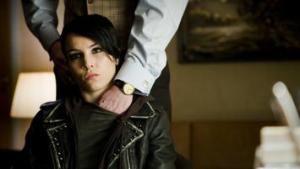
5) Lisbeth Salander (played by Noomi Rapace) gives her abusive guardian a tattoo in The Girl With The Dragon Tattoo.
For any and every girl who has ever been used, abused, hurt, spoken down to, insulted, manipulated, or betrayed by someone who claimed to only be looking after her best interests, this scene was truly cathartic. When I say that Noomi Rapace’s Lisbeth will be iconic, it’s largely because of scenes like this. In that one scene, Lisbeth is established as a woman who will never be victimized and it gives hope any for those of us who don’t have dragon tattoos.
4) Footage from Theirry’s completed “documentary” is revealed in Exit Through The Gift Shop.
And the audience is suddenly forced to question just how much of anything they’ve seen is the truth.
3) The spinning top wobbles at the end of Inception.
Or does it?
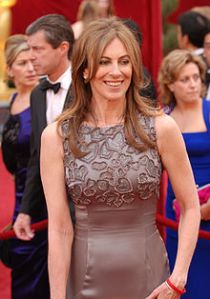
2) Kathryn Bigelow becomes the first woman to win the Oscar for best director while her ex-husband glowers in silence.
I wasn’t a huge fan of The Hurt Locker but I still squealed with delight as Kathryn Bigelow accepted the award that should have gone to Sofia Coppola back in 2004. Not only did Bigelow make history but she did it by beating her soulless jerk of an ex-husband, James Cameron. And then she gave one of the best acceptance speeches in Oscar history, all the while looking about 20 years younger than she actually is. In short, Kathryn Bigelow showed every Oscar winner — past, present, and future — exactly how it’s done.
1) The final fifteen minutes of Black Swan
In 15 minutes, Darren Aronofsky reminded me of how much I love ballet and audiences of why we love movies in the first place.

 Through the Shattered Lens