In 1990, Marlon Brando received his final Academy Award nomination when he was nominated for his supporting performance in 1989’s A Dry White Season.
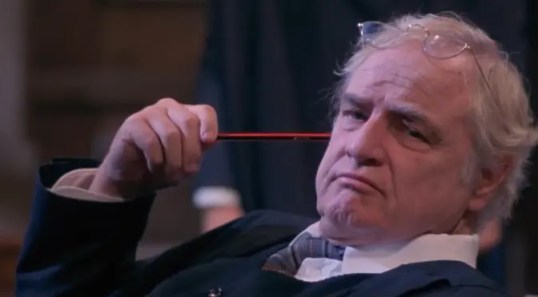
Brando played Ian McKenzie, a human rights lawyer who lives and work in South Africa at the height of the Apartheid regime. When we first see McKenzie, he’s sitting in his office and complaining about how all the flowers surrounding him have given him a permanent allergy. When Ben Du Toit (Donald Sutherland) explains that he’s trying to learn the truth about why his gardener and his gardener’s son both died in the custody of South Africa’s “special branch,” McKenzie replies that bringing the case would be a waste of time. McKenzie makes several dismissive comments about the case and tells Du Toit that pursing the matter would lead to Du Toit becoming a pariah himself. Only when Du Toit says that he’ll just find another lawyer to pursue the manner does McKenzie agree to take the case. His comments may have seemed callous but they were McKenzie’s way of testing Du Toit’s commitment to actually getting to the truth.
Up until the death of his gardener, Ben Du Toit was someone who blindly believed in the system. A former rugby star and a teacher, Ben grew up in South Africa and is proud to call himself a “true African.” (In one of the film’s best scenes, Ben’s driver, Stanley — played by Zakes Mokae, — informs Ben that being an African in South Africa means not being allowed to vote and having to carry identification papers everywhere with him.) When the gardener’s son is first arrested, Ben repeatedly says, “He must have done something.” When Ben’s gardener is arrested, Ben believes that it’s all just a terrible mistake and that he’ll be released soon. Even after the gardener is killed, Ben initially believes the official story that the death was a suicide. It’s only after Stanley takes Ben to the funeral home and shows him the gardener’s tortured body that Ben finally comes to realize that he was tortured to death by Captain Stolz (Jurgen Prochow).
Still, Ben is naive enough to assume that McKenzie will be able to get some sort of justice. In court, McKenzie easily exposes the flaws in Stolz’s story. When Stolz claims that the dead man’s injuries were the result of the man throwing himself against the bars of his cell, McKenzie mentions that the man’s back was injured and then asks if he was throwing himself backwards. Stolz smirks and says that the man was “an animal.” McKenzie may be a brilliant lawyer but it’s a foregone conclusion that he’s going to lose the case. Stolz is exonerated and the expression on McKenzie’s face is one that indicate that he is not surprised at all.
It’s a small role. Brando gets less than ten minutes of screentime but he makes perfect use of them and shows that, even in the latter half of his career, Brando could still give a good performance when he cared about the material. Both Brando and Susan Sarandon took small roles in this anti-Apartheid drama because they believed in the message. Sarandon’s casting is a bit distracting. She never becomes the journalist she’s playing, instead she just seems like a movie star lending her name to a cause that she believes in. But Brando becomes Ian McKenzie and he expertly reveals the absurd lengths to which the Apartheid government will go to excuse its actions.
The majority of the film deals with Ben Du Toit and his slow-awakening about the truth of the country that he calls home. Upon realizing the truth about the country’s government and its actions, Du Toit declares that he can no longer go back to being who he once was and it costs him his family, his home, and ultimately his life. Donald Sutherland does a wonderful job, portraying Du Toit’s growing understanding of what’s actually happening in South Africa. Wisely, the film doesn’t portray Du Toit as being a saint. It fully understands that Du Toit only started to care about Apartheid when it effected somebody that he knew and fortunately, Stanley is always there to call Du Toit out whenever he starts to forget about his own role in supporting the system that he now opposes. It’s a powerful and heartfelt film, one that is well-known for Brando’s performance but works just as well when Brando is off-screen as well.


 Through the Shattered Lens