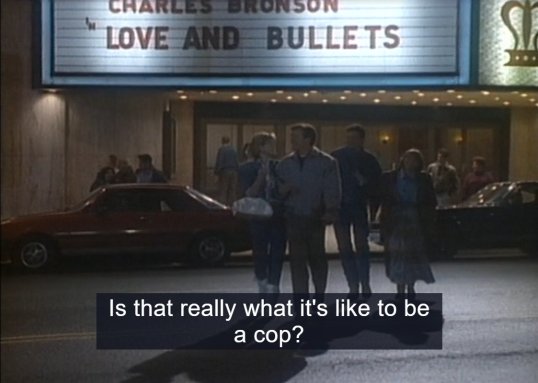
January True Crime: Shoot First: A Cop’s Vengeance (dir by Mel Damski)


Made for television in 1991 and possessing a rather unwieldy title, Shoot First: A Cop’s Vengeance tells the story of two friends in San Antonio in the early 80s.

Farrell Tucker (Dale Midkiff) and Stephen Smith (Alex McArthur) are both cops.  They entered the police academy together, they graduated as a part of the same class, and they both hope to be partners while working to keep the streets of San Antonio safe.  Tucker is laid back and friendly and not one to worry too much about following all of the regulations.  Stephen Smith, on the other hand, is uptight and, at first, by-the-book.  He grew up in a poverty-stricken, crime-riddled neighborhood and it left a definite impression on him.  He hates crime and criminals but what he really can’t stand is a justice system that seems to be more concerned with the victimizers than with the victims.  Tucker and Smith enjoy spending their time together, drinking at the local cop bars and practicing their shooting on the weekends.  Tucker’s not much of a shot, whereas Smith is a sharpshooter who rarely misses.

At first, no one notices or even cares that some of San Antonio’s less upstanding citizens are getting gunned down in the streets.  But when Smith somehow manages to be first on the scene to a series of shootings, it gets the attention of Internal Affairs.  With Sergeant Nicholas (Terry O’Quinn) investigating the possibility of a cop-turned-vigilante and Chief Hogan (G.D. Spradlin) announcing that no one is above the law, Smith starts to get a bit paranoid and Tucker is forced to consider that his friend could very well be a murderer.

And, of course, Tucker’s right!  The first scene features Tucker confronting Smith and then the majority of the film is told in flashback.  Even if not for that narrative choice, one could guess at Smith’s guilt just from the title of the film.  When Shoot First: A Cop’s Vengeance was released on home video, the title was changed to Vigilante Cop, which made Smith’s guilt even more obvious.  Finally, some viewers will guess that Smith is guilty because the film is based on a true story.  Officer Stephen Smith actually did go on a killing spree, gunning down men who he felt had escaped the law and even sending threatening letters to his chief when the latter announced that vigilante activity would not be tolerated.  Officer Stephen Smith went from being a follower of the rules to someone who attempted to write his own rules.  It’s an interesting story for anyone who wants to google it.

As for the film, it’s adequate without being particularly memorable.  Alex McArthur and Dale Midkiff both give good performance as Tucker and Smith and the cast is full of talented people like Terry O’Quinn, G.D. Spradlin, Bruce McGill, and Lynn Lowry.  Observant viewers will even notice a long-haired Jeremy Davies, showing up for a split-second.  I liked the performance of Loryn Locklin, as the waitress who marries Smith and then discovers that her charming husband actually has some very serious issues.  The main problem with the film is that the story moves a bit too slowly for its own good and some of the Texas accents were more than a little dodgy.  If you’re looking for an action film, this won’t be for you, though the shootings are surprisingly graphic for something that was made for television.  Shoot First: A Cop’s Vengeance is a rather routine telling of an interesting story.
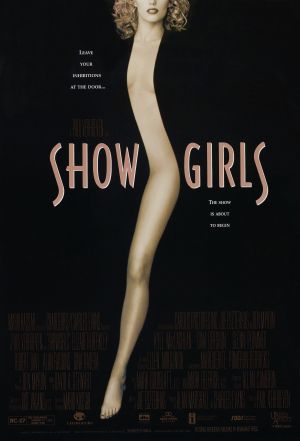
Embracing the Melodrama Part II #90: Showgirls (dir by Paul Verhoeven)


ShowgirlsWell, this is it!

Showgirls in the 1995 film that, 20 years after it was first released, is still held up as the standard by which all subsequent bad films are judged.  The story behind the production is legendary.  Screenwriter Joe Ezsterhas was paid a then-record sum to write a script that ripped off All About Eve and featured lines like, “Come back when you’ve fucked some of that baby fat off,” and “You’re the only who can get my tits poppin’ right!”  (And let’s not forget the heroine’s oft-repeated catch phrase, “It doesn’t suck.”)  A major studio specifically hired Paul Verhoeven with the understanding that he was going to give them an NC-17 rated film.  And finally, the lead role was given to Elizabeth Berkley, an actress whose previous experience amounted to co-starring on Saved By The Bell.

(And, let’s be honest, the only reason Jessie Spano was a tolerable character was because she wasn’t Screech.)

Berkley plays Nomi Malone, a sociopath who wants to be a star.  She hitchhikes her way to Las Vegas where, as is destined to happen to anyone who shows up in Vegas or New York with a clunky suitcase, she is promptly robbed of all of her possessions.  “Fuck!  Fuck!  Fuck!  Fuck!” she yells, showing off the very expensive dialogue that was written for her by Joe Ezsterhas.  Eventually, Nomi starts to take her frustration out on a random car.  The car, it turns out, belongs to sweet-natured Molly (Gina Revara), who is a seamstress for a tacky Vegas show called Goddess.  

(Seriously, Goddess makes Satan’s Alley from Staying Alive look like a work of quiet genius.)

Soon, Nomi is living in Molly’s trailer and working as a stripper at the Cheetah Club.  The Cheetah Club is owned by Al, who is amazingly sleazy but who is also played by Robert Davi.  Robert Davi is one of those actors who knows how to make terrible dialogue interesting and it’s instructive to watch him perform opposite Elizabeth Berkley and the rest of the cast.  Whereas the majority of the cast  always seems to be desperately trying to convince themselves that their dialogue is somehow better than it actually is, Davi knows exactly what he’s saying.  Watching his performance, it’s obvious that Davi understood that he was appearing in a bad film so he figured that he might as well enjoy himself.

The same can be said of Gina Gershon, who plays Cristal Connors, the star of Goddess.  Sexually voracious Cristal is basically a male fantasy of what it means to be bisexual.  Cristal hires Nomi to give a lapdance to her sleazy boyfriend, Zack (Kyle MacLachlan, giving a good performance despite having to spend the entire film with hair in his eyes) and then arranges for her to be cast in the chorus of Goddess.  There’s absolutely nothing subtle about Gershon’s performance and that’s why it’s perfect for Showgirls.  It’s been argued that Showgirls is essentially meant to be a huge in-joke and, out of the huge cast, only Gershon, Davi, and occasionally MacLachlan seem to be in on it.

Certainly, it’s apparent that nobody bothered to tell Elizabeth Berkley.  Berkley gives a performance of such nonstop (and misdirected) intensity that you end up feeling sorry for her.  She’s just trying so hard and she really does seem to think that she can somehow make Nomi into a believable character.  And it’s actually a bit unfair that Elizabeth is always going to be associated with this film because I doubt any actress could have given a good performance in a role as inconsistently written as Nomi.  One second, Nomi is a wide-eyed innocent who is excited about living in Las Vegas.  The next second, she’s screaming, “FUCK OFF!” and threatening strangers with a switch blade.  She may be a survivor (and I imagine that’s why we’re supposed to root for her) but she’s also humorless, angry, and apparently clinically insane.

Hilariously, we’re also continually told, by literally everyone else in the movie, that she’s a great dancer, despite the fact that we see absolutely no evidence of this fact.  Check out this scene below, where Nomi dances with a lot of enthusiasm and little else.

Once Nomi is cast in Goddess, she promptly sets out to steal both the starring role and Zack from Cristal.  Nomi’s cunning plan, incidentally, amounts to fucking Zack in his pool and shoving Cristal down a flight of stairs.  Nomi’s finally a star but when a Satanic rock star named Andrew Carver (William Shockley) comes to town, Nomi is confronted with the sordid truth about Las Vegas and, because this long film has to end at some point, Nomi must decide whether to take a stand or…

Well, you can guess the rest.

(Incidentally, I like to assume that Andrew Carver was meant to be a distant cousin of the great short story writer Raymond Carver.)

There seems to be two schools of thought when it comes to Showgirls.

Some critics claim to Showgirls is just crap.  They say that it’s a terrible film with bad dialogue, bad acting, and terrible direction.  These critics view Joe Eszterhas as being the villain of this tale, a misogynist who conned the studios into paying two million dollars for a terrible script.

And then other critics claim that Showgirls is crappy on purpose.  They claim that Verhoeven meant for the film to be a satire of both American culture and Hollywood showbiz dramas.  For these critics, Verhoeven used Eszterhas’s terrible script and Elizabeth Berkley’s inexperience to craft a subversive masterpiece.

Myself, I fall somewhere in between.  Based on Verhoeven’s other films — Starship Troopers comes immediately to mind — I think his intent with Showgirls probably was meant to be satirical and subversive.  But, at the same time, I would argue that Verhoeven’s intent doesn’t change the fact that Showgirls is a surprisingly boring film.  For all the sex and the nudity and the opulent costumes and sets and all of the over-the-top dialogue, Showgirls is never really that interesting of a film.  It barely even manages to reach the level of being so-bad-that-it’s-good.  Instead,  it’s slow, it’s draggy, and — satiric or not — the bad performance, the bad dialogue, and the nonstop misogyny get a bit grating after a few minutes.

Of course, that’s why you should never watch Showgirls alone.  Showgirls is a film that you have to watch as a part of a group of friends so that you can all laugh together and shout out snarky comments.  The first time I ever saw Showgirls was at a party and it was a lot of fun.  But, for this review, I rewatched the film on Netflix and I was surprised by how much of a chore it was to sit through the entire running time.  This is one of those films — like Birdemic and The Room — that you have to watch with a group.  You watch for the experience, not the film.