Film Review: Save The Tiger (dir by John G. Avildsen)


1973’s Save The Tiger tells the story of Harry Stoner (Jack Lemmon).

When Harry was a young man, he loved baseball and he felt like he could conquer the world.  He saw combat in World War II and spent the final part of the war on the Island of Capri, recuperating after being wounded in battle.  Harry went on to partner up with Phil Greene (Jack Gilford) and they started a clothing company in Los Angeles, Capri Casuals.

Now, Harry is a middle-aged man who is still haunted by nightmares about the war.  He’s married.  He has a daughter attending school in Switzerland.  He’s respected in the industry.  He lives in a nice house in Beverly Hills.  And he’s totally miserable.  He wakes up every day and wonders what is happening to the country.  He talks about witnessing a wild pitch at a baseball game, missing the days when something like that could seem like the most important thing in his life.  He spends all of his time at work, cheating to balance the books and keeping clients happy by setting them up with a sophisticated prostitute named Margo (played, with a weary cynicism, by Lara Parker).

Save The Tiger covers just a few days in the life of Harry Stoner, as he searches for some sort of meaning in his life.  He gives a ride to a free-spirited hippie (Laurie Heineman) who offers to have sex with him.  (Harry replies that he’s late for work.)  He accepts an award at an industry dinner and, as he tries to give his acceptance speech, he is haunted by the sight of dead soldiers sitting in the audience.  With Phil, he debates whether or not to balance the books by setting fire to one of their warehouses in order to collect the insurance.  Harry sees a poster imploring him to “Save the Tigers.”  Who can save Harry as he finds himself increasingly overwhelmed by the realities of his life?

As I watched Save the Tiger, I found myself thinking about two other films of the era that featured a middle-aged man dealing with a midlife crisis while searching for meaning in the counterculture.  In Petulia and Breezy, George C. Scott and William Holden each found meaning in a relationship with a younger woman.  And while Petulia and Breezy are both good films, Save The Tiger is far more realistic in its portrayal of Harry’s ennui.  There is no easy solution for Harry.  Even if he accepted the hippie’s offer to “ball” or if he acted on the obvious attraction between himself and Margo, one gets the feeling that Harry would still feel lost.  Harry’s problem isn’t that he’s merely bored with his life.  Harry’s problem is that he yearns for a past that can never be recaptured and which may only exist in his imagination.  If George C. Scott and William Holden were two actors who excelled at playing characters who refused to yield to the world’s demands, Jack Lemmon was an actor who played characters who often seemed to be desperate in their search for happiness.  Save The Tiger features Lemmon at his most desperate, playing a character who has yielded so often and compromised so much that he now has nowhere left to go.

It’s not exactly a cheerful film but it is one that sticks with you.  Jack Lemmon won his second Oscar for his performance as Harry and he certainly deserved it.  Lemmon does a wonderful job generating some sympathy for a character who is not always particularly likable.  Many of Harry’s problems are due to his own bad decisions.  No one forced him to use “ballet with the books” to keep his business open and no one is forcing him to hire arsonist Charlie Robbins (Thayer David, giving a performance that is both witty and sinister at the same time) to burn down not only his warehouse but also an adjoining business that belongs to an acquaintance.  Harry could admit the truth and shut down his business but then how would he afford the home in Beverly Hills and all the other symbols of his success?  Harry yearns for a time when he was young and his decisions didn’t have consequences but that time has passed.

This isn’t exactly the type of film that many would expect from the director of Rocky but director John G. Avildsen does a good job of putting the viewer into Harry’s seedy world.  I especially liked Avilden’s handling of the scene where Harry hallucinates a platoon of wounded soldiers listening to his awards speech.  Instead of lingering on the soldiers, Avildsen instead uses a series of a quick cuts that initially leave the audience as confused as Harry as to what Harry is seeing.  Both Rocky and Save The Tiger are about a man who refuses to give up.  The difference is that perhaps Harry Stoner should.

“You can’t play with us, mister!” a kid yells at Harry when he attempts to recreate the wild pitch that so impressed him as a youth.  In the end, Harry is a man trapped by his memories of the past and his dissatisfaction with the present.  He’s made his decisions and he’ll have to live with the consequences but one is left with the knowledge that, no matter what happens, Harry will be never find the happiness or the satisfaction that he desires.  The tigers can be saved but Harry might be a lost cause.

Retro Television Reviews: Blood Sport (dir by Jerrold Freedman)


Welcome to Retro Television Reviews, a feature where we review some of our favorite and least favorite shows of the past!  On Sundays, I will be reviewing the made-for-television movies that used to be a primetime mainstay.  Today’s film is 1973’s Blood Sport!  It  can be viewed on YouTube.

David Birdsong (played by Gary Busey, who was 29 at the time) is a high school senior with a potentially bright future ahead of him.  He’s the quarterback of his high school’s football team and it looks like he’s on the verge of leading his team to an undefeated season.  He’s getting recruited by all the big schools.  Scouts are coming to his games to watch him play.  He also has one of the highest GPAs at his school, though it’s suggested that might have more to do with his importance to the football team than his actual study skills.

“Don’t you have anything else you want to do with your life?” his high school principal (David Doyle) asks him and David’s reaction indicates that he’s never really given it much thought.  From the time he was born, David’s father, Dwayne (Ben Johnson), has been shaping his son to become a star athlete.  Dwayne is happiest when he’s watching David play, whether on the field or in the highlight reels that he keeps down in the basement.  When Dwayne sees that his son isn’t on the field, he’s the type of father who will get out of the stands and argue with the coach on the sidelines.  Dwayne continually tells David not to stay out too late.  The one time that David does, Dwayne slaps him hard enough to send his son to the floor.

Coach Marshall (Larry Hagman) is determined to get his undefeated season, no matter how hard he has to push his players.  The coach is the type who is convinced that his players respect him for his stern ways and his long-winded speeches but little does he realize that they all secretly despise him.  When one of his players drop dead of a heart attack during practice, Coach Marshall demands that the player stop being lazy and get up.  When he realizes that the player is never going to get up, Coach Marshall angrily asks, “Why did this have to happen now!?”  Later, at a pep rally, Coach Marshall announces that his team had a private meeting and agreed that they would win the final game in the player’s memory.  The team is disgusted but the rest of the town loves their coach.

David is never happier than when he’s on the field, playing football and being cheered by both the crowd and his team.  But, through it all, he sees reminders that the future in uncertain.  On the sidelines, David spots an injured player, watching the game with the knowledge that his dreams of getting a scholarship have ended.  When David visits a college, he’s reminded that being the best high school player doesn’t mean much in college and when he says that he’s a quarterback, he is told that his coach will ultimately decide who he is and David will accept the coach’s decision because David isn’t being offered a scholarship to think for himself.

When the film originally aired in 1973, it was called Birdsong but the title was changed to Blood Sport for both subsequent showings and for a European theatrical release.  Blood Sport is the more appropriate title because, even though the main character is named David Birdsong, the film is ultimately about all of the athletes who are expected to put their health at risk for the people on the sidelines.  It’s not just football that’s a blood sport, the film suggests.  It’s the entire culture that has sprung up around it, the one that cheers when players are at their best but which also looks away at the times when the players need the most help.

At 29 years of age, Gary Busey is a bit too old to be totally convincing as a high school senior but he still does a good job of capturing David’s gradual realization that he’s never really had any control over his own life.  Ben Johnson and especially Larry Hagman also give good performances as the two men who are living vicariously through David’s accomplishments.  Hagman is so believably obnoxious as the coach that you’ll want to cheer when someone finally finds the guts to stand up to him and tell him to just shut up for a minute.

The film ends on an ambiguous note, leaving many questions open about David’s future.  One hopes that he’s started to find the strength necessary to live his own life but it’s ultimately hard to say.  In the end, nothing is guaranteed, no matter how far you can throw a football.

TV Review: Night Gallery 2.1 “The Boy Who Predicted Earthquakes/Miss Lovecraft Sent Me/The Hand of Borgus Weems/Phantom of What Opera?”


The second season of Night Gallery premiered on September 15th, 1971.  Once again, Rod Serling led viewers through a darkened museum, inviting them to look upon macabre paintings and imagine the story behind image.

The first episode had four — that’s right, four! — different stories!  Apparently, the show’s producers demanded that, for the 2nd season, each episode feature shorter stories along with some light-heated segments.  From what I’ve read, Rod Serling was not particularly happy with the directive and it’s perhaps significant that, after writing every story featured in Night Gallery‘s first season, he only wrote one of the stories featured in the second season premiere.

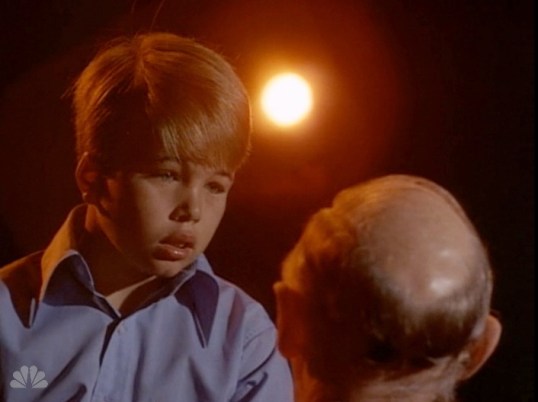
The Boy Who Predicted Earthquakes (dir by John Badham, written by Rod Serling)

Herbie (played by 12 year-old Clint Howard, younger brother of Ron) is a little boy with a very special gift.  He can see the future.  He seems like a normal child, the type who rambles about random subjects except that, at random, he’ll suddenly stop and ominously predict the future.  After Herbie correctly predicts both the rescue of a missing girl and an earthquake, Herbie is given his own TV show.  For a year, Herbie makes predictions, all of which come true.  Then, suddenly, Herbie refuses to shares his latest prediction and says that he doesn’t want to do the show anymore.  What has Herbie seen and is it a good thing or a bad thing?

The Boy Who Predicted Earthquakes gets the second season of Night Gallery off to a good start.  Centered by a natural performance from Clint Howard, The Boy Who Predicted Earthquakes is an intelligently written and thought-provoking story.  Not only does it examine the burden of being able to see the future but it’s also a provocative look at how society exploits the gifted.  With the exception of Herbie’s grandfather (William Hansen), the people around Herbie are less concerned with what he predicts than that people keep watching.  The segment ends on an appropriately dark note, one that will keep the viewer thinking.

Miss Lovecraft Sent Me (dir by Gene Kearney, written by Jack Laird)

A gum-chewing babysitter (Sue Lyon) show up for her latest job.  It’s at a castle!  And the owner of the castle (played by Joseph Campanella) has gray skin, is wearing a cape, and has a Transylvanian accent!  What could it all mean?

This is a short comedic segment.  Apparently, the producer of Night Gallery, Jack Laird, had the idea to liven things up with sketches like this one.  Serling was apparently not a fan of the idea but Miss Lovecraft Sent Me isn’t that bad.  It’s silly and insubstantial because Joseph Campanella and Sue Lyon handled their roles well.  It’s impossible not to laugh when the babysitter reads aloud the names of the books that Campanella has sitting on his bookshelf.

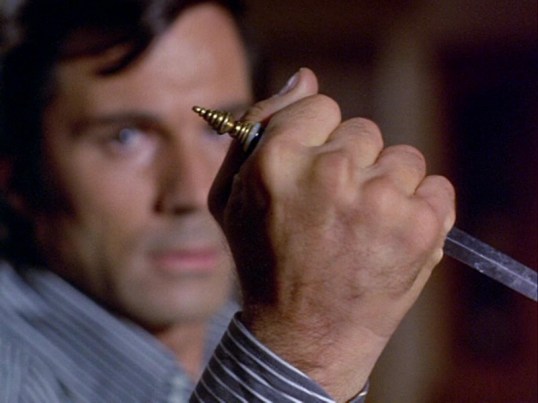
The Hand of Borgus Weems (dir by John M. Lucas, written by Alvin Sapinsley)

Peter Lacland (George Maharis) sits in a doctor’s office and asks Dr. Ravadon (Ray Milland) to remoe his right hand.  Peter explains that his right hand has a mind of its own and that it keeps trying to kill everyone who Peter comes into contact with.  Peter explains that his hand has been possessed!

There’s a surprisingly large number of stories out there about possessed hands.  The Hand of Borgus Weems doesn’t necessarily bring anything new to the genre and it gets a bit bogged down with its flashback structure but it’s still an enjoyably creepy little segment, featuring good performances from George Maharis and Ray Milland.  Possessed hands are also creepy, no matter what.  Like The Boy Who Predicted Earthquakes, it also has an effective ending, which is quite a contrast to the often insubstantial conclusions of Night Gallery’s first season.

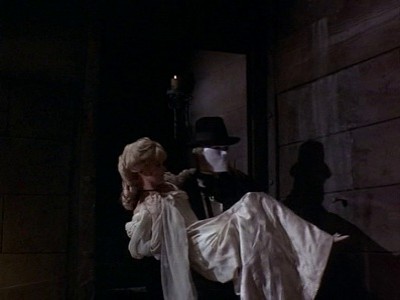
Phantom Of What Opera?  (written and dir by Gene Kearney)

This is a short, 4-minute comedic story — a skit really — featuring Leslie Nielsen as the Phantom of the Opera and Mary Ann Beck as Christine. This version starts out like a typical Phantom segment, with the Phantom kidnapping Christine, taking her down to the dungeon, and telling her never to remove his mask.  Christine, of course, removes his mask while he’s playing the organ just for him to then discover that she’s also wearing a mask.  It all leads to love and a happy ending!  It’s kind of a sweet segment, actually.

So the 2nd season of Night Gallery got off to a pretty good start!  Would future episodes continue the trend?  We’ll find out soon as I continue to watch Night Gallery.

Previous Night Gallery Reviews:

  1. The Pilot
  2. The Dead Man/The Housekeeper
  3. Room With A View/The Little Black Bag/The Nature of the Enemy
  4. The House/Certain Shadows on the Wall
  5. Make Me Laugh/Clean Kills And Other Trophies
  6. Pamela’s Voice/Lone Survivor/The Doll
  7. They’re Tearing Down Tim Riley’s Bar/The Last Laurel

The TSL’s Horror Grindhouse: The Terminal Man (dir by Mike Hodges)


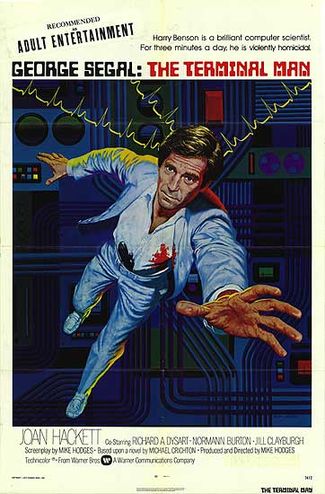
Check out the poster for 1974’s The Terminal Man.

Look at it carefully.  Examine it.  Try to ignore the fact that it’s weird that George Segal was once a film star.  Yes, on the poster, Segal has been drawn to have a somewhat strange look on his face.  Ignore that.  Instead, concentrate on the words in the top left corner of the poster.

“ADULT ENTERTAINMENT!” it reads.

That’s actually quite an accurate description.  The Terminal Man is definitely a film for adults.  No, it’s not pornographic or anything like that.  Instead, it’s a movie about “grown up” concerns.  It’s a mature film.  In some ways, that’s a good thing.  In some ways, that’s a bad thing.

Taking place in the near future (and based on a novel by Michael Crichton), The Terminal Man tells the story of Harry Benson (played, of course, by George Segal).  Harry is an extremely intelligent computer programmer and he’s losing his mind.  It might be because he was in a serious car accident.  It may have even started before that.  Harry has black outs and when he wakes up, he discovers that he’s done violent things.  Even when he’s not blacked out, Harry worries that computers are going to rise up against humans and take over the world.

However, a group of scientists think that they have a way to “fix” Harry.  It’ll require a lot of brain surgery, of course.  (And, this being a film from 1973, the film goes into excruciating details as it explains what’s going to be done to Harry.)  The plan is to implant an electrode in Harry’s brain.  Whenever Harry starts to have a seizure, the electrode will shock him out of it.  The theory is that, much like Alex in A Clockwork Orange 0r Gerard Malanga in Vinyl, Harry will be rendered incapable of violence.

Of course, some people are more enthusiastic about this plan than others.  Harry’s psychiatrist (Joan Hackett) fears that implanting an electrode in Harry’s brain will just make him even more paranoid about the rise of the computers.  Other scientists worry about the ethics of using technology to modify someone’s behavior.  Whatever happens, will it be worth the price of Harry’s free will?

But, regardless of the risks, Harry goes through with the operation.

Does it work?  Well, if it worked, it would be a pretty boring movie so, of course, it doesn’t work.  (Allowing Harry’s operation to work would have been like allowing King Kong to enjoy his trip to New York.)  Harry’s brain becomes addicted to the electrical shocks and, as he starts to have more and more seizures, Harry becomes even more dangerous than he was before…

The Terminal Man is a thought-provoking but rather somber film.  On the one hand, it’s a rather slow movie.  The movie does eventually get exciting after Harry comes out of surgery but it literally takes forever to get there.  The movie seems to be really determined to convince the audience that the story it’s telling is scientifically plausible.  On the other hand, The Terminal Man does deal with very real and very important issues.  Considering how threatened society is by people who cannot be controlled, issues of behavior modification and free thought will always be relevant.

Though the film may be slow, I actually really liked The Terminal Man.  Judging from some of the other reviews that I’ve read, I may be alone in that.  It appears to be a seriously underrated film.  As directed by Mike Hodges, the film is visually stunning, emphasizing the sterility of the white-walled hospital, the gray blandness of the doctors, and the colorful vibrancy of life outside of science.  Though he initially seems miscast, George Segal gives a good and menacing performance as Harry.

The Terminal Man requires some patience but it’s worth it.

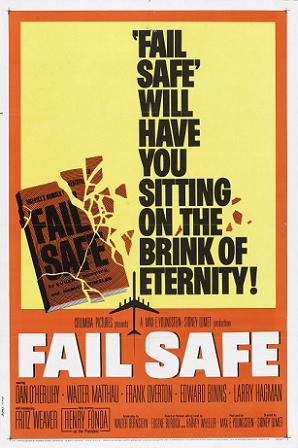
Shattered Politics #23: Fail-Safe (dir by Sidney Lumet)


Fail_safe_moviep

After watching Dr. Strangelove, you may find yourself asking what that film would have been like if it had treated its doomsday scenario seriously.  Well, you can find out by watching yet another film from 1964, Sidney Lumet’s Fail-Safe.

What’s Fail-Safe about?  Well, basically, it tells the exact same story as Dr. Strangelove, except without the humor.  Once again, an American bomber is accidentally ordered to launch a nuclear attack against Russia.  Again, the President (played, somewhat inevitably, by Henry Fonda) has to have an awkward conversation with the leader of Russia.  Again, a sinister defense advisor (this time played by Walter Matthau) argues that the world can survive a nuclear war.

Admittedly, there is no equivalent to George C. Scott’s Buck Turgidson in Fail-Safe.  However, there is a General Black (Dan O’Herilihy) who has a recurring nightmare about watching a bullfight while the sky around him glows with radiation.

Fail-Safe has the same plot as Dr. Strangelove but none of the humor.  In fact, Fail-Safe has absolutely no humor at all.  It’s one of the most somber films that I’ve ever seen.  It has a good opening with General Black’s nightmare and an effective ending that makes excellent use of freeze frames but the middle of the film is basically just a collection of endless debates.

And I’m sure that approach made sense at the time because, after all, Fail-Safe was dealing with a serious theme, it was directed by a serious filmmaker, and it featured a bunch of serious actors.  And maybe if I had never seen Dr. Strangelove, Fail-Safe would not seem like such a slow and boring movie.  But I have seen Dr. Strangelove and, as a result, it’s impossible to watch Fail-Safe without wanting to hear Henry Fonda say, “You can’t fight here!  This is the war room!”

The Daily Grindhouse: Homebodies (dir by Larry Yust)


Can we just be honest about something?

Most of us are a little bit scared of the elderly.

Oh, we try to deny it.  We talk about how they’re “real characters” or we attempts to convince ourselves that their eccentricities are actually signs of an incurable zest of life.  We tell ourselves that old people remind us of the value of carpe diem but, ultimately, they creep most of us out because, when we look at them, we see our own future.  Regardless of what we do today or tomorrow, we’re all going to eventually become old.  Perhaps that’s why there’s a whole industry devoted to keeping old people out of sight and out of mind.

Today’s entry in the Daily Grindhouse, the obscure 1974 film Homebodies, is effective precisely because it understands that unpleasant truth.

Directed by Larry Yust, Homebodies tells the story of Mattie (Paula Trueman).  Mattie is one of seven elderly retirees who are the sole residents of a condemned apartment building.  All around them, buildings are being torn down and replaced with new apartments.  When an uncaring social worker (Linda Marsh) shows up and informs them that they’re going to be forcefully relocated to an assisted living facility, Mattie take matters into her own hands.  She realizes that every time there’s an accident on a construction site, work stops for a few days.  Hence, if there are enough accidents, work will be stopped indefinitely.  Mattie and her fellow residents (some reluctantly and some not) are soon murdering anyone they view as a threat.  While this is effective initially, things get complicated once Mattie starts to view some of her fellow residents with the same contempt that she previously reserved for construction workers.

Homebodies is one of those odd and dark films that could have only been made in the 70s.  When the film begins, one would be excused for expecting to see a heart-warming comedy about a bunch of plucky seniors outsmarting the forces of progress and real estate.  After all, the elderly residents of the condemned building are all appropriately quirky and, as played by Paula Trueman, Mattie doesn’t seem like she’d be out-of-place as one of the prankers on Betty White’s Off Their Rockers.  Linda Marsh’s social worker and Kenneth Tobey’s construction foreman both seem like the type of authority figures who one would expect to see humiliated in a mawkish 1970s comedy film.

Instead, Homebodies turns out to be an effectively creepy and dark little film.  When the elderly residents of the apartment building fight back, they do so with a surprising brutality that’s all the more effective because of the harmless exteriors of Mattie and her fellow residents.  Paula Trueman makes Mattie into a truly fascinating and frightening monster.  When a few of her fellow residents start to question Mattie’s methods, you truly do fear for them because Mattie has truly proven herself to be capable of just about anything.  While Trueman dominates the film, the entire cast is excellent.  As a classic film lover, I was happy to see that one of the residents was played by Ian Wolfe, a character actor who will be recognizable to anyone who has ever watched TCM.

(Remember the old man who gave the lecture at the observatory in Rebel Without A Cause?  Him.)

I first saw Homebodies on YouTube and I was going to share it below but, apparently, the video has been pulled from the site.  That’s a shame because it’s a film that definitely deserves to be seen, if for no other reason than to appreciate the performances from a cast of underrated character actors who, sadly, are no longer with us.   Unfortunately, the best I can offer is this Spanish-language trailer for the film.