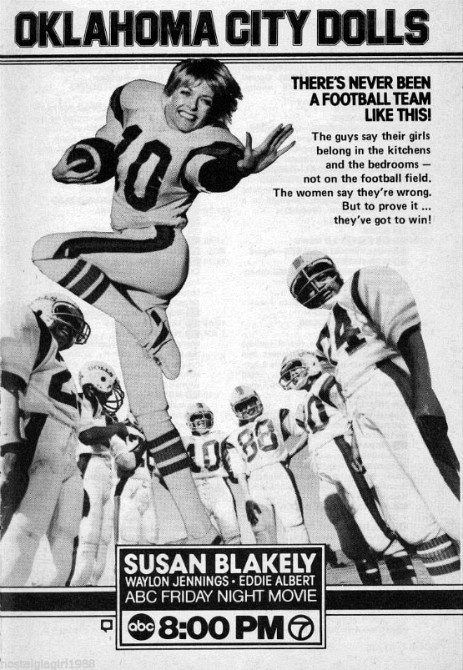
The Oklahoma City Dolls (1981, directed by E.W. Swackhamer)


At an Oklahoma manufacturing plant, the women are always expected to put in extra hours while their male co-workers practice as a part of the company’s football team.  Shop steward Sally Jo (Susan Blakely) files a complaint with the EEOC.  John Miller (Robert Hooks) pays a visit to the plant and says that the women have to be given the same opportunities and benefits as the man, including recreation time.  The plant’s foreman, J.D. Hines (David Huddleston), agrees.  The woman can have recreation time as long as they’re doing what the men are doing and that’s playing football.  Determined to show up Hines and all of her sexist co-workers (and her boyfriend, played by Waylon Jennings), Sally Jo puts together a football team and even gets a broken-down former NFL coach (Eddie Albert) to serve as their trainer.

There actually was a woman’s football team called The Oklahoma City Dolls.  They played in the National Women’s Football League and they won the league’s championship three times.  However, they don’t appear to have anything to do with this movie, which is as much about Sally Jo trying to get a fair treatment for the workers as it is about hitting the field and running it in for a touchdown.  There are some parts of the movie that work.  I liked Eddie Albert’s performance as the alcoholic coach and the scene where he discovered that his community service would include coaching a group of women who had never played football before.  Folk singer Ronee Blakley was good as the team’s emotionally fragile wide receiver.  I even liked that the women didn’t all automatically become the world’s best football players.  The movie’s main weakness was that Susan Blakely just wasn’t believable as someone who lived in a trailer park, used “ain’t” in every sentence, and spent her time organizing a union.  She was too glamorous for the role and her scenes with Waylon Jennings all felt overwritten and overacted.  The story couldn’t decide if it wanted to be a drama about working in a factory or a football comedy and it was pretty uneven as a result.  The good thing is that the movie’s heart was in the right place, even if it didn’t always score a touchdown.

As for the real life Oklahoma City Dolls, they were active from 1976 to 1979.  An attempt to revive the team in 1982 failed when their financial backers pulled out at the last seconds.  The National Women’s Football League folded in 1988.
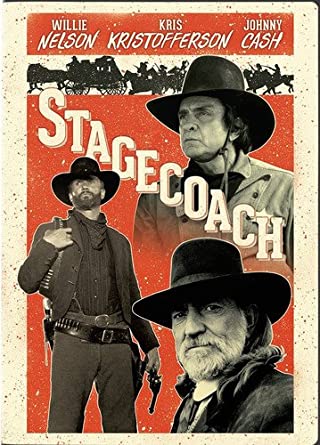
Stagecoach (1986, directed by Ted Post)


The year is 1880 and Geronimo and his Apaches are on a warpath against the people who have taken their land.  Despite the warnings of the local Calvary officers, one stagecoach tries to make the long journey from Arizona to New Mexico.  The seven passengers may start out as strangers but they’re going to have to work together to survive the journey.  The most famous passenger is dentist-turned-gunslinger Doc Holliday (Willie Nelson).  The most infamous is the Ringo Kid (Kris Kristofferson), an outlaw who has recently escaped from prison and who is looking for revenge against the men who framed him for a crime that he didn’t commit.  Henry Gatewood (Anthony Fraciosa) is a banker who has embezzled money and is looking to make a quick escape.  Foppish Trevor Peacock (Anthony Newley) sells liquor.  Dallas (Elizabeth Ashley) is a former prostitute looking to start a new life.  Mrs. Mallory (Mary Crosby) is nine months pregnant and traveling to reunite with her husband, an officer in the Calvary.  Finally, Hatfield (Waylon Jennings) is a chivalrous gambler.  Riding atop the stagecoach is Buck (John Schneider), who gets paid 8 dollars a month to risk his life taking people through Apache country, and Curly (Johnny Cash), the tough-but-fair town marshal who plans to arrest the Ringo Kid as soon as they reach civilization.

Made for television, Stagecoch is an adequate remake of the John Ford classic.  The story remains basically the same, with the main difference being that the majority of the characters are now played by country-western singers who are a few years too old for their roles.  Doc Holliday, who died of “consumption” when he was in his 30s, is played by Willie Nelson, who doesn’t look a day under 70.  The Ringo Kid is played by Kris Kristofferson, who, despite having literally played Billy the Kid a decade earlier, still doesn’t look like he’s ever been called a “kid” at any point in his life.  Compared to their original counterparts, the remake’s characters have been slightly tweaked so that they fit with the outlaw country images of the singers playing them.  Doc Holliday sympathizes with Geronimo and says that his use of whiskey is “medicinal.”  Kristofferson’s Ringo Kid is more openly contemptuous of authority than John Wayne’s.  Waylon Jennings is less of a cynic in the role of Hatfield than John Carradine was and Johnny Cash sits atop the stagecoach like a man on a holy mission.

The cast is the main reason to watch this version of Stagecoach.  The film can’t match the original but Nelson, Kristofferson, Jennings, and Cash obviously enjoyed playing opposite each other and, even if Nelson and Kristofferson are miscast, all of them bring some needed country-western authenticity to their roles.  As for the non-singers, Mary Crosby, Elizabeth Ashley, and John Schneider all make the best impressions while both Franciosa and Newley seem too 20th Century for their western roles.  Director Ted Post does a good job with the action scenes and keeps the story moving, even if the remake’s status as a TV production keeps him from capturing visual grandeur of Ford’s original.  Stagecoach is a respectful remake of a classic, one that can be appreciated when western fans on its own merits.

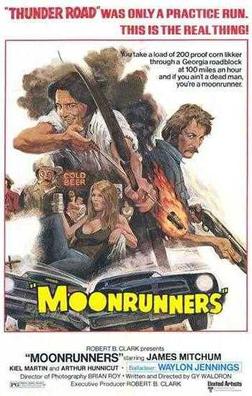
Moonrunners (1975, directed by Gy Waldron)


Does this sound familiar?

Grady and Bobby Lee Hagg (played by Kiel Martin and Jame Mitchum) are just some good ol’ boys, never meaning no harm, but they’ve still been in trouble with the law since they day they were born.  They live in rural Georgia, on a farm owned by their Uncle Jesse (Arthur Hunnicutt).  Uncle Jesse’s an expert on two things: the Bible and how to brew the best whiskey.  Uncle Jesse is moonshiner with integrity.  No one knows his formula and he won’t sell his moonshine to just anyone.  He doesn’t want anything to do with the New York mob and their efforts to move in on the moonshine racket.

Uncle Jesse’s main rival is Jake Rainey (George Ellis), the corpulent county commissioner who used to be Jesse’s business partner but who now is in league with the Mafia.  Jake and the Hagg boys have a rivalry that is sometimes friendly but still dangerous.  Helping Jake control the county is a formerly honest lawman named Rosco P. Coltrane (Bruce Atkins).

The Hagg boys are on probation so they can’t leave the county and they can’t carry guns.  Instead, they hunt with bow and arrow.  They drive a fast car that they’ve named Traveller (after General Lee’s horse).  Grady dreams of going to Nashville with Beth Anne Eubanks (Chris Forbes) and becoming a country music star.  Bobby is a laid back race car driver who is having an affair with Jake Rainey’s wife.

The film follows the Hagg boys as they transport moonshine, outrun the police, and occasionally get into bar fights.  The movie was shot on location on Georgia, features several car chases, and it’s narrated by country singer Waylon Jennings.

Moonrunners was filmed in 1973 but not released until 1975.  It didn’t get much attention when it was released but it did go on to inspire a television series called The Dukes of Hazzard.   Even considering the show’s popular success and current cult status, Moonrunners is still a largely unknown film.  (It’s so obscure that Warner Bros. was reportedly shocked to discover that they were required to pay several million in royalties to the film’s producers before they could move ahead with their own film adaptation of The Dukes of Hazzard.)  However, Moonrunners is superior to The Dukes of Hazzard in every way.

Of course, being better than The Dukes of Hazzard may seem like a low bar to clear but Moonrunners is still one of the better moonshiner films out there.  The car chases are genuinely exciting and well-filmed and the cast feels authentic.  Arthur Hunnicutt and George Ellis both seem like they naturally belong next to a still while James Mitchum and Kiel Martin are well-paired as Grady and Bobby Lee.  Mitchum, in particular, channels the laconic charisma of his father, Robert.  Not surprisingly, Moonracers is far rougher and has more of an edge than The Dukes of Hazzard.  The TV show may have been for kids but the movie is not.

It’s a B-movie, of course.  The soundtrack, which is full of outlaw country, is sometimes obtrusive.  I burst out laughing at the film’s most dramatic moment because Waylon Jennings suddenly started singing a song called “Whiskey Man.”  The DVD release appears to have been copied straight from a VHS tape so the images were often grainy.  It’s not a perfect movie but I still enjoyed Moonrunners for what it was, a celebration of fast cars, pretty girls, and rebellious attitudes.  Your collection of car chase films is incomplete without it!