Vincent Price was born, at the start of the 20th Century, in St. Louis, Missouri. When he first began his film career in the 1930s, he was promoted as a leading man and he was even tested for the role of Ashley Wilkes in Gone With TheWind. (Imagine that!) However, Price would find his greatest fame as a horror icon.
Among the fans of Price’s horror films was a young animator named Tim Burton. In 1982, Price and Burton would work together for the first time, with Price providing the narration for a short, stop motion film that Burton had written and directed. Called Vincent, the film was about a seven year-old boy named Vincent who wanted to be — can you guess? — Vincent Price! The six-minute film follows Vincent as he gets involved in all sorts of macabre activities. Of course, as Vincent’s mom points out, Vincent isn’t actually a monster or mad scientist. He’s just a creative child with an overactive imagination. (To say the short feels autobiographical on Burton’s part would be an understatement.) The animation is outstanding and full of wit but it really is Vincent Price’s wonderful narration that makes this short film a classic.
Both Price and Burton would later call making this film one of the most creatively rewarding collaborations of their respective careers.
Here to continue to spread the Halloween spirit is Vincent Price, performing The Tell-Tale Heart. This is from 1970 and was a part of a PBS special called An Evening With Edgar Allan Poe.
That’s the question I asked myself as I watched 1964’s The Tomb of Ligeia. Loosely based on a short story by Edgar Allan Poe, The Tomb of Ligeia tells the story of Verden Fell (Vincent Price). Fell’s wife, Ligeia, has recently died but Fell worries that her spirit is still haunting and watching him. One gets the feeling that Fell hated his late wife but, at the same time, was obsessed with her. Fell has an eye condition which causes him to wear dark glasses on the rare occassions that he leaves his manor. He’s definitely a creepy guy but that doesn’t stop Rowena (Elizabeth Shepherd) from falling in love with him and leaving her fiancé, Christopher Gough (John Westbrook), to marry him. Unfortunately, Rowena is soon feeling the spirt of Ligeia as well, in the form of a black cat who keeps attacking Rowena.
Now, in all honesty, I doubt that Roger Corman specifically had an issue with cats. It’s possible the Edgar Allan Poe had an issue with cats, as he lived at a time when cats were rarely kept as pets and were instead just used to catch and kill mice and rats. (And, in fairness to the 19th century, that was a very important job in those days of bad hygiene and outhouses.) There’s no cats to be found in Poe’s short story about Ligeia but there was one very prominently featured in The Black Cat. As Ligeia was not exactly one of Poe’s most detailed stories, it’s probable that Corman and screenwriter Robert Towne just included the evil black cat because that story was one of Poe’s best-known.
That said, for me, it was difficult to watch an entire movie about people hating and attempting to destroy a cat. It’s certainly not the cat’s fault that it’s been possessed by the spirit of Ligeia. As I watched the film, it occurred to me that cats may not have been as popular in the 1960s as they are today. I mean, there was no internet when this film was made and, as a result, people weren’t constantly being bombarded by cute cat pictures. Instead, people probably just knew cats for their habit of hissing at people and scratching their owners. Today, we find that behavior to be cute. Perhaps back in 1964, people felt differently.
If I seem to be rambling on about the cat, that’s because there’s not really a lot to be said about The Tomb of Ligeia. It was the last of Corman’s Poe films and neither Corman nor Price seem to be particularly invested in the material. Price is actually rather miscast as Verden Fell. Fell is meant to be a mysterious aristocrat, in the spirit of Maxim de Winter from Rebecca. But Vincent Price is …. well, he’s Vincent Price. Vincent Price was a wonderful actor and personality but he wasn’t particularly enigmatic. From the first minute we see Price, we know that he’s being haunted by his dead wife because he’s Vincent Price and the same thing happened to him in several other films.
The Tomb of Ligeia is full of the ornate sets and beautiful costumes that were featured in all of Corman’s Poe films. And even a miscast Vincent Price is still fun to watch. But, when compared to the other films in the Poe Cycle, this one falls flat.
In 1964’s The Masque of the Red Death, Vincent Price stars as Prospero.
Prospero is a nobleman in medieval Italy, a decadent tyrant who rules his villages with an iron hand and who proudly and openly worships Satan. When an old woman in one of the villages dies of the plague, Prospero orders the village to be burned to the ground. He returns to his castle where, with his mistress (Hazel Court), he plans to throw a masquerade for the local nobility. His plan is for everyone to hide out in the castle until Death has passed. The problem, of course, is keeping Death from sneaking into the castle and claiming everyone within.
Prospero also abducts three villagers, Ludovico (Nigel Green), his daughter Francesca (Jane Asher), and Francesca’s boyfriend, Gino (David Weston). The three villagers find themselves in a decadent world, where Prospero and his attendants are motivated by their own greed and petty jealousies. Keeping Death from entering the castle would probably be a lot easier if the people in the castle would stop trying to kill each other. It’s an odd atmosphere within the castle. Everyone fears Death and yet, everyone seems to be doing all that they can do invite it in with them. Can anyone, even a worshipper of the Damned liked Prospero, truly escape Death?
The Masque of the Red Death is not only the best of Roger Corman’s Edgar Allan Poe adaptations but it’s also the best film that Corman ever directed. Working with cinematographer Nicolas Roeg (who was himself destined to have quite a career as a director of enigmatic films), Corman fills the screen with vivid colors and scenes of medieval decadence. Price gives one of his best performances, playing Prospero as someone who is in love with his own amoral nature but whose arrogance quickly gives way to fear when he starts to suspect the Death has somehow managed to enter the castle. The inhabitants of the castle are all memorably eccentric and, in many cases, evil. A man in an ape costume is burned to death and hardly anyone seems to notice or care. Prospero and his nobles think that they’re above death because of their wealth and their place in society but, of course, no one can escape Death.
David Weston and Jane Asher are both well-cast as the two lovers, though Asher is clearly more a product of the swinging sixties than medieval Italy. Patrick Magee and Skip Martin are both memorable as members of Prospero’s court, with Skip Martin giving an especially diabolical performance as a murderous court jester. In the end, though, this film truly belongs to Price, Corman, and Roeg. Roeg’s cinematography is dazzling, with the use of red foreshadowing his later film, Don’t Look Now. Corman’s direction puts the viewer right in the center of Prospero’s court. And Vincent Price gives one of his best performances as the self-amused but unashamedly evil Prospero. The Masque of the Red Death remains a classic of 60s pop art and the best of Corman’s many films.
In the 18th century, the inhabitants of Arkham, Massachusetts yank Joseph Curwen (Vincent Price) out of his mansion and tie him to a tree. They accuse Curwen of being a warlock who is in league with the devil and who has been bringing young women to his “palace,” and putting them in a trance. They burn Curwen alive but, before the flames are lit, they also give Curwen a chance to speak and curse both them and their descendants.
You really do have to wonder about the logic behind witch (and warlock) burnings. They seem counter-productive because they always give the accused just enough time to cast one final curse before being burned to a crisp. Indeed, you have to wonder why witches and warlock were allowed any final words to begin with. I mean, at some point, you would think everyone would notice that the final words were always a curse.
Anyway. 110 years later, Joseph Curwen’s descendant, Charles Dexter Ward (Vincent Price, again) rides into town with his wife, Anne (Debra Paget). He is stunned to see that Arkham has apparently fallen on hard times, with many of the town’s people being horribly disfigured. It’s explain to him that the disfigurements and the poverty are all a result of his ancestor’s curse. That’s going to make things a bit awkward, considering that Charles Dexter Ward has not only inherited the Palace but he’s also inherited a copy of Necronomicon and a legacy of messing with Cthulhu. The townspeople don’t want Ward around but he and Anne decide to spend the night in the Place regardless.
Of course, it doesn’t take long for Curwen’s spirit to possess Charles. Soon, Charles is trying to resurrect Curwen’s mistress, Hester (Cathie Merchant) and pursuing Curwen’s goals of breeding a race of super humans by forcing the women of the town to mate with the fearsome Yog-Sothoth. Charles also seeks vengeance on the descendants of those who burned Curwen at the stake, as if all of the poverty and the deformities aren’t punishment enough. Again, this is why you don’t give warlocks and witches a chance to get out one last curse before being executed.
Though The Haunted Palace is usually considered to be a part of Roger Corman’s Edgar Allan Poe cycle, the story itself is actually based on H.P. Lovecraft’s The Case of Charles Dexter Ward. (In Lovecraft’s novella, Ward seeks out his evil ancestor whereas, in the film, Ward is more or less an innocent victim.) The film’s title comes from a Poe poem, which is recited at both the beginning and the end of the film. But the film itself, with its references to the Cthulhu mythos and its hideous New England setting, is definitely a work of Lovecraftian horror.
Fortunately, it’s an effective work of Lovecraftian horror, one that captures the feeling of people unwisely trying to control a force of evil that they cannot begin to comprehend. Roger Corman keeps the action moving quickly and creates a gothic atmosphere of impending doom. Vincent Price, toning down his usual theatrics, is chillingly evil as Curwen and sympathetic as Charles. The film’s strongest performance, however, comes from Debra Paget, who desperately tries to free her husband from Curwen’s control. Any woman who has suddenly felt as if she can no longer recognize the man who she once loved will be able to relate to Paget’s performance.
The Haunted Palace is a strong entry in the films of Roger Corman and Vincent Price and one of the better adaptations of the work of H.P. Lovecraft.
The original The House on Haunted Hill is a classic and one that we make it a point to share every Halloween. And since October is now halfway over, now seems like the perfect time to do so!
I have to admit that I’ve never been a huge fan of anthology films. Anthology films are almost always a bit uneven. Some filmmakers are better suited to making short films than others and, as anyone who has ever sat through one can tell you, sitting through a boring short film is actually worse than having to watch a boring long film. Too often, anthology films are just a collection of boring short films. If you get lucky, there might be a good segment hidden amongst all of the bad segments. But even so, that often means sitting through 30 minutes of bad filmmaking for 15 minutes of something that’s moderately entertaining.
1962’s Tales of Terror is an anthology horror film. Directed by Roger Corman, the film is a part of his Poe cycle and features adaptations of three Poe short stories, Morella, The Black Cat, and The Facts In The Case of M. Valedemar. While it definitely suffers from the flaws that afflict many anthology films, Tales of Terror is saved a bit by the presence of Vincent Price. Price not only appears in all three of the films but he also provides the narration that links each film. As I mentioned when I reviewed The Premature Burial, one cannot underestimate the importance of Vincent Price and his unique style of acting when it comes to discussing Corman’s Poe adaptations. With his dramatic flourishes and his theatrical style of speaking, Price was the perfect star for these films. As an actor, he perfectly complimented Corman’s flamboyant and colorful direction. It also helps that Price himself seems to be truly enjoying himself in all of these films. His eccentricity brings the film’s to life.
As for the separate stories that make up Tales of Terror, things get off to a rather macabre start with Morella. Leonora (Maggie Pierce) returns home to visit her father (Vincent Price), who is now a drunken wreck who continues to blame Leonora for the death of her mother, Morella (Leona Gage). Morella died while giving birth to Leonora. Leonora is shocked to discover that her father is keeping her mother’s decomposing body in the mansion. Leonora, who is suffering from a terminal illness, tries to take care of her father. However, Morella’s spirit remains in the house, leading this story to a rather depressing and unsettling ending. This story was effectively done, playing out like a particularly morbid companion to The Fall Of The House of Usher.
The Black Cat is presented as a comedy, starring Peter Lorre as a man who becomes convinced that his wife is cheating on him with a snobby wine taster who is, of course, played by Vincent Price. This overlong segment did not work for me and I have to admit that a lot of that is because I love cats, black cats in particular. Beyond that, the humor is a bit too broad. Corman could do comedy, as he showed with Little Shop of Horrors, but he seems to be trying a bit too hard here.
Finally, the third segment is The Facts In The Case of M. Valdemar, in which Vincent Price plays the title character. The dying Valdemar employs a hypnotist (Basi Rathbone) to put him in a trance to help relieve his suffering. However, the hypnotist hopes to marry Valdemar’s wife (Debra Paget) and, after putting Valdemar into a trance, he leaves the dying man there. Valdemar, whose body starts to decay, cannot die. But, once he becomes angry enough, he can still rise from his bed to seek revenge even as his body putrefies. This segment was the best of the three, featuring Price’s best work in the film and also a wonderfully villainous turn from Basil Rathbone. The makeup effects that were used to capture Valdemar’s decay remain effectively frightening today.
Tales of Terror is two good stories and one mediocre one, which is better than the usual anthology film. Still, not surprisingly, the main reason watch is for the wonderful Vincent Price.
Hi there and Happy October 8th! For today’s treat from the ranks of horror films that have fallen into the public domain, I present to you one of the most important films in horror history. Though it wasn’t appreciated when it was first released back in 1964, The Last Man On Earth was not only the 1st Italian horror film but George Romero has also acknowledged it as an influence on his own Night of the Living Dead.
It’s easy to be a little bit dismissive of The Last Man On Earth. After all, the low-budget is obvious in every scene, the dubbing is off even by the standards of Italian horror, and just the name “Vincent Price” in the credits leads one to suspect that this will be another campy, B-movie. Perhaps that’s why I’m always surprised to rediscover that, taking all things into consideration, this is actually a pretty effective film. Price does have a few over-the-top moments but, for the most part, he gives one of his better performances here and the black-and-white images have an isolated, desolate starkness to them that go a long way towards making this film’s apocalypse a convincing one. The mass cremation scene always leaves me feeling rather uneasy.
The film is based on Richard Matheson’s I Am Legend and no, it’s nowhere as good as the book. However, it’s still a worthy adaptation and one that stays true to the tone of the text, including the fact that Price’s main tormenter was also once his neighbor and best friend. This is one of those films that just hits differently in the wake of 2020’s COVID hysteria.
If you have 87 minutes to kill, please enjoy The Last Man On The Earth.
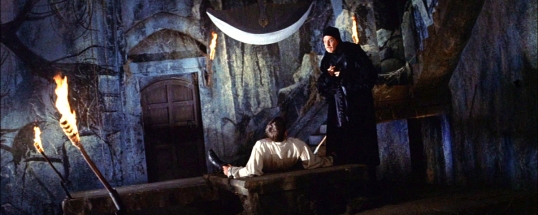
The second of Roger Corman’s Edgar Allan Poe adaptations, 1961’s The Pit and The Pendulum opens in much the same way as The Fall of the House of Usher. A young Englishman (played by John Kerr) rides a horse across a colorful but desolate landscape. A castle sits in the distance.
Of course, as opposed to the 19th Century British setting of The Fall of the House of Usher, The Pit and the Pendulum takes place in 16th Century Spain, at a time when the country was still scarred by the horrors of the Inquisition. And Francis Barnard is not traveling to the castle to see his fiancée but instead, he’s searching for information about the disappearance of his sister, Elizabeth (played by the one and only, Barbara Steele). At the castle, Francis meets Elizabeth’s husband, Nicholas (Vincent Price) and Nicholas’s sister, Catherine (Luana Anders). Nicholas explains that Elizabeth died under mysterious circumstances, while suffering from a rare blood disorder that seemed to quickly sap away her will to live. Nicholas’s best friend, Dr. Leon (Anthony Carbone), explains that Elizabeth died of fright after she locked herself in one of the iron maidens in the castle’s torture chamber….
Oh yes, the castle has a torture chamber. Nicholas’s father was a leader of the Inquisition and he used the castle as a place to conduct his business. Nicholas’s father was a madman who suspected that his wife was cheating on him. One day, while young Nicholas was exploring the torture chamber, he witnessed his father murder both his wife and his brother. Nicholas watched as his mother was entombed alive and ever since, he’s been terrified of the idea of premature burial. In fact, his fear that he may have buried alive Elizabeth while she was still alive is driving him mad. The sudden arrival of the suspicious Francis doesn’t help matters….
The Pit and the Pendulum opens with splashes of color spreading across the screen, a sign that Corman was once again in a pop art state of mind when he directed this film. The Pit and The Pendulum takes everything that worked (and didn’t work) about The Fall of the House of Usher and it turns it all up by a notch or two. The castle is even more gothic. Vincent Price’s Nicholas is even more mentally fragile than his Roderick Usher, though Nicholas is also a quite a bit more sympathetic. If Roderick was a control freak who used his family’s curse as an excuse to embrace his own authoritarian tendencies, Nicholas is just a frail man suffering from PTSD. He’s definitely more of a victim than a victimizer … or, at least, he is at first. Much like Mark Damon is The Fall of the House of the Usher, John Kerr is a bit of a stiff in the role of Francis but it doesn’t matter. Vincent Price is the main attraction here and Corman’s direction shows that he understood that.
And then there’s the Pendulum. It takes a while for the Pendulum and its swinging blade to make an appearance but when it does, it lives up to the hype. The Pendulum swings and Corman goes all out, zooming into Price’s crazed eyes while the Pendulum comes closer and closer to its latest victim. The images are tinted red and green and the Pendulum itself seems to swing in a slow motion, the cinematic equivalent of a nightmare come to life.
The Pit and the Pendulum is a wonderful work of gothic pop art. Featuring Vincent Price at his most wonderfully unhinged, this is a film we should all watch this Halloween.
Pit and the Pendulum (1961, dir by Roger Corman, DP: Floyd Crosby)


 Through the Shattered Lens