Jack Burton (Kurt Russell) is not a complicated person. He drives a truck for a living. He’s loyal to his friends. He likes a good beer and a pretty girl. He tries to do the right thing so when the fiancée of his best friend, Wang Chi (Dennis Dun), is kidnapped, he teams up with Wang to rescue her. And when Jack’s truck gets stolen after he runs over an evil, ancient Chinese sorcerer named Lo Pan (James Hong), Jack just wants to get his truck back. Instead, Jack finds himself in the middle of an ancient battle between good and evil as Lo Pan searches for a green-eyed woman to sacrifice so that he can defeat a curse that was put upon him centuries ago.
Big Trouble In Little China is one of John Carpenter’s most exuberant films. It mixes kung fu action with special effects and a good dose of physical humor from Kurt Russell. When Lisa and I watched this movie a few months ago, Lisa commented that this film was Kurt Russell’s “Bruce Campbell movie,” and the more I think about it, the more I agree. Russell plays Jack with a mix of cockiness and klutziness that should be very familiar to anyone who has followed the adventures of Ash Williams. While Dennis Dun gets to do the typically heroic stuff that you would expect from the star of a movie like this, Russell is just someone who wants to get his truck back and who is consistently weirded-out by the magic around him. Carpenter makes sure that the movie is full of action as he pays tribute to the kung fu films that he watched when he was still in film school. James Hong is great villain and the rest of the cast, including Kim Cattrall as lawyer Gracie Law, all match the energy of Russell, Hong, and Dun. Complete with flying swordsmen, demons with glowing eyes, and a lightning-wielding warrior that probably inspired Mortal Kombat‘s Raiden, Big Trouble In Little China is a fun slice of 80s action.
Unfortunately, the film was not appreciated when it was first released. Stung by the critical reaction to the film, Carpenter abandoned working for the studios and instead become an independent filmmaker. Big Trouble In Little China, however, has stood the test of time and has become better appreciated with age. Today, it’s rightly viewed as one of Carpenter’s best films.
Speilberg had 1941, Lucas had Howard the Duck, and John Carpenter had Prince of Darkness. I’m not going to spend a whole review impugning the Master of Horror, BUT….this was really really really bad. When I was young, several months ago Pre-COVID (more on my COVID experience tomorrow- you’ll love it: there’s sweat, fever, explosive things, and I couldn’t smell any of it!) , I reviewed the Dracula mini-series and now Prince of Darkness (John Carpenter). You’re going to start thinking that I have a vampire fetish, but don’t worry Prince of Darkness not only does not have a Dracula figure; it’s unclear if it has much of anything going on at all. Imagine watching a movie called A Man Named John and John appeared briefly at the very end of the movie with no lines. You’d think that was really weird because you are a smart and discerning film consumer.
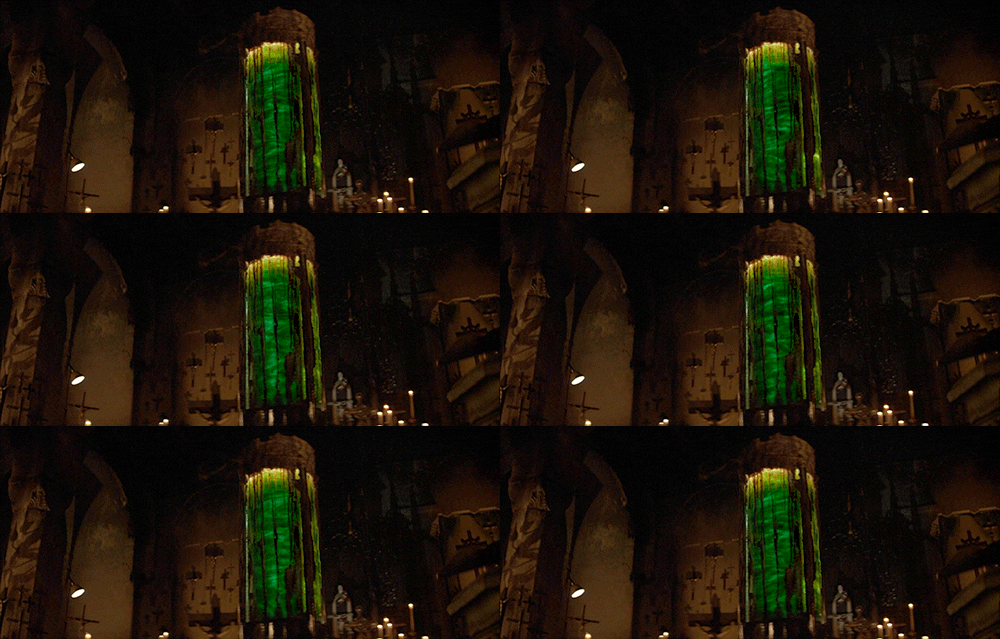
It starts out in Los Angeles in the 1980s, which looks like the LA of today, but it had MUCH less poop everywhere than today. Ahhh, progress. After the first 10 minutes of the film, I can tell you that: the Prince of Darkness is infact and evil alien who lives inside of a swirling Vitamix that looks alot the green juice they try sell me at the gym
– This is what the POD looked like for most of the film :
I always knew that the green juice smoothie was pure evil!!!
Jesus was also an alien and trapped the POD in the Vitamix above; furthermore, the Church was aware of it and kept it quiet in LA because they were Angels fans, a professor of physics at the local community college forced his physicist students to become Ghost Facers in exchange for a higher grade, and homeless people are murderers now. I know these things because I got an expositioning that I shall never ever forget. The students go to see the Eeeeeeevil Vitamix and get sprayed with evil juice and become really lazy zombies. This goes on for a LONG LONG time. You’d think they’d just use tomato juice to get out the evil or some Shout, but maybe Shout wasn’t invented yet?
One of the physicists becomes possessed with POD and tries to reach into a mirror to release her more evil dad. Ok, why not? It’s a family affair, it’s a family affaaaaiiiirr. Just as the evil is about to enter our world one of the physicists pushes the POD into the other dimension through the mirror taking her along with it. This was really dumb. Why not just shove the POD? She didn’t look very big. You’re also physicist; you could’ve made a lever or something. LAZY PHYSICIST!!! You never really got to know the POD or the physicists for that matter. It was like John Carpenter was willed an abandoned building and just wrote a script around that location because why waste a perfectly good abandoned building?!
The biggest puzzle of all was why the main physicist quasi-hero couldn’t get his mustache to line up properly? It’s like the left side of his mustache was trying to escape his face and was willing to leave the right side of the mustache behind- such a cowardly left-side mustache!
Hmmm, I wonder if anyone will notice that I trim my mustache while tilting my head?
Thank you all! You get to learn about COVID tomorrow; it’s pretty pretty…. pretty… gross.
Long before there was Lost, there was Lost Horizon!
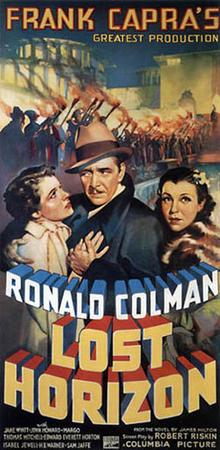
Much like the famous television show, the 1937 film Lost Horizon begins with a group of strangers on an airplane. They’re people from all walks of life, all with their separate hopes and dreams. When the plane crashes, they find themselves stranded in an uncharted land and, much like the Lost castaways, they are shocked to discover that they are not alone. Instead, they’ve found a semi-legendary place that is ruled over by a man who has lived for centuries. Much as in Lost, some want to return to civilization while others want to remain in their new home. Both Lost and Lost Horizon even feature a terminally ill woman who starts to recover her health after becoming stranded.
Of course, in Lost, everyone was just flying from Australia to America. In Lost Horizon, everyone is trying to escape the Chinese revolution. Among the passengers on the plane: diplomat Robert Conway (Ronald Colman), his irresponsible brother, George (John Howard), a con artist named Henry (Thomas Mitchell), a paleontologist (Edward Everett Horton), and the very ill Gloria (Isabel Jewell).
While Lost featured a plane crash on a tropical island, Lost Horizon features a plane crash in the Himalayas. In Lost, the sinister Others sent spies to infiltrate the survivors. In Lost Horizon, the mysterious Chang (H.B. Warner) appears and leads the survivors to a place called Shangri-La.
Shangi-La is a lush and idyllic valley that has somehow flourished in one of the most inhospitable places on Earth. The happy inhabitants inform the survivors that they never get sick and they never fight. They’re led by the High Lama (Sam Jaffe), a philosopher who explains that he is several hundred years old. The valley is full of magic and the Lama tells the survivors that Shangri-La is their new home.
Now, I’ve seen enough horror movies that I spent most of Lost Horizon waiting for the Lama to suddenly reveal that he was a vampire or an alien or something. Whenever anyone in a movie seems to be too good to be true, that usually means that he’s going to end up killing someone about an hour into the story. But that didn’t happen in Lost Horizon. Instead, the Lama is just as wise and benevolent as he claims to be and Shangri-La is as much of a paradise as everyone assumes. I guess we’re just naturally more cynical in 2018 than people were in 1937.
Of course, the Lama isn’t immortal. Not even the magic of Shangri-La can prevent the inevitably of death. The Lama is looking for a successor. Could one of the survivors be that successor? Perhaps. For instance, Robert absolutely loves Shangri-La. Of course, his brother George is determined to return to the real world. He has fallen in love with one of the inhabitants of Shagri-La and plans to take her with him, despite the Lama’s warning about trying to leave…
Frank Capra was a huge fan of James Hilton’s book, Lost Horizon, and he spent three years trying to bring it to the big screen. Based on Capra’s previous box office successes, Colombia’s Harry Cohn gave Capra a budget of $1.25 million to bring his vision of Shangri-La to life. That may not sound like much today but, at the time, that made Lost Horizon the most expensive movie ever made. The production was a notoriously difficult one. (The original actor cast as the elderly Lama was so excited to learn he had been selected that he dropped dead of a heart attack.) As a result of both its ornate sets and Capra’s perfectionism, the film soon went overbudget. When Capra finally delivered a first cut, it was over 6 hours long. Capra eventually managed to edit it down to 210 minutes, just to then have Harry Cohn order another hour taken out of the film. When Lost Horizon was finally released, it had a running time of 132 minutes.
Seen today, Lost Horizon is definitely an uneven work. With all the cutting and editing that went on, it’s hard to guess what Capra’s original vision may have been but, in the final version, much more time is devoted to the characters discussing the philosophy of Shangri-La than to the characters themselves. (It’s always good to see Thomas Mitchell but he really doesn’t get much to do.) Since you never really feel like you know what any of these characters were like outside of Shangi-La, it’s hard to see how being in Shagri-La has changed them. You just have to take their word for it. That said, it’s a visually stunning film. Capra may have gone over budget creating the look of Shangri-La but it was money well-spent. If I ever find myself in a magic village, I hope it looks half as nice as the one in Lost Horizon.
Despite all of the drama that went on behind the scenes and a rather anemic box office reception, Lost Horizon was nominated for best picture. However, it lost to The Life of Emile Zola.
“Say goodbye to classical reality, because our logic collapses on the subatomic level… into ghosts and shadows.”
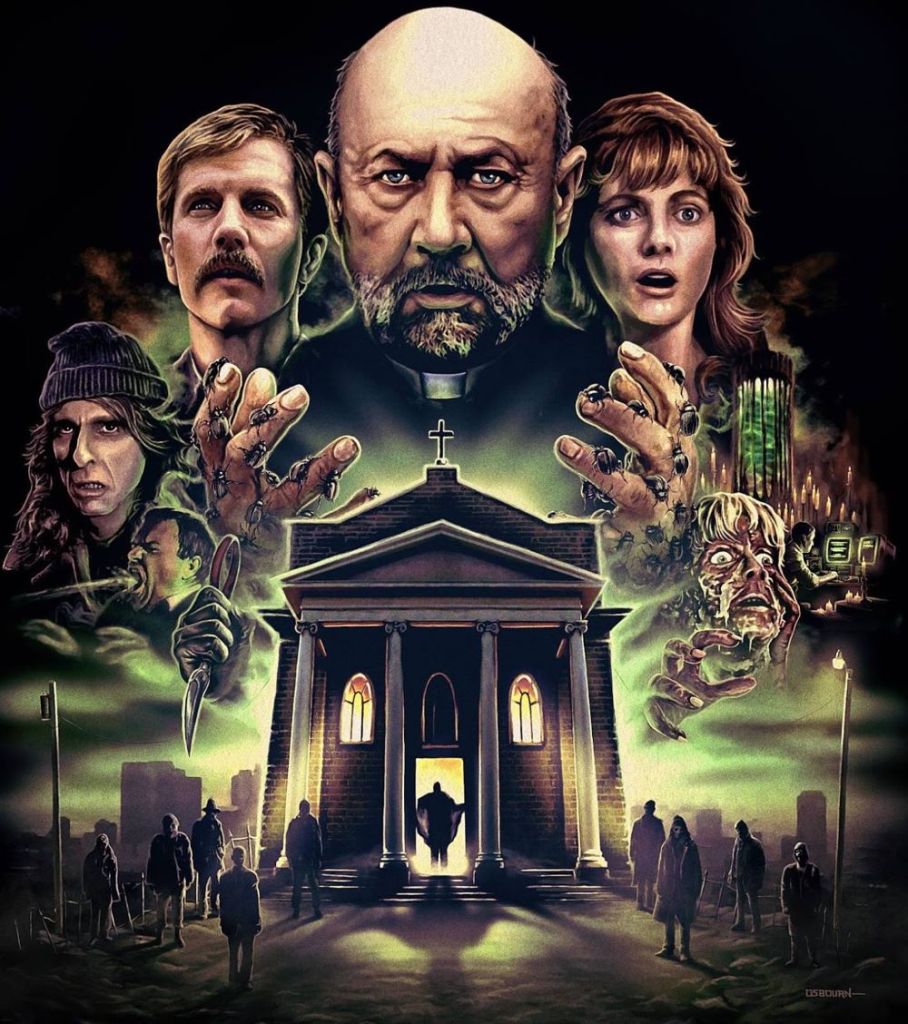
John Carpenter’s Prince of Darkness is a criminally underrated entry in his canon—a blend of philosophical, apocalyptic horror and supernatural mystery that’s as unsettling as it is deliberately strange. Released in 1987, the film often gets eclipsed by Carpenter classics like The Thing and In the Mouth of Madness. Even so, it stands out as a unique organic link between science-driven paranoia and cosmic horror—the sort of film that grows on you as you unravel its layers.
The setup is simple but immediately offbeat: In a derelict Los Angeles church, Father Loomis (Donald Pleasence, always at his nervous best) stumbles on a swirling green cylinder hidden away in the basement. Loneliness and age hang over Loomis as he realizes this is no mere relic but possibly the essence of absolute evil—the literal embodiment of Satan. Sensing he’s in over his head, the priest reaches out to Professor Birack (Victor Wong), a physicist whose rational mindset is quickly tested by the uncanny. Birack arrives with a diverse team of grad students and lab techs, each bringing curiosity, skepticism, and just enough personality to keep things lively.
What starts as an academic investigation quickly goes off the rails. Strange, shared dreams trouble the researchers—fragmented transmissions from the future, warning of disaster in unsettling, VHS-glitch style. Meanwhile, the area outside the church transforms into a kind of urban wasteland: homeless people, gripped by an unseen force, stumble with zombie-like intent, trapping the group inside. Inside, members fall prey to unsettling phenomena, from unexplained possession to increasingly grotesque violence. There’s a sense that the evil in the cylinder isn’t content to simply stay put—and the combination of supernatural implication and scientific uncertainty gives everything a persistent, gnawing tension.
Carpenter directs the film with measured, stifling precision. His color palette—rotting yellows, bruised greens, washed-out sunlight—creates a perpetually uneasy mood. He uses slow tracking shots and carefully composed frames to ratchet up suspense, and the score (co-composed with Alan Howarth) pulses with ominous synths that buzz beneath all the dialogue, making even the film’s quieter moments feel restless and charged with threat. Compared to the gooey spectacle of The Thing, the terror in Prince of Darkness is more metaphysical—less visible monsters, more eroding reality.
Sound and image work together to keep the audience on edge: moments of unsettling silence are punctuated by visual oddities, like swarms of bugs or the warped geometry of the church’s shadows. The group’s scientific attempts to decode the evil—a jumble of quantum theory, apocalyptic Christian lore, and unsettling mathematics—do more to ramp up anxiety than offer answers. Carpenter seems to delight in ambiguity; the revelations never clarify so much as deepen the void, giving shape to a primordial kind of fear.
The film’s most iconic device is its recurring nightmare sequence, where the group—cut off from the world—witnesses a cryptic, shadowy figure emerging from the church, broadcast as a tachyon transmission from the future. It’s classic Carpenter: deeply unsettling, oddly hypnotic, and open to any number of interpretations. The blending of science fiction and theological horror feels fresh and ambitious, and it’s fair to say these sequences alone have ironically kept the film alive in horror culture discussions and remixes.
The cast, featuring Pleasence and Wong, manages the film’s shifts in tone—moving from banter about theoretical physics to genuine terror with surprising ease. The grad students are likable enough for you to root for, especially Lisa Blount and Jameson Parker, who carry the emotional brunt as things collapse. Alice Cooper’s cameo as a silent, menacing street dweller further anchors the film’s reputation for “unexpected creepy” in the best way possible.
While there are flashes of gore—possessions, injuries, even some memorable stabbings—Carpenter resists making violence the centerpiece. The real horror here is psychological: paranoia, loss of agency, and the collapse of foundational beliefs. Where The Thing was about trusting (or not trusting) your friends, Prince of Darkness is about grappling with a world where even faith and science seem powerless and interchangeable in the face of the unknown.
Thematically, this is Carpenter at his most cerebral and bleak. The notion that neither faith nor science can adequately tackle the unfathomable echoes Lovecraft, yet Carpenter grounds it all in urban decay and deadpan dialogue rather than Gothic flourish. The questions get bigger—what good is faith if truth is poisonous, and what does science matter against a force older than logic? Dialogue about quantum uncertainty and theological paradoxes isn’t there to solve anything, but to make everything less secure.
If the film has a flaw, it’s that its pacing feels deliberately patient—some might say slow. Tension accumulates gradually, and you’re invited to sit in the discomfort as the group loses sleep, loses one another, and loses touch with reality. As the stakes escalate, the line between dream and waking life shreds, leading to an ending that’s haunting, ambiguous, and deeply open-ended. There’s no neat wrap-up or cathartic victory—only trauma, unsolved terror, and a lingering sense that evil never really left, just waited.
It’s this refusal to explain or comfort that gives Prince of Darkness its lasting cult appeal. Carpenter puts cosmic pessimism front and center: knowledge itself stands as a kind of curse, and both faith and reason bend beneath the weight of mystery. Rather than offer solutions, the movie warns about the dangers of peeling back reality’s surface—a theme that’s only grown more unsettling in the years since it was made.
Watching Prince of Darkness now, the film may not fit everyone’s idea of a fun Friday-night scarefest. But if you want horror that’s slow, dense, and sticks with you, this is essential viewing. Carpenter delivers a bleak, hypnotic nightmare about what happens when explanations fail—when the universe itself seems ready to swallow us whole. Whether you’re a die-hard genre fan or someone looking for something different, Prince of Darkness is cult horror at its most unshakable—proof that the scariest stories are often those that leave their deepest secrets unexplained.
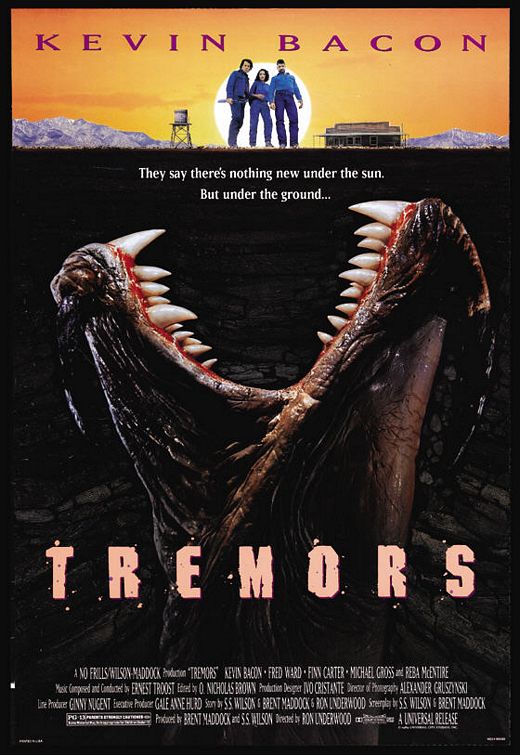
I just happened to catch one of my favorite creature-feature films on cable this morning and I had forgotten just how much fun this film was and is to still watch. I am talking about 1990’s horror-comedy Tremors by director Ron Underwood (who would follow it up with the very successful and funny City Slickers a year later) and starring the comedic duo of Kevin Bacon and Fred Ward. I was still in high school when I saw this in the theaters and even then this film had me from the get-go.
Tremors is a throwback to all the Saturday matinee creature-features and monster mash films that were huge during the 50’s and through the 60’s. It’s plot was simple enough that even a little kid could keep up with what was going on. We had a small, rundown mining town in the middle of nowhere (it always happens to be one of those small desert or valley towns which dotted the landscape once the national interstate was completed) whose fortunes have seen better days, hell better decades from the looks of it. The town has its cast of characters with Fred Ward and Kevin Bacon’s roles of Earl and Val the two main leads. We even get long-time genre actor Victor Wong in a supporting role as the town’s only store owner and also it’s two-bit hustler always looking to find a new way to make a buck. One of the funniest roles goes to Michael Gross (the dad in the 80’s hit family show Family Ties) who, with Reba McEntire as his wife, play some crazy-ass survivalists who try fighting off the creatures of this feature the giant, underground worms the survivors have dubbed “Graboids” for their propensity to grab people and animals with prehensile tentacle like appendages which shoot out from their mouths.
No, Tremors wasn’t some live-action version of the ever popular hentai, though I wouldn’t be surprised if the writers of the film were subconsconsciously influenced by them. What the film ended up being was one of the funnier horror comedies which ended the 80’s and announced the 90’s. It was also one of the last few great non-CGI creature features to come out of Hollywood. The Graboids were definitely animatronic and rubber-suited props, but they moved and looked real that one didn’t question whether they were real or not. It would be these creatures who would end up the stars and highlight of this film (the ensemble cast a good second) and follow-up sequels would and could never live up to it. It didn’t help that the sequels ended up using too much CGI which just ruined the illusion built-up by the original.
So, if you ever feel bored and suddenly see that one of the many basic cable channels are showing this little horror-comedy gem from the 1990’s I recommend you watch it with snacks and drinks on hand. There are many ways to make one stop being bored by watching something on the “Tele” and I say Tremors is one of those ways.
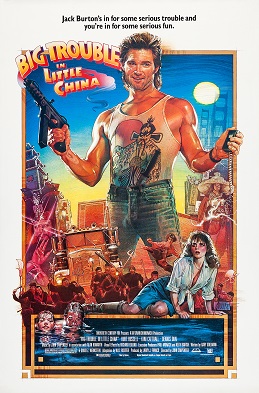 Jack Burton (Kurt Russell) is not a complicated person. He drives a truck for a living. He’s loyal to his friends. He likes a good beer and a pretty girl. He tries to do the right thing so when the fiancée of his best friend, Wang Chi (Dennis Dun), is kidnapped, he teams up with Wang to rescue her. And when Jack’s truck gets stolen after he runs over an evil, ancient Chinese sorcerer named Lo Pan (James Hong), Jack just wants to get his truck back. Instead, Jack finds himself in the middle of an ancient battle between good and evil as Lo Pan searches for a green-eyed woman to sacrifice so that he can defeat a curse that was put upon him centuries ago.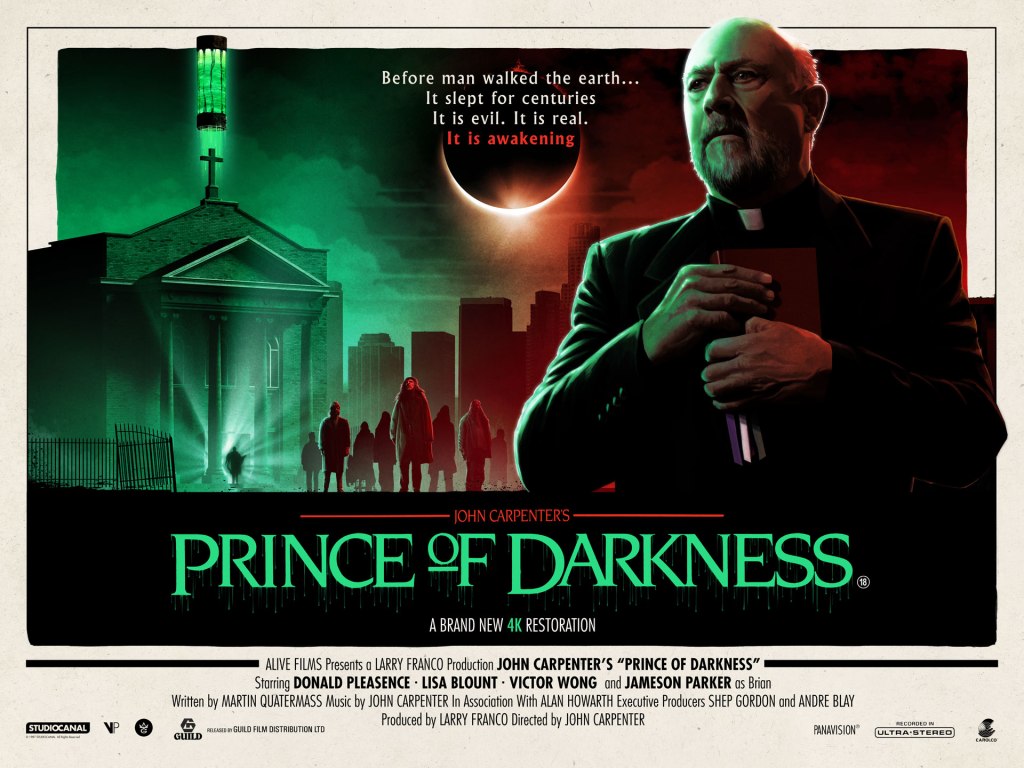

 Through the Shattered Lens