The Unnominated #15: Touch of Evil (dir by Orson Welles)


Though the Academy of Motion Picture Arts and Sciences claim that the Oscars honor the best of the year, we all know that there are always worthy films and performances that end up getting overlooked.  Sometimes, it’s because the competition too fierce.  Sometimes, it’s because the film itself was too controversial.  Often, it’s just a case of a film’s quality not being fully recognized until years after its initial released.  This series of reviews takes a look at the films and performances that should have been nominated but were, for whatever reason, overlooked.  These are the Unnominated.

I come here to defend Charlton Heston.

1994’s Ed Wood is a great film that has one unfortunate line.  Towards the end of the film, director Ed Wood (Johnny Depp) meets his hero, Orson Welles (Vincent D’Onoforio), in a bar.  They talk about the difficulties of directing a film.  Wood talks about the trouble that he’s having with Plan 9 From Outer Space.  Welles says that he can understand what Wood is going through because the studio is forcing him to cast Charlton Heston as a Mexican in his next movie.

And look, I get it.  It is true that Charlton Heston does play a Mexican prosecutor named Mike Vargas in Welles’s 1958 film, Touch of Evil.  And it is true that Heston is not the most convincing Mexican to ever appear in a film.  And I understand that there are people who enjoy taking cheap shots at Charlton Heston because he did have a tendency to come across as being a bit full of himself and he was a conservative in a industry dominated by Leftists. There are people who actually think Michael Moore doesn’t come across like a self-righteous prick when he confronts Heaton in Bowling for Columbine.  I get the joke.
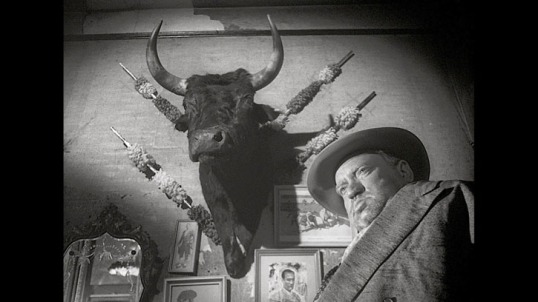
But it’s not true and it’s not fair.  When Touch of Evil was first put into production by Universal, Welles was not hired to direct.  He was hired to play Hank Quinlan, the formerly honest cop with a habit of planting evidence on those who he believed to be guilty.  When Charlton Heston was offered the role of Vargas, he asked who had been hired to direct.  When he was told that a director hadn’t been selected, Heston was the one who suggested Welles be given the job.  When, as often happened with Welles’s film, the studio decided to take the film out of Welles’s hands, Heston argued for Welles’s vision while Welles was off trying to set up his long-dreamed of film of Don Quixote.  Say what you will about Charlton Heston’s career, he fought for Orson Welles, just as he later fought for Sam Peckinpah during the making of Major Dundee.  Heston may not have agreed with either Welles or Peckinpah politically but he fought for them when few people were willing to do so.
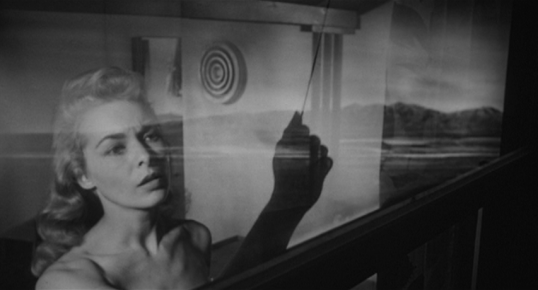
That Touch of Evil is a brilliant film is pretty much entirely due to Welles’s directorial vision.  The story is pure pulp.  While investigating the murder of an American businessman in Mexico, Vargas comes to believe that Quinlan is attempting to frame a young Mexican for the crime.  While Vargas watches Quinlan, his wife Susie (Janet Leigh) is menaced by the crime lord Joe Grandi (Akim Tamiroff), who has his own issues with both Vargas and Quinlan.  The plot may be the stuff of a B-programmer but, as directed by Welles, Touch of Evil plays out like a surreal nightmare, a journey into the heart of darkness that is full of eccentric characters, shadowy images, memorably askew camera angles, and lively dialogue.  Welles and cinematographer Russell Metty create a world that feels alien despite being familiar.  Just as he did with Gregg Toland in Citizen Kane, Welles shapes a film that shows us what’s happening in the shadows that most people try to ignore.

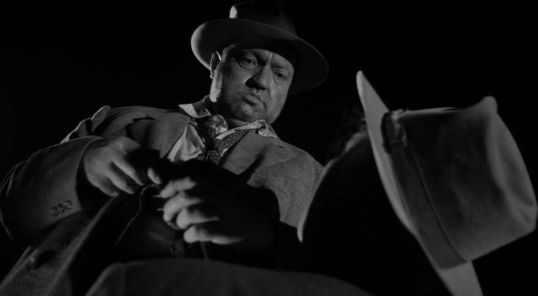
There’s really not a boring character to be found in Touch of Evil and the cast is full of old colleagues and friends of Welles.  Marlene Dietrich shows up as Quinlan’s former lover.  Mercedes McCambridge plays a leather-clad gang leader.  Dennis Weaver is the creepy owner of a remote motel.  (Two years before Psycho, Touch of Evil featured Janet Leigh being menaced in a motel.  Mort Mills, who played Psycho’s frightening highway patrolman, plays a member of law enforcement here as well.)  Zsa Zsa Gabor shows up for a few brief seconds and it makes a strange sort of sense.  Why shouldn’t she be here?  Everyone else is.  Joseph Cotten plays a coroner.  Ray Collins plays a local official.   In the film’s skewered world, Charlton Heston as Mike Vargas works.  His upright performance grounds this film and keeps it from getting buried in its own idiosyncrasies.   Big personalites are everywhere and yet the film is stolen by Joseph Calleia, playing Quinlan’s quiet but observant partner.  Calleia’s performance is the heart of the film.

Touch of Evil was not nominated for a single Oscar and that’s not surprising.  It’s not really the type of film that was noticed by the Academy in the 50s.  It was too pulpy and surreal and, with its story of a crooked cop framing someone who might very well be guilty anyway, it was probably too subversive for the Academy of the 1950s.  It would take a while for Touch of Evil to be recognized for being the noir masterpiece that it is.  In a perfect world, Welles would have been nominated for directing and for his larger-than-life performance as Quinlan.  Joseph Calleia would have been nominated for Supporting Actor and perhaps both Janet Leigh and Marlene Dietrtich would have been mentioned for Supporting Actress.  That didn’t happen but it would have been nice if it had.
Previous entries in The Unnominated:

  1. Auto Focus 
  2. Star 80
  3. Monty Python and The Holy Grail
  4. Johnny Got His Gun
  5. Saint Jack
  6. Office Space
  7. Play Misty For Me
  8. The Long Riders
  9. Mean Streets
  10. The Long Goodbye
  11. The General
  12. Tombstone
  13. Heat
  14. Kansas City Bomber

Film Review: The FBI Story (dir by Mervyn LeRoy)


In 1959’s The FBI Story, veteran FBI agent Chip Hardesty (James Stewart) delivers a lecture to a group of new FBI recruits.  He tells them the story of both the FBI and his time as a member of the agency.  Somewhat implausibly, it turns out that Chip was involved with nearly every major FBI operation, as we discover while watching this flashback-filled, episodic film.

Battling the Ku Klux Klan in the Deep South?  Chip was there.

Investigating the Oklahoma Indian murders?  Chip was not only there but he was also the one who solved them through handwriting analysis!  (Decades later, the crimes and the investigation would serve as the basis of Martin Scorsese’s Killers of the Flower Moon.)

During the public enemy era, Chip was there.  He was there when Baby Face Nelson killed several unarmed FBI agents, including Chip’s best friend (Murray Hamilton).  He was there when John Dillinger was gunned down in Chicago.  He was there when my distant ancestor “Pretty Boy” Floyd was killed in Ohio.  He wasn’t there when J. Edgar Hoover personally arrested Alvin Karpis or when “Machine Gun” Kelly said, “Don’t shoot, G-Man!” but Chip still makes sure to tell the recruits about it.  He also talks about the gunfight that killed Ma Barker, presented her as being a machine gun-toting madwoman.

Chip investigates subversives during World War II and helped to round up Americans of German and Japanese descent during the internment era.  (Chip insists that they weren’t rounded up because of their ancestry but because the FBI had gotten reports that they might be disloyal.)   When the war wraps up, Chip turns his attention to fighting the international communist conspiracy and good for him.  (Communism sucks!)

Strangely enough, it appears that Chip also tells the recruits a good deal about his personal life because we certainly do see a lot of it.  Chip marries a librarian named Lucy (Vera Miles), who struggles with the demands of being an FBI agent’s wife but who ultimately accepts that Chip has to do his duty.  Sometimes, Lucy wants Chip to quit and sometimes, Chip is tempted to get out.  But they always remember that Chip and the FBI have a job to do.  They raise a family.  They lose a son at Iwo Jima.  Their faith in God and country remains undiminished.

The FBI Story was made with the full cooperation of the FBI, with J. Edgar Hoover personally approving the script and making suggestions.  Hoover even appeared as himself in the film, accepting a report about an airplane bombing with a grim look on his face.  At one point, Chip is prepared to quit the FBI until he hears a speech from Hoover and he’s so inspired that he keeps his resignation letter tucked away in his suit pocket.  Since this film came out in 1959, there’s no details of the FBI tapping the phones of Martin Luther King or Hoover collecting dirt on his political opponents.  Instead, The FBI Story is pure propaganda, your reminder that law enforcement never makes mistakes and civil liberties can be always be sacrificed for the greater good.

It’s simplistic propaganda and it’s overlong and it promotes a few falsehoods as facts.  (Despite what the film says, Pretty Boy Floyd had nothing to do with the Kansas City Massacre and most historians agree that Ma Barker was not the criminal mastermind that Hoover made her out to be after she was caught in the crossfire between her sons and law enforcement.)  The film rather casually dismisses the concern over the World War II internments of American citizens.  To me, something like that is a big deal but the film insists to us that it was all blown out of proportion.  That’s the one moment when not even the film itself seems to be totally sold on what it’s selling.

Fortunately, the film stars the ever-reliable James Stewart, who brings his natural mix of charm and gravity to the role of Chip Hardesty.  Stewart was a bit too old to play Chip as a bumbling young man in the early part of the film but, as the character grows up, so does Stewart’s performance.  The scene where he and Vera Miles learn that his son has been killed in combat feels like it’s from a different and far better movie.  I guess my point here is that James Stewart was one of those actors who could make even questionable material watchable and that’s certainly what he does with The FBI Story.  The FBI, at a time when Hoover was aging and the excesses of the McCarthy era had left many Americans uneasy about the government, decides to borrow James Stewart’s credibility to boost their own.  You may not like the FBI but how can you not love Jimmy Stewart?

The FBI Story came out the same year as one of Stewart’s best films, Anatomy of a Murder, a film that was a complicated as The FBI Story was simplistic.  Stewart gives one of his best performances in Anatomy of a Murder, playing the type of character that Chip Hardesty probably wouldn’t want to have much to do with.  With these two films, Stewart showed us both sides of the American justice system, the men who are tasked with enforcing the law and, even more importantly, the men who are tasked with making sure that law was enforced fairly.  Whichever side your on, you have to be happy to have Jimmy Stewart there.