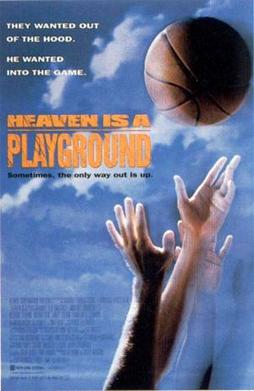
Heaven Is A Playground (1991, directed by Randall Fried)


In the projects of Chicago, Byron Harper (Michael Warren) runs a nonprofit basketball farming system and helps black kids, many of whom would have no other prospects other than a live of poverty or crime, to find a home in college basketball programs.  Byron is passionate about what he does but he’s also a stern taskmaster and not quick to forgive.  When one of his best players, Casey (Nigel Miguel), developed a drinking problem, Byron kicked him off his team.  Byron’s main concern is his stepson, Truth (Victor Love).  Truth is a great basketball player but also has an addiction to cocaine and an attitude problem.

For reasons that are never made clear, white lawyer Zack Telander (D.B. Sweeney) shows up on the court and says he wants to play one-on-one with Byron.  Everyone assumes that Zack is a drug dealer and they tell him to get lost.  But when one of the players is shot, Zack is the only person at the court who has a car.  Zack rushes the player to the hospital and he wins Byron’s trust.  Byron needs Zack to look over a professional contract that is being offered to Truth by sleazy sports agent David Racine (Richard Jordan).

For reasons that are again never made clear, Byron tells Zack to coach some of the more troubled players on the court, including Casey.  At first, Zack isn’t much of a coach but eventually, he gets the players to trust him and start playing like a team.  He also tries to get burned-out Matthew Lockhart (Bo Kimble) to start playing the game again.

Heaven Is A Playground is a mess of a movie that doesn’t really seem to be sure what it wants to say about basketball, the projects, or race relations.  The main problem is that a lot of the decisions made by Byron and Zack don’t make any sort of logical sense.  Moments of broad comedy are mixed with moments of high drama and it makes for an unconvincing and overly melodramatic sports movie.

Heaven Is A Playground had a long pre-production phase.  At one point, a young Michael Jordan agreed to play the role of Matthew Lockhart.  By the time the film actually went into production, Jordan was a superstar and had neither the time (nor, probably, the desire) to co-star in a low-budget sports movie.  After the movie flopped, director Randall Fried sued Jordan for breach-of-contract, claiming that he caused the film’s box office failure by refusing to appear in it and, as a result, Fried’s directorial career stalled.  In the suit, Fried claimed that he was on the verge of being “the next Steven Spielberg” until Jordan refused to do his film.  The jury found Jordan not liable and awarded him $50,000.

(Trying to sue Michael Jordan was a terrible idea in 1998 and it’s probably still a terrible idea today.  People love Jordan!)

Personally, I have to say that Mike made the right decision.
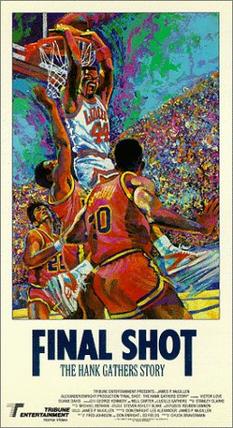
Final Shot: The Hank Gathers Story (1992, directed by Charles Braverman)


Hank Gathers is one of the most intriguing “what if?” stories of modern basketball.  Growing up in the Raymond Rosen Projects of Philadelphia, Hank stayed out of trouble by playing basketball.  An outstanding high school player, he went first to USC before transferring to Loyola Marymount.  Along with his friend Bo Kimble, he was a stand-out player at Loyola.  However, on March 4th, 1990, the 23 year-old Gathers collapsed during a game with Portland and died on the court, the victim of an abnormal heartbeat.  His last recorded words were, “I don’t want to lay down!”  Gathers set records in college.  Would he have done the same in the NBA?  Sadly, we’ll never know but he definitely had the talent and the ability to be one of the best.

Final Shot is a by-the-numbers biopic of Hank Gathers, focusing on his life in the projects and his friendship with Bo Kimble.  Victor Love plays Gathers while Kimble is played by Duane Davis and they both give good performances.  Their friendship feels real and when Hank helps Bo recover from a broken leg and when Bo worries about Hank’s recently diagnosed heart condition, the scenes are sincere in a way that lifts the film above the normal biopic clichés.  Nell Carter and George Kennedy both have good roles as well, Carter as Hank’s mother and Kennedy as Hank’s high school coach and mentor.  This is the type of role that Kennedy could have played in his sleep so I appreciated that he actually gave a believable performance.

Final Shot is a made-for-TV movie so it doesn’t dig too deeply into Gathers’s life outside of basketball, the way that college treat their athletes, or the systems that made playing basketball Hank’s only way of escaping the projects.  For what it is, though, it’s a fitting tribute.

Retro Television Review: Miami Vice 3.8 “Better Living Through Chemistry”


Welcome to Retro Television Reviews, a feature where we review some of our favorite and least favorite shows of the past!  On Mondays, I will be reviewing Miami Vice, which ran on NBC from 1984 to 1989.  The entire show can be purchased on Prime!

This week, Tubbs’s cover is blown …. again.

Episode 3.8 “Better Living Through Chemistry”

(Dir by Leon Ichaso, originally aired on November 14th, 1986)

While working undercover as Ricardo Cooper (and yes, I’m pretty sure I heard the fake Caribbean accent at the start of this episode), Tubbs is stunned to discover that his former partner from New York, Clarence Batisse (Victor Love), is now working as a DJ at a club owned by a local drug lord.

Tubbs is even more shocked when Clarence announces to the entire club that “Ricardo Cooper” is actually an undercover cop.

Somehow, and it’s not really made clear how, Tubbs is able to escape the club without getting shot.  Sonny also somehow manages to convince the drug dealers that he didn’t know that Tubbs was actually a cop.  So, Sonny “Burnett” continues to play his part in the undercover operation while Tubbs tries to figure out why Clarence blew his cover.

Clarence is bitter.  His career with the NYPD came crashing down when he shot a bookie during a raid.  Clarence claimed the bookie had a gun but the gun was never found.  Tubbs didn’t see the gun and refused to lie for his partner.  However, when Tubbs realizes that Clarence has been reduce to working for a drug lord, he sets about to try to clear Clarence’s name.

Meanwhile, informant Izzy (Martin Ferrero) has been hired to babysit the drug lord’s chemist, nerdy Henry Luna (Nelson Villamor).  Luna has developed cocaine that is so pure that most people can’t even survive doing one hit.  The Vice squad know that, if the cocaine hits the streets, it will lead to a gang war.  But then Luna does a hit of his own cocaine and falls over dead.

Tubbs does manage to clear Clarence’s name but it doesn’t matter.  Clarence has gone so far over to the dark side that he sets up Tubbs and Crockett to be attacked in a surprise raid.  Tubbs and Crockett kill the bad guys and, at the end of the episode, Tubbs takes Clarence into custody.  A good cop has gone very bad….

This was a weird episode.  It was technically a Tubbs episode but it seemed like the majority of the running time was taken up with Izzy babysitting the chemist.  Izzy is one of those supporting characters who works best in small amounts.  Building almost an entire episode around him just serves to highlight that there’s really not much depth to Izzy as a character.  He’s cowardly and he talks a lot.  It’s funny until it isn’t, which is another way of saying that it gets old after ten minutes.  The comedy of Izzy and the Chermist didn’t really fit in with the scenes of Tubbs trying to clear his former partner’s name.  The tone of the episode was all over the place, making this a rare Miami Vice episode that didn’t seem to know what it wanted to be.

On the plus side, the drug lord owned a club that was full of motorcycles and where Peter Gabriel’s Sledgehammer was the most popular song.  There was one very exciting shoot-out at the club.  That was a good thing.  Otherwise, this was Miami Vice at its least effective.