The TSL’s Horror Grindhouse: The House on Skull Mountain (dir by Ron Honthaner)


Before I say anything else about 1974’s The House on Skull Mountain, I just want to say how much I love the film’s poster.  Seriously, that poster is everything that you could hope for from an exploitation film print ad.  Everything about it, from the lightning to the giant skull to the mansion to the unfortunate person plunging to her doom is pure perfection.  I especially like the question at the bottom of the poster: “Which of these five will come down alive?”

And, to be honest, it’s actually a fairly honest poster.  The majority of the film really does take place in a house on a mountain that has features that look like a skull.  Of course, the skull in the movie is not quite as prominent as the one in the poster.  The house actually does look a lot like the one on the poster.  There’s also a lot of lightning in the movie.  It’s the same basic lightning stock footage that has appeared in almost every film ever produced by Roger Corman.  In The House on Skull Mountain, it’s used as a transitional device.  “Is that scene over?” you might find yourself wondering.  Well, don’t worry.  The lightning stock footage will let you know.

One reason that I’m focusing on the poster is because the film itself is kind of anemic.  In the movie, the house on top of Skull Mountains belongs to Pauline Christophe, a direct descendant of the first king of Haiti.  Upon her death, Pauline’s four great granchildren are invited to hear the reading of her will.  None of the four have ever met Pauline or each other.  Phillippe (Mike Evans) is an alcoholic who says stuff like, “Baby, what’s the scene?”  Harriet (Xernona Clayton) is fragile and nervous and it certainly doesn’t help her nerves when she briefly sees a hooded skeleton sitting a few rows in front of her on her flight to Atlanta.  Lorena (Janee Michelle) drives too fast but is otherwise responsible and mature.  And then there’s Dr. Andrew Cunningham (Victor French), who shows up late and turns out to be white.

“You’re the wrong color!” Phillippe snaps at him.

Andrew shrugs and says that he’ll explain it all later.  He does eventually tell a story about being abandoned on the front steps of an orphanage but the dialogue is so awkwardly-written and delivered that I’m not sure if he is being serious or if he is poking fun at Phillippe’s shock.

Because Andrew showed up late, the four of them have to stay in the house for a week until Pauline’s lawyer returns to read the will.  Keeping them company is the butler, Thomas (Jean Durand), and Loutte (Ella Woods) the maid.

And that’s not all!  It also appears that there is a robed skeleton wandering around the house as well!  Add to that, the relatives start having visions.  One falls down an elevator shaft.  Another has a heart attack after someone stabs doll with a pin.  Could all of this have something to do with the fact that Pauline and her servants were all dedicated practitioners of voodoo?

Sad to say but the House on Skull Mountain is pretty dull.  The film does provide a brief history lesson concerning how Haiti was the only nation to be formed as a result of a slave rebellion and how the real-life Henri Christophe went from being a slave to a king but the film doesn’t really do much with the information.  It’s tempting to look for some sort of subtext in the film’s plot but it’s really just not there.  Much like Andrew being the only white member of a historically important black family, the history of Haiti and the actual origins of Haitian voodoo are elements that are brought up and then quickly abandoned.   There is one good and lengthy voodoo ceremony but otherwise, the whole film is almost all filler.  When it’s not showing us the same lighting stock footage, it’s showing us Andrew and Lorena wandering around Atlanta.

But seriously, that movie poster is to die for.

A Movie A Day #244: Death of a Gunfighter (1969, directed by Allen Smithee)


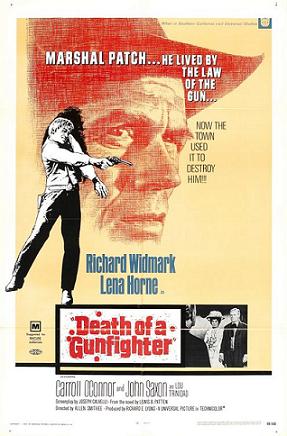
At the turn of the 20th century, the mayor and the business community of Cottonwood Springs, Texas are determined to bring their small town into the modern era.  The Mayor (Larry Gates) has even purchased one of those newfangled automobiles that have been taking the country by storm.  However, the marshal of Cottonwood Spings, Frank Patch (Richard Widmark), is considered to be an embarrassing relic of the past.  Patch has served as marshal for 20 years but now, his old west style of justice is seen as being detrimental to the town’s development.  When Patch shoots a drunk in self-defense, the town leaders use it as an excuse to demand Patch’s resignation.  When Patch refuses to quit and points out that he knows all of the secrets of what everyone did before they became respectable, the business community responds by bringing in their own gunfighters to kill the old marshal.
Death of a Gunfighter is historically significant because it was the very first film to ever be credited to Allen Smithee.  The movie was actually started by TV director Robert Totten and, after Widmark demanded that Totten be fired, completed by the legendary Don Siegel.  Since Totten worked for 25 days on the film while Siegel was only on set for 9, Siegel refused to take credit for the film.  When Widmark protested against Totten receiving credit, the Director’s Guild of America compromised by allowing the film to be credited to the fictitious Allen Smithee.

In the years after the release of Death of a Gunfighter, the Allen (or, more often, Alan) Smithee name would be used for films on which the director felt that he had not been allowed to exercise creative control over the final product.  The Smithee credit became associated with bad films like The O.J. Simpson Story and Let’s Get Harry which makes it ironic that Death of a Gunfighter is not bad at all.  It’s an elegiac and intelligent film about the death of the old west and the coming of the modern era.  It also features not only one of Richard Widmark’s best performances but an interracial love story between the marshal and a brothel madame played by Lena Horne.  The supporting cast is full of familiar western actors, with Royal Dano, Harry Carey, Jr., Larry Gates, Dub Taylor, and Kent Smith all making an impression.  Even the great John Saxon has a small role.  Though it may be best known for its “director,” Death of a Gunfighter is a film that will be enjoyed by any good western fan.

A Movie A Day #170: Chato’s Land (1972, directed by Michael Winner)


Don’t mess with Charles Bronson.

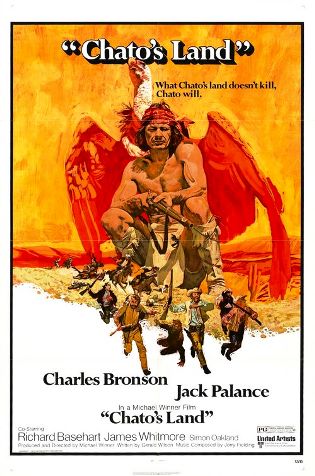
That’s the main lesson that can be taken away from Chato’s Land.  In this western, Bronson plays Chato, an Apache who enters the wrong saloon and is forced to shoot a racist sheriff in self-defense.  Former Confederate Captain Quincey Whitemore (Jack Palance) forms a posse to track Chato down but soon discovers that his posse is not made up of the best and brightest.  Instead, most of them are sadistic racists who just want to kill Apaches.  Despite Whitemore’s efforts to stop them, the posse rapes Chato’s wife and kills his best friend.  Chato trades his white man’s clothes for a loin cloth and sets out for revenge.

Chato’s Land is historically significant because it was the first of many films that Charles Bronson made with Michael Winner.  The most famous Bronson/Winner collaboration was Death Wish, which also featured Charles Bronson as a man who seeks revenge after his wife is raped.  What is surprising about Chato’s Land is how little screen time Bronson actually has.  Most the film is spent with the posse, which is full of familiar faces (Richard Jordan, Simon Oakland, Victor French, Ralph Waite, and James Whitmore all report for duty).  It actually works to the film’s advantage, making Bronson even more intimidating than usual.  There’s never any doubt that Chato is going to kill every member of the posse but since almost every member of the posse is loathsome, that’s not a problem.

It’s possible that Chato’s Land was meant to be an allegory for the Vietnam War, which is probably giving Michael Winner too much credit.  (In an interview, the author of Death Wish, Brian Garfield, once shared an anecdote about Winner inserting a shot of three nuns into Death Wish and bragging about how the shot was meaningless but that it would fool the critics into thinking he was making a grand statement about something.)  Like most of Winner’s films, Chato’s Land is good but not great.  There are parts of the movie that drag and Jack Palance and Charles Bronson don’t get to share any big scenes together, which seems like a missed opportunity.  Bronson, who was always underrated as an actor, gives one of his better performances as Chato.  Chato does not say much but Bronson could do more with one glare than most actors could do with a monologue.  In Europe, Bronson was known as Il Brutto and Chato’s Land features him at his most brutal.

This Eagle Doesn’t Fly: FLAP (Warner Brothers 1970)


gary loggins's avatarcracked rear viewer

flap1

FLAP is an attempt by director Sir Carol Reed to jump on the late 60’s/early70’s “relevance” bandwagon by depicting the modern-day mistreatment of the American Indian. It’s a seriocomic character study that struggles to find it’s identity, and as a result fails at both comedy and drama.

FLAP is Flapping Eagle, an ex-soldier living back on the reservation who’s “pissed off at everybody”. He’s a hard drinking man, as is just about all the Indians here, feeding into the stereotypical “drunken Indian” image. Flap’s had enough of the noise coming from construction workers building a highway project right next to the rez, and causes a fracas between the hardhats and the Indians, damaging a bulldozer in the process. Native Wounded Bear (who has a correspondence school law degree) points out the highway is gong through sacred burial ground, which turns out not to be the case. Everyone’s up in arms, especially local…

View original post 461 more words

Film Review: There Was a Crooked Man… (1970, directed by Joseph L. Mankiewicz)


Crooked_manI first saw There Was A Crooked Man as a part of TCM’s tribute to the great actor Warren Oates.  Warren Oates was rarely cast in the lead but, as a character actor, he appeared in supporting roles in several great films.  Unfortunately, There Was A Crooked Man is not one of them.

Directed by Joseph L. Mankiewicz and written by the screenwriting team of Robert Benton and David Newman (best known for writing Bonnie and Clyde), There Was A Crooked Man is meant to be a comedic western.  Outlaw Paris Pittman (Kirk Douglas) is arrested while visiting a bordello.  Paris is sent to an Arizona prison, where everyone tries to get him to reveal where he has hidden the stash from a $500,000 robbery.  Pittman uses everyone’s greed to manipulate them into helping him attempt to escape.  Standing in Pittman’s way is the new warden, a liberal reformer played by Henry Fonda.

There Was A Crooked Man is a long movie that features a lot of familiar faces.  Burgess Meredith plays The Missouri Kid, who has been in prison for so long that he is now an old man.  Hume Cronyn and John Randolph play a bickering gay couple who eventually become a part of Pittman’s scheme to escape.  Even Alan Hale, the skipper from Gilligan’s Island, shows up as a guard named Tobaccy!  There Was A Crooked Man is a big movie but it’s also not a very good one.  It’s not serious enough to be a good drama but it’s not funny enough to be a good comedy either.

At least the movie has Warren Oates going for it.  Oates plays Harry Moon, a prisoner who is drafted into Pittman’s escape plot.  It is a typical Warren Oates supporting role but he steals every scene that he appears in.  Even in the smallest of roles, Warren Oates was worth watching and he’s the best thing about There Was A Crooked Man.

Hume Cronyn, Warren Oates, Kirk Douglas, Michael Blodgett, and John Randolph in There Was A Crooked Man

Hume Cronyn, Warren Oates, Kirk Douglas, Michael Blodgett, and John Randolph in There Was A Crooked Man