Lisa Marie Reviews An Oscar Nominee: In Old Chicago (dir by Henry King)


One of the ten films to be nominated for Best Picture of 1937, In Old Chicago tells the story of the O’Leary family.

When we first meet the O’Learys, they’re riding across the Illinois frontier in a covered wagon.  After patriarch Patrick O’Leary (J. Anthony Hughes) is killed in a freak accident, Hazel O’Leary (Alice Brady) decides to settle in the bustling town of Chicago.  Hazel and her three sons build a life for themselves in a poor, largely Irish neighborhood known as the Patch.  Hazel makes a living as a laundress and soon, her home is big enough for her to take in a cow named Daisy.  Better not put that lantern too close to Daisy, Mrs. O’Leary….

As for the O’Leary boys, they all build a life of their own in 19th century Chicago.

Free-spirited Dion (Tyrone Power) hangs out in the saloon owned by sinister Gil Warren (Brian Donlevy) and, to his mother’s consternation, he falls for a singer named Belle (Alice Faye).  Eventually, Dion and Belle open up their own saloon and go into competition with Warren.  Dion soon emerges as one of the leaders of the Patch, a rogue with a charming smile and zero ethics but a total love for his family.

The youngest, Bob (Tom Brown), falls in love with a German immigrant named Gretchen (June Storey).  Bob asks Gretchen to marry him while Mrs. O’Leary’s cow stares straight at camera.

Finally, the oldest of the O’Leary boys is Jack (Don Ameche).  Jack become a crusading lawyer and eventually, he runs for mayor on a reform ticket.  With Dion’s help, Jack is able to defeat Gil Warren.  But now that Jack is mayor, he immediately sets his sights on tearing down the Patch and, in his words, “starting over.”

In Old Chicago has a two-hour running time and a lot happens in those two hours.  Not only is there all the drama between the brothers but also there’s a handful of production numbers featuring Alice Faye.  (Considering that she’s performing at a saloon in the slums of Chicago, it’s impressive that Belle can put on such an elaborate show.)  Of course, anyone with a knowledge of history knows that every minute of In Old Chicago is building up to the moment when Mrs. O’Leary’s cow kicks over that lantern and all the wooden buildings in Chicago go up in flames.  In Old Chicago is an early disaster movie and, talented cast aside, the main reason that anyone will be watching will be for the recreation of the Great Chicago Fire.  As flames roar around them and cattle stampede through the streets, hundreds of extras run for their lives.  As Alice Brady, Tom Brown, and Alice Faye stare off to the horizon, the city of Chicago explodes in front of them.  Even today, the scenes of the city on fire are impressive.

As for the rest of the film, I enjoyed the melodramatic excess of it all.  The stars weren’t exactly the most dynamic actors of the 1930s but Tyrone Power and Don Ameche were both handsome and likable enough to carry the film and it’s easy to see why In Old Chicago was, at the time of its production, the most expensive film ever made.  It’s a big film, with ornate sets, hundreds of extras, and elaborate production numbers.  It’s entertaining, even though I did occasionally find myself growing impatient as I waited for the fire to finally start burning.

One thing this film is not is historically accurate.  Not only is it now generally agreed that Mrs. O’Leary’s cow was innocent of starting the fire but Mrs. O’Leary’s son was never mayor of Chicago.  It is true that Chicago caught fire in 1871 and that the mayor turned to General Philip Sheridan (played here by Sidney Blackmer) for help in both putting out the fire and keeping order in the streets.  For the most part, though, In Old Chicago is total fiction.  That didn’t bother me but then again, I don’t live in Chicago.

In Old Chicago was nominated for Best Picture of the Year but lost to The Life of Emile Zola.  However, Alice Brady won the Oscar for Best Supporting Actress.
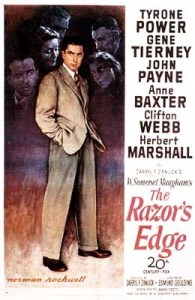
Lisa Reviews An Oscar Nominee: The Razor’s Edge (dir by Edmund Goulding)


Oh, 1919!  What a year.  The Great War had ended, leaving much of Europe devastated.  American soldiers were coming home and, scarred by the horrors they had experienced, becoming members of a lost generation.  The Spanish Flu was infecting millions, on the way to eventually wiping out 3% of the world’s population.  It was a grim time so it’s no surprise that many chose to close their eyes and pretend like everything was fine.  Only a few people were willing to look at the world and say, “There has to be something more.”

The 1946 film The Razor’s Edge tells the story of one such man.  Before the war, Larry Darrell (Tyrone Power, Jr.) was like most of his friends back in Chicago.  He was carefree.  He was wealthy.  He was engaged to marry the beautiful but self-centered Isabel (Gene Tierney).  But then he went off to fight in World War I and the experience changed him.  On the final day of the war, another soldier sacrificed his life to save Larry and Larry is now haunted by that man’s death.  No longer sure about his place in the world, Larry announces that he’s rejecting his former life.

Of course, that’s an easy thing to do when you’re rich.  Larry is lucky enough to have an inheritance that he can live off for a few years.  All of his former friends think that Larry’s just struggling to adjust to being back home and they expect that he’ll get over it soon enough.  Isabel’s uncle, Elliott (Clifton Webb), thinks that Larry’s acting like a total fool.  For Larry’s part, he no longer cares what any of them think.  He’s going to travel the world, seeking enlightenment.

While Larry’s searching, life goes on without him.  Isabel ends up marrying one of Larry’s friends, Gray Maturin (John Payne).  Larry’s best friend from childhood, Sophie (Anne Baxter), suffers a personal tragedy of her own and, when Larry next meets her, she’s living as a drunk on the streets of Paris.  Larry keeps searching for the meaning of it all.  He works in a coal mine.  He discusses philosophy with a defrocked priest.  Eventually, he ends up in the Himalayas, where he studies under a Holy Man (Cecil Humphreys).

It’s an intriguing idea and still a relevant one.  Unfortunately, the movie doesn’t really work because Larry tends to come across as being a little bit full of himself.  I could imagine someone like Henry Fonda working wonders with the role but Tyrone Power seems totally miscast as Larry.  When you look at Power, you find it hard to believe that he’s ever had a bad day, much less a need to spend months hiding in the Himalayas.  He comes across as the last person you would necessarily want to take spiritual advice from.  The fact that Webb, Tierney, Payne, and Baxter are all perfectly cast only serves to enforce just how miscast Power is.  It’s a well-intentioned film with nice production values but it’s never quite compelling.

The Razor’s Edge was based on a novel by W. Somerset Maugham.  Interestingly, the film features Maugham as a character, played by Herbert Marshall.  Even more interesting is the fact that the film was apparently remade in 1984, with Bill Murray cast as Larry Darrell.  I’ve never seen the remake so I have no idea if Murray is an improvement on Power.

(Also, since I’ve been pretty critical of Power in this review, let me recommend Witness For The Prosecution, in which Power is much better cast.)

The Razor’s Edge was nominated for Best Picture but lost to another film about returning vets, The Best Years of Our Lives.

The Third Annual Academy Awards: 1916


Over on Through the Shattered Lens Presidents the Oscars, Jedadiah Leland and I have been reimagining Oscar history, one year at a time! Today, we take a look at 1916, the year of Thomas H. Ince, Civilization, and Intolerance!

Lisa Marie Bowman's avatarThrough the Shattered Lens Presents The Oscars

Thomas H. Ince, the 2nd President of AMPAS Thomas H. Ince, the 2nd President of AMPAS

In the long history of the Academy of Motion Picture Arts and Sciences, 1916 was dominated by one man: Thomas H. Ince.

Today, Ince is a largely forgotten figure and his many accomplishments have been overshadowed by the mysterious and potentially sordid circumstances of his death in 1924.  However, in 1916, Ince was one of the most popular figures working in the film industry.  He was the first producer to build his own studio in California and, with D.W. Griffith and Academy President Mack Sennett, founded the Triangle Motion Picture Company.  When, following the 2nd Academy Awards ceremony, Sennett announced the he would not be running for a second term as president of the AMPAS, Ince was the obvious choice to replace him.

As President, Ince immediately launched a recruiting drive to bring more industry professionals into the organization…

View original post 1,487 more words

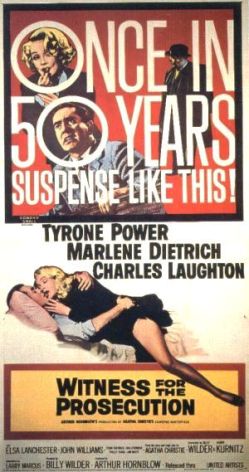
Lisa Watches an Oscar Nominee: Witness for the Prosecution (dir by Billy Wilder)


Movie_poster_for_-Witness_for_the_Prosecution-

Earlier today, I DVRed the 1957 best picture nominee, Witness for the Prosecution, off of TCM.  I watched the film as soon as I finished dinner and, having now seen Witness for the Prosecution, I am prepared to give you my professional and erudite review.

Okay, are you ready for it?  Here we go:

🙂 Oh my God, I freaking love this movie!!!!!!!!! 🙂

Witness for the Prosecution is many things.  It’s a courtroom drama.  It’s a domestic comedy.  It’s a twisty murder mystery.  It’s a showcase for three great performers.  It’s crowd pleaser that will make you think and, even if it does involve people killing each other, it will probably make you smile as well.  Don’t let that 1957 date fool you.  Witness For the Prosecution is a lot of fun.

Leonard Vole (Tyrone Power) is a somewhat sleazy man who has two claims to fame.  One is that he claims to be responsible for inventing the egg beater.  The other is that he’s been accused of murdering Mrs. French (Norma Varden), a wealthy widow who had recently named Leonard as the beneficiary of her will.  Everyone assumes that Leonard must have been having an affair with Mrs. French but Leonard claims that he’s innocent.

Suspecting that he is soon going to be arrested, Leonard hires Sir Wilfred Robarts (Charles Laughton) to serve as his attorney.  Though Sir Wilfred is recovering from a heart attack and has been ordered to not take on any more stressful criminal cases, he agrees to defend Leonard.  He proceeds to do just that, under the watchful eye of his nurse, the protective Mrs. Plimsoll (Elsa Lanchester).

(The testy relationship between Sir Wilfred and Mrs. Plimsoll provides the film with its comedic relief.  Laughton and Lanchester were married in real life and, watching the film, you can tell that they had a lot of fun acting opposite each other.)

Sir Wilfred is convinced that he can win acquittal for Leonard, especially since Leonard’s German wife, Christine (Marlene Dietrich), is willing to provide an alibi for him.  (In one of the film’s best moments, Sir Wilfred talks about how distraught Christine will be to discover that Leonard has been arrested just to then have the very calm and self-possessed Christine step into the room.)  However, to everyone’s shock, Christine is called as a witness for the prosecution.  She testifies that Leonard confessed the murder to her and that she only provided an alibi out of fear and love.

Things aren’t looking good for Leonard but then, a mysterious woman with a cockney accent contacts Sir Wilfred and reveals that Christine may have had reasons of her own for not giving Leonard an alibi…

Witness For The Prosecution ends with a voice over that says, “The management of this theater suggests that for the greater entertainment of your friends who have not yet seen the picture, you will not divulge, to anyone, the secret of the ending of Witness for the Prosecution.”  And I have to say that, when I heard that, it just made me love the film even more.  I had enjoyed the film so much and had so much fun following all the twists and the turns of the mystery that I found myself nodding in agreement.

“Sure, 58 year-old voice over,” I said, “I will not divulge the secret ending of Witness For The Prosecution.”

And I’m not going to!  Though, to be honest, you’ll probably guess the secret before it’s revealed.  It’s a plot twist that has been imitated by so many other courtroom dramas that it’s probably not as much of a mind-blower today as it may have been back in 1957.

But no matter!  Witness For The Prosecution is still a lot of fun.  Even if you figure out the mystery early, you can still watch the film and enjoy Laughton’s wonderfully theatrical performance.

Witness for the Prosecution was nominated for best picture and, interestingly enough, another theatrical courtroom drama — 12 Angry Men — was also nominated that year.  It’s interesting to compare the low-key drama of 12 Angry Men to the cheerful flamboyance of Witness For The Prosecution.  They are both great films about the law but each is told from a very different perspective.

Of course, in the end, both of these great films ended up losing to The Bridge On The River Kwai.