4 Shots From 4 Films is just what it says it is, 4 shots from 4 of our favorite films. As opposed to the reviews and recaps that we usually post, 4 Shots From 4 Films is all about letting the visuals do the talking.
This October, I am going to be using our 4 Shots From 4 Films feature to pay tribute to some of my favorite horror directors, in alphabetical order! That’s right, we’re going from Argento to Zombie in one month!
Today’s director: the master of French surrealism, Jean Rollin!
4 Shots From 4 Films
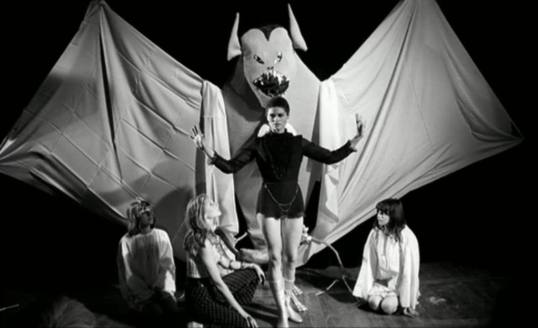
The Rape of the Vampire (1968, dir by Jean Rollin)
4 Shots From 4 Films is just what it says it is, 4 shots from 4 of our favorite films. As opposed to the reviews and recaps that we usually post, 4 Shots From 4 Films is all about letting the visuals do the talking.
4 Shots From 4 Films
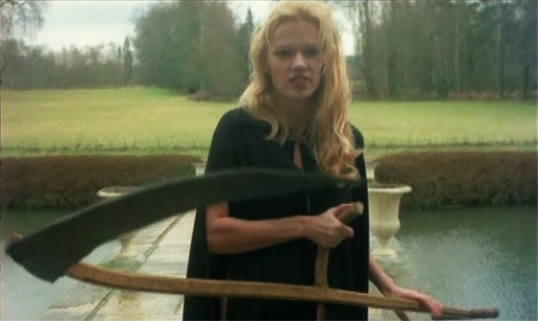
Requiem For A Vampire (1971, directed by Jean Rollin)
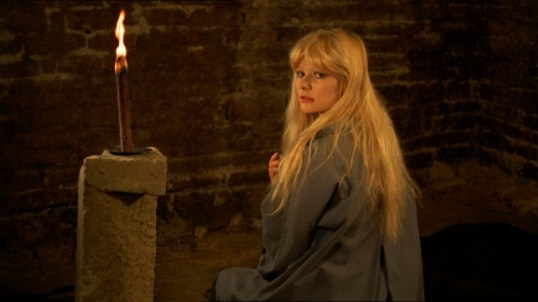
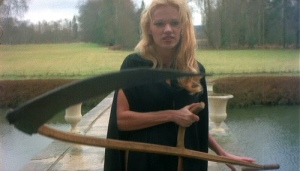
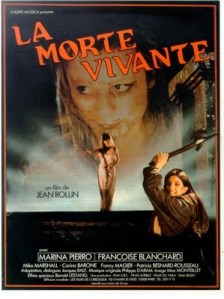
The Living Dead Girl (1982, directed by Jean Rollin)
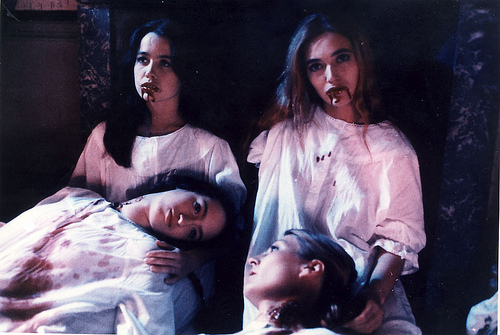
Two Orphan Vampires (1997, directed by Jean Rollin)
The Fiancee of Dracula (2002, directed by Jean Rollin)
Hi! It’s time for yet another edition of Lisa Marie’s Favorite Grindhouse and Exploitation Film trailers so let’s just jump right into it, shall we? I’m going on vacation next week and I’m currently attempting to do about a thousand things at once (and it’s not as easy as it looks) so I’m going to keep my commentary to a minimum for this edition. Fortunately, these trailers speak for themselves.
1) The Castle of Fu Manchu (1968)
2) Zeder (1983)
3) Freeway (1996)
4) The Gumball Rally (1976)
5) Unhinged (1982)
6) Two Orphan Vampires (1997)
Regardless of how busy I may be, I will always find the time to let people know that this is one of my favorite films from one of my favorite directors, the great Jean Rollin.
My favorite film director, France’s Jean Rollin, passed away on December 15th at the age of 72.
There are three types of people in the world: those who love Rollin, those who will eventually love Rollin once their eyes are opened, and those who just don’t matter.
When I first told Arleigh that Rollin had passed, he mentioned that the American director Blake Edwards had died as well. Oddly enough, I sometimes think of my favorite Rollin film — Night of the Hunted (which I reviewed on this site) — as being a rather grim, Grindhouse version of another one of my favorite films, Breakfast at Tiffany’s. The main difference, of course, is that Edwards’ Holly Golightly is allowed to triumph at the end while Rollin’s version is destroyed by an embarrassed mainstream establishment. History, I think, has given us little room for doubt concerning which vision is closer to the truth.
In his best films (Night of the Hunted, The Living Dead Girl, Two Orphan Vampires, Requiem For A Vampire, The Grapes of Death, Fascination, Lost In New York, The Sidewalks of Bangkok, Shiver of the Vampires), Rollin proved himself to be a cinematic poet with an eye for dream-like imagery and a special skill for capturing the mysteries, ambiguities, and ultimate beauty of female friendship and sisterhood.
Je ne crois pas au bon. Je ne crois pas au mal. Je ne crois pas en Dieu. Je crois seulement à l’amour et au Rollin.
Sometimes, I feel that there are only two types of people in the world. There’s the minority who appreciate the dreamlike atmosphere and sensual obsessions that dominate the vampire films of French director (and genius) Jean Rollin.
And then there’s the majority who don’t. We refer to this majority as being “the idiots.”
As for me, Jean Rollin is one of my favorite directors. I’ve previously reviewed his low-budget masterpiece, Night of the Hunted, on this site. I hope, in the future, to review even more of his films.
For now, I’d just like to share a scene from one of his later films, the hauntingly beautiful and elegiac Two Orphan Vampires.
Rollin is a director best known for spending the past five decades making films in which he continually and obsessively returns to a few key themes: the importance of memory, a nostalgia for the innocence of youth mixed with the knowledge that youthful innocence could also be destructive, a fascination with the beach, an obvious love of architecture (Rollin films old castles the way that an American director might film an action sequence), and — most notoriously — the use of two female protagonists who are usually portrayed as possessing a very strong, sister-like bond even though it’s rare that they actually are blood-related.
A good deal of Rollin’s current following comes from men who feel that there’s an erotic element to Rollin’s portrayal of female friendship. And to an extent, they’re right. But to an even greater extent, it doesn’t matter. Regardless of why the relationships between Rollin’s protagonists exists, the important thing is that they are portrayed as sharing an unbreakable bond. Whether they’re linked by lust, friendship, or just memory, Rollin’s women are bonded by a very true, very real love and that’s what makes his movies special to me.
This is what the scene below is all about. The two orphan vampires of the title are two teenage sisters. During the day, they are blind but when the sun goes down, they can not only see but they become vampires as well. Two Orphan Vampires is a surprisingly sad and haunting look at their attempts to survive in a world that has no place for them. In the scene below, after failing in several attempts to get the blood they need to continue to live, each sister resorts to drinking the blood of the other. To me, every thing that Rollin had directed before was leading up to this scene.
(This scene is also prototypical Rollin in that the budget is obviously low, the actors are more than adequate but, at the same time, are obviously not professionals, and the English dubbing is poorly done. And yet the scene itself — especially when seen in the larger context of both the entire film and Rollin’s movies as a whole — is actually more sincere and memorable than the majority of what is produced by the mainstream. In short, this is pure Rollin in that you either get it or you don’t.)






 Through the Shattered Lens