Brad reviews COCKFIGHTER (1974), starring Warren Oates!


I read about the movie COCKFIGHTER many years ago, and I remember the review being very positive. I had never watched the film before, but with today being Warren Oates’ birthday and it being available on Amazon Prime, I decided I’d finally watch it. 

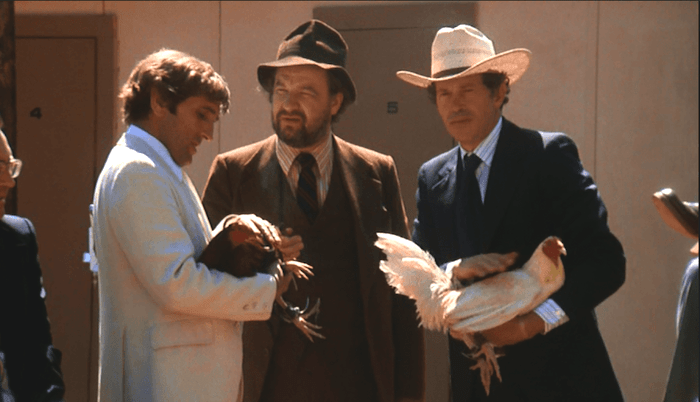
Directed by Monte Hellman and based on Charles Willeford’s 1962 novel, COCKFIGHTER introduces us to Frank Mansfield (Warren Oates), a man completely obsessed with the southern “sport” of cockfighting. As we meet him, he’s in the process of losing a bet and a cockfight with Jack Burke (Harry Dean Stanton). The loss isn’t just a setback, it costs him all of his cash, his truck, his trailer, and his current girlfriend Dody White (Laurie Bird). We also notice in these early scenes that Frank only communicates through sign language and writing notes. It seems that he’s been living under a self-imposed vow of silence. Two years earlier, on the eve of the big, season-ending cockfighting grand finale, Frank’s big-mouthed braggadocio caused him to lose his prized cock, and the prestigious “Cockfighter of the Year” medal in a meaningless hotel bet, also against Jack Burke. Frank vows not to speak again until he wins that medal. Coming up with cash in the only way he can by selling his family’s home, Frank buys a new cock named White Lightning from Ed Middleton, played here by the film’s writer Charles Willeford. Armed with new fowl and a new, capital rich partner named Omar Baradansky (Richard B. Shull), Frank will not let anything stop him, including the love of his life Mary Elizabeth (Patricia Pearcy) or an axe wielding competitor (Ed Begley, Jr.), from being named “Cockfighter of the Year” and finally regaining his voice and the respect he desires!

COCKFIGHTER definitely has some things going for it. First and foremost, Warren Oates is so good in the lead role as the obsessed man who puts success in cockfighting above anything else in his life, including every other person. He literally sells the family home out from under his alcoholic brother Randall (Troy Donahue) in order to fund his next cock purchase after he’s gone bust. This sets up quite the sight gag for such a gritty and realistic film as a large truck and trailer drives away the family home taking up the entire state highway. When his long time fiancé asks him to give up cockfighting, he just gets up, leaves her shirtless and heads back out on the circuit. He writes her a letter from the road and tells her he loves her, but he also makes it clear that life without cockfighting is a life that he’s unwilling to live. Oates’ Frank Mansfield is not the kind of person you’d ever want to depend on in life, but he’s also an uncompromising individual who is determined to live life wholly on his own terms, accepting of the successes and failures that come with it. I watched the film because it features Warren Oates, and after having done so, I can say that his performance is truly special. 

COCKFIGHTER is one of those movies that makes us feel like we’re watching real people, and that’s kind of fascinating even if they reside in a world that we don’t really want to live in. The primary credit for that has to go to director Monte Hellman and Oscar winning cinematographer Nestor Almendros (DAYS OF HEAVEN). The restraint that is shown in the storytelling, as well as the sweaty, ramshackle authenticity of the Georgia locations, brings the story to life. The supporting cast also does its part to create the world of COCKFIGHTER. Harry Dean Stanton as Jack Burke, Frank’s primary rival in the cockfighting game, is excellent as you might expect, and he seems a lot like a regular guy. I really like Richard B. Schull, who plays Frank’s outgoing and talkative partner Omar. His friendly and gregarious personality seems a little untrustworthy at first, but he turns out to be the most likable person in the film. And finally, I want to shoutout Charles Willeford. Not only did he write the source novel and screenplay for COCKFIGHTER, he also gives a solid performance as Ed Middleton, an old-timer in the game who treats Frank with honesty and decency when he’s hit rock bottom. 

With all the positive things I’ve said above, I have to address the graphic depiction of cockfighting in COCKFIGHTER. This was the 70’s, and the scenes shown here are real and were very difficult for me to watch. It’s not fun to see animals fight and kill each other, and this is coming from a person who loves fried chicken and is not particularly an animal lover. The scenes are presented as matter of fact and in service of the story, but that still doesn’t make them easy to watch. Director Monte Hellman has gone on record to express his personal disgust at even filming these scenes. While a movie made in the 1970’s probably couldn’t have been made without these sequences, I just wanted to make it clear that this film is probably unwatchable for a lot of people.

Overall, COCKFIGHTER is a relic of the 1970’s. It’s a gritty and realistic film, featuring a great central performance from Warren Oates. It’s also an ethically troubling film that features real animal on animal violence. Based on that I don’t necessarily recommend the film. Rather, I just want to share my own thoughts, and you can determine if you want to watch it or not. That’s what I’ve tried to do above. 
Late Night Retro Television Review: Monsters 2.20 “Micro Minds”


Welcome to Late Night Retro Television Reviews, a feature where we review some of our favorite and least favorite shows of the past! On Wednesdays, I will be reviewing Monsters, which aired in syndication from 1988 to 1991. The entire series is streaming on YouTube.

In this episode, a new lifeform is discovered.

Episode 2.20 “Micro Minds”

(Dir by Anthony Santa Croce, originally aired on March 4, 1990)

In a college science lab, astronomy student Paula (Belle Avery) is convinced that her personal computer is  picking up communications being sent to her from an extra-terrestrial civilization.  When Dr. Thomas Becker (Troy Donahue) comes by the lab to find out why Paula hasn’t been coming to class, he is at first dismissive of her theory.  But then he hears the voice of Grok (David Parmenter) coming through the computer and he realizes the truth of what has happened.

Paula has made contact with another lifeform.

But it’s not an lifeform from another planet.  Instead, it’s a microscopic protozoa that has evolved in the laboratory’s cooling tank.  Grok can speak but it doesn’t know much about the world outside of the tank.  When Becker shines a light over the tank, Grok thinks that Becker is God.  Becker, to Paula’s alarm, rather likes the idea of being God.

Soon, Becker is pouring salt and sugar into the cooling tank, all in an attempt to speed up Grok’s evolution.  Paula thinks that Becker is moving too quickly.  Eventually, a giant version of Grok (imagine a slimy version of the killer carpet from The Creeping Terror) materializes in the lab and attacks Paula.  Paula destroys it and Becker, realizing the Paula also means to destroy the rest of Grok, responds by killing her.  Becker, thinking that he has saved Grok, does not realize that Grok is planning on using him to destroy the human race.

I had a bit of a hard time following the plot of this episode, as you may have guessed from the somewhat jumbled synopsis above.  This episode of Monsters is an homage to the B-science fiction films of the 50s and 60s and, as such, there’s a lot of technobabble which doesn’t make much sense but which is there so the viewer can at least pretend like the story is rooted in some sort of reality.  In this case, the incoherence is the point.

The casting of former teen idol Troy Donahue as the professor is another call back to the 50s.  After Donahue’s star faded, he appeared in his share of low-budget horror and sci-fi films.  Donahue gives a good performance here, doing a nice job of portraying Dr. Becker’s growing megalomania.  (That said, whenever anyone referred to him as “Becker,” I was reminded of that terrible Ted Danson show where he played the doctor who was always pissed off whenever he got off the subway.)

As for the episode’s monster, it looked awful and fake but again, one gets the feeling that was deliberate.  To be honest, it didn’t look any worse than some of the monsters that showed up in Roger Corman’s alien invasion films.

This was an okay episode.  Even if I couldn’t always follow the plot, the story held my attention.  It was a well-done homage to cheap sci-fi, even if it never was quite as much fun as Plan 9 From Outer Space.

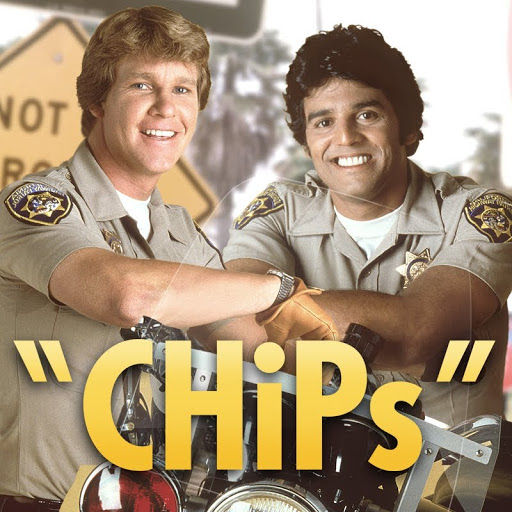
Late Night Retro Television Review: CHiPs 2.1 “Peaks and Valleys”


Welcome to Late Night Retro Television Reviews, a feature where we review some of our favorite and least favorite shows of the past!  On Mondays, I will be reviewing CHiPs, which ran on NBC from 1977 to 1983.  The entire show is currently streaming on Freevee!

This week, the second season begins.

Episode 2.1 “Peaks and Valleys”

(Dir by Phil Bondelli, originally aired on Sept. 16th, 1977)

The second season premiere of CHiPs brings some changes.

Most noticeably, the theme song has been redone and now, instead of being driven by the horn section, it now features a bass-driven disco beat.  From the minute the new version of theme song begin, you know that you’re watching a show that was filmed in the heart of the 70s.

Secondly, the second season premiere is considerably less gritty than any of the episodes that aired during the first season.  If the first season concerned itself with showing the day-to-day duties of the members of the California Highway Patrol, from the mundane to the occasionally exciting, the second season announces from the start that it’s about fast cars, fast motorcycles, and slow motion crash footage.

Ponch is considerably more competent in this episode than he ever was during the first season.  For his part, Getraer no longer seems to dislike Ponch as much as he did just a few months ago.  No mention is made of Ponch being on any sort of departmental probation.  Now, Ponch is as professional and competent as Jon Baker.

Finally, the California High Patrol now has a new chief mechanic.  Harlan Arliss (played by Lou Wagner) is short, sarcastic, and wears a tie along with his white mechanic coat.  Arliss is not impressed with the way Baker and Ponch treat their motorcycles, though he seems to reserve most of his ire for Baker.  (“Your tire pressure is low!”)  Arliss may seem like he is overly critical but he also keeps a really cute dog at the garage.

That said, some things remain the same.  As always, Baker finds himself feeling unappreciated.  The episode opens with a camper the crashes in slow motion.  The driver, Bob Niles (a bearded Troy Donahue), suffers a spinal injury as the result of someone moving him after the accident.  Niles can’t remember exactly who moved him and it appears that Baker, Ponch, and the Highway Patrol might get sued.

Then Baker burns his hand saving a man from a burning vehicle.  And a little child shoots a toy gun at Baker.  And then two rednecks call in a fake emergency so that they can shoot up a police car.  Is it any surprise that both Baker and Ponch are tempted to quit the force and take a job selling used cars for Baker’s high school friend, Stan Bosca (Richard Gates)?

Fortunately, Bob does get his memory back and remember that it was a bunch of construction workers who moved him.  So, it sucks for those well-intentioned workers (hello, lawsuit!) but at least Baker and Ponch are off the hook.  And, after seeing how sleazy the used car business is, Baker and Ponch decide to remain on the force and go disco dancing instead!

Actually, Ponch dances.  Baker watches and smile awkwardly.  It’s interesting that the majority of the episode is centered around Baker having an existential crisis but it all ends by highlighting Ponch on the dance floor. If nothing else, it proves that the people behind the show understood that Wilcox was the actor while Estrada was the one with the big personality.

I enjoyed this episode.  The scenery was nice.  The show made good use of slo mo of doom when Niles crashed his vehicle.  The dog was cute.  And the opening theme song was so catchy that I’m still hearing it hours after watching the show.  With this episode, the second season got off to a good start.

Retro Television Review: Fantasy Island 4.19 “The Proxy Billionaire/The Experiment”


Welcome to Retro Television Reviews, a feature where we review some of our favorite and least favorite shows of the past!  On Tuesdays, I will be reviewing the original Fantasy Island, which ran on ABC from 1977 to 1984.  Almost the entire show is currently streaming on Daily Motion.

This week, things get weird.

Episode 4.19 “The Proxy Billionaire/The Experiment”

(Dir by Richard Benedict, originally aired on March 21st, 1981)

This week’s episode is a bit of an odd one.

The first fantasy is fairly typical for the series.  Playing two roles, Robert Goulet is cast as both a billionaire and as Frank Miller, a Wall Street analyst who wants to be a billionaire.  The real billionaire agrees to allow Frank to live his life for the weekend.  Frank soon discovers that being a billionaire is …. well, actually, it’s pretty cool.  Except, of course, Phyllis Davis and Troy Donahue are plotting to poison him at a luau so that they can steal all of his money.  Fortunately, Mr. Roarke shows up at the luau in time to catch the vial of poison as Davis and Donahue attempt to toss it away.  Frank learns that being a billionaire is fine as long as no one wants to kill you.  Still, he has to return to his normal life at the end of the weekend.  Fortunately, the millionaire’s administrative assistant (Britt Ekland) has fallen in love with Frank and she decides to leave the Island with him.

As I said, this story felt pretty typical of Fantasy Island.  Probably the highlight was Mr. Roarke walking in on Tattoo badgering Frank for financial advice.  Roarke responded by giving Tattoo a strong glare that, if nothing else, reminded the audience that Tattoo and Roarke absolutely despise each other.

The other fantasy was …. well, it was weird.  Dr. Lucas Bergmann (James Broderick) and his daughter,  Lisa (hey!), come to the Island.  Each has a fantasy.  Lisa (played by Laurie Walters) says her fantasy is for Lucas to relax and enjoy himself and to stop obsessing over bringing the dead back to life.  Lucas’s fantasy is to bring the dead back to life.  Roarke sets Lucas and Lisa up in a bungalow that once belonged to another scientist who also wanted to play God.  Roarke warns Lucas that the local Islanders are superstitious and they might not appreciate him tampering in God’s domain.

(If the Islanders are that superstitious, how are they handling living on a magical island that is ruled by a mercurial demigod?)

Soon, the Islanders are beating their drums and Lucas’s mute assistant (Woody Strode) is looking concerned.  Lucas steps outside and discovers that Lisa has apparently drowned in a nearby lake.  Lucas decides that she’ll be the subject of his experiment.  Can he bring her back to life?  Lucas doesn’t find out because the Islanders storm his bungalow and Lucas runs into the jungle, fleeing until he eventually runs into Roarke, Tattoo, and …. LISA!

It turns out that Lisa was only pretending to be dead in order to teach her father a lesson.  And it also turns out that the Islanders were in on it and Woody Strode can speak.

WHAT!?

Seriously, was there not a simpler and perhaps less traumatic way to teach Lucas a lesson?  This seems like an awful lot of trouble to go to.  Lucas does realize that he doesn’t need to raise the dead to be happy so that’s good.  Still, this whole thing just feels weird.

Of course, weird is good when it comes to Fantasy Island.  With Roarke and Tattoo barely on speaking terms, it’s even more important for the fantasies to be memorable.  And I will never forget about the time Mr. Roarke tricked a scientist into believing his only child was dead.  Seriously, I’m stunned Mr. Roarke was never sued.

Next week, we meet Mr. Roarke’s goddaughter!

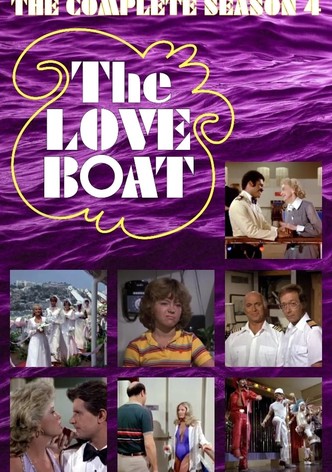
Retro Television Review: The Love Boat 4.8 “The Baby Alarm/Tell Her She’s Great/Matchmaker, Matchmaker Times Two”


Welcome to Retro Television Reviews, a feature where we review some of our favorite and least favorite shows of the past!  On Wednesdays, I will be reviewing the original Love Boat, which aired on ABC from 1977 to 1986!  The series can be streamed on Paramount Plus!

This week …. stuff happens!

Episode 4.8 “The Baby Alarm/Tell Her She’s Great/Matchmaker, Matchmaker Times Two”

(Dir by Ray Austin, originally aired on November 29th, 1980)

This episode opens with Doc, Gopher, and Julie all angry with Isaac.  Apparently, while they were on shore leave, they went to see a church production of MacBeth, one that starred Isaac’s Aunt Tanya (Isabel Sanford) as Lady MacBeth.  Apparently, the play was terrible and Aunt Tanya was even worse and somehow this is Isaac’s fault.

(Myself, I’m more confused by the idea of a church doing a production of MacBeth.)

Isaac, however, has one more favor to ask.  Aunt Tanya is going to be a passenger on the next cruise, along with her husband, Charles (Mel Stewart).  Isaac begs everyone to tell Tanya that she was great in the play.  Everyone acts as if this is the most difficult thing that they’ve ever been asked to do but they finally agree.  Even Captain Stubing agrees, even though he wasn’t at the play.

(Again, I’m confused as to why everyone is so upset over having to be polite to Isaac’s aunt.  Were they all planning on throwing tomatoes at her and booing when she boarded the ship?)

All of the praise goes to Aunt Tanya’s head and, halfway through the cruise, she decides to leave her husband and go to Hollywood to be a star.  Isaac finally has to tell Tanya that she’s not a good actress and that he had to beg his co-workers to be nice to her.  Good Lord, how bad could she have been?  The important thing, though, is that, by crushing Tanya’s dreams and confidence, Isaac is able to save the marriage.

Speaking of marriage, Mr. and Mrs. Clark (Troy Donahue and Terry Moore) think that it would be great if their son, Brett (Lorenzo Lamas, who looks nothing like either Troy Donahue or Terry Moore), married his friend-since-childhood, Cathy Cummings (Melissa Sue Anderson).  Cathy’s parents (Farley Granger and Joan Lorring) agree!  Brett and Cathy get so annoyed with all of the matchmaking going on that they decide to pretend that they’re sleeping together just to freak out their parents.  And it works, despite the fact that the parents wanted them to get together in the first place.  I guess the parents expected them to hold off on having sex until after the wedding.  Get with the times, you boomers!  Anyway, having fake sex causes Cathy and Brett to fall in love so I guess there will be real sex in the future …. but only after they say, “I do!”  Dumb as this storyline was, Lorenzo Lamas and Melissa Sue Anderson were really cute together.

Finally, Cynthia Bowden (Susan Howard) boards the boat with her adorable baby.  The baby has a sixth sense.  If he cries, Cynthia knows that any nearby man is no good.  For instance, no good Gig Wayburn (Stan Sells) is only interested in one thing and the baby cries as soon as he enters the cabin.  Good, baby!  Fortunately, when the baby’s father, Bill (John Reilly), shows up on the boat, the baby doesn’t cry at all and it leads to a happy reunion between him and Cynthia.

This week’s episode was pretty bland and I actually found myself struggling to remember much about it while writing up this review.  Some cruises are like that, I guess.

Oh well….

….

….

….

….

Personally, I think I’d make a kickass Lady MacBeth.

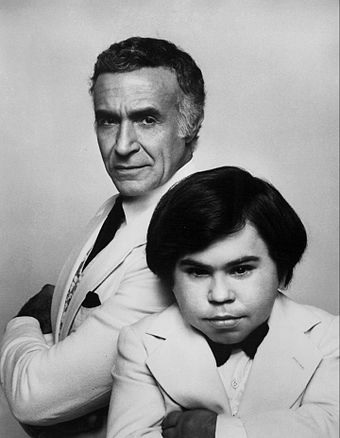
Retro Television Review: Fantasy Island 2.9 “The Appointment/Mr. Tattoo”


Welcome to Retro Television Reviews, a feature where we review some of our favorite and least favorite shows of the past!  On Tuesdays, I will be reviewing the original Fantasy Island, which ran on ABC from 1977 to 1986.  The entire show is currently streaming on Tubi!

This week, Tattoo finally gets his chance to be in charge!

Episode 2.10 “The Appointment/Mr. Tattoo”

(Dir by Cliff Bole, originally aired on November 18th, 1978)

This week’s episode opens with Tattoo in a very good mood.  Apparently, Mr. Roarke has promised Tattoo that Tattoo will someday get a chance to be in charge of a guest’s fantasy and Tattoo has decided that he is now ready to take on that responsibility!  As is typical of this show, Roarke responds to Tattoo’s enthusiasm by pretending to not remember what Tattoo is talking about.  Tattoo not only has to explain their deal but he literally has to beg Roarke to uphold his part of the bargain.  Roarke smiles at Tattoo’s excitement and says, in a tone that suggests the opposite, “I can hardly wait.”

(In many ways, Tattoo has the same relationship with Roarke that Nick Nack had with Scaramanga in The Man With The Golden Gun.  There’s a lot of passive-aggressive resentment to be found in every exchange between the two.)

Tattoo is in charge of granting the fantasies of Dee Dee (Barbi Benton) and near-sighted Evelyn Kastenbaum (Connie Stevens).  Dee Dee and Evelyn are Vegas showgirls who want to marry millionaires.  Tattoo hires two lounge singers, Jack (Troy Donahue) and Bernie (Fred Grandy), and instructs them to write a Broadway musical that will star Dee Dee and Evelyn.  Investors will come to the Island to see about investing in the show and surely, two of them will fall in love with Dee Dee and Evelyn!

It sounds like a great plan!  Way to go, Tattoo!

The only problem is that Dee Dee and Evelyn end up falling in love with Jack and Bernie.  In fact, during the musical’s big wedding number, the four of them are married by a minister who, Roarke explains, has always had a fantasy about appearing in a musical.  Tattoo is upset.  He says that he failed to grant the girls their fantasies.  But then Roarke explains that Bernie and Jack are actually millionaire playwrights who came to the island to fulfill their fantasy of writing a musical.  It all works out, even if it does appear that Tattoo was actually never really in charge of the fantasy.

While this is going on, Dr. John Carlson (Bert Convy) has a fantasy about meeting with a big financial backer and getting the money to build a hospital that will be named after himself.  However, while trying to drive to the meeting, John comes across a Fantasy Islander (Nancy Kwan) who is in the middle of a very difficult labor.  It turns out that her village only has one doctor and he’s away.  To save her life, Dr. Carlson will not only have to miss his meeting but he will also have to rediscover the joy of taking care of patients on a one-on-one basis.

(Why did all of the native Fantasy Islanders live in remote villages with so few modern resources?  Did Mr. Roarke just not care about them?)

Oh no, Dr. Carlson didn’t get his fantasy!  But don’t worry.  It turns out that Dr. Carlson’s wife (Tasha Noble) had a fantasy that the doctor would finally rediscover his love for medicine and that their marriage would improve.  So, at least someone got what they wanted!

Dr. Carlson’s fantasy was fairly predictable but the stuff with the showgirls, the playwrights, and the Broadway show was actually pretty cute.  It was definitely silly but Fantasy Island is at its best when its silly.  Plus, Mr. Tattoo finally got his fantasy.  Yay!

It was a fun episode.

Film Review: Susan Slade (dir by Delmer Daves)


Shortly after this 1961 film begins, 17 year-old Susan Slade (Connie Stevens) announces, “We’ve been sinful!”

She’s talking to her first lover, Conn White (Grant Williams).  You would think that anyone — even someone as unbelievably naive and innocent as Susan Slade — would know better than to ever trust someone named Conn White but no.  From the minute that Conn and Susan met on an ocean liner heading from South America to California, it was love at first sight.  In fact, Susan was so sure of her love that she spent the night in Conn’s cabin, fully knowing that it would mean surrendering her status as an Eisenhower era good girl.

Conn laughs off her concerns about sin.  He also tells her that it makes perfect sense for her not to tell her parents (played by Dorothy McGuire and Lloyd Nolan).  “When we’re married,” he asks, “are you going to tell your mother every time that we make love?”

Wow, Conn still wants to get married even though he’s already had sex with her!?  And he’s also extremely wealthy and stands to inherit control of a multinational corporation!  He sounds like the perfect guy!  Way to go, Susan!

Unfortunately, it turns out that Conn does have one flaw.  He really, really likes to go mountain climbing.  In fact, he’s planning on scaling fearsome old Mt. McKinley.  While Susan and her family settle into life in Monterey, California, Conn heads up to Alaska.  He promises Susan that he’ll keep in touch but, when she doesn’t hear from him, she fears the worse.  Has he abandoned her?  Was he lying when he said he wanted to get married?  Then one day, she gets a call from Conn’s father, informing her that Conn fell off the mountain and died.  Susan’s almost father-in-law tells her that Conn’s body cannot be retrieved from the mountain.  Though it’s neither confirmed nor denied by the film, I decided that this was because Conn faked his own death to get out of having to spend any more time listening to Susan talk about sin.

Anyway, Susan’s single again but, fortunately, she does not lack for suitors.  For instance, there’s the spoiled Wells Corbett (Bert Convy), who is kind of shallow and arrogant but who has a lot of money.  And then there’s Hoyt Brecker (played, in reliably vacuous style, by Troy Donahue), who is poor but honest and who is also an aspiring writer.  “Someday,” Susan declares,”they’ll say that Robert Louis Stevenson, Jack London, and Hoyt Brecker wrote here!”  Who will Susan chose?  The sensitive artist who loves her unconditionally or the arrogant rich boy who smirks his way through the whole film?

Complicating matters is the fact that Susan is …. pregnant!  That’s right, this is another one of those movies from the early 60s where having sex outside of marriage always leads to an unplanned pregnancy.  And, because this movie is from 1961, the only solution is for the Slades to move down to Guatemala for two years, just so they can fool the people on Monterey into believing that the baby is actually McGuire’s and that Susan Slade is not an unwed mother but is instead an overprotective older sister.  Will either of Susan’s two suitors be waiting for her when she and her family return to California?

Now, please don’t get me wrong.  I do understand that there’s a big difference between 1961 and 2019 and that there used to be a lot more scandal attached to sex outside of marriage and unwed pregnancy.  In fact, I guess that difference is really the only thing that makes Susan Slade interesting to a modern viewer.  As soon as we see that this film was directed by Delmer Daves (the poor man’s Douglas Sirk) and that it stars Troy Donahue, we know who poor Susan is going to end up with so it’s not like there’s any real surprises lurking in the film’s plot.  And none of the actors, though Connie Stevens sometimes to be trying, seems to be that invested in the film’s story.  Instead, Susan Slade is mostly useful of a time capsule of the time in which it was made, a time when sex outside of marriage was unironically “sinful” and the only possible punishment was either pregnancy, death, or both.  Indeed, Susan Slade is less concerned about the hypocrisy of a society that would force Susan to lie about her new “brother” and more about whether bland lunkhead Troy Donaue will still be willing to marry Susan even if she’s no longer eligible to wear white at their wedding.  The film seems to be asking, “After being sinful, can Susan Slade become a good girl again?”  As a movie, it’s fairly turgid but as a cultural artifact of a time in which everyone was obsessed with sex but no one was willing to talk about it, Susan Slade is occasionally fascinating.

Poor Susan Slade!  If only she had gotten pregnant in a 1971 film instead of one made in 1961, her story could have been so different.  But no, she was sinful in the early 60s and that means she’ll be have to settle for Troy Donahue.


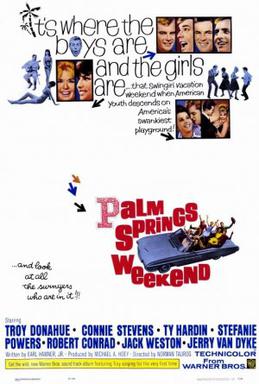
Film Review: Palm Springs Weekend (dir by Norman Taurog)


The 1963 film Palm Springs Weekend asks the question, “When is a beach film not a beach film?”

When it takes place in the freaking desert!

That’s right, Palm Springs Weekend takes place in the middle of the California desert.  There’s no ocean in sight nor are there any beaches on which to frolic.  Instead, there’s just a cheap motel and a swimming pool.  That said, Palm Springs Weekend pretty much follows the same formula as all of the beach films that were released in the early 60s.  A group of college students hop on a bus and head off for the weekend.  One student is wacky.  One student is rich, wild, and dangerous to know.  And, of course, one student is clean-cut, responsible, boring, asexual, and studious and all about doing the right thing.

Troy Donahue, the blandest teen idol of all time, plays the clean-cut student.  His name is Jim and he’s a college basketball star.  Even when he’s on the bus traveling to Palm Springs, he’s still got a book to study.  Jim’s the type who wears a suit and a tie to the pool.  He ends up falling in love with Bunny Dixon (Stefanie Powers) and the two of them spend a lot of time talking about sex in the most chaste way possible.  Bunny’s father (played by Andrew Duggan) is the chief of police and he doesn’t want any crazy college kids causing trouble in his town!  Well, it’s a pretty good thing that all he has to worry about is Troy Donaue asking his daughter if she wants to take a moonlight stroll in the middle of the desert.

(Trust me.  I’ve spent enough time in the desert to know that the last thing you want to do when you live near rattlesnakes is take a moonlight stroll.)

Jim’s best friend is Biff (Jerry Van Dyke).  Biff is the wacky college student, which means that he plays the ukulele and he gets all the comedic moments.  In this film, that amounts to getting babysitting an annoying boy and, at one point, falling into an extremely sudsy pool.  Luckily, Jim’s there to deliver CPR, which leads to soap bubbles floating out of Biff’s mouth and …. you know what?  I’m tired of writing about Biff.

Anyway, Biff and Jim really aren’t that important.  The entire film pretty much belongs to Robert Conrad and Connie Stevens, largely because they’re the only two actors who are allowed to break out of the trap of always either being bumbling and innocent or dramatic and self-righteous.  Robert Conrad plays Eric Dean, who is a spoiled rich kid who owns an expensive and fast car and who is basically a fun-loving sociopath.  Meanwhile, Connie Stevens plays Gail, who is a high senior and who is pretending to be a college student.  And while the film insists that we should somehow be disappointed in Gail because she’s acting wild and breaking curfew and doing more than just talking about whether or not it’s appropriate to kiss on the first date, she’s actually the most compelling character in the film because, at the very least, she’s actually setting her own rules and making her own decisions.  Since Palm Springs Weekend was made in 1963, it ultimately feels the need to try to punish Gail for thinking for herself but that doesn’t change the fact that she’s still a far more interesting character than the blandly innocent Bunny.  Gail’s a rebel.  Gail’s the future.  All hail Gail!

Anyway, Palm Springs Weekend is pretty forgettable and it’s never as much fun as any of AIP’s old Beach Party films.  That said, I’d still recommend it if you’re a history nerd like me.  It’s definitely a film of its time, a time capsule of an era.

Going There: Bad Blood (1989, directed by Chuck Vincent)


Oh man, this is a twisted movie.

Yuppie lawyer Ted (adult film actor Randy Spears, credited here as Gregory Patrick) is shocked when he sees a painting of a man who looks just like him.  He is told that the portrait was painted in 1964 and that the man in the painting is the late husband of the artist, Arlene (porn legend Georgina Spelvin, credited here at Ruth Raymond).  Arlene goes on to reveal that Ted is actually her long-lost son and then she invites him and his wife, Evie (Linda Blair, credited here as Linda Blair), to come out to her mansion.  What Ted doesn’t realize is that Arlene believes that he is actually her husband reincarnated and she is planning on doing away with Evie so that she can have her son all to herself and do what it is she wants to do with him.  Yes, this film goes there.

Chuck Vincent was one of the leading directors of the Golden Age of Porn.  Unlike most other adult film directors, his movies were popular with not only the public but also with critics.  (His best-known film, Roommates, received a rave in the New York Times.)  In the 80s, Vincent tried to make the move into mainstream film, mostly directing sex comedies and dopey thrillers.  Most of his mainstream films featured adult performers in dramatic roles, which made them very popular on late night cable.

Bad Blood feels like a combination of Fatal Attraction and Misery.  There’s even a scene where Arlene ties up her son in bed and then breaks his toes to keep him from leaving.  (Bad Blood, though, came out a year before Rob Reiner’s film so the resemblance is probably a coincidence.)  Spelvin, who was widely regarded as being the best actress to ever regularly appear in pornographic movies, gives a great, demented performance as Arlene and Linda Blair is also good as Evie.  Chuck Vincent was a good director, even when he was doing schlocky straight-to-video stuff like this.  Perhaps because of his background in adult films, Vincent never hesitated about taking his films to the places where other directors would be scared to tread.  Sadly, Vincent died in 1991 and most of his movies have fallen into obscurity.

Faust Goes Metal: Shock ‘Em Dead (1991, directed by Mark Freed)


Spastic Colon, an up-and-coming metal band, desperately needs a new guitarist, so much so that they allow a nerdy pizza boy named Martin (Stephen Quadros) to come in off the street and audition.  Martin, with his thick glasses and his total lack of talent, blows the audition and is told to leave and never return.  Not only does Martin lose his chance to be a rock star but he also loses his job when his boss (Aldo Ray) fires him for leaving work to audition.  While wandering around dejected, Martin runs into the local voodoo priestess (Tyger Sodipe), who offers to make him a rock star in exchange for his soul.

Martin agrees and after a ceremony involving a double neck guitar, Martin wakes up to discover that he is now an extremely talented guitarist who lives in a gigantic mansion with three outrageously hot groupies.  Martin now has big, heavy metal hair and no longer needs to wear his glasses.  Renaming himself Angel Martin, he not only becomes Spastic Colon’s new guitarist but he also pulls the band’s manager (Traci Lords) away from her boyfriend.  The only problem is that Martin cannot eat normal food and has to regularly feast on the souls of his groupies in order to stay alive.

Shock “Em Dead is the 1000th retelling of the old Faust legend, about the man who gets everything that he desires but loses his soul in the process.  A real product of its time, it’s impossible to watch Shock “Em Dead without thinking about how Martin sold his soul to become the type of musician that, in just a few months, would be made obsolete by Kurt Cobain and Nirvana.  I have fond memories of Shock “Em Dead because it always used to air on HBO back when I was growing up but, for the most part, this is a really crummy movie, with a bad script, bad acting, and bad special effects.  Shock “Em Dead does prove that Traci Lords had enough talent that, if not for her background as an underage porn star, she probably could have had a mainstream film career.  The film also provided small roles for Aldo Ray and Troy Donahue while the legendary Michael Angelo Batio served as Angel’s “guitar double.”