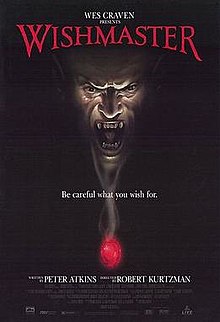
Horror Film Review: Wishmaster (dir by Robert Kurtzman)


Do you all remember Wishmaster?

Played by Andrew Divoff, the Wishmaster was a genie (or a djinn) who made his film debut in the 1997 film of the same name. The Djinn’s schtick is to randomly approach people and say something like, “Would you like to be rich?” or “Would you like all of your enemies to suffer?” He grants wishes but he does so in ironic ways. So, if you say want to be rich, you might very well turn into someone named Rich who is on the verge of getting hit by a bus. If you say that you want to escape from your mundane life, you might end up in a straight-jacket under water, struggling to perform one of Harry Houdini’s signature escapes.

I rewatched Wishmaster a few months ago and what I immediately discovered was the the Djinn wasn’t really that good at his job. He pretended to be clever in the way that he would fool humans but, honestly, it often seemed less like he was tricking people and more like he really wasn’t playing fair. Take the security guard who made the mistake of wishing for an escape. As I just mentioned, The Djinn immediately put him underwater in a straight-jacket. But the guard’s wish was not to have to escape. The guard’s wish was to simply escape. So, putting him in a life-and-death situation and telling him to figure it out for himself wasn’t fulfilling the guard’s wish. It just seemed like the Djinn wanted to drown someone and he decided to use his wish-granting job as an excuse.

The guard, by the way, was played by Tony Todd, one of the many horror icons who appeared in small roles in Wishmaster. (Today, Tony Todd is best known for the Final Destination films but, when Wishmaster came out, he was known for playing the Candyman.) Among the other cameos:

From Phantasm, Angus Scrimm provided the narration while Reggie Bannister played an unlucky pharmacist.

From Friday the 13th, Kane Hodder played a security guard who made the mistake of saying that he wished he could see the Djinn try to walk straight through him.

Day of the Dead’s Joseph Pilato played a crane operator.

John Carpenter vet George “Buck” Flower played an angry homeless man.

Sam Raimi’s brother, Ted Raimi, showed up long enough to get crushed by a crate.

And finally, Robert Englund played the somewhat pretentious professor who was responsible for bringing the Djinn to America in the first place.

As you can probably guess by looking at all of the cameos, Wishmaster is not a film that’s meant to be taken seriously. It’s often deliberately campy. Wes Craven may have produced it and was undoubtedly responsible for recruiting many of the actors who appeared in it but the film’s direction was handled by special effects maestro, Robert Kurtzman and he puts more emphasis on the visual effects than on any sort of serious exploration of the somewhat random series of events that make up the film’s storyline. Of course, when seen today, the film’s special effects look a bit cheap but, for many viewers (like me!), that’s actually a part of the film’s grisly charm.

Wishmaster does have a plot but it’s not particularly important. The Djinn tries to make Alexandra (Tammy Lauren) make three wishes so that he can unleash the forces of Hell. Why he spends all of his time granting wishes to other people instead of just concentrating on Alex is never really explained. It may be an often dumb movie but it’s also undeniably entertaining when taken on its own terms. Andrew Divoff is enjoyably sinister as the Djinn, playing the character with a sarcastic wit to go along with his evil schemes. It’s a fun movie to watch, even if it does feel like it was basically slapped together in a handful of days.

You should always be careful what you wish for but Wishmaster is still an entertaining piece of 90s horror.

(Author’s Note: Wow, this is embarrassing.  Right after I posted this review, I discovered that I previously reviewed Wishmaster in 2018!  Whoops!  Well, it’s nice to see that my thoughts on the film have remained consistent. — LMB)

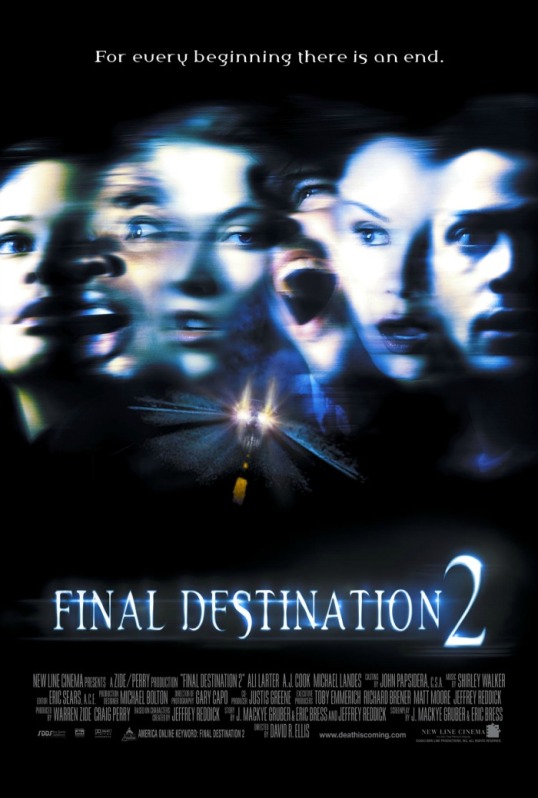
Horror Film Review: Final Destination 2 (dir by David R. Ellis)


After I rewatched Final Destination, I watched it’s sequel, 2003’s Final Destination 2.

Final Destination 2 is not only one of the best horror sequels ever made but it’s also the film that, even more than the first installment of the series, established what we consider to be a typical Final Destination film.  The characters are far more eccentric and the deaths are far more elaborate.  Death itself shows a sense of humor that wasn’t present in the first Final Destination film.  If you manage to escape Death the first time, Death isn’t just going to track you down.  It’s going to play without and have some fun before it finally fills its quota.

Final Destination 2 opens with Kimberly Corman (AJ Cook) having a vision of a crash on the interstate.  She’s so freaked out by her vision that she blocks the entrance ramp.  This may save the life of everyone stalled behind her but it also ends up killing all of her friends when a truck smashes into her SUV.  Fortunately, Kimberly survives because she had gotten out of the vehicle to talk to a policeman named Thomas Burke (Michael Landes).

So, the bad news is that all of Kimberly’s friends are dead.

The good news is that Kimberly has a whole new group of friends, all of the people who were supposed to die on that highway but who are now alive and on Death’s do-over list as a result of Kimberly’s actions.

Along with Kimberly and Thomas, Death now has to take care of lottery winner Evan Lewis (David Paetaku), stoner Rory (Jonathan Cherry), neurotic chainsmoker Kat (Keegan Tracy Connor), teacher Eugene Dix (T.C. Carson), and Nora (Lynda Boyd) and her son, Tim (James Kirk).  It turns out that Death is not only after them because they didn’t die on the highway but also because they all have a connection to the deaths that occurred in the first Final Destination.  It’s actually a pretty clever idea and it also provides an excuse for Clear Rivers (Ali Larter) to return from the first film and act as a sort of death guru.

Needless to say, the deaths are elaborate.  In fact, they’re so elaborate that Final Destination 2 occasionally feels like a satirical take on the first film.  It’s not just that Nora loses her head in an elevator accident.  It’s that there just happens to be an old man carrying a box full of claws on the elevator.  In another scene, Rory looks inside a closet and sees hundreds of things that could possibly kill him, my favorite being the bowling ball that just happens to be precariously balanced on the top shelf.  When Clear Rivers returns, she doesn’t just explain how death works.  She also gives them a list of safety precautions that make her sound like an overly protective parent, looking at her son or daughter’s apartment and freaking out over how many appliances have been plugged into one outlet.

Final Destination 2 is a clever film with an appropriately dark and macabre sense of humor.  On the one hand, all of the characters are well-written and the cast is so likable that you don’t want to see any of them die.  On the other hand, Death is so inventive that it’s hard not to want to see what it has up its sleeve.  And, like the first film, the sequel works because it gets at a universal truth.  You can avoid death but can never truly escape it.

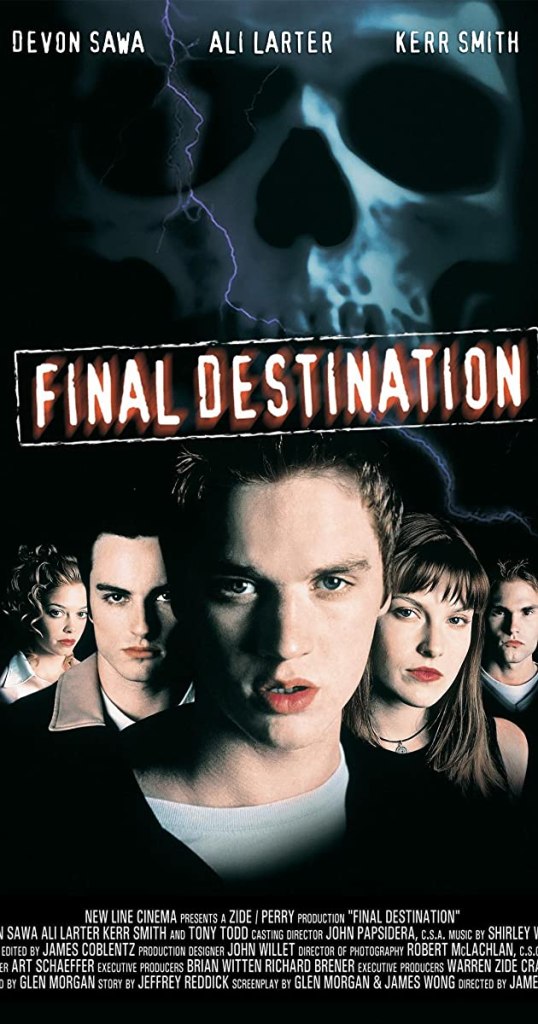
Horror Film Review: Final Destination (dir by James Wong)


I was recently rewatching the 2000 film, Final Destination, and a few things occurred to me.

Number one, no one ever really thanks Devon Sawa for getting them off that plane before it explodes.  Final Destination opens with a group of high school students boarding a plane so that they can go on their senior class trip to Paris.  (I wish I had gone to their high school.  Our senior class trip was to …. well, we didn’t get one.)  When Alex Browning (Devon Sawa) has a vision of the plane exploding, he freaks out and he, his teacher, and a few other students are kicked off the plane.  Needless to say, everyone’s pretty upset with Alex but then, just a few minutes after taking off, the plane does explode.  Alex was right.  He saved everyone’s lives.

And yet, no one ever says, “Thank you, Alex!”  Instead, everyone is still like, “Hey, that’s the weirdo that ruined our trip to Paris!”  No, the plane exploding is what ruined your trip to Paris.  Alex saved your life!  Poor Alex.  And yet, it kind of makes sense.  In the face of inexplicable tragedy, people need someone to blame and Alex is a convenient scapegoat.

That scapegoating continues once the survivors of the flight start to mysteriously die.  No one wants Alex near them, even though Alex has managed to figure out that Death is stalking them because they messed up its plans by getting off of that plane.  Then again, Alex doesn’t always come across as if he’s the most stable person in the world.  Gaunt and hallow-eyed, Sawa portrays Alex as someone who haunted by survivor’s guilt even before it became obvious that he and his former friends were being targeted.  Sawa, it should be said, gives a remarkably good performance in Final Destination.

Another thing that occurred to me as I rewatched Final Destination is that, in this film, Death doesn’t have much of a sense of humor.  The Final Destination sequels are notorious for their elaborate and often ironic death scenes, the majority of which seem to indicate that Death might be a little bit too clever and precocious for its own good.  However, in the first Final Destination, Death is a lot more direct and, in some ways, a lot more sadistic.  Terry Chaney (Amanda Detmer) steps out in the street and gets run over by a bus.  Goofy Billy Hitchcock (Seann William Scott — why two n’s Seann!?) makes the mistake of standing too close to the railroad tracks and he loses the top half of his head.  Death really only get creative when it comes to taking out Todd Waggner (Chad E. Donella) and Ms. Lewton (Kristen Cloke) and, even then, it’s methods are nowhere near as elaborate as they would eventually become.

The final thing that I noticed is that Final Destination holds up really well.  It’s hard to remember now but, when Final Destination first came out, a lot of critics dismissed it as just being a slasher film with a slightly clever twist.  But actually, that twist is far more than just “slightly” clever and the film really does a lot more with the idea than it’s often given credit for.  Final Destination is a film full of thrills and chills — I still freak out at some of those death scenes — but it’s also a film that always makes me think about mortality.  Has our destiny already been written?  Can we defeat death?  Or are we just pawns with our fates predetermined?  In the end, that’s what makes Final Destination so effective.  We all know that we can’t escape death, both in real life and in the movies.  The one thing that everyone has in common is that death is eventually going to come for all of us.  It’s the one enemy that we can’t defeat or laugh away.  Instead, all we can do is try to hold it off for a while.  Final Destination taps into the fears that we all have.

The plot is clever.  The script is frequently witty.  I liked the fact the characters were all named after horror movie icons.  Plus, you got Tony Todd dominating the entire film with just a brief role.  Final Destination is a classic.

Horror Film Review: Wishmaster (dir by Robert Kurtzman)


Remember the Wishmaster films?

There were four of them and they all deal with this ancient Djinn (Andrew Divoff) who, during each film, would escape from his magical prison and then wander around granting people their wishes.  Of course, since the Djinn was evil, there was always a catch.  He would either interpret the wish very literally or he would manipulate people into asking for the wish in the wrong way.  As a result, people would always get their wish but they’d get in a way that would make them suffer.

For instance, a typical Wishmaster conversation would go something like this:

“I wish I was a better actor.”

“Am I to understand that you wish you were John Wilkes Booth?”

“Wait …. what?”

“As you wish.”

Sic semper tyrannis!”

The first Wishmaster was released in 1997 while the fourth (and, to date, last) installment was released in 2002.  They’ve never gotten as much attention as some of the other horror franchises from that period, largely because there was really only so much that you could do with a character like the Djinn.  Part of the problem was that almost every scene depended on someone not understanding the importance of being clear when making a wish.  There’s only so many times that you can watch the Djinn trick people into saying, “I wish I never get old,” before the whole novelty of it all wears off.

That said, the Wishmaster films did have one thing going for them and that was Andrew Divoff.  A veteran character actor (and one who you might recognize from Lost, where he played a member of the Others who was both Russian and who had only one eye), Divoff was always creepy as fug in the role of the Djinn.  Whenever someone made the mistake of making a wish, this little smile would appear on Divoff’s face and you knew that someone was about to learn an important lesson about being careful what you wish for.  Divoff was seriously frightening of the Djinn, so much so that you regretted that the films themselves could never quite keep up with his performance.

Last night, I watched the first Wishmaster film for the first time in six years and it was actually a little bit better than I remembered.  The plot itself is typical Wishmaster stuff.  The Djinn is trapped inside of a gem that eventually makes it way to the United States.  An idiot lab worker attempts to experiment on it, which leads to the gem exploding, the Djinn getting free, and an epidemic of mass wish granting.  Nobody seems to have learned the lesson that the first thing you wish for is more wishes.

Wishmaster is stupid but fun.  The first film was produced by Wes Craven and perhaps that explains why the film is full of cameos from everyone who was anyone in low-budget 90s horror.  As a result, you’ve got Kane Hodder saying that he would “love it if” the djinn “tries to go right through him,” and Robert Englund playing a businessman and Tony Todd showing up as a doorman.  It’s nice to see them all, though ultimately the main reason to watch the film is for Andrew Divoff’s wonderfully smirky turn as the Djinn.  It’s hard not to wish that he had another horror franchise to dominate.

Be care what you wish for!

(Sorry, had to do it….)


Guilty Pleasure No. 7: Final Destination 2


FinalDestination2

The Final Destination series started off as a nice little horror film with a pretty original take on the slasher genre. We don’t have a psycho maniac on the loose killing off teens and pretty young adults. No, this film had Death itself stalking the usual photogenic and stereotypical young people (and the token adult). The film didn’t just have Death stalking and killing them but doing so in the most complex Rube Goldberg-like death scenes ever on film.

As with any horror film that has any sort of success this one received a sequel and then more sequels until it has become an almost bi-yearly event. My favorite of the series will always be the second film in the franchise.

Final Destination 2 is not a good film by any stretch of the imagination, but what it lacked in the fresh originality of the first film it more than made up in the inventiveness of it’s kills. Final Destination 2 makes absolutely no sense whatsoever other than Death decides to kill off a bunch of new young people. The film’s plot doesn’t even follow the same rules brought up in the first film. But none of that matters because it’s all about the kills and deaths. From the eye-opening freeway pile-up in the beginning of the film to a large plate glass literally squashing a teenage boy straight into the pavement, the kills in this film could never truly be topped by any of the others later on in the series.

As a guilty pleasure this one is always a must-see for me. Though I make sure I’m not going out on a drive any time soon after seeing it.

Lisa Marie Is Surprised by Final Destination 5 (dir by Steven Quale)


So, earlier today, I saw Final Destination 5 and guess what isn’t half as bad as you might think?

Now, I’m going to assume that if you’re reading this review, then you probably already know what this film is about.  Seriously, once a film has reached its fifth installment, you have absolutely no excuse for not knowing what’s going on.  Still, just in case you need to be reminded, here’s how this series works. All of the Final Destination films follow the same basic storyline: a group of attractive but generally anonymous people are gathered together for some everyday event like Nascar or a flight to France.  Suddenly, there’s some huge disaster that generally involves a lot of things exploding and people dying.  However, it turns out that the disaster we just saw was instead the main character’s vision of what’s going to happen.  That character freaks out which leads to him and a handful of other people avoiding the disaster.  However, by not dying, they’ve managed to tick off Death and soon, our survivors are dying in a variety of ludicrously convoluted ways, the key being that they’re dying in the order that they died in the original vision.  (Fortunately, Tony Todd shows up in each film and explains how it all works.)  Anyway, in each film, we learn of a different way to cheat death and each film ends with both the final survivors and the audience learning that actually you can’t cheat death.  In many ways, the Final Destination series is the perfect reflection of the 21st Century.  The same crap keeps happening and, in the end, we’re all doomed regardless.

Final Destination 5 sticks to established formula.  This time, the big disaster is a bridge collapse and the twist is that a survivor can fill death’s quota by killing someone else.  That’s kind of a neat idea and the film actually has a little bit of clever fun with that at the end.  Still, I wish the film had taken the whole idea to its logical, grindhouse extreme and just had all the survivors running around desperately looking for innocent people to murder.

There’s a lot of very legitimate criticisms that one can make about Final Destination 5.  Though the supporting cast is well-chosen (especially Miles Fisher — who could be Tom Cruise’s twin brother, seriously, David Koechner and Courtney B. Vance), the main character is played by Nicholas D’Agosto, who gives a performance that is so free of charisma that you have a hard time believing that he was ever alive to begin with.  Emma Bell plays D’Agosto’s girlfriend and it is seriously amazing to see how little chemistry the two of them have together.  (Then again, this also helps to make the film’s final twist entertaining as opposed to traumatic…)  As much as I love to see Tony Todd doing his Tony Todd thing, it’s hard not get impatient with the fact that these characters need to be told that they’re in a Final Destination film.

But let’s be honest — those criticisms may be valid but who cares?  This is a Final Destination film and if you’re not willing to consider it on the basis of what it is, then don’t waste your time watching it and bitching about how it’s not The Help.  Judged solely on that basis, Final Destination 5 is actually a return to form for the series.  The deaths are all nicely done and memorably grotesque and there’s a real nasty twist at the end of the film that basically serves as a reward for all the horror fans who have stuck with the series since the beginning.  I wish I could tell you what that twist was but seriously, it’s way too neat for me to spoil it.  I’ll just say that I squealed in delight when I saw it. 

Finally, this is a 3-D film that was actually made in real 3-D.  The 3-D was not tacked on as an afterthought and, as a result, this is rare film that actually uses the 3-D to make the movie better as opposed to just trendier.  This is a film where guts spill freely, eyeballs literally pop out of the screen, and it’s all just the perfect definition of good, stupid fun.

(That said, I do have to admit that this film was apparently made specifically to freak me out because, oh my God, it’s like they exploited every single fear that I have.  As Arleigh can tell you, I am terrified of two things — heights and drowning.  Which means that if you really want to see me scared, just get me thinking about the prospect of plunging several hundred feet into a large body of water.  Seriously, just typing that freaks me out.  So, of course, what does this film open with?  A freaking bridge collapsing.  And don’t even get me started on the laser eye surgery…agck!  I’ll just stay blind as a bat, thank you very much.)