Retro Television Review: Pigs vs. Freaks (dir by Dick Lowry)


Welcome to Retro Television Reviews, a feature where we review some of our favorite and least favorite shows of the past!  On Sundays, I will be reviewing the made-for-television movies that used to be a primetime mainstay.  Today’s film is 1984’s Pigs vs. Freaks!  It  can be viewed on YouTube.

In the late 1960s, a small town is divided between the conservative older generation and their rebellious hippie children.  Former high school football star Doug Zimmer (Patrick Swayze) has just returned from fighting in Vietnam and, unlike many of his former classmates, he is firmly on the side of the establishment.  He wears his hair short.  He has a job as a cop.  He tries to keep his younger sister, Janice (Penny Peyser), from hanging out with hippies like his former best friend, Neal (Grant Goodeve).

Neal is also the son of the local police chief, Frank Brockmeyer (Eugene Roche).  Though Frank and Neal have different political beliefs and Frank is always telling Neal to get a haircut, they still have a respectful relationship.  When Neal complains that cops like Doug and his partner, Sgt. Cheever (Brian Dennehy), are always harassing the hippies who want to play football in park, Frank suggests a football game between the hippies and the police.  When Neal agrees, the game becomes known as “Pigs vs. Freaks.”

While Frank coaches the Pigs and signs a few former athlete as police reservists, Neal recruits his former little league coach, a bearded guru who now goes by the name of Rambaba Organimus (Tony Randall) to serve as the Freak’s coach.  He also places a call to a former football star named Mickey South (Adam Baldwin) and talks him into coming down from Canada to play in the game.  Of course, Mickey is wanted by the FBI for dodging the draft so it might not seem like a great idea for him to risk federal prison for an exhibition football game but no matter!  Who cares that there are now two federal agents watching the Freaks practice?  There’s a game to be won!

Pigs vs. Freaks is an amiable mix of comedy and drama.  Some of the comedy, like Tony Randall’s bearded guru and Stephen Furst’s perpetually frantic hippie linebacker, is a bit too broad but there’s enough moments of dramatic insight that it’s easy to overlook those flaws.  I appreciated the fact that both the Freaks and the Pigs are treated fairly, with both sides getting a chance to make a case for themselves.  When they first appear and start harassing the hippies for playing football in the park, it’s easy to dismiss both Doug and Cheever as fascists but a later scene, which is very well-played by both Brian Dennehy and Patrick Swayze, establishes them as just being two men who are confused by the direction of the world.  Swayze, in particular, gives a strong performance that reveals the vulnerability underneath Doug’s tough exterior.  As for the hippies, Mickey South is no self-righteous crusader but instead someone who feels the Vietnam War is wrong but who is also someone who both misses and loves his home country.  Adam Baldwin does a wonderful playing him and is well-matched with Grant Goodeve, who plays the most reasonable hippie that one could hope to meet.

It’s a likable film and well-intentioned, a portrait of two opposing groups brought together by the love of one game.  Some will cheer for the Pigs.  Some will cheer for the Freaks.  I cheered for both.

Retro Television Review: The Brady Bunch Hour 1.1 “The Brady Bunch Variety Hour”


Welcome to Retro Television Reviews, a new feature where we review some of our favorite and least favorite shows of the past!  On Fridays, I will be reviewing The Brady Bunch Hour, which ran on ABC from 1976 to 1977.  All nine episodes can be found on YouTube!
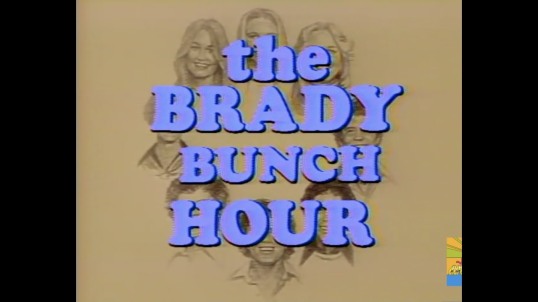
The year was 1976 and cocaine was very popular.

Well, seriously, how else do you explain the existence of The Brady Bunch Hour?  Produced by Sid and Marty Kroft, The Brady Bunch Hour imagined a world in which the Bradys got their own variety show.  Now, this could have made sense if the show had been hosted by “the stars of the Brady Bunch” but instead, in this show, Mike Brady specifically abandoned his job as an architect so he and the family could move to Hollywood and star on a variety show.

Almost all of the Bradys returned to do the show.  Eve Plumb balked at signing a five-year contract and, as a result, Geri Reischl was cast as Jan Brady.  Barry Williams, who was starring on Broadway in Pippin, returned to play Greg “Music is My Life” Brady.  Maureen “Marcia” McCormick was also excited to get a chance to dance and sing.  Susan “Cindy” Olsen was excited over the prospect of appearing in skits.  (She was told that the skits would be SNL-style skits.)  Both Christopher “Peter” Knight and Mike “Bobby” Lookinland were aware of their own musical limitations.  Knight eventually agreed to return when he was told that he wouldn’t have to do much dancing or singing.  Lookinland tried to get out of appearing in the show by demanding a lot of money.  To his surprise, the producers not only paid him what he asked for but his demands led to everyone else getting a bigger paycheck as well.  Ann B. Davis had left acting to work for a church but she appeared on the show as a “guest star.”  Florence Henderson, who had the most singing and dancing experience of anyone in the original cast, was not enthusiastic about The Brady Bunch Hour but she agreed to give it a shot for the fans and the kids.

Actually, the most enthusiastic member of the cast was Robert Reed.  Reed, who rarely had a good word to say about his time on The Brady Bunch (though he did get along with the rest of the cast), was surprisingly enthusiastic about getting to dance and sing despite not being very good at either one of those things.  Alone amongst the cast, he reportedly never lost his enthusiasm for the Brady Bunch Hour.

But enough background!  Let’s take a look at this bizarre, only in the 70s type show!

Episode 1.1 “The Brady Bunch Variety Hour” 

(Dir by Art Fisher, originally aired on November 28th, 1976)

We open with a line of dancers doing kicks in a front of a swimming pool.  On the screen behind the dancers, the faces of the Brady Bunch are projected.  We immediately notice that Jan is now played by Geri Reischl and she’s the only one of the kids who appears to be sincerely happy to be there.  While the other members of the Bunch are obviously struggling to smile, Fake Jan can’t wait to get out on stage and perform.  And she quickly gets that opportunity when the family comes out to perform Baby Face.  While the Bunch sings an off-key rendition of the song, the dancers dive into the pool.  The audience goes crazy as the announcer says, “Ladies and gentleman, the Brady Bunch!”

This performance only lasts for two minutes but it’s hard not to notice that all of the members of the Bunch appear to be totally exhausted by the time it’s over.  Robert Reed especially looks like he’s on the verge of fainting.

With the performance over, the Bradys argue over who will be the first to speak.  Carol reveals that the Bradys are each assigned a number, like at the DMV, and the Bradys are now serving “Number 27!”  “Who has number 27!?” Mike demands.  “Mike, check your number,” Carol says.  Yes, you guessed it!  Mike is 27 and he explains that he’s an architect but his family is forcing him to star on a variety show.  “I didn’t want to do this,” Mike tells us.  “We’re all very excited!” Carol shouts.

(Again. in real life, Robert Reed was the only member of the Bunch who wanted to do the show, despite the fact that he could neither dance or sing.)

Carol introduces the members of the Bunch.  Greg says music is his life.  The audience goes crazy for Marcia.  Peter flirts with dancer.  Jan complains, though the naturally cheerful Geri Reischl is a bit less convincing when it comes to playing bitter as Eve Plumb was.  Bobby announces that he grew 2 and a half inches this year.  Cindy announces she grew 3 inches.  Carol explains that Mike is the first architect to have his own variety show.  Maybe there’s a reason why architects are not typically given this opportunity.

Suddenly, everyone starts singing Baby Face again.  Mike falls in the pool.  The audience loves it.

After a commercial break, we find the Bradys (sans Mike) at the family’s new Hollywood home.  The kids agree that Mike has to be dumped from the show because, as Greg puts it, “he’s not very good.”  Carol tells them that Mike is their father and that he will always be a part of the act.  Carol points out that Mike doesn’t enjoy wearing tights and that he’s only doing the show for his ungrateful children.  Carol has a point.  These kids suck.

The doorbell rings and Tony Randall, looking like he’s already realizes this is a mistake, steps into the living room.  He says that he needs a script.  Bobby calls him “Tony.”  Randall replies, “You can call me Mr. Randall.”  Bobby suggests that Tony Randall could be the family’s new father.  Mike comes down the stairs, just in time to hear his family begging Tony Randall to become their new father.  AWKWARD!  Anyway, Tony refuses to steal Mike’s role.  To me, it seems like the kid owe Mike an apology but he doesn’t get one.  However, everyone does eventually agree that they love him.  Then Bobby suggests Burt Reynolds could be their father.

We then cut to the Brady Bunch performing One from A Chorus Line.  Mike takes center stage for this performance, wearing a glittery white suit and a hat.  The viewer gets the feeling that this was all done to show that Robert Reed really could perform and dance but it has the opposite effect for both him and the entire family.

At the Brady Bunch home, Greg plays his guitar.  Marcia comes in and wonders if Mike and Carol were ever young.  This leads to a flashback to the 1950s, with young Mike and his gang (played by the Brady boys) hanging out at the roller rink and hitting on four girls, played by Carol and the Brady Daughters.
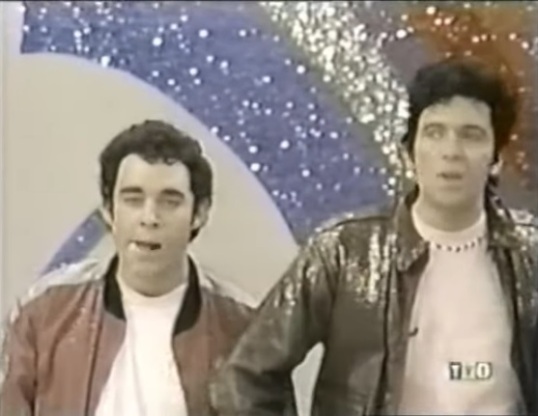
Now, you may think that things couldn’t possibly get worse than the Brady Bunch paying tribute to Grease.  (Actually, Grease wouldn’t come out for another two years so I’m not really sure what the point of this skit was.)  Well, it does get worse because Donnie and Marie Osmond roll up on a motorcycle and everyone sings Splish Splash.  It’s not so much that the Bradys (with the exception of Fake Jan and Florence Henderson) can’t dance or sing.  It’s that the audience applauds every little thing that they do, in much the same way that parents give out pity applause at a talent show at an elementary school.

Once the flashbacks ends, Greg welcomes the audience to the second half of the show.  Peter pushes Greg into the pool.  Greg grabs Peter and throws him in the pool.  The audience loves it but, judging from the way their bodies hit the water, it’s obvious that neither Greg nor Peter were trained stuntmen and they were both risking injury for a joke that wasn’t really that funny.  Oh well, no matter!  It’s time for the show’s dancer to put on clown makeup and do an aquatic dance number.

Cut to the Brady Bunch’s Hollywood home, where Mike is playing Risk with the kids and bitching about how he “always lands on Yugoslavia.”  You know, I felt bad for Mike when the kids were trying to replace him with Tony Randall but now I see that the kids had a point and that Mike is always whining about something.

Meanwhile, Marcia is talking on the landline about how much she loved The Boy In The Plastic Bubble.  “Barbarino in a bubble!”  Excuse me, Marcia …. his name is Travolta!

Continuing to play the game, Mike announces, “I just landed on East Germany and your mother already owns it!”  “With three hotels,” Carol says.  Uhmmm …. okay, are we playing Risk or Monopoly?  WHAT THE HELL IS GOING ON!?

Peter, meanwhile, call his girlfriend and breaks their date because “My Dad is being held prisoner in East Germany.”  It turns out that Peter is interested in another girl, which leads to Mike and Carol reprimanding him and teaching him an important lesson about honesty.  This skit goes on forever.  It’s almost bad enough to make me wish for another musical number….

Be careful what you wish for because this skit is followed by Cindy and Bobby introducing “our big brother,” and saying that they think he’s very talented.  As if to specifically humiliate them, Greg comes out on stage and oversings Corner of the Sky.  (Corner of the Sky comes from Pippin, a show that Greg left so that he could co-star on the Brady Bunch Hour.)  Perhaps the most interesting thing about this sequence is that Bobby and Cindy both appear to have joined a cult.

This is followed by a skit in which a disgruntled Mike and Bobby show up on stage dressed as a rabbit and a chicken.  They are soon joined by Greg, who is dressed as a bear, and Tony Randall, who is dressed as himself.  Tony announces that he’s going to sing a song about animals but he doesn’t want any of the Bradys to be involved.  (Considering that he was the show’s “special guest star,” it’s interesting that Tony Randall only appears twice on the show and, both times, he makes it clear that he holds the Brady Bunch in complete and utter disdain.)

After Tony does his song, Alice the Maid (Anne B. Davis) appears and says that she watched the Bradys grow up.  This leads to a montage of old Brady Bunch clips and Florence Henderson singing The Way We Were and, believe it or not, it actually works.  For once thing, Florence Henderson could actually sing and The Way We Were is exactly the right song for her performance style.  I mean, make no mistake.  It’s silly and schmaltzy but it’s also kind of touching.

Finally, it’s time for the big finale!  The Bradys are on stage, dressed in white, but they can’t decide what medley they want to perform.  Greg wants to do music from “that Rocky Horror show!”  “This is a family show!” Mike yells.  Carol suggests something from The Sound of Music.  The kids don’t want to do old stuff.  “We’re young and we want to do young music,” Marcia says.  Alice runs on to the stage and tells them to just sing something.

Greg takes her words to heart and performs Attitude Dancing, while wearing an outfit that makes it look like he’s about to jump a motorcycle over a line of school buses.

Mike and Carol sing Cheek to Cheek and then the kids sing Dance With Me.  Carol responds by singing I Could Have Danced All Night, which is another good song for her.  Unfortunately, the kids start to sing Do The Hustle and eventually segue into Shake Your Booty.  All the Bradys dance, including an embarrassed-looking Alice.  Fake Jan gets a solo and proves that, unlike the other Brady kids, she actually has a pretty good voice.

In the final comments, Carol thanks the audience.  “Without you, there would be Brady Bunch,” she says.  “I think I had something to do with it,” Mike says, which …. I mean, I know it’s awkward to point this out but Mike can really only take credit for half of the kids.  So, really, Mike didn’t have much to do with it beyond the fact that he quickly moved on from his first wife’s death.  (Or is Mike the one who got divorced?  I can never keep track of who was divorced and who was widowed.)

Anyway, on that cheery note, the show ends.

Wow, that was exhausting.  My main impression of the pilot of The Brady Bunch Hour is that it wasn’t good but it was impossible to look away.  It was fun to watch but I can already tell that the show’s corny humor and badly-choreographed musical numbers are going to get tiresome pretty quickly.  Fortunately, this thing only ran for 9 episodes so this is only going to cost me nine weeks of my life.  Yay!

Confessions of a TV Addict #10: Neil Simons’ Greatest Hit THE ODD COUPLE Will Endure


gary loggins's avatarcracked rear viewer


When Neil Simon passed away this weekend at age 91, the world lost one of the 20th Century’s greatest comedy minds. Simon got his start writing for radio along with brother Danny Simon, and the pair soon moved into the then-new medium of television, hired by producer Max Leibman for the staff of YOUR SHOW OF SHOWS starring Sid Caesar, Imogene Coca, Carl Reiner, and Howard Morris. This seminal variety show ran from 1950-54 and featured the talented comedy minds of writers Mel Brooks , Selma Diamond, Mel Tolkin, and Reiner on its staff. The Simons siblings moved to Caesar’s next venture CAESAR’S HOUR (1954-56) along with most of the writing staff, joined by newcomers Larry Gelbart and Aaron Ruben .

The Simons joined the staff of THE PHIL SILVERS SHOW (1955-59) for its final season, chronicling the escapades of con artist Sgt. Bilko. During this time, Neil began working…

View original post 503 more words

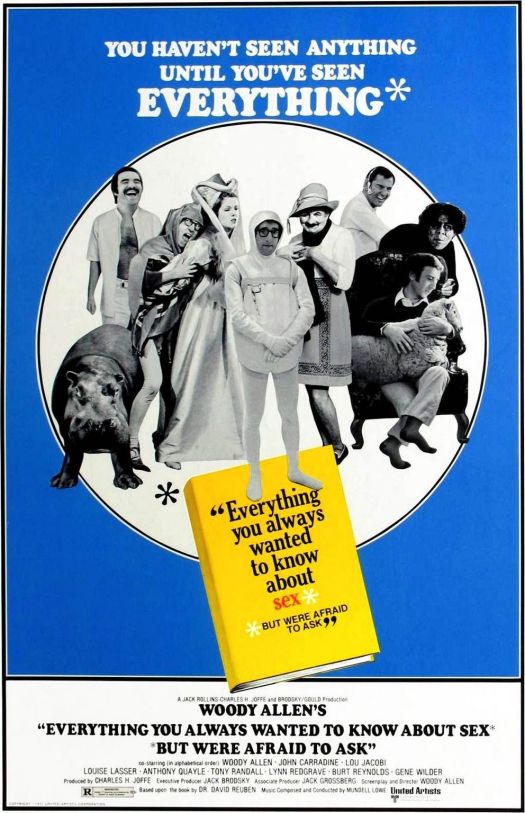
Gettin’ a Woody: EVERYTHING YOU ALWAYS WANTED TO KNOW ABOUT SEX* (United Artists 1972)


gary loggins's avatarcracked rear viewer

*(but were afraid to ask)

Say what you will about Woody Allen (and I’m sure some of you will), but from 1969 to 1977 he wrote, directed, and starred in some of the laugh-out-loud funniest movies ever made (after that, things got a bit pretentious, and his output has been hit-or-miss far as I’m concerned). Allen’s inventive mind took Dr. David Reuben’s best-selling sex manual EVERYTHING YOU ALWAYS WANTED TO KNOW ABOUT SEX (*but were afraid to ask) and turned it into a hilarious anthology that skewers not only societal mores and morals, but every segment parodies a different film genre.

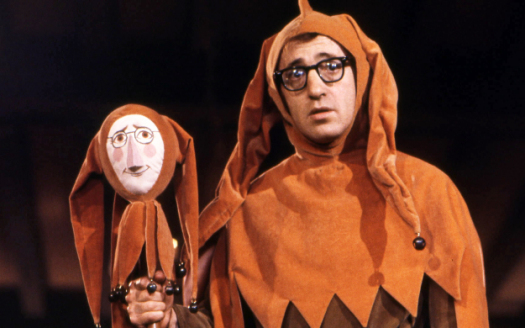
Some are better than others, but each has something funny to offer. The first, “Do Aphrodisiacs Work?”, finds Woody as a medieval court jester whose lousy Bob Hope one-liners bomb with the King (Anthony Quayle). The randy jester is dying to enter the Queen’s (Lynn Redgrave) “royal chambers”, but…

View original post 633 more words

Let’s Talk About Sex: BOYS’ NIGHT OUT (MGM 1962)


gary loggins's avatarcracked rear viewer


“Sex farces” were extremely popular during the late 50’s/early 60’s. They were filled with martinis, smarmy innuendoes, and smutty jokes, though no sex ever really happens. The comedies of director Frank Tashlin and the Doris Day/Rock Hudson teamings helped popularize this rom-com subgenre. A good example is BOYS’ NIGHT OUT, a humorous take on suburban mores starring James Garner and Kim Novak.

The premise is pretty simple: four friends commute every day from suburban Connecticut to New York City. They are divorced Garner and his married buddies Howard Duff , Howard Morris , and the ubiquitous Tony Randall, who made a career appearing in these type of films. When the “boys” catch Garner’s boss out with his mistress, they start to daydream what it would be like to get their own love shack going, away from their wives and equipped with a beautiful blonde to do their bidding. Garner balks…

View original post 352 more words

Embracing the Melodrama Part III #1: No Down Payment (dir by Martin Ritt)


Back in 2014 and 2015, I did a series of reviews that I called Embracing the Melodrama, in which I reviewed some of the best (and worst) melodramas ever made.  All together, I reviewed 186 films as a part of Embracing the Melodrama, everything from Sunrise to Reefer Madness to The Towering Inferno to Cocaine: One Man’s Seduction.  I had so much fun doing it that I’ve decided to do it again.

No, don’t worry.  I’m not going to attempt to review 186 films this time.  Instead, for Embracing The Melodrama Part III, I am going to limit myself to reviewing 8 films.  I’ll be posting one Embracing the Melodrama review a day, from now until next Sunday.

Let’s kick things off with 1957’s No Down Payment, a film about life in … THE SUBURBS!

(cue dramatic music)

The suburbs!

Is there any place in America that’s more dramatic?  Is it any wonder that, since the early 50s, films have regularly been using the suburbs as an example of everything that’s apparently wrong with America?  Every year sees at least one major film about how terrible life is in the suburbs.  Last year, for instance, George Clooney directed a film called Suburbicon, which was regularly cited as a possible Oscar contender before it was released and everyone was reminded of the fact that George Clooney is a terrible director.  That said, I can understand why filmmakers continue to be drawn to the suburbs.  Secret affairs.  Dangerous drugs.  Duplicitous children.  Fractured families.  Barbecuing alcoholics.  Undercover occultists.  You can find them all in the suburbs!

No Down Payment opens with David (Jeffrey Hunter) and Jean Martin (Patricia Owens) driving down a California highway and looking at the billboards that dot the landscape.  Every billboard advertises a new community, inviting people to make a new and better life away from the crowded city.  David and Jean smile, amused by how blatant all of the ads are.  That’s when they see the billboard that’s advertising their new home:

Sunrise Hill Estates

A Better Place For Better Living

Soon, David and Jean are moving into their new home and meeting their new neighbors.  It turns out that most of the houses in Sunrise Hill Estates are available for “no down payment” and the majority of the residents are struggling financially.  Though David may look at all of his neighbors and say, “Looks like everybody here is living a wonderful life,” the truth is something far different.

(If David’s line sound a bit too on the nose and obvious, that’s because almost all of the dialogue in No Down Payment was too on the nose and obvious.  As a side note, “on the nose” is an extremely strange expression.)

David’s neighbors include:

Herm Kreitzer (Pat Hingle) and his wife, Betty (Barbara Rush).  Herm owns an appliance store and sits on the town council.  Herm is gruff but likable.  He’s the leader of his neighborhood and he welcomes the Martins with a backyard party.  Herm’s employee, Iko (Aki Aleong), wants to move to Sunrise Hill but no one is willing to give him a reference because he’s not white.

Troy Boone (Cameron Mitchell) and his wife, Leola (Joanne Woodward).  We know that Troy is going to be trouble because he’s played by Cameron Mitchell.  We know that we’re going to like Leola because she’s played by Joanne Woodward.  Troy’s an auto mechanic and a veteran.  He wants to be appointed the chief of police but the town is reluctant to hire him because he doesn’t have a college education.  Leola wants to have a child but Troy says that they can’t even think about that until he has a good job.

And then there’s Jerry Flagg (Tony Randall) and his wife, Isabelle (Sheree North).  Jerry is a used car salesman and he’s also a drunk.  Jerry spends most of the movie hitting on other women and embarrassing Isabelle.  Jerry has no impulse control and, as a result, he’s heavily in debt.  His only hope is that he can convince a family to buy an expensive car that they really don’t need.  When last I checked, that’s what a used car salesman is supposed to do.

The film deals with a lot of issues — prejudice, sexism, economic insecurity — that are still relevant today.  Unfortunately, the film itself is a bit slow and what was shocking in the 50s seems rather jejune today.  Watching the film, you get the feeling that, as with many films of the 50s, all of the interesting stuff is happening off-screen.  That said, the film has an interesting cast.  Jeffrey Hunter and Patricia Owens are a bit dull as the Martins but then you’ve got their neighbors!  Any film that features Cameron Mitchell glowering can’t be all bad but the best performance comes from Tony Randall, who is memorably sleazy and desperate as Jerry Flagg.  For a fun experiment, watch this film right before watching Will Success Spoil Rock Hunter?

Tomorrow, we’ll continue to embrace the melodrama with 1961’s Common Law Wife!

A Movie A Day #114: Scavenger Hunt (1979, directed by Michael Schultz)


When game designer Milton Parker (Vincent Price) dies, all of his greedy relatives and his servants gather for the reading of his will.  Parker’s lawyer, Benstein (Robert Morley), explains that Parker is leaving behind a $200 million dollar estate to whoever can win an elaborate scavenger hunt.  Dividing into five teams, the beneficiaries head out to track down as many items as they can by five o’clock that evening.  Among the items that they have to find: a toilet, a cash register, an ostrich, a microscope, and an obese person.  Hardy har har.
The five teams are made up of a who’s who of sitcom and television actors who had time to kill in 1979.  The Odd Couple‘s Tony Randall is Henry Motely, who is Parker’s son-in-law and who works with his four children.  Soap‘s Richard Mulligan plays a blue-collar taxi driver named Marvin Dummitz (because funny names are funny) who teams up with his friend, Merle (Stephen Furst).  The Mary Tyler Moore Show‘s Cloris Leachman (an Oscar winner, no less) gets stuck with the role of Milton’s greedy sister, Mildred.  She works with her conniving lawyer (Richard Benjamin) and her stupid son (Richard Masur).  Maureen Teefy plays Milton’s niece while his nephews are played by Willie Aames and Dirk Benedict.  Cleavon Little, James Coco, Roddy McDowall, and Stephanie Faracy play the servants.

It doesn’t stop there, though.  Avery Schreiber plays a zookeeper.  Meat Loaf plays a biker who beats up Richard Benjamin.  Ruth Gordon, Stuart Pankin, Pat McCormick, and Scatman Crothers all have cameos.  Even Arnold Schwarzenegger makes an appearance as a gym instructor who knocks Tony Randall out of a second story window.

There are a lot of famous people in Scavenger Hunt.  It’s just too bad that the movie itself is barely watchable and not at all funny.  It tries to go for the zaniness of It’s A Mad, Mad, Mad, Mad World but, unless watching Willie Aames steal a clown head from Jack in the Box is your idea of hilarity, the film never comes close to succeeding.  Michael Schultz directed some classic films (like Car Wash) during the 1970s but, unfortunately, he also directed Sgt. Pepper’s Lonely Hearts Club Band and this.

Scavenger Hunt used to show up on a late night television, where it was always advertised as starring Arnold Schwarzenegger.  (He barely has five minutes of screentime.)  It was released on DVD/Blu-ray earlier this year but watching for the cameos is the only reason to take part in this Scavenger Hunt.

Film Review: The King of Comedy (dir by Martin Scorsese)


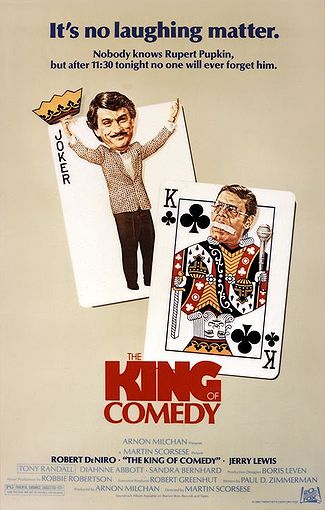
Kingofcomedy

Oh my God, do y’all want to see a really great film?

Then you need to do what I did earlier tonight.  You need to sit down and watch Martin Scorsese’s 1983 media satire, The King of Comedy.

Want to know more about The King of Comedy?  Then read on!  But be aware that there are spoilers in the review below!

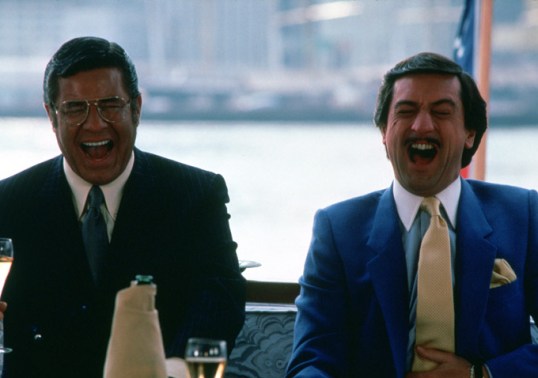
The King of Comedy tells the story of … well, it actually tells the story of several people.  On the one hand, it’s the story of Jerry Langford (played by Jerry Lewis, who gives a performance that is so good that you might even forget that he directed The Day The Clown Cried), a comedian who has his own late night talk show.  Jerry is a celebrity, the type who is mostly famous for being himself.  He makes his living by interviewing people at night but, in his daily life, he struggles to interact with the world at large.  Whenever Jerry steps outside, people start yelling at him.  When he walks away from one elderly fan, she responds by screaming insults at him.  If Jerry seems to be paranoid, it’s because he has good reason to be.

For instance, Masha (a chillingly unhinged performance from Sandra Bernhard) is obsessed with him.  When we first see Masha, she is jumping inside of Jerry’s limousine and refusing to leave.  When she finally gets a chance to be alone with her idol, her manner alternates between desire and hostility.  She may love Jerry but she could just as easily kill him.

And then there’s Rupert Pupkin (Robert De Niro).  Rupert is the character who brings Jerry and Masha together.  He’s a stand-up comedian, the self-described “king of comedy.”  He’s convinced that he can be a star if he can just get on Jerry’s show.  Rupert spends his time imagining the great friendship that he and Jerry could have, if only Jerry would let him on TV.  In his mind, he plays out the scene in which Jerry begs Rupert to take over the show.  Of course, in reality, Rupert lives in his mother’s basement and is surrounded by card-board cutouts of celebs that he will never meet.  When we first see Rupert, his only real skill seems to be the ability to get on everyone’s last nerve.

It’s a little hard to believe now but, when De Niro started his career, he almost exclusively played fuck-ups.  True, he may have won an Oscar for playing Vito Corleone in The Godfather, Part II.  But even while he was playing Vito, he was also playing the erratic and perpetually in debt Johnny Boy in Mean Streets.  In Taxi Driver, he was the delusional Travis Bickle and, in Raging Bull, he was a boxer who managed to alienate just about everyone in the world before finally ending up as an obese self-parody.  But, out of all the fuck-ups that the young(ish) Robert De Niro played, perhaps none was a bigger fuck-up than Rupert Pupkin.

Rupert Pupkin is a character whose sole purpose in life seems to be to make other people cringe with embarrassment.  He is the type of guy who will always come on too strong and say the wrong thing.  Even when Rupert manages to meet Jerry, he is so annoying that Jerry can barely wait to get away from him.  He is the type who asks if you want to see a picture of his “pride and joy” and then shows you a picture of two bottles of dishwashing liquid.  It undoubtedly took some courage to so fully commit to such an off-putting character but that’s exactly what De Niro did.  Rupert is perhaps one of the most annoying characters in cinematic history and yet, perhaps because he’s played by Robert De Niro, you can’t help but feel sorry for him.  You never exactly like him.  But you can’t help but feel a little bit sorry for him.  He is just so clueless!

Of course, what Rupert lacks in common sense, he makes up for in ambition.  He truly believes that he’s destined to be the king of comedy and if he and Masha have to kidnap Jerry Langford for that to happen, so be it.  It is perhaps not surprising that Rupert and Masha would kidnap Jerry and threaten to kill him unless Rupert is invited to appear on the show.  What is surprising is the fact, once we finally see Rupert’s act, we discover that it’s not as bad as we were expecting:

Apparently, when the film was first released, there was some controversy over whether or not Rupert actually appeared on TV and became a star or if it was just another of his delusions.  What’s funny is that there wouldn’t be any controversy today.  In 1983, the idea of someone going to such extremes to be famous may have seemed over-the-top.  In 2016, however, we all know Rupert would eventually end up with his own reality show.  In its way, The King of Comedy is one of the most prophetic films ever made.

The King of Comedy is a great film that, even after all these years, still deserves to be seen.  In fact, it’s probably even more relevant today than when it was first released.

the-king-of-comedy-deniro