Doctor Who — Pyramids of Mars (1975, directed by Paddy Russell)


Did you ever wonder who built the pyramids of Egypt?

It was the aliens, of course!

In 1911, Dr. Marcus Scarman (Bernhard Archard) excavates a pyramid.  When he enters a room that has the Eye of Horus over the doorway, he is hit by a beam of light.

Months later, The Doctor (Tom Baker) and Sarah Jane (Elisabeth Slader) materialize at the Scarman Estate in England.  They run into Dr. Scarman’s friend, Dr. Warlock  (Peter Copley).  (Dr. Warlock?  Really?)  Warlock explains that Scarman has been missing every since he went to Egypt and that his estate is now occupied by a mysterious man named Namin (Peter Maycock).

Namin is eagerly waiting the arrival of Sutekh (Gabriel Woolf), who Namin thinks is an ancient Egyptian god but who is actually the last-surviving member of the Osirian alien race.  The Osirians imprisoned Sutekh on a temple on Mars but Sutekh has taken over the body of Scarman and is using him to construct a missile that will free Sutekh from his Martian prison.  The possessed Scarman returns his estate, kills Namin, and gets to work.

Pyramids of Mars takes the usual Doctor Who themes of aliens and time travel and mixed them with mummies and ancient Egyptian curses.  This serial doesn’t skimp on the horror.  Sutekh tries to strangle almost everyone he meets and, once the Doctor and Sarah reach Mars, there’s plenty of scenes of mummies come to life and stalking pyramind to appeal to the most discerning of viewers.  Pyramids of Mars is one of the Doctor Who episodes that is perfect for October!

Doctor Who — The Ark In Space, The Sontaran Experiment, Genesis of the Daleks, Revenge of the Cybermen, Terror of the Zygons


The 12th season of Doctor Who got off to a shaky start with Robot, a serial that was ultimately distinguished only by the introduction of Tom Baker as the Fourth Doctor.  The best thing about Robot is that it ended with The Fourth Doctor peeking out of the TARDIS and inviting Sarah Jane Smith (Elisabeth Sladen) and Harry Sullivan (Ian Marter) to join him on his further adventures.  By inviting them, he was inviting the audience as well.

The remaining episodes of the 12th season not only established Tom Baker as the Doctor but it also reestablished Doctor Who as being a show about an alien who could travel through time and space.  After several seasons of The Third Doctor largely staying on Earth and in the present, the 12th Season reminded everyone that the Doctor could turn up anywhere.

The Ark In Space (1975, directed by Rodney Bennett)

The first place that the Doctor takes Sarah and Harry is to Nerva, a space station that floating above the Earth.  The time is 10,000 years into the future.  Forced to flee the Earth due to solar flares, the crew of the space station has spent a millennia in suspended animation.  During that time, the space station has been invaded by the Wirm, a space insect that has laid its eggs in some of the crewmen.  When everyone is revived, the infected crewmen are transformed into creatures that are half-human and half-insect.

The Ark in Space is a classic space opera.  When I was a kid and our PBS station first started to broadcast Doctor Who, they started with a four-hour bloc, which included Robot, The Ark In Space, and The Sontaran Experiment.  After Robot, with its basic plot and bad special effects, it was a relief to then see The Ark In Space, a serial that lived up to all of the Doctor Who hype.  Not only did Tom Baker fully step into the role of the eccentric Fourth Doctor but this serial also featured Elisabeth Sladen and Ian Marter in active roles as well.  This serial said that the days of the passive companion were (temporarily) over.

The plot of The Ark in Space does have some similarities to Alien, which came out for years later.  I think that’s probably just a coincidence.

The Sontaran Experiment (1975, directed by Rodney Bennett)

Having defeated the Wirm and saved the remaining colonists on the Ark, The Doctor, Harry, and Sarah transport down to Earth to repair a receiver terminal.  They discover that the Earth is not as deserted as they assumed.  A group of human astronauts returned to the planet earlier but they were captured by Styre (Kevin Lindsay), a Sontaran who has been sent to Earth to prepare it for an invasion so that the Sontarans can use the planet as an outpost in their never ending war with the Rutans.

This serial was only two episodes long but The Sontarans were always good villains.  They’re relentless, destructive, and very, very stupid.  This story featured one of Tom Baker’s best moments, when he convinced Styre to throw away his weapon because it made him look weak.  Styre fell for it because Sontarans will fall for anything.

Genesis of the Daleks (1975, directed by David Maloney)

This is it.  This is the first true classic of the Tom Baker era and also the best of the classic Dalek stories.  Terry Nation was invited back to Doctor Who to write about his most famous creations and he created one of the show’s most enduring villains in the process.

A Time Lord appears to the Doctor and his companions and tells them that they need The Doctor to change history.  (This goes against all Time Lord law, which is why they gave the job to a known renegade like The Doctor.)  The Daleks have been determined to be too much of a threat.  The Doctor is to go back to the time of their creation and “interfere.”

The Doctor, Harry, and Sarah Jane find themselves on Skaro, where the war between the Thals and the Kaleds have left the planet ravaged and inhospitable.  The Thals and the Kaleds each live in a domed city and spend their days shooting missiles at each other.  Terry Nation often said that the Daleks were meant to be a stand-in for the Nazis and he makes that clear in this episode with the Kaleds wearing SS-style uniforms and spouting theories about racial superiority.

In this episode, Nation introduces Davros (Michael Wisher), the horribly scarred and crippled scientist who will ultimately be responsible for transforming the Kaleds into the Daleks.  (The Kaleds who don’t want to be Daleks are wiped out by those who do.)  Davros would appear in every subsequent Dalek episode of classic era Doctor Who and his effectiveness would be diluted by repetition.  In his first appearance, though, he immediately establishes himself as a frightening and truly evil Doctor Who villain.  If their first appearance suggested that the Daleks retreated into the shells for survival in their nuclear-ravaged world, this episode shows that it more about Davros wanting to play God.

A six-episode serial, Genesis of the Daleks more than justifies its epic length.  The heart of the serial is a moment when the Doctor, on the verge of wiping out the Daleks forever, stops to wonder if he has the right to do so.  This was a key moment in the development of The Fourth Doctor.  The Fourth Doctor may have been an eccentric but he was an eccentric with a conscience who realized that even the worst creatures deserved a chance at redemption.  In the end, The Doctor does not destroy the Daleks, though he does set back their evolution by an undetermined number of years.  As the Doctor explains it, good will always rise up to counter the evil of the Daleks.

This episode features the apparent destruction of Davros but you can never keep a good villain down.  Both Davros and his creations would return.

Revenge of the Cybermen (1975, directed by Michael Briant)

After a classic Dalek story, I guess it was inevitable that Doctor Who would feature a Cyberman episode.

Following the events of Genesis of the Daleks, the Time Lords return The Doctor, Sarah Jane, and Harry to the Nerva space station.  They arrive several centuries before the events in The Ark In Space.  Without the TARDIS (it’s traveling back through time to meet them), The Doctor and his companions discover that the majority of Nerva’s crew is dead and that the remaining members are using the station as a space beacon to warn people about a drifting planetoid.  The planetoid is made of gold and the Cybermen show up at Nerva because, being uniquely vulnerable to gold dust, they want to destroy it.

If Genesis of the Daleks re-imagined the Daleks, Attack of the Cybermen proves to be just a typical Cybermen story and a disappointing one.  The best thing about this episode is that it gave Tom Baker a chance to once again prove his Doctor bonafides by defeating a classic Doctor Who villain.

Terror of the Zygons (1975, directed by Douglas Camfield)

Terror of the Zygons was the first seral of the thirteenth season but, since it’s also Harry Sullivan’s final appearance as a regular member of the TARDIS crew (though he would return in a later episode for a one-off appearance), it still feels like a twelfth season episode.

Having been reunited with the TARDIS, the Doctor, Sarah Jane, and Harry return to present-day Earth.  The Brigadier (Nicholas Courtney) and UNIT are investigating attacks on oil rigs by a giant sea creature.  Sea Devils, again?  No, this time it’s the Zygons, who are far less sympathetic.

This was a typical UNIT story, the type of thing that Jon Pertwee did regularly.  Tom Baker’s more mischievous version of the Doctor feels slightly out-of-place with UNIT but it is still a pleasure to see Nicholas Courtney and John Levene again and this episode finally explains what everyone has been seeing in Loch Ness over the years.  This episode ends with Harry returning to UNIT while Sarah Jane and the Doctor returned the TARDIS.  Harry Sullivan was a strong character and producer Philip Hinchcliffe later said it was a mistake to write him out of the series.

Ian Marter, who played Harry Sullivan, continued to be associated with Doctor Who as one of the better writers of the Doctor Who novelizations.  He also wrote two stand-alone novels featuring Harry’s adventures without the Doctor.  Ian Marter died of a heart attack when he was just 42 but Harry Sullivan lived on, frequently being mentioned in both the classic series and the revival.

That’s it for the 12th season, the season that truly made Tom Baker the Doctor and which was one of the best of the classic series.  As these were the first episodes of Doctor Who that I ever saw, I have a lot of nostalgia for them.  The Ark In Space, The Sonatarn Experiment, Genesis of the Daleks, and even Terror of the Zygons still hold up well to this day.


Doctor Who — Robot (1974-1975, directed by Christopher Barry)


Robot, the first serial of Doctor Who‘s 12th season, introduced us to a new Doctor.  The Third Doctor has regenerated and in his place is a slightly younger and more eccentric man.  Robot was the first regeneration story to introduce the idea of the Doctor being disorientated after regenerating.  The Fourth Doctor (Tom Baker) wakes up without the Third Doctor’s pressing concern for Earth or the goings-on at UNIT.  At first, at least, he has the wanderlust of the First Doctor without the Third Doctor’s sense of duty.  He wants to get in his TARDIS and explore the universe.

The only thing that stops him from leaving are his companion, Sarah jane Smith (Elisabeth Sladen), and the Brigadier (Nicholas Courtney).  When they tell him that there have been some technology thefts and that they need his help to investigate, the Doctor agrees to stick around and help out.  Of course, before he investigates, he changes his costume.  Out are the Edwardian clothes that the Third Doctor favored.  In are wide-brimmed hats, trenchcoats, and scarves.  Very, very long scarves.

(His scarf in Robot is nowhere near as long as it would eventually get.)

When he was cast as the Doctor, Tom Baker was a character actor who has found some success (even receiving a Golden Globe nomination for his performance as Rasputin in Nicholas and Alexandra) but not enough to give up his part-time job as a construction worker.  When he wrote to the BBC asking for a job, the letter was forwarded to Doctor Who producer Barry Letts.  Letts, who was struggling to find someone to replace the popular Jon Pertwee, hired Baker for the role after watching Baker play a villain in The Golden Voyage of Sinbad.  (There’s a movie I might have to review before the month is over.)  Tom Baker would go on to have the longest run of any actor as the Doctor and, for years, he was consistently voted the most popular of the actors who have played the Doctor.  That’s not bad for someone who, before receiving the role, was tauntingly called “Sir Laurence” by his co-workers at the construction site.

Tom Baker was also the first Doctor that many Americans experienced.  When I was a kid and my local PBS station first started showing Doctor Who, they started with the Tom Baker years.  For many American, Tom Baker was the one who introduced them to things like the TARDIS, Daleks, and Cybermen.  Tom Baker’s Doctor, with the scarf and the sneaky smile and the eccentric humor, became an iconic figure the world over.

Considering how important Tom Baker would be to the show, it’s interesting that his first serial is nothing special.  The thefts are the work of a group of humans who want to construct a robot out of “living metal” so that they can steal Britain’s nuclear command codes and hold the world hostage.  An attempt to shoot the robot with a disintegrator gun causes the robot grows to supersize.  It develops a crush on Sarah Jane, and is destroyed by an early computer virus.  The giant robot special effects rival the dinosaurs from Invasion of the Dinosaurs for ineptitude.  The episode ends with asking Sarah Jane and UNIT’s Dr. Harry Sullivan (Ian Marter) to accompany him on a trip in the TARDIS.

The only thing that really stands out about this episode is Tom Baker’s performance as the Doctor.  I hesitate to say that anyone was ever destined to play a role but Baker is so confident from the start and seems like such a natural while interacting with veteran cast members like Nicholas Courtney, Elisabeth Sladen, and John Levene that it’s hard to believe that anyone other than Tom Baker was ever considered for the role of The Fourth Doctor.  From the start, Tom Baker just seems like be belongs there.

Robot may not have been classic Doctor Who but Tom Baker was the classic Doctor.

Mary Whitehouse’s Worst Nightmare: 8 Frightening Serials From Doctor Who’s Classic Era


“Tea time brutality for tots.”

That was the term that a woman named Mary Whitehouse used to describe Doctor Who in 1975.  Mary was the founder of the National Viewers and Listeners Association and, in her crusade to return Britain to decency, she often leveled her harshest criticism at Doctor Who, a show that she regularly claimed was too scary for television.

Did she have a point?  Of course not.  Even children who were scared of the Daleks when they were nine or ten eventually grew up to realize that all you had to do to escape those mutant bastards was run up a staircase.  Still, Doctor Who did occasionally have its memorable horror moments.

Here are eight frightening episodes from Doctor Who‘s classic era:

  1. State of Decay (4 episodes, 1980)

Everyone remembers this classic from the Tom Baker years.  The TARDIS materializes on a planet where the villagers live under the shadow of a dark tower.  Ruled over by three cruel lords, Zargo, Camilla, and Aukon, the villagers are forced to regularly sacrifice their young to appease their rulers.  The Doctor, Romana, K-9, and Adric investigate and discover that Zargo, Camilla, and Aukon are vampires!  After being defeated by the Time Lords, the vampires retreated into E-Space, where they found a new planet to rule.  Of course, that little tosser Adric wants to become a vampire.  Why Romana and the Doctor didn’t leave Adric behind on the vampire planet, I’ll never understand.

2. Horror of Fang Rock (4 episodes, 1977)

This underrated serial is also from the Tom Baker era.  The Doctor and Leela land on the Island of Fang Rock, just off the coast of England, in the early 20th century.   The inhabitants of an isolated lighthouse are being killed, one-by-one, by an alien known as a Rutan.  This episode is full of gothic atmosphere and, despite the Doctor’s best efforts, almost everyone dies.

3. The Talons of Weng-Chiang (6 episodes, 1977)

Of all the Tom Baker episodes, this is my personal favorite.  The Doctor and Leela find themselves in Victorian-era London, where they investigate a murder and discover that they are not the only time traveler in London.  When most people talk about this serial, they focus on the terrible giant rat and the wonderful supporting characters of Jago and Lightfoot.  What I always remember is the Peking Homunuculus, a psycho killer who looks like a puppet and squeals like a pig!

4. The Deadly Assassin (4 episode, 1976)

One final Tom Baker episode.  The Deadly Assassin is unique in that it features the Doctor with no companions.  When the Doctor travels to Gallifrey, he discovers that The Master (played by Peter Pratt) is still alive and determined to destroy the Time Lords.  Having used all of his regenerations, The Master is now not only at his most evil but also horribly disfigured and decaying, a sight to give nightmares to any impressionable viewer!

5/6. Kinda (4 episodes, 1982) and Snakedance (4 episodes, 1983)

Peter Davison was an underrated Doctor and never was he better than in Kinda and its sequel, Snakedance.  In both of these episodes, The Doctor must deal with the efforts of the Mara to possess his companion, Tegan.  Both of these episodes were more creepy than scary but, thanks to the performances of Peter Davison and Janet Fielding, they were effective nonetheless.

7. Spearhead From Space (4 episodes, 1970)

Jon Pertwee made his debut as the Third Doctor in this serial.  The Doctor is exiled to Earth just in time to deal with an invasion by the Nestenes.  Serving as the Nestenes’s invasion force are the Autons, life-size plastic dummies that come to life at inopportune times.  With their stiff movements and expressionless faces, the Autons were regularly cited as one of the Doctor’s creepiest enemies.

8. The Daemons (5 episodes, 1971)

The Third Doctor vs. The Devil!  The Master as a vicar!  A killer statue!  Not even the Brigadier’s order of “Chap with wings!  Six round rapid!” could lighten up the atmosphere of this Jon Pertwee classic.

The Doctor and friends

Lisa Reviews The Oscar Nominees: Nicholas and Alexandra (dir by Franklin J. Schaffner)


Nicholas_and_Alexandra-831476012-large

(Depending on how much you know about world history, the review below may contain spoilers.)

It was nearly four years ago that I decided that my goal in life was to watch and review every single film — no matter how obscure or potentially disappointing — that had ever been nominated for best picture.  Of course, that’s not my only goal.  If anything, I may have too many, often contradictory goals in my life.  But seeing all of the best picture nominees was definitely one of them and, all these years later, it’s a goal that I’m still trying to achieve.  With the help of TCM and their nonstop schedule of movies made long before I was born, it’s also a goal on which I am slowly but surely making progress.

Last night, as I scrolled through the guide, I noticed that TCM would be showing Nicholas and Alexandra, a three and a half hour film from 1971.  Now normally, I would be hesitant about watching a film that long, if just because I have ADHD and I doubt I’d be able to concentrate on it.  In a theater, watching the action unfold on a big screen, it wouldn’t be a big deal.  However, it’s totally different when you’re talking watching a movie on TV in a house that is full of potential distractions.  Add to that, Wednesday night is when I usually watch shows like Survivor, Hell’s Kitchen, and South Park.

But, here’s the thing.  The title Nicholas and Alexandra sounded familiar to me and not just because I’m an obsessive history nerd.  I did some checking and I discovered that, regardless of how obscure the film may be today, Nicholas and Alexandra was nominated for best picture.  It lost to The French Connection but it was nominated.

So, of course, I had to watch it.

And you know what?

NA

It’s not a terrible movie.  It’s certainly not great.  It has multiple flaws and it’s hard to imagine this film being nominated alongside films like The French Connection, Last Picture Show, and A Clockwork Orange.  Watching the movie, I got the feeling it was probably nominated because it was a big, expensive epic and not because it was one of the best of the year.  But, if you stick with the film (which, if we’re going to be honest here, is much easier said than done), it’s not quite as disappointing as you might expect it to be.

Nicholas and Alexandra tells the story of the last monarch of Russia, Tsar Nicholas II (Michael Jayston).  Struggling to escape the shadow of his father and incapable of understanding what life is like for those not born into royalty, Nicholas is portrayed as being well-meaning but autocratic and blind to the fact that the days of royalty are rapidly coming to an end.  His wife, Alexandra (Janet Susman) is also unpopular with both the Russian citizenry and the royal court on account of being German.

Alexandra spends most her time doting on her youngest son, Alexei, who suffers from hemophilia.  When a flamboyant Serbian monk named Rasputin (Tom Baker) claims that he has the power to heal Alexei, Alexandra immediately brings him into the court.  Soon, rumors are flying across Russia about Rasputin’s relationship with Alexandra.

Meanwhile, men with names like Lenin (Michael Bryant), Trotsky (Brian Cox), and Stalin (James Hazeldine) are plotting to lead a “worker’s revolution…”

If you know anything about history, it’s not really a spoiler to reveal what happens in the second half of Nicholas and Alexandra.  (And if you’re not into history, you probably would not have any interest in watching the movie in the first place.)   Archduke Franz Ferdinand is assassinated, plunging the entire world into war.  Russia declares war on Germany and the German-born Alexandra becomes even more unpopular than before.  The rest of the royal court, jealous over the mad monk’s influence, plots against Rasputin.  The Tsar is forced from the throne and Nicholas and his family spend their last days as captives of the people they once ruled.  Now a powerless prisoner, Nicholas finally starts to understand the world beyond his palace walls.  However, in the end, Nicholas, Alexandra, their children, and their loyal servants are taken into a small room and violently executed.  End of movie.

NA2

So, there are a lot of things wrong with Nicholas and Alexandra.  Not the least of the film’s problem is an unwieldy length and generally slow pace.  (The film was directed by Franklin J. Schaffner, who also directed the still-fun original Planet of the Apes.  Little of the flair he brought to Planet of the Apes is present here.)  This is one of those films that is full of incident with various characters popping up and discussing the intricacies of international politics with little concern as to whether or not any of this is the least bit cinematic or even compelling on a narrative level.  The film has a huge cast but very few memorable characters.

Even worse is that neither Nicholas nor Alexandra never come across as being all that interesting.  The film makes the case that Nicholas’s downfall was largely a result of him being unlucky enough to rule at a time when people across Europe and Asia were rejecting the old ways for the new ways of revolution and industrialization.  Nicholas is continually portrayed as being well-meaning but isolated and that has the potential to be interesting but, at times, the film feels almost as emotionally detached as its characters.

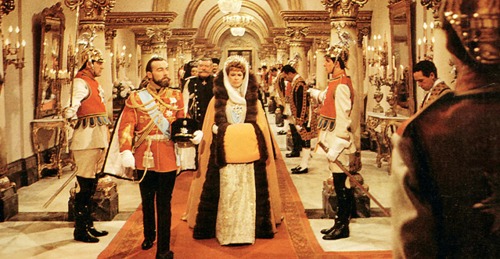
That said, Nicholas and Alexandra does work as a spectacle, as a showcase for beautiful clothing and ornate scenery.  As a character study, Nicholas and Alexandra largely fails but, as a fashion show, it’s actually a lot of fun.    Early on in the film, there’s a lengthy sequence in which Nicholas and Alexandra walk down the red-carpeted hallways of their palace.  It’s shot through Nicholas’s eyes and we see a collection of guards and noblemen and women standing to the side and bowing their heads as the Tsar and his wife walk past.  It’s a good scene and one that perfectly shows not only the life that Nicholas is used to but also why Nicholas doesn’t want to change that life.

baktna03

Perhaps not surprisingly, the first two hours of Nicholas and Alexandra work best when they focus on the flamboyant character of Rasputin.  Baker does a really go job as Rasputin, delivering all of his lines with a ferocious intensity while staring with obviously unhinged eyes.  When he’s with Alexandra, Rasputin is calculating and coldly conniving, providing just enough comfort to keep her under his control.  When he’s with Nicholas or any of the other male members of the court, he reveals himself to be an arrogant libertine, making profane jokes and bragging about his conquests.  It’s a really good performance but, as with so many other good performances in this film, it occasionally gets lost in the film’s dense production.

The best moments of Nicholas and Alexandra come towards the end, with the humbled Nicholas finally revealing his humanity and the Tsar’s family struggling to maintain their dignity even as their inevitable fate approaches.  At this point, the performers came to life.  The film suddenly had an emotional resonance.  It finally became about something!  For those final 20 or so minutes, Nicholas and Alexandra suddenly seemed worthy of being awarded.

In fact, based on those final 20 minutes, I would even be willing to see a sequel called Nicholas and Alexandra and Rasputin Makes Three.  

(Though I’m not sure how that sequel could ever be made.  As @Kev1Media pointed out when I suggested it on twitter, Adam Sandler would have to be somehow involved.)

As for Nicholas and Alexandra, it’s not a great film but if you’re into history or you’re an Oscar completist like me, the film has its occasional charms.  You just have to be willing to look for them.

Nicholas and Alexandra

Trash TV Guru : “The Day Of The Doctor” — The “Doctor Who” 50th Anniversary Special


4753398-high-doctor-who


First off, a couple of disclaimers : this is one of those reviews that’s going to pre-suppose a fair amount of knowledge about the BBC’s Doctor Who  from the outset, so if you’re not at the very least a casual viewer of the show, you’re going to feel pretty lost right from the word go. So, ya know — newbies beware. Secondly, it’s well-nigh impossible, at this point, to discuss The Day Of The Doctor without indulging in some pretty serious “spoiler talk,” so if you’re part of the legion of “spoiler police” that apparently have nothing better to do than troll around the internet looking to play seagull (fly in, make a lot of noise, shit all over everything, and fly back out) with any review that gives away any plot points whatsoever, now would be a good time fuck directly off. Major “spoilers” do, in fact,  abound here, so — you’ve been warned.

Now, with all that out of the way —

For those of us who have been “Whovians” for a long time, the 50th anniversary really has been something of a “pinch me, I gotta be dreaming” type of year, hasn’t it? Especially for us sad souls who stuck with fandom during the so-called “wilderness years” between 1989 and 2005, when the 30th anniversary gave us the debacle that was Dimensions In Time, the 35th anniversary gave us — well, nothing, I guess — and the 40th anniversary essentially went unnoticed, even by us, because we were all too busy speculating about what the  just-announced-at-the-time new series would end up looking, feeling, and being like.

Our only frames of reference, then, for how the BBC would celebrate a major anniversary with the show as a going concern were the 10th, 20th, and 25th anniversaries. For the tenth, there wasn’t much by way of hoopla and tie-in merchandising and the like, but we did get The Three Doctors (why I’m saying “we” here I have no idea, as I was barely two years old at the time and had never, to my knowledge at least, seen the show — but whatever), which was not only the first big “reunion story,”  but a pretty cracking good adventure, as well, that introduced the now-legendary figure of Omega into the Who mythos.

For the 20th, it has to be said that the Beeb pulled out all the stops. For one splendid year there they seemed to be willing to acknowledge that this creaky little cheap show that they tried their best to keep out of the public eye really was a genuine global phenomenon despite their best efforts to make it anything but, and we got a slew of anniversary-themed books, toys, magazines, posters — you name it.

And there was Longleat. Ah, yes, Longleat. Fandom’s own Woodstock. The biggest single Doctor Who-related event ever, tales of it still abound — and, like fish stories, grow with each re-telling — to this day. I wasn’t there. I was a 12-year-old kid in the US. But  we heard about it,  even without the benefit of instantaneous online communication. It sounded great then. It sounds even better now. Memories, real or imagined, of Longleat frankly eclipse anything else as far as the 20th anniversary is concerned, especially since the special 90-minute “reunion story” we all got to see, The Five Doctors, was a rather tepid affair at best.

I’ll tell you what, though — warts and all, The Five Doctors was a key moment for American fans for one simple reason : we got to see it first. That’s’ right, us poor yanks, who had yet to see William Hartnell, Patrick Troughton, or, in most cases, even Jon Pertwee reruns — we sad former colonists who had been subsisting on a diet of the same Tom Baker and Peter Davison stories over and over again ad infinitum — we got the anniversary special a matter of hours before it was shown on its own native soil. There was a quiet message being sent here — try as the suits at the BBC might to present an image on the home front as a broadcasting organization that specialized in period costume dramas and in-depth news (remember when there was such a thing?), internationally, they knew which side their bread was buttered on. Doctor Who was their number one worldwide property, and the booming American fan market was where the action was. Let’s just not tell the folks back in the UK, shall we?

Following on from that, though, something curious happened — more or less immediately after admitting that an international breakthrough was taking place, with a Doctor Who  convention going on, quite literally, every weekend in one major American city or other, Auntie Beeb suddenly remembered that the show was an embarrassment. At the very same moment that an ever-hungrier North American fan base was clamoring for more Who, the powers that be decided to give us less. In these days before mass-released DVD or even VHS, a famished fan can only subsist on the same set of re-runs over and over again for so long, and the BBC effectively killed its own golden goose by putting the show “on hiatus” for 18 months — then giving us drastically shortened seasons when it did, in fact, quietly return.

As a result, the 25th anniversary was a complete disaster, both at home and abroad. Very little recognition was given to the occasion from official quarters, and the “special story” broadcast to commemorate what should have been a proud milestone instead was a limp little Cybermen three-parter called Silver Nemesis that essentially followed the exact same plotline as the recently-concluded (and far superior) Remembrance Of The Daleks, only with different villains.

All in all, it was an anniversary well worth forgetting.

Fast forward a quarter century and things couldn’t be more different. Doctor Who is the shit, as far as the BBC is concerned. This is is a new iteration of Who, of course, broadcast by a new BBC that, for good or ill,  has its eye more on its balance sheets than its purported reputation.  Fans around the world are lapping it up, Who-themed merchandise is ubiquitous, and the money machine is rolling. Of course the 50th anniversary is going to be the biggest multi-media juggernaut the BBC has ever undertaken, what do you think they are — stupid?

Full disclosure — I’m something of a curmudgeon when it comes to Doctor Who. I miss the days when the cracks showed and the creaks could be heard. I loved the inventiveness that the Philip Hinchcliffes and Robert Holmeses and Barry Lettses and Malcolm Hulkes (among too many others to mention) were forced to either find or fall back on to make silk purses out of sow’s ears. I loved the first season of the new series, to be sure, but it’s been leaving me feeling increasingly unimpressed ever since. Under Russell T. Davies’ stewardship, I felt it became bland and formulaic. Under Steven Moffat’s.  it’s become bland, formulaic, and overly impressed with itself.

But never once did I consider throwing in the towel and walking away. No sir (or madam). You always keep hope alive for the home team.

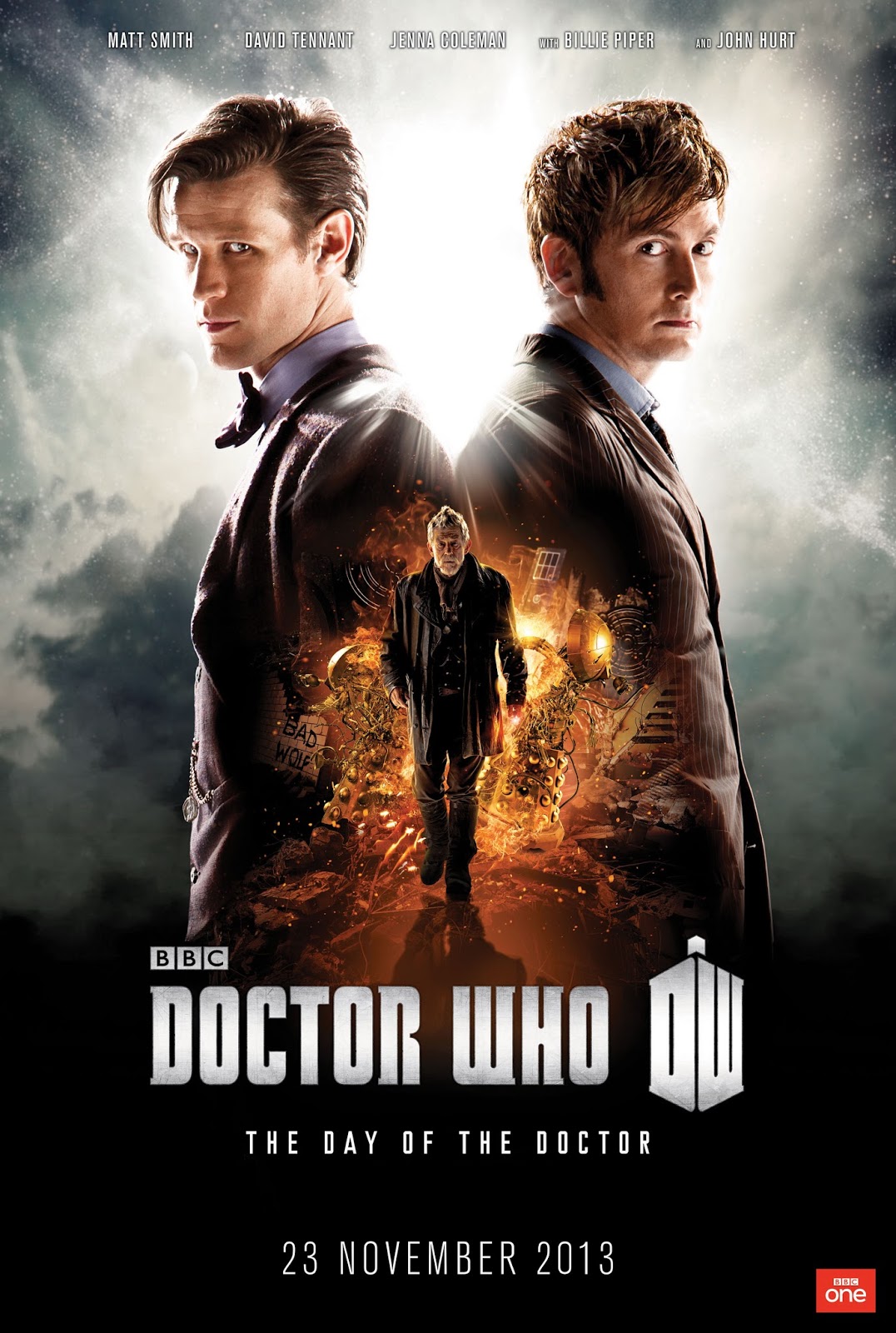
And so here we all are — November 23rd, 2013, exactly 50 years to the day from the broadcast of An Unearthly Child, and all of us, everywhere around the world, get to see The Day Of The Doctor, the culmination of an entire year of set-to-overdrive mass-marketing, at exactly the same time.

But was it any good?  And, furthermore, are we all still a bit too giddy to even care?

Well, having watched it twice now, I feel the time has come to give it at least something  of a fair-minded analysis, even if the glow of the occasion hasn’t faded entirely just yet.

day-of-the-doctor-batch-b-6


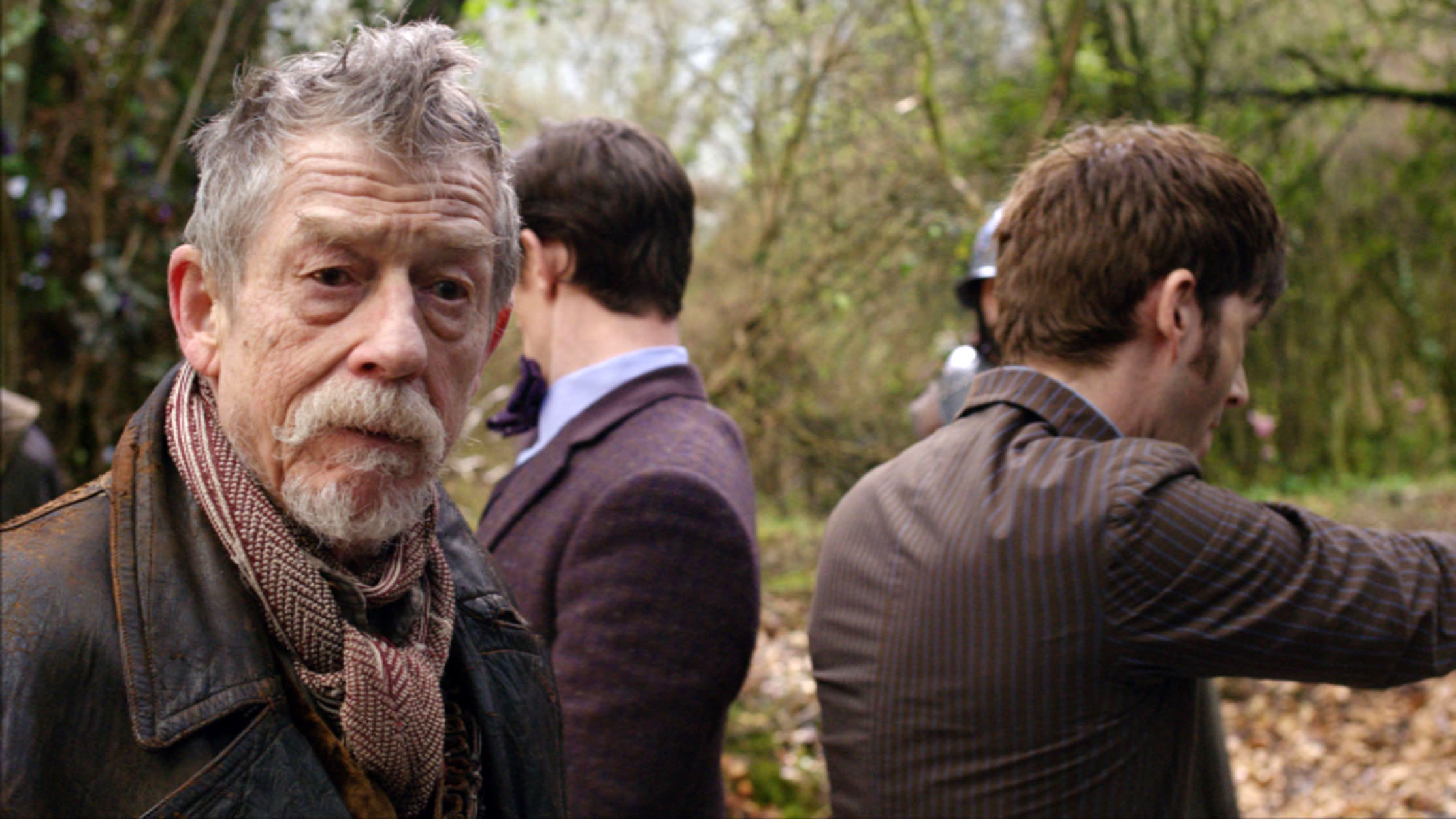
Indications were that we would probably very well be in for a monumental-type story that would shake the foundations of everything we knew and shake up the Etch-A-Sketch all over again. After intense months of speculation, the Night Of The Doctor mini-“webisode” (and thank you thank you for bringing  back Paul McGann !) confirmed that John Hurt was, indeed, a “missing Doctor” that none of us had known about before — furthermore, he was no ordinary Doctor, he was “The War Doctor,” whatever that means. We figured there would be Daleks. We knew David Tennant and Billie Piper were returning. We assumed we’d be plunged back into the Time War — and, once it was announced that Eleventh Doctor Matt Smith would be departing come the Christmas special, we guessed that we might finally get some inkling as to what his (far too heavy-handedly) forthcoming demise at a place called Trenzalore was all about.

We got some of that. And something else that we probably weren’t expecting, as well — an accessible, “stand-alone” story featuring the return of fan- favorite monsters the Zygons. For a time, at any rate.

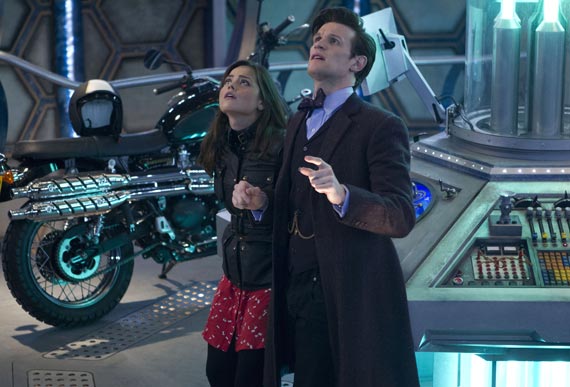
There’s some rather bland set-up material (that once again bastardizes the memory of U.N.I.T., this time doubling the insult by throwing The Brigadier’s daughter into the mix) with Smith and current companion Clara (played by Jenna Coleman) at the outset, then we do, in fact, go back into the Time War with John Hurt’s War Doctor, then we get re-introduced to Billie Piper (not, mind you, as Rose Tyler — in fact, she seems to still think she’s working on The Secret Diary Of A Call Girl here), and then, after cribbing much of the basic multi-Doctor story set-up idea from both The Thee Doctors and The Five Doctors, writer/head honcho Steven Moffat takes a turn and gives us a somewhat nifty standard-issue Zygon -invasion story that pretty much works, even if he did rip the core idea straight from Grant Morrison’s old Doom Patrol story “The Painting That Ate Paris.” No real harm in that, mind you — Doctor Who has often been at its best when liberally “borrowing” from other works.

Then, though, things do go a bit pear-shaped (again). After lots of fairly successful three-Doctor banter, some good, old-fashioned breaking out of jail cells (that were never locked, but that’s another story), some running around in corridors (yes!), and some nifty little doppleganging that should adequately thrill n’ chill the kiddies in the audience (and ,okay, some of us grown-ups, as well), Moffat does something — I dunno. Curious, I guess, if you’re being generous, and stupid and/or lazy if you’re not.

After spending over 40 minutes bringing the human/Zygon confrontation to a head, getting them all in a room, and employing a very nifty conceit to flat-out force them to negotiate, he drops the whole story. We never find out how it ends. And we’re back in Time War territory again. Only this time with a bigger Deus Ex Machina at the center of it than even anything RTD ever gave us — a big Hellraiser-box-on-steroids with a gleaming red button that the Doctor can push to just end everything.

And he does. Or did. But he doesn’t anymore.
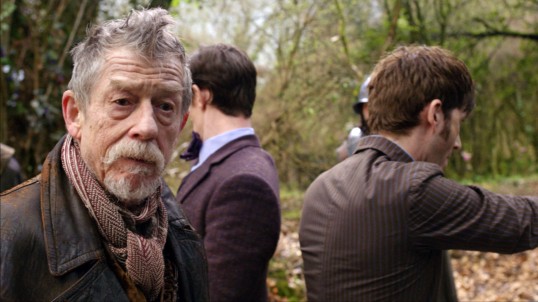
Doctor Who – 50th Anniversary Special - The Day of the Doctor


Look, we all know that this show has strayed pretty far from its roots. “You can’t change history, Barbara! Not one line!” has given way to a new “philosophy” of “time can be re-written.” But this, well — let’s just say that the very events that gave birth to the Ninth (or I guess that should now be Tenth) Doctor, Christopher Eccelston, and in turn his successors in the role — well, they’re just no more. The past seven seasons of the show? Well, I guess they still happened — but now, apparently, not the way we saw them. At least not anymore. And the Doctor is most certainly no longer the “Last Of The Time Lords.”

So — what does it all mean? Shit, I dunno. Gallifrey still exists. In a painting.  It never stopped existing (except, ya know, when it did). And whereas the entire history of Doctor Who is based on the concept of a Time Lord running away from home (even though that mythology was developed nearly a decade after the show first aired) — a point that was re-emphasized in The Five Doctors with Fifth Doctor Peter Davison”s famous “Why not? That’s how it all started!” line — now we’re told that the Doctor is going “where I’ve always been going — back home.”

So, ya know, all that Trenzalore stuff we’ve been building up to? Forget all that. It’s Gallifrey or bust now, folks!

I guess all this should be exciting — and maybe, on paper, it is. I like being thrust into unknown waters as far as Doctor Who goes. Even though I’m a bit of a self-admitted sad old traditionalist, as stated earlier. In the days when all we had going were the Eighth Doctor BBC novels, Lawrence Miles’ much-maligned Interference, which basically set all of Who continuity on its ear (for a time, at any rate) excited me. And all this could well do the same — if I had more confidence in the current show-running regime to get things right. Which I don’t. Buuuuuuttttt —

They did get some things here right, unquestionably. The “old school” opening shots in  black and white, complete with vintage theme music, were marvelous. The direction by Nick Hurran was energetic, pacy, and cinematic (in a good way) throughout. The Three Doctors redux portion of the story, with John Hurt functioning as a William Hartnell stand-in, was a joy to watch. Clara seems to be coming along nicely as a companion and was essential to the proceedings here without overshadowing them — as Davies had a tendency to do with Rose, in particular.  And as for that ending —
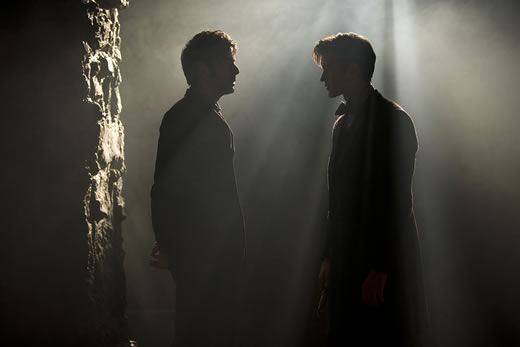
doctor-who-day-of-the-doctor-nov-17-13


Okay, it was about as subtle as a neo-Nazi march through downtown Tel Aviv in broad daylight, I’ll grant you — Clara : The curator wants to see you. The Doctor (sitting, as Clara exits) : Okay. A curator. I’d like to be a curator. I’d be a good curator. Curators are cool. I should retire one day. Maybe I’ll be a curator when I retire. Yes, that’s it, I’ll retire and be a curator. In fact, I bet in some “timey-wimey” way I’ve already done that. And this curator guy who’s about to talk to me, shit, who are we kidding? It’s me. Or another of me, at any rate. It’s Tom Baker. He’s here. In the building.  That’s Tom Baker standing right behind me — but still : it was. Tom Baker. Standing right behind him. And yes,  the dialogue was trying too hard to be mysterious and momentous and came off instead as clumsy, but cone on, people. There he was. The Doctor. My Doctor. And I deserve to smile for the rest of the day for that reason alone. And so do you.

So who knows? Maybe a partial changing of the guard is all that’s in order here. Maybe Moffat just needs to scrap all the baggage that’s hanging on Matt Smith — baggage that, okay, “The Moff” himself put there, but let’s not nitpick here — and start fresh with Thirteenth (did I get that right?) Doctor Peter Capaldi, who actually makes his brief debut in this story in another very cool (if, yeah, very gimmicky) moment. Maybe a re-write of the last seven-plus seasons is just what — sorry! — the Doctor ordered. Maybe it’ll be good for him to go home again. If — and only if — once that’s all over,  he follows the best advice his Ninth (excuse me, I guess that’s Tenth) persona ever gave : “run for your life!”

I’ve been waiting a good few years now for Doctor Who to relieve itself of the burden of its own excesses and get back to the strength — and dare I say beauty — of its core premise, as so splendidly told in Mark Gatiss’ awe-inspring TV movie (and the real highlight of the 50th anniversary so far) An Adventure In Time And Space — a mysterious traveler making his way through the the past, the present, and the future of the whole,  entire universe in a rickety old blue police box that’s bigger on the inside than it is on the outside. That, right there, is all we’ve ever needed.

The Day Of The Doctor did enough , glaring flaws notwithstanding, to make most any fan — including this one — feel more than just a little bit giddy throughout, and I’m reasonably thankful for that,  but it came up short in terms of re-setting the table in the kind of fundamental fashion I’m still hoping to see. It rattled the cupboards, and that’s a good first step, but we’ll have to see where and how the pieces fall after the Christmas special, which has rather stolen its thunder as the big “event” piece of Doctor Who for the year. We seem to be heading straight into the heart of Who mythology and continuity for one last (I hope, at any rate) big blow-out. So, yeah — let him go home again. If that’s what he needs to do to run away.

After all, that’s how it all started.


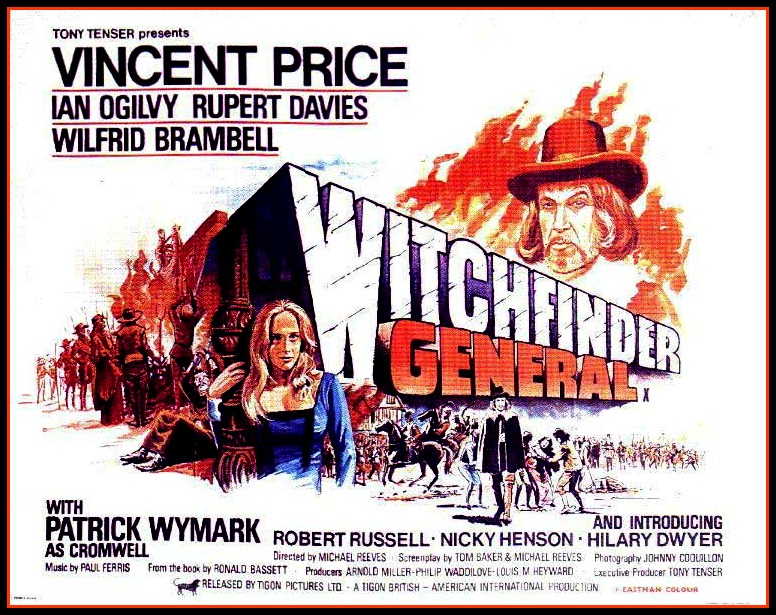
Quickie Review: Witchfinder General (dir. by Michael Reeves)


The late 1960’s saw a major shift in horror films. There have always been horror films which had an inordinate amount of gore and violence, but were always relegated to the niche cinemas which catered to horror exploitation films. In 1968 it all changed with the release of George A. Romero’s Night of the Living Dead. Not only did this film graphically show gore and violence on the screen it also paired it with a well-told story. Another film which became infamous the very same year for it’s portrayal of torture, rape and sadism on the screen was British filmmaker Michael Reeves’ horror film, Witchfinder General.

Witchfinder General starred horror icon Vincent Price in the title role as Matthew Hopkins who was tasked as the Witchfinder General by the Cromwell government during the English Civil War of the 17th-century. His Hopkins would travel the region of East Anglia (Cromwell-controlled territory) rooting out witchcraft and sorcery wherever they might be found. Assisting him in this task is the thuggish, brute Stearne (played by Robert Russell) who relished in torturing suspected witches in towns the two visit. It’s during one such visit to the town of Brandeston, Suffolk that Hopkins and Stearne begin a sequence of events which would pit them against the soldier Richard Marshall (who also happens to fight on the same side as Hopkins and Stearne) whose fiancee and her uncle became the latest victims of the Witchfinder General’s sadistic methods of rooting out confessions.

The film as a horror has less to do with the supernatural, but more of the hypocritical horror which begets a political environment where powerful men contest for more power and uses fear and the superstitious ignorance of a populace to cement their power. In this amoral vacuum comes in the opportunistic Matthew Hopkins who uses the power given to him by his government to not just do his duty to eradicate witchcraft but also abuse it for his own personal (and as seen in the film a way to sate his own personal lusts) gain. It’s this hypocritical nature of who was suppose to be a Puritanical and righteous agent of God which emphasizes the true historical horror of religion and politics becoming one and the same.

Vincent Price as Matthew Hopkins was at the top of his game in Witchfinder General. He gives his role not just an air of superiority over everyone he meets and deals with, but he also makes Hopkins’ truly an amoral character who sees nothing wrong in taking advantage of his position and actually feels like he deserves the desperate attentions of those willing to do anything to save their loved ones from his machinations. Robert Russell as his licentious and sadistic assistant Stearne also does a great job in portraying an individual who might seem brutish and thuggish, but who was also more honest with is situation than his master. It makes for an interesting pair despite their roles being the film’s prime antagonists.

The film more than truly earned the outcry it received upon it’s release in 1968 as scenes of torture and sadism was extreme for a British horror film industry so used to the Gothic sensibilities of the Hammer Films of the era. Graphic depictions of burnings, torture and drowning were done not to seem gratuitious or to cater to the burgeoning gorehound crowd of the era, but done so matter-of-factly that they seem even more horrific.

The Witchfinder General really helped usher in the death of gothic horror which dominated the genre with the Hammer Films in the UK and the Edgar Allan Poe films of Roger Corman in the US. The film continues to impress new generations of horror fans and is still considered by older fans of the genre as one of the best horror films ever made. For some the film might look dated due to the acting (most of the actors of the era were stage actors first and film ones second) and the effects work, but they also fail to look at the film in context of the era and how even by today’s standard it would still shock those not well-versed in the genre of horror. They definitely don’t make horror films like this anymore and that’s a shame on many levels.