This particular scene was my third favorite from Tobe Hooper’s Salem’s Lot.
There’s much to love about this scene. It’s a very claustrophobic sequence with our protagonist Ben Mears (played by David soul) left in the morgue by his friend Bill Norton for just a few minutes. The scene itself gradually builds in tension as Ben realizes that at any second the body on the morgue table could get up. The word vampire rarely gets uttered during the first third of the series, but Ben suspects the worst and he knows that he’s ill-prepared to deal with his fears if they bear fruit.
There’s a definite tv network quality to the way the scene is shot, but Hooper milks the creeping dread and terror with each passing second as Ben creates a makeshift crucifix and begins to chant random Bible passages as a way to bless his home-made icon. When his fears have been confirmed there’s not a sense of relief that he’s not crazy, but one of sheer terror.
This third joins part one and part two of my favorite scenes from Salem’s Lot and when witnessed as a set should give an idea just how terrifying and underrated this mini-series adaptation of the classic Stephen King vampire novel really is.
Those were some of the most terrifying words I’ve ever heard growing up. It’s all because of one scene from the tv mini-series which adapted Stephen King’s vampire novel, Salem’s Lot. It was a scene in the novel that terrified me as a young boy reading King for the first time.
I’ve always been gifted (or I sometimes say cursed) with having a very overactive imagination. This is why horror has always been such a fascinating genre for me. Even where the horror is all up in one’s face with it’s gore and messy aftermath my mind’s eye would make things worst or just constantly play it on repeat in my head days after the film has ended. It’s even worst when the horror comes across less through gore and more through atmosphere and built-up dread moving towards a jump-scare or something more insidious.
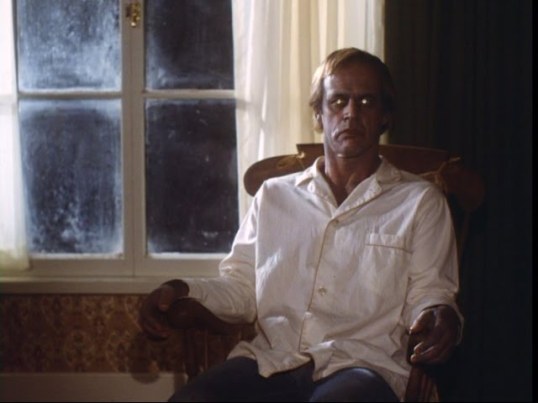
This particular scene is my second favorite from the Salem’s Lot mini-series. The first one I had posted a couple years back which just barely lags behind this one for third. What made this scene so effective despite it’s tv-style production was Tobe Hooper’s direction. Despite working with the censorship inherent in broadcast tv, Hooper was able to create a palpable sense of dread as the old English teacher Matt Burke senses a presence up in one of his house’s rooms. It was the same room where one of his former students had passed away in his sleep.
As the audience we already have an idea who or what is in that second floor room. Matt Burke has an idea as well, but his morbid curiosity wins out as he decides to investigate. Yet, despite such a lack in judgement he does come armed with a crucifix in hand. The way the scene builds and builds as Burke climbs the stairs and hesitating before opening the door to the room was almost too much to bear.
The reveal of his former student, Mike Ryerson, back in the room sitting in the rocking chair as one of the undead only increases the horror of the scene. His snake-like mannerisms was a new take on the vampire behavior. It’s not the usual silk and lace bloodsucker we grew up watching. This was a vampire that behaved like a predator beguiling it’s next prey. From the way Ryerson (played by Geoffrey Lewis) hissed his words and undulated his body as he stood to face his former teacher was disturbing at the very least.
Just writing about it and seeing the scene for the umpteenth time still gives me the shakes.
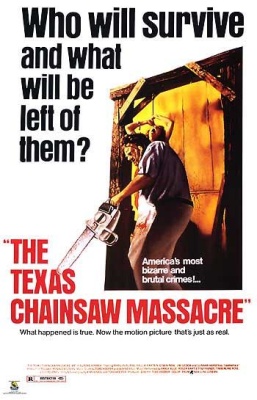
I like to use 2010’s Nightmare on Elm Street as the basis for horror remakes I’m not fond of. So when Texas Chainsaw 3D was announced, I automatically wrote it off as being something you could put on the shelf right next to this one. I have to admit I was actually surprised. Yeah, it’s a bad movie, but I didn’t find myself scoffing nearly as much as I did Nightmare, which really didn’t work for me at all. I just don’t see myself running back to see this one. I believe part of this has to do with the way the film opens.
Having gone into the film blind, I expected a remake of the remake. Essentially the same story we had with The Texas Chainsaw Massacre: The Beginning. The shock was that the film starts with the events of the original Tobe Hooper film, rendered in 3D (which was very cool, I might add). It then moves to the afternoon after the last victim ran away. This gives anyone who may be unfamiliar with the original a bit of a bridge, and personally having never liked any of the original sequels, I liked the aftermath that takes place.
Essentially, Texas Chainsaw 3d is the story of Heather Miller (played by Percy Jackson’s Alexandra Daddario), who receives word from her lawyer that she’s inherited a home in Dallas, Texas. What she doesn’t realize is that this inheritance comes with a few problems. She decides to hop in a van and head down there, accompanied by her friend Nikki (Tania Raymonde), Nikki’s date Kenny (Keram Malicki-Sanchez), and her boyfriend (Tremaine “Trey Songz” Neverson, who the girls in my audience gave the same whoops and catcalls normally reserved for Pattinson/Lautner in a Twilight Showing).
Basically, the movie becomes the cliché “draw this person into isolation and Bam!” that every horror film has, but I’ll admit that I watched a lot of those scenes with my eyes averted, so in that aspect, it got the job done. The visual makeup effects were done by Robert Kurtzman, the “K” in the KNB Effects group (The Walking Dead’s Gregory Nictotero and Howard Berger are the others), and there’s no shortage of blood in this film. While it’s not quite on the level on what the upcoming Evil Dead looks like – that appears to be on the epic Dead Alive levels – Chainsaw does have limbs lost, blood spurting and Leatherface’s signature weapon used to fullest extent. Those moments of isolation come of as very intense, and the direction isn’t bad.
The 3D in the film was nice, though used sparingly. To be honest, the best use of the effects was in what it added to the pieces of the original film that were used. I really enjoyed the outcome there and there are a few key “weapon in the camera” shots that may make you flinch.
Horror films have their eye candy. Sex sells, let’s face it. In Chainsaw, both Raymonde and Daddario had the guys captivated, and Scott Eastwood (Clint’s Son) works for the ladies. While there’s no nudity in the film, good considering how many kids were at my showing, there’s enough skin to appreciate.
What I didn’t like about the film was that in this day and age where you have smart heroes in horror stories – one need only look at Cabin in the Woods here – Chainsaw resorts to the classic “two step, drop” method, meaning that characters meaning to escape will only make it a few steps before stumbling over their feet. I don’t know if that works anymore for audiences. The times that it happened at my showing brought about more laughter than it did horror. Granted, I can’t say I’d be the best of runners with someone wielding a noisy chainsaw behind me, but you’d be damn sure I’d be up or kicking from the floor if I had to. Additionally, the heroes make a few stupid mistakes, which they have to I suppose. Still, I would have liked a few more smart moves. One other thing is that Leatherface himself, while menacing, doesn’t have the same effect that the Brynarski one in Marcus Nispel’s film with Jessica Biel. The Leatherface in that film was a hulking behemoth of a dude that ran with football player like speeds. Chainsaw 3D’s Leatherface is more like your grandpa that caught you stomping around his rose garden and chased after you with garden shears. It’s the equivalent of seeing Dawn of the Dead running zombies and going back to shuffling walkers.
Overall, Texas Chainsaw 3D isn’t anything fantastic and new. You can wait for it on 3D Blu-Ray. If you are an absolute fan of the series, it’s worth a look for both the connections to the original and a cool Gunnar Hansen cameo. Or you can watch it just for Daddario. Just make sure someone else buys you the ticket.
Stephen King’s novels and short stories were mined relentlessly during the late 70’s and through the 80’s and the early 90’s. For the most part the film and tv adaptations of his work were adequate and passable. Some were downright awful and made one wonder if King was just trying to cash as many of his work for licensing paychecks or if he really thought the studios who purchased the rights would actually do a good job adapting them. One such studio which seemed to have done a very good job adapting one of King’s greatest works, Salem’s Lot, was Warner Brothers who adapted the classic vampire novel to become a mini-series for CBS.
I never saw the mini-series when it first aired in 1979, but I did see it a few years later when it re-aired on TV and then many more times on VHS and then on DVD. Tobe Hooper directed the hell out of this mini-series and turned what was a very complex modern retelling of Bram Stoker’s Dracula into a 3-hour mini-series that was both gothic and downright terrifying despite the restraints of TV.
While the mini-series does seem dated now it still retains that creepiness, foreboding atmosphere and scares which made Hooper’s Salem’s Lot one of the better King adaptations. The scene which will always stick with me and still gives me the chills whenever I watch it is when Danny Glick’s younger brother visits him in the hospital. This scene is just downright scary whether watching it as a 9 year-old or one in their 30’s.
“I mean, in a sense we’re all vampires. We drain energy from other life forms. The difference is one of degree. That girl was no girl. She’s totally alien to this planet and our life form… and totally dangerous.” — Dr. Hans Fallada
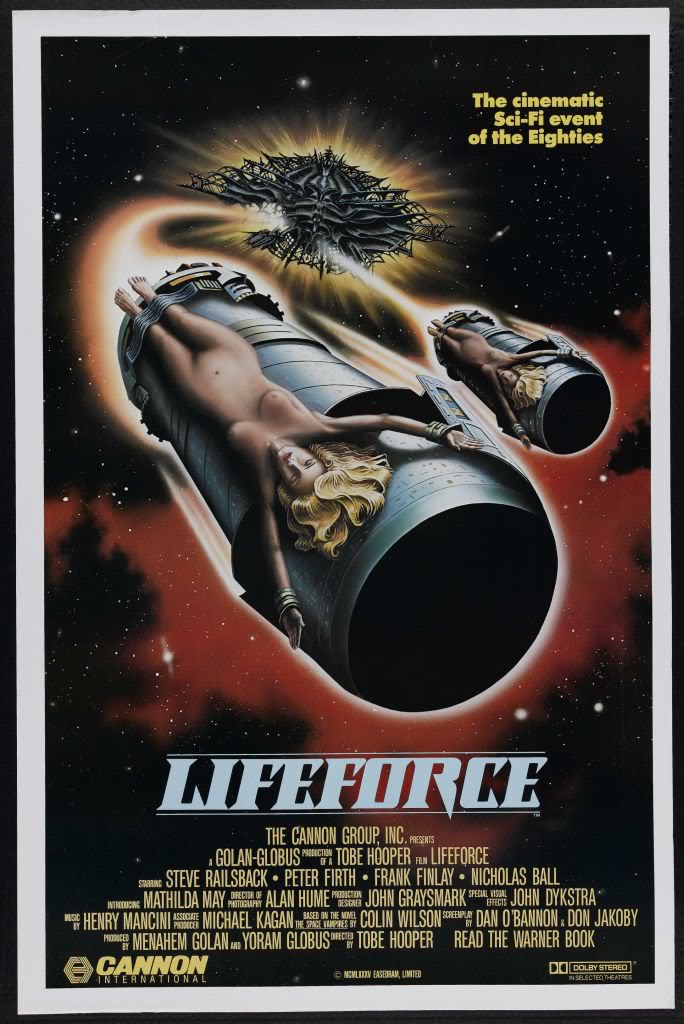
1985’s Lifeforce, directed by Tobe Hooper, was critically panned and barely registered at the box office. Yet in the decades since its release, something curious has happened: the film has gathered a loyal cult following among fans of science fiction and horror. Hooper’s film fuses so many genre conventions that it resists classification—too strange for pure sci-fi, too grandiose for standard horror. The result is a striking and eccentric reinvention of the vampire myth, a lavish but uncanny blockbuster that feels imported from an alternate cinematic timeline.
The film begins squarely in the realm of science fiction. Conceived during the public fascination with Halley’s Comet ahead of its 1986 return, Lifeforce rode the wave of comet-themed media flooding the decade. Most were cheap cash-ins. Hooper’s film stood out for its ambition and its visual scale.
Coming off Poltergeist, Hooper received an unusually large budget—a far cry from the lean, feral energy of The Texas Chainsaw Massacre. The story follows the crew of the shuttle Churchill as they discover a massive alien spacecraft hidden in the comet’s tail. Inside, frozen in suspended animation, are three humanoid figures. The ship’s dignified name feels ironic, even doomed; considering what’s to come, Demeter might have been more fitting. Like the sailors of Stoker’s novel, these astronauts inadvertently ferry an ancient predatory force home—yet this time, the threat arrives from the stars.
The horror unfolds once the crew retrieves its mysterious “specimens.” Members die in gruesome succession until only one survivor, Colonel Tom Carlsen (Steve Railsback), escapes in a pod back to Earth. Railsback’s performance is an intriguing mix of unhinged emotion and grim conviction. His intensity suits a film that constantly walks the line between pulp spectacle and cosmic tragedy.
When the story shifts to London, Lifeforce transforms into a supernatural thriller with procedural undertones. Peter Firth’s Colonel Colin Caine becomes the viewer’s compass: calm, authoritative, and determined to impose order on mounting chaos. As London succumbs to panic and outbreak, his steady professionalism anchors the outlandish events. His partnership with Railsback’s haunted, psychic Carlsen gives the middle act its volatile energy.
Among the supporting cast, Frank Finlay leaves one of the strongest impressions as Dr. Hans Fallada, a scientist fascinated by death and metaphysical energy. He serves as both philosopher and investigator, treating the vampiric invasion as a riddle of life itself. His restrained curiosity lends weight to scenes that might otherwise descend into absurdity. While the city collapses, Fallada studies the phenomenon with eerie calm, treating catastrophe as an experiment in cosmic entropy.
Patrick Stewart also makes a memorable, if brief, appearance as Dr. Armstrong, the head of a psychiatric hospital linked to the Space Girl’s psychic presence. His role builds to the film’s most grotesque and bizarre sequence: an exchange of minds, sudden possession, and an unnervingly intimate kiss with Railsback. The moment condenses everything Lifeforce represents—erotic, macabre, and unconcerned with boundaries. Stewart brings a gravitas that makes the absurd strangely compelling, a counterweight to Railsback’s volatility and Mathilda May’s silent allure.
May, as the unnamed Space Girl, says little but dominates the film through presence alone. She embodies an alien ideal of beauty and destruction, gliding through scenes with a composure that’s both sensual and predatory. Her nudity, much debated at the time, plays less as exploitation and more as elemental symbolism—the human body as an expression of both creation and death, desire and annihilation.
Supporting figures from the British military and government round out the ensemble, emphasizing the film’s descent into bureaucratic chaos. Michael Gothard’s Kane, a Ministry of Defence officer struggling to reconcile logic with the inexplicable, captures the helplessness of institutional order collapsing under cosmic threat. His pragmatic exchanges with Firth highlight competing instincts between reason and survival.
As the infection spreads, Lifeforce expands into a vision of urban apocalypse that fuses British science fiction and American spectacle. London becomes a nightmare tableau—crowds of shriveled corpses feed on energy while arcs of blue plasma swirl through the sky. The city’s fall evokes both George A. Romero’s zombie apocalypse and the metaphysical unease of Nigel Kneale’s Quatermass stories. Amid the insanity, Finlay and Firth remain the emotional touchstones, keeping the audience oriented as narrative logic begins to dissolve.
For all its ambition, however, Lifeforce suffers from erratic pacing and tonal whiplash. The first act unfolds with deliberate, moody wonder, then abruptly veers into frenzied exposition and psychic melodrama once the story reaches Earth. The balance between unsettling mystery and outright spectacle often collapses under its own weight. Scenes that should evoke cosmic terror sometimes tip into unintended camp, particularly in the dialogue-heavy middle stretch. Hooper’s direction, though visually imaginative, occasionally struggles to maintain coherence amid the script’s shifting identities—part creature feature, part disaster epic, part metaphysical drama. The editing, especially in the theatrical cut, undercuts tension with rushed transitions that leave emotional beats hanging. Railsback’s manic performance, while strangely compelling, can also verge on excess, blurring the line between conviction and chaos.
Tonally, the film wavers between awe and amusement. For some viewers, its earnest delivery will read as self-parody; for others, its collision of erotic horror and science fiction grandeur gives it a singular vitality. Lifeforce’s flaws are inseparable from its daring. It dares to fail boldly, and in that failure finds a kind of messy transcendence—larger than reason, too strange to fade.
In the end, Lifeforce lingers as one of the strangest hybrids of its era: part gothic fable, part erotic horror, part apocalyptic science fiction. It was too eccentric to find mainstream success, yet its sincerity and scope give it lasting resonance. The ensemble performances and tonal daring hold the film together, transforming potential chaos into something mythic—a story about possession, contagion, and humanity’s fatal pull toward the unknown.
Beneath its spectacle, the film engages in a deeper dialogue between gothic and cosmic horror traditions. Its characters represent a spectrum of responses to the incomprehensible: Fallada’s intellectual curiosity, Firth’s stoic resolve, Railsback’s frenzy, and May’s serene seduction. Together they form a portrait of human fragility in confrontation with the infinite. Where gothic horror finds fear in the collapse of reason, cosmic horror finds it in the vast indifference of the universe.
By fusing these lineages, Lifeforce becomes a mythic apocalypse that feels both intimate and vast—an encounter between flesh and void, terror and temptation. Its fusion of genres, ideas, and performances ensures its peculiar power endures, a reminder that some of the strangest failures of 1980s cinema are also its most visionary.