Valentine’s Day is a big deal! It can have more than one song of the day, right?
I mean, how can I let this day go by without sharing my favorite Bond theme song? All Time High may have been written because there weren’t many words that rhymed with Octopussy but it’s still not only one of my favorite Bond themes but also one of my favorite love songs.
Plus, it’s one of the few songs that I used to absolutely kill with during karaoke night at Grandpa Tony’s.
(Grandpa Tony’s was a nice little restaurant. The owner was a former boxer who had a crush on my mom so he had no problem with her four daughters singing their hearts out every Friday! The older you get, the more you treasure memories like that.)
All I wanted was a sweet distraction for an hour or two Had no intention to do the things we’ve done Funny how it always goes with love, when you don’t look, you find But then we’re two of a kind, we move as one
We’re an all-time high We’ll change all that’s gone before Doing so much more than falling in love On an all-time high We’ll take on the world and win So hold on tight, let the flight begin
I don’t want to waste a waking moment, I don’t want to sleep I’m in so strong and so deep, and so are you In my time, I’ve said these words before, but now I realize My heart was telling me lies, for you, they’re true
We’re an all-time high We’ll change all that’s gone before Doing so much more than falling in love On an all-time high We’ll take on the world and win So hold on tight, let the flight begin
So hold on tight, let the flight begin We’re an all-time high
The 1981 film, The Survivor, opens with a group of school children watching as a plane crashes in the distance. Of the 301 people on the plane, 300 die. Somehow, the only survivor is the pilot, David Keller (Robert Powell). It’s rare for a pilot to be the sole survivor, especially in a crash as severe as the one in this film. Even more shocking, David walks away without a scratch on him or any memory of what happened in the minutes before the crash.
Though the airline wants to keep David hidden away until after it has determined what caused the crash, David insists on helping with the investigation. He is haunted by strange visions and the sound of screaming passengers. He has to know if the crash was his fault or if there was a bomb on the plane. While the tabloid press tries to take his picture, the families of the victims blame him for the crash. “There he is,” one angry woman shouts at a funeral service that is overseen by Joseph Cotten (in his last film role), “the pilot who walked away!”
When one of the tabloid photographers gets a little bit too aggressive in his attempts to take David’s picture, he finds himself pursued by a ghostly apparition of a little girl. The photographer is so frightened of the little girl that he stumbles in front of a train, which has to rank right up there as one of the dumbest ways that someone can die in a horror movie. Later, the photographer’s girlfriend tries to look at one of the pictures of David and her hand is promptly chopped off by a paper cutter. That’s not quite as bad as stumbling in front of a train.
As David tries to understand what is happening, he realizes that he’s being followed by a woman named Hobbs (Jenny Agutter). Hobbs says that she is a medium. She witnessed the crash and now, she’s in contract with the spirits of the dead. At one point, David and Hobbs suddenly start trying to strangle each other. They manage to break free of whatever has possessed them but it’s obvious that these spirits are not fooling around. (That said, the attack begins and ends so abruptly that, for those of us watching, it inspires more confusion than fright.)
The idea behind The Survivor is an intriguing one. The film was directed by David Hemmings, the British actor who is probably best-remembered for starring in the 60s classic, Blow Up and in Dario Argento’s classic Deep Red. Along with co-founding Hemdale Films, Hemmings also directed a handful of movies. Unfortunately, intriguing premise aside, The Survivor is not one of Hemmings’s better directorial efforts. There are a few effective visuals and Jenny Agutter is well-cast as Hobbs but the film’s pace is extremely slow and Robert Powell seems to be more bored than enigmatic as the title character. The film’s plot calls out for an all-out grindhouse approach. Hemmings’s instead gives us a stately and rather self-important film that ultimately feels like a lesser episode of some obscure 70s anthology show.
That said, this film does feature Joseph Cotten in his final film appearance. He only has two scenes but he brings a quiet dignity to the role of the Priest. The film doesn’t really work but Joseph Cotten and Jenny Agutter give performances that survive the wreckage.
Today, the Shattered Lens wishes a happy birthday to recording artist Rita Coolidge!
Rita Coolidge, who rose from being a backing singer to being a successful headliner in her own right, sung my favorite James Bond theme song, All Time High from Octopussy.
(Not surprisingly, this was a rare care of the Bond film’s title not being used in the theme song.)
I love this song and not just because it’s one of the few that I can actually sing. As performed by Coolidge, this song captures the romance, mystery, and fun that epitomized the Bond franchise before Daniel Craig came along and turned James Bond into a sexless, weepy loser.
It only seems appropriate to make All Time High today’s song of the day!
All I wanted was a sweet distraction for an hour or two Had no intention to do the things we’ve done Funny how it always goes with love, when you don’t look, you find But then we’re two of a kind, we move as one
We’re an all-time high We’ll change all that’s gone before Doing so much more than falling in love On an all-time high We’ll take on the world and win So hold on tight, let the flight begin
I don’t want to waste a waking moment, I don’t want to sleep I’m in so strong and so deep, and so are you In my time, I’ve said these words before, but now I realize My heart was telling me lies, for you, they’re true
We’re an all-time high We’ll change all that’s gone before Doing so much more than falling in love On an all-time high We’ll take on the world and win So hold on tight, let the flight begin
So hold on tight, let the flight begin We’re an all-time high
One Night in Bangkok was written, by Benny Andersson, Bjorn Ulvaeus, and Tim Rice for a musical called Chess.Chess, which was meant to be a satire of the Cold War, tells the story of two chess champions, one an American and one a Russian. One Night in Bangkok opens the second act as the American, who has now retired from playing professionally, is hired to provide commentary for a chess championship that is being held in Bangkok. As is evident from the lyrics, he is not impressed by the city. In fact, the American was so unimpressed by the city that the song was banned in Thailand and officially condemned by the Thai government.
The song was performed by actor Murray Head, who played the American in the Broadway production. The single proved to be an unexpected hit, reaching number three in Canada and the U.S. and number twelve in the UK. It’s gone on to have a long life outside of Broadway, being successfully covered by several different groups.
As of this writing, it’s still officially banned in Thailand.
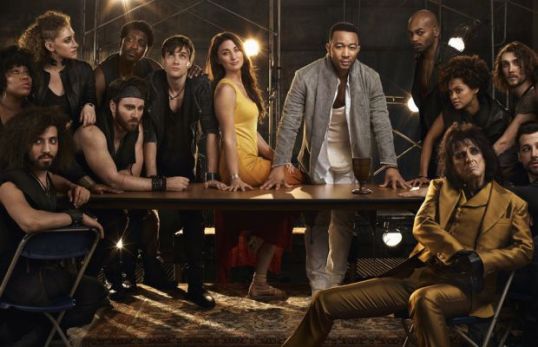
On Sunday night, my family and I ended our Easter Sunday by watching Jesus Christ Superstar Live. Now, before I say anything else about NBC’s latest live musical production, there are a few things that I should make clear:
In college, there was this girl in my dorm who started the semester as a pagan, spent a month as an evangelical, and then ended the semester as a pagan again. When she was going through her evangelical phase, she would listen to the Jesus Christ Superstar soundtrack constantly, with the volume turned up so loud that you could hear it up and down the hallway. Seriously. 24 hours a day. 7 days a week. After three days, I was sick of hearing it. I found myself wondering if anyone had ever been driven to murder over having to listen to Heaven On Their Minds one too many times. Fortunately, something happened to cause her to once again lose her faith and she went back to listening to Fall Out Boy.
For quite some time afterward, I would instinctively cringe whenever I heard any of the songs from Jesus Christ Superstar. In fact, it wasn’t until I first came across the 1973 film version that I was able to once again appreciate it as a musical and overlook its association with that annoying pagan. From the first time I watched it, I really liked that movie and, every time I rewatch it, I like it even more. When I started watching Sunday’s production, I was seriously wondering if I’d be able to set aside my feelings about both the pagan and the movie and judge the television version on its own merits.
Well, I shouldn’t have worried. While I still prefer the original film version, Sunday’s television production was wonderfully conceived and executed. From the first note of music to the final curtain call, Jesus Christ Superstar Live In Concert captured my attention and refused to let it go, keeping me watching even through the lengthy commercial interruptions. The musicians and the singers sounded great, or at least they did once the audience mics were turned down. (At the start of the show, the audience was so loud that they threatened to drown out Heaven On Their Minds.) The production design was simply amazing, combining downtown New York with ancient Judea in a way that reminded us just how timeless the musical’s story truly is. (The 1973 film opened with a bunch of hippies driving through the desert. The 2018 production opened with Jesus’s name being spray painted on a wall. Both openings felt perfect for the story that was being told.)
As for the cast, Brandon Victor Dixon was compellingly intense as Judas and Norm Lewis was properly intimidating as Caiaphas. The big marquee name was Alice Cooper, who obviously enjoyed playing the production’s burlesque version of Herod. That said, the entire show was stolen by Ben Daniels, who was wonderfully conflicted as Pilate. I wasn’t as impressed by Sara Bareilles as Mary Magdalene, or I should say that I apparently wasn’t as impressed with her performance as everyone else on twitter. (To me, she seemed a bit too peppy, especially in the early numbers. I know I’m in the minority as far as that goes.) Finally, in the role of Jesus, John Legend grew on me. Of course, in the show, Jesus doesn’t really become an interesting character until he sings “Poor Jerusalem” and that was the moment that Legend himself seemed to truly feel comfortable with the role.
It’s probably pointless to compare the 1973 film to the 2018 version but still, I did find it interesting how the live version reimagined the relationship between Jesus and Judas. In the 1973 version, Jesus is largely aloof for almost the entire film. Judas seems to be frustrated because he can’t figure out what Jesus is planning to do and Jesus himself never seems to feel that he can allow himself to get truly close to anyone. In the film, Judas’s anger is the anger of someone who has spent the last few years of his life following a leader and who is now wondering if he’s been wasting his time. He’s like a Democrat who has just realized that his party is even less interested in reigning in Wall Street than the Republicans.
In the live version, the Jesus/Judas relationship came across as being a bromance gone wrong. In this version, Judas’s disatisfaction is less political and more jealousy over Jesus being closer to the Magdalene than to him. When Judas snaps at Jesus in the 2018 version, Jesus actually seems to get personally offended. The dynamic between Dixon and Legend is definitely different from the one between Ted Neeley and Carl Anderson in the original version. Of course, there’s nothing wrong with that. That’s one of the wonderful things about theater. When successfully done, each subsequent production brings something new to an old story.
Jesus Christ Superstar definitely worked. As far as the current wave of live television musicals is concerned, this was the best one yet.
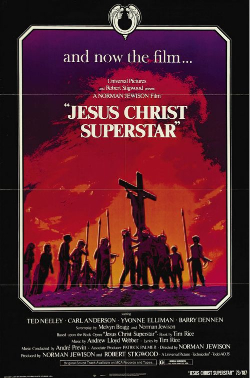
The 1973 film, Jesus Christ Superstar, opens with a desert in Israel. All is still. All is quiet. Suddenly, we see a cloud of dust in the distance. A bus is speeding through the desert and the music on the soundtrack explodes with a sudden urgency.
The bus comes to a stop and we notice that there’s a big cross tied to the top of it. The doors open and suddenly — oh my God, it’s hundreds of hippies! American hippies In Israel! They’re climbing off the bus, one after another. Some of them are being tossed sub machine guns. Another gets a whip. One of them puts on a purple robe and looks like he is slightly disturbed. Others are dressed in black. Makeup is applied. Everyone’s having a great time. One heavy-set fellow, with frizzy hair, climbs to the top of the bus and sits down on a throne. He watches as everyone else pulls down the cross. One long-haired man, who was never seen leaving the bus, is suddenly among the hippies. He’s dressed in white and everyone is suddenly bowing before him.
Well, almost everyone. One of the bus’s passengers, a serious-looking man (Carl Anderson), has walked away from the hippies. From a safe distance, he looks back at them and he seems to be as confused by all of this as we are.
Why is everyone in the desert? That’s relatively easy to explain. They’re performing a Passion Play. Carl Anderson is playing Judas. The man in white is Ted Neeley. Whether he is meant to be an actor playing Jesus or Jesus himself is a question that the movie leaves for you to decide. We never see him get off the bus and, perhaps more importantly, we don’t see him get on the bus at the end.
(Just you watch. I’ll mention that Jesus gets crucified at the end of this movie and someone will pop up in the comments and say, “How about a spoiler alert?”)
Hmmm…religion and hippies. Those are two things that, in the past, I have definitely had issues with. In fact, you would totally be justified in assuming that I would hate Jesus Christ Superstar. And yet, I don’t. I actually rather like it.
True, there are some things that make me cringe. The sound of all the disciples singing, “What’s the buzz, tell me what’s a happening?” always makes me shudder and say, “Oh my God, this is so 1973!” A scene where Judas suddenly finds himself being chased through the desert by a modern tank is just a bit too on-the-nose. Finally, I understand that Ted Neeley’s stage performance as Jesus is highly acclaimed but, to me, his performance in this film will always be known as the Screaming Jesus. Too often, it’s obvious that Neeley is still performing as if he’s on stage and has to project to the back row. It’s interesting to compare him to Carl Anderson, who also played Judas on stage but who, in the movie, gives a performance that is powerful specifically because it’s a cinematic performance, as opposed to a stage performance.
But, even with all that in mind, there’s so much about this movie that works. Based on the rock opera by Tim Rice and Andrew Lloyd Webber, Jesus Christ Superstar is definitely a product of its time, serving as a time machine for amateur historians like me. (Then again, I guess you could say that about any movie the opens with hippies driving a school bus across Israel.) Sometimes, the lyrics are a bit obvious but the songs still stick around in your head. And it’s not just Carl Anderson who gives a good performance. Yvonne Elliman, Josh Mostel, Bob Bingham, Larry Marshall, Barry Dennen — they all contribute strong work, both musically and otherwise.
And then there’s the big Simon Zealotes/Poor Jerusalem production number:
There’s several reasons I love this scene but mostly it just comes down to the fact that it captures the explosive energy that comes from watching a live performance. Larry Marshall (who plays Simon Zealotes) has one of the most fascinating faces that I’ve ever seen in a film and when he performs, he performs as if the fate of the entire world depends on it. As previously stated, I’ve never been sold on Ted Neely’s performance as Jesus but Carl Anderson burns with charisma in the role of Judas.
Mostly, however, I just love the choreography and watching the dancers. I guess that’s not that surprising considering just how important dance was (and still is, even if I’m now just dancing for fun) in my life but, to be honest, I’m probably one of the most hyper critical people out there when it comes to dance in film, regarding both the way that it’s often choreographed and usually filmed. But this scene is probably about as close to perfect in both regards as I’ve ever seen. It goes beyond the fact that the dancers obviously have a lot of energy and enthusiasm and that they all look good while dancing. The great thing about the choreography in this scene is that it all feels so spontaneous. There’s less emphasis on technical perfection and more emphasis on capturing emotion and thought through movement. What I love is that the number is choreographed to make it appear as if not all of the dancers in this scene are on the exact same beat. Some of them appear to come in a second or two late, which is something that would have made a lot of my former teachers and choreographers scream and curse because, far too often, people become so obsessed with technical perfection that they forget that passion is just as important as perfect technique. (I’m biased, of course, because I’ve always been more passionate than perfect.) The dancers in this scene have a lot of passion and it’s thrilling to watch.
Beyond that, there’s the insane burlesque of Josh Mostel’s performance as Herod and Barry Dennen’s neurotic interpretation of Pilate. There’s Yvonne Elliman’s performance of I Don’t Know How To Love Him. There’s that famous closing shot, a happy accident that was achieved when a shepherd just happened to wander past the camera.
And, of course, there’s this:
The performance above pretty much sums up the appeal of Jesus Christ Superstar. It’s both ludicrous and powerful at the same time.
I know there’s some debate as to whether Jesus Christ Superstar is sincere or sacrilegious. In college, there was this girl in my dorm who started the semester as a pagan, spent a month as an evangelical, and then ended the semester as a pagan again. When she was going through her evangelical phase, she would listen to the Jesus Christ Superstar soundtrack constantly. Seriously. 24 hours a day. 7 days a week. After three days, I was sick of hearing it. I found myself wondering if anyone had ever been driven to murder over having to listen to Heaven On Their Minds one too many times. Fortunately, something happened to cause her to once again lose her faith and she went back to listening to Fall Out Boy.
I don’t think that, as conceived by Rice and Lloyd Webber, Jesus Christ Superstar is in any way sacrilegious. At the same time, it does have a potentially subversive streak to it. This is especially true of the film version. At times, director Norman Jewison seems to be almost deliberately parodying the excesses of more conventional religious films. Instead of spending millions to recreate the ancient world, Jesus Christ Superstar uses ruins and desert. Instead of featuring ornate costumes, Jesus Christ Superstar features Roman soldiers who wear pink tank tops. Ultimately, Jesus Christ Superstar reveres Jesus but dismisses the conventions of both organized Christianity and epic filmmaking. Judah Ben-Hur would not have known what to do with himself if he wandered onto the set of Jesus Christ Superstar.
It’s over the top, silly, ludicrous, and ultimately rather powerful. Jesus Christ Superstar is a film that shouldn’t work and yet it does.
 Through the Shattered Lens