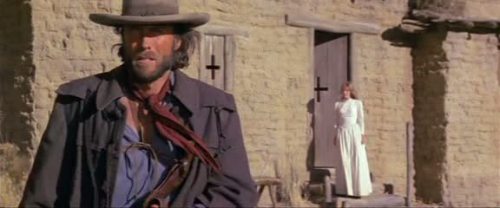
Towards the end of 1976’s The Outlaw Josey Wales, Josey (played by Clint Eastwood) says, “I guess we all died a little in that damned war.”
He’s referring to the American Civil War and the film leaves you with no doubt that Wales knew what he was talking about. A farmer living in Missouri, Josey Wales wasn’t involved in the Civil War until a group of guerillas, the Redlegs, raided his home and killed his family. Seeking vengeance, Wales joined the Bushwackers, a group of Confederate guerillas that were led by the infamous “Bloody Bill” Anderson. After Anderson’s death and the South’s surrender, Senator James H. Lane (Frank Schofield) offers amnesty to any of the Bushwackers willing to surrender and declare their loyalty to the United States. Fletcher (John Vernon), the leader of the surviving Bushwackers, thinks it’s a good idea and his men eventually agree to surrender.
Everyone except for Josey Wales.
Fletcher tells Josey that he’ll be an outlaw and that Lane will send his men to capture and execute him. “I reckon so,” Josey Wales replies. It’s not that Josey was particularly a fan of the Confederate cause. Instead, having lost his family and his home and having seen hundreds of men killed, Josey no longer cares. He’s got a death wish, something that becomes apparent when he later sneaks over to Lane’s camp and discovers that the leader of the Redlegs, Terrill (Bill McKinney), has been made a captain in the Union Army. The surrendering Bushwackers, with the exception of Fletcher and a young man named Jamie (Sam Bottoms), are gunned down as they swear allegiance to the United States. Joey springs into action, hijacking a Gatling gun and mowing down soldiers. It’s a suicidal move and Josey appears to be willing to die, until he sees that Jamie has been wounded. Josey and Jamie go on the run, pursued by soldiers and bounty hunters.
It sounds like the start of typical Clint Eastwood film and, make no mistake about it, The Outlaw Josey Wales features everything that most people have come to expect from Eastwood. Josey Wales is an expert shot, often firing two guns while charging forward on his horse. Josey has a way of words, explaining the purpose of getting “plain man dog mean” and telling a bounty hunter that there are better ways to make a living. The main difference, though, is that Josey is no longer seeking revenge. He’s lost his family and his home and he knows nothing is going to bring them back. He sought revenge during the Civil War and saw so many people killed that, much like Jimmy Stewart in Broken Arrow, he just wants to disappear from civilization.
The problem is that men like Lane and Terrill have no intention of letting Josey Wales disappear. The sociopathic Terrill sees it as almost being his God-given duty to kill Josey Wales and anyone else that he dislikes. The bounty hunters are also after Josey Wales. As Fletcher explains it, bounty hunting is the only way that many former soldiers can make money and feed their families. As Josey moves through the southwest, his legend grows. Every town that Josey stops in, he hears stories about the growing number of men that he has supposedly killed.
Josey also discovers that he can’t do it all alone. He soon finds himself as a part of a new family, a collection of misfits that don’t have a home in Senator Lane’s America. Lone Waite (Chief Dan George) is an elderly Cherokee man who suggests that Josey head for Mexico. Little Moonlight (Geraldine Keams) is a Navajo woman who Josey rescues from two bounty hunters. Sarah Turner (Paula Trueman) and her granddaughter, Laura Lee (Sondra Locke), are rescued from Comancheros. Josey negotiates the release of two of Sarah’s ranch hands and befriends Chief Ten Bears (Will Sampson) while doing so. Slowly, Josey comes out of his shell and starts to embrace life once again. Josey goes from searching for death to searching for peace.
It’s one of Eastwood’s best films, ending on a note of not violence but instead sad regret. It’s not only a portrait of a man learning to embrace life but it’s also a portrait of a country trying to figure out how to come back together after the bloody savagery of the Civil War. Some, like Fletcher and Josey, want to move on. Others, like Terrill, don’t have an identity beyond fighting and killing. Eastwood gives a good performance but, as a director, he gives every member of the cast a chance to shine. If you only know John Vernon as Dean Wormer from Animal House, his sad-eyed performance here will be a revelation.
Originally, The Outlaw Josey Wales was meant to be directed by Phillip L. Kaufman but Eastwood felt that Kaufman was taking too long to set up his shots and worrying about details that really didn’t matter. Reportedly, while Kaufman was away from the set, spending hours searching for a historically-correct beer bottle to be used in a bar scene, Eastwood directed the scene himself and then convinced producer Robert Daley to fire Kaufman and allow Eastwood to direct the film. (Kaufman also objected to the script’s anti-government subtext but seriously, that’s pretty much the subtext of every film that Eastwood has ever been involved with.) The DGA later instituted a rule that, on productions in which the director was fired, the replacement could not be a member of his crew or an actor in the cast but that was too late to help out Kaufman.
(Rumor has it that another reason Kaufman was fired was because he and Eastwood both “liked” Sondra Locke. This was the first of six films that Eastwood and Locke would do together.)
To be honest, I think it worked out in the film’s favor. It’s a little surprising that someone other than Eastwood was ever considered as director to be begin with, so perfectly does the story and the lead character fit with Eastwood’s persona. Eastwood captures both the beauty of the untouched land and also the bloody violence of combat. In many ways, this film almost feels like a prequel to Unforgiven. The Outlaw Josey Wales is Eastwood at his best.




 Through the Shattered Lens