Before I talk about this trailer, allow me to share a few facts: my family used to live in Fouke, Arkansas! I’ve been down to Boggy Creek! I never saw the famous Fouke Monster but I went out looking for him a few times! Anyway, this is the trailer for The Legend of Boggy Creek, which is a documentary about an apeman that supposedly lives in the area (though, according to Wikipedia, he hasn’t been spotted since ’98 so maybe he drowned or moved to Missouri). This film is somewhat infamous because it features reenactments of various monster sightings, some of which star people who actually lived in Fouke at the time and who play themselves (and a few of them later sued once the film came out). It was also the first film directed by Charles B. Pierce, who directed a lot of independent films in Arkansas and North Texas, including the classic The Town That Dreaded Sundown. Sadly, Pierce passed away last year at the age of 71.
This is one of those trailers that I discovered while randomly searching Youtube and, I have to be honest, my first thought was that it was a parody trailer. But no, after researching the manner, I can say that Mean Mother is a real movie. It was apparently yet another one of the cinematic offerings of the late Al Adamson.
This Italian film is one of the countless Omen/Exorcist rip-offs that came out in the 70s. Actually, The Night Child is an indirect rip-off of those two films as it’s actually a rip-off of a previous Italian version of the Exorcist, Beyond The Door. What I especially love about this trailer is the “Keeping telling yourself, she’s only a child,” line which is obviously meant to recall the “Keep telling yourself, it’s only a movie…” tagline from Last House On The Left.
“Meet today’s women…beautiful, liberated, and ready for action! They’re the young nurses and they’re growing up fast!” I love the narrator of this trailer. I’ve heard his voice in several exploitation trailers from the early 70s and he just has a way of delivering the sleaziest lines in the most cheerful, harmless way. I’d love to know who he was and if he’s still with us.
Oh. My. God. Okay, I saw this movie a few years ago and I was watching it by myself at 3 in the morning with all the lights off while there was a thunderstorm going on outside and there was this howling wind that kept on making all the windows shake. I got so scared, it’s not even funny. This is a remake of the silent classic. It stars Klaus Kinski, Bruno Ganz, and Isabelle Adjani and was directed by the one and only Werner Herzog.
“Why don’t you come along and see me this week? And bring your girlfriend…” This trailer was specifically designed to promote this film in Australia. Needless to say, that’s not actually Sylvia Kristel providing the voice over.
Earlier this morning, while suffering from an annoyingly persistent case of insomnia, I decided to spend 2 hours watching a classic Italian exploitation film, Alberto De Martino’s oddly effective Omen rip-off, Holocaust 2000.
In Holocaust 2000, Kirk Douglas plays a businessman who wants to build a gigantic nuclear power plant in the Middle East. There are a few problems with this plan. First off, the site that Douglas selects just happens to be right next to a cave that is full of religious artifacts. Secondly, there’s a handful of angry environmentalists picketing his London office. And, perhaps the biggest problem, Douglas’ son happens to be the Antichrist. This fact is obvious to the viewer because not only is his son named Angel (yes, we’re in the land of irony) but he also looks and acts nothing like Douglas. Not only does Angel have a noticeably weak chin (no cleft to be seen at all) and speak with a rather posh accent but he’s also so extremely English that he’s even played by an actor named Simon Ward.
In other words, the viewer is pretty much in on the game from the beginning. What makes the movie work is that director De Martino understands that everyone’s going to know that Angel’s the antichrist from the minute he first appears so, as opposed to the Omen films, he doesn’t waste a lot of time playing any “is-he-or-isn’t-he” games. Instead, in the great tradition of Italian exploitation, De Martino jumps straight into the apocalypse without worrying about things like narrative cohesion and the end result is an enjoyably chaotic film that rarely makes sense but is never boring. Whereas the Omen films are almost tedious in their attempts to provide theological justification for all the blood that’s spilled on-screen, Holocaust 2000 has a cheerful, let’s-make-it-up-as-we-go-along feel to it that, at times, almost makes the whole thing feel like some long lost Lucio Fulci film.
Holocaust 2000 is probably best known for two sequences. The first features a helicopter blade very graphically chopping off the top of a man’s head. If seeing the original Dawn of the Dead made me nervous around helicopters, seeing Holocaust 2000 has ensured that I will never ever step anywhere near one of those things. Seriously, I’ve seen a lot of gore over the past few years but the decapitation scene in this movie …. well, perhaps it’s best to just shudder and move on. (For the record, Holocaust 2000 came out before Dawn of the Dead so the helicopter decapitation scene here was not stolen from that film. If anything, it was simply a more graphic version of David Warner losing his head in the Omen.)
The second sequence is a scene in which a very nude Kirk Douglas (who, it must be admitted, looked a lot better at 61 than most 20 year-olds do today) has a nightmare in which he watches the world literally come to an end. Set to Ennio Morricone’s intense and memorable score, this sequence manages to be surreal, disturbing, and entertaining all at the same time. It epitomizes everything that makes Holocaust 2000 such a surprisingly effective work of pure cinematic exploitation.
Like many of the great Italian exploitation films, Holocaust 2000 was released under several titles. It is currently available on DVD under the title Rain of Fireand a big bleh to Lionsgate for choosing to go with such a boring name. Admittedly, I can see their logic. Though the movie was first released in theaters in 1977, it took 31 years for it to show up on DVD. During that time, 2000 came and went and the world didn’t end (or maybe it did and the last 10 years have just been an extended hallucination, the choice is yours). But still, Rain of Fire sounds like a substandard country song about a nasty divorce that ends in murder. On the other hand, a title like Holocaust 2000 — nakedly exploitive and borderline offensive — represents everything that we’ve come to so love about Italian exploitation films.
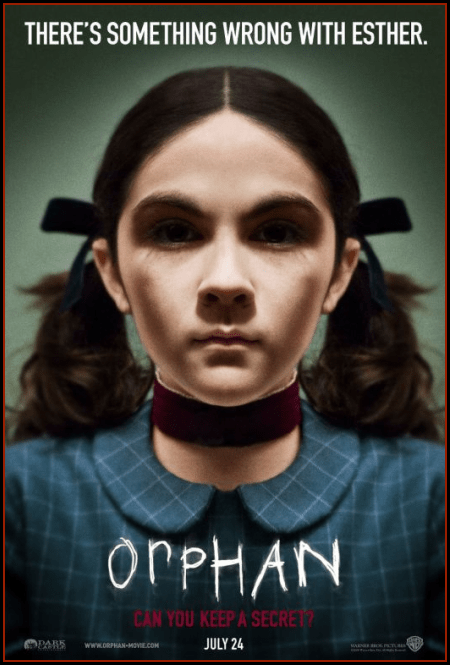
There has been a complaint which has been getting louder and louder for the past several years from both horror and mainstream film fans. The complaint is that horror films of late have either been remakes or another sequel. While this complaint is not exclusive to the horror genre (non-horror genres have had the same problem) it is more prevalent and happens more often. Once in awhile a film will come out that tries to be different and put out an original story. Spanish director Jaume Collet-Serra has done just that with his second foray into feature filmmaking with Orphan. While the film won’t win many awards and become the critical darling the way Let the Right One In did Collet-Serra’s Orphan does bring a fresh new take on the evil child subgenre. Despite some of the flaws and script problems the film does entertain throughout most of its running time until it loses steam in the final 15 minutes.
Jaume Collet-Serra first got his start directing the 2005 remake of House of Wax. A film more famous (infamous in some people’s eye) for being the first major film of socialite Paris Hilton. A film that deservedly got panned by critics, but still did well enough in the box-office to put horror fans on notice that Collet-Serra might be a filmmaker to keep an eye on. Orphan marks his second full-lenght feature and using the screenplay by David Leslie Johnson, Collet-Serra tries a hand in the evil child subgenre which has more than it’s share of classic titles like The Omen, The Bad Seed and The Good Son. While this subgenre of horror usually means some sort of demonic-possession or some sort of mental or genetic abnormality causing for their psychotic or sociopathic behavior, in Orphan an interesting reason was given to the nature of it’s titual character.
The film begins with a harrowing and quite disturbing scene of the Vera Farmiga’s character pregnant and in labor, but also starting to miscarriage her child. The graphic nature of the scene quickly lays down the hammer that Orphan will not hold things back just because childen will be involved throughout most of it’s running time. We then see Farmiga’s Kate and her husband John (played by Peter Sarsgaard) at the local orphanage as they attempt to fix their family and ease Kate’s emotional turmoil over the miscarriage by adopting a child. They meet Esther a 9-year-old Russian orphan girl who seem to be the perfect child at first glance. Esther’s well-spoken and well-mannered at such a young age. Esther soon becomes part of John and Kate’s young family which consists of a younger deaf daughter named Max and a son named Daniel. While Max accepts Esther as a new older sister Daniel senses something just off-putting about Esther and reacts much more coldly towards his new dopted sister.
The majority of Orphan‘s second and first half of the third and final reel shows Esther’s true nature peek through the facade of Old World genteel and proper behavior. 12-year-old Isabelle Fuhrmann does an excellent job portraying the sociopathic and manipulative Esther. It is difficult to believe that a child actor of her age able to tackle such a dark role and actually pull it off without making the character too over-the-top or campy. In fact, no matter how one thinks of the performances of the rest of the film’s cast (Farmiga does a good job in the Cassandra-role with Sarsgaard an average performance as the hapless and clueless husband) this film is totally Fuhrmann’s and she sticks the landing.
While the film tries to make something original (and most of it is to a point) out of a tried-and-true model of the evil child storyline the script doesn’t hold up through the length of the film. The story itself is quite interesting when one really steps back to look at it, but there’s several leaps in logic the Kate character makes which will illicit more than a few confused reactions (running away from incoming help and into the dark, unknown being a major one). The dialogue itself is serviceable with none of it wince-inducing. There’s just a sense that the film’s reveal in the end of the film as to Esther’s true nature was just handled in a very clumsy manner. The twist is very original but the execution of that reveal after the tense and very brutal 40-50 minutes before it comes off quite flat. Orphan definitely looked like a script which was in need of several more rewrites to reconcile the first 3/4’s of the film with the final part. Yet, despite the ridiculous manner in which the final 10-15 minutes unfolds Collet-Serra manages to keep the film from dragging along through two hours. It actually plays much faster for a film with such a long running time.
In the end, Orphan marks a decidedly better effort from Jaume Collet-Serra, but one which still shows that he has some polishing to do to join the ranks of better horror directors of his generation. The film is enjoyable enough if given a chance. Most horror fans will enjoy the film and some may even embrace it because of the silly ending. Mainstream audiences looking for a change of pace from the strum und drang of the summer blockbuster season could do no worse than Orphan. It is not a perfect film and not even an above-average one, but it is a good horror film that tried to add something new to the genre, but hampered by a storyline that cannot sustain the tension it built-up and the brutality it showcased. In the hands of a much more seasoned filmmaker with a better hashed out screenplay Orphan could’ve become an instant classic.
First off, a confession of my own. When I’m not reviewing movies or chattering away on twitter, I work in a law office. Before anyone panics, I’m not a lawyer, I just hang out with a couple of them. For the most part, I answer the phone, I schedule appointments, and I keep all the files in alphabetical order. On a few very rare occasions, I’ve accompanied my boss to court and the thing that has always struck me about real-life courtroom drama is how boring it all really is. There are no surprise witnesses, no impassioned closing statements, and those all trail rarely, if ever, jump to their feet and start yelling that they’re innocent. For the most part, real life lawyers are usually just as poorly groomed and bored with their work as the rest of us. Don’t even get me started on the judges, the majority of whom seem to have judgeships because they weren’t really making the grade as an attorney.
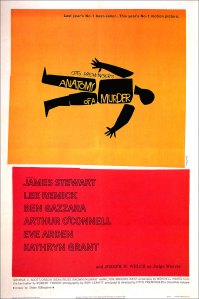
As a result, it’s rare that I get much out of seeing lawyer-centric movies or tv shows any more. After seeing the reality of it, I find fictionalized courtroom theatrics to be ludicrous and, for the most part, evidence of a lazy writer. However, I’m happy to say that last night, I discovered that — no matter how jaded I may now be about the legal process — Anatomy of a Murder is still one of my favorite movies.
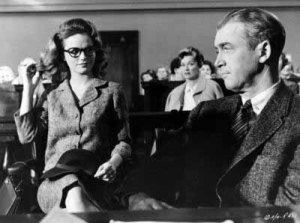
Based on a best-selling novel and directed by the notorious Otto Preminger, Anatomy of a Murder tells the story of Paul Beigler (James Stewart), a former district attorney who is now in private practice after having been voted out of office. Having apparently fallen into a state of ennui, Beigler spends his time drinking with another alcoholic attorney (Arthur O’Connell) and trying to avoid his secretary’s (Eve Arden) attempts to get paid.
However, things change for Beigler when he is hired to defend an army officer named Frederick Manion (Ben Gazzara). Manion has been arrested for murdering a bar own named Barney Quill. Manion says that he was justified in committing the murder because Quill raped his wife, Laura (Lee Remick). Others claim that Manion is himself just a notoriously violent bully and that the openly flirtatious Laura was having an affair with Quill. Despite strongly disliking Manion and disturbed by Laura’s own obvious instability, Beigler takes on the case.
Beigler decides to argue that Manion was temporarily insane when he shot Quill and that he was acting on “irresistible impulse.” As shaky as that line of defense might seem, it’s not helped by the fact that Manion himself is a bit of a brute. Meanwhile, Beigler finds himself facing not the innefectual D.A. in court but instead a young, ambitious prosecutor from the State Attorney General’s Office, Claude Dancer (played by a young and obviously ambitious George C. Scott). As the trial begins, small hints start to appear that seem to indicate that there’s a lot more to the murder of Barney Quill than anyone realizes…
Director Otto Preminger is an odd figure in film history. Up until the early 60s, he was a consistently interesting director who made intelligent, well-acted films that often challenged then-contemporary moral attitudes. However, once the 60s hit, he became something of a parody of the egotistical, old school, autocratic filmmaker and his films seemed to suffer as a result. Like many of the film industry’s top directors, he found himself adrift once the 60s and 70s hit. His decline was so dramatic that, as a result, there’s a tendency to forget that he made some truly great and important films, like Laura, Carmen Jones, The Man With The Golden Arm, and, of course, Anatomy of a Murder.
Anatomy of a Murder represents Preminger at his best. His own natural tendency towards embracing melodrama and shock are perfectly balanced with an intelligent script and memorable performances. Whereas later Preminger films would often come across as little more than big screen soap operas, here he makes the sordid believable and compelling. Preminger has never gotten much attention as a visual filmmaker but here, he uses black-and-white to perfectly capture the grayness of the both the film’s location and the moral issues that the film raises. He keeps the camera moving without ever calling attention to it. As a result, the movie has an almost documentary feel to it.
As previously stated, Preminger gets a lot of help from a truly amazing cast. At first, it’s somewhat strange to imagine a Golden Age icon like Jimmy Stewart appearing in the same film as a dedicated method actor like Ben Gazzara. These are two men who represent not only different philosophies of acting but seemingly from two different worlds as well. However, Preminger uses their differing acting styles to electrifying effect. One of the joys of the movie is watching and contrasting the old style, “move star” turns of James Stewart, Arthur O’Connell, and Eve Arden with the more “naturalistic” approaches taken by their younger co-stars, Gazzara, Lee Remick, and especially George C. Scott. The contrast in style becomes a perfect reflection of the film’s contrast between what is legal and what is correct. All the actors, as both individuals and as an ensemble, give memorable performances. When you look at the cast, you realize that any one of their characters could have been the center of the story without the film becoming any less compelling.
Lee Remick (a notoriously fragile actress who, for years, I knew solely as the poor woman who kept getting attacked by her adopted son in the original Omen) brings out the best in everyone she shares a scene with. Whether she’s making Stewart blush or breaking down on the witness stand, she dominates every scene as an insecure young woman who forces herself to be happy because otherwise, she’d have to confront the fact that she’s miserable. (I should admit that I related more than a bit to Remick’s character. To me, the movie was about her and therefore, about me.)
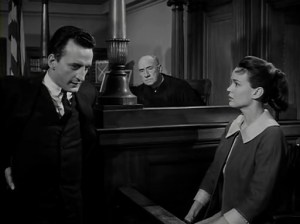
She is perhaps at her best towards the end of the film when she is on the witness stand and is cross-examined by George C. Scott. Starting out as flirtatious and seemingly confident, Remick slowly and believably falls apart as Scott methodically strips away every layer of defense that, until now, she’s spent the entire movie hiding behind. By the end of the scene, Remick has shown as every layer of pain that has built up in Laura Manion over the years. For his part, Scott is simply amazing in this scene. Determined and focused, Scott doesn’t so much cross-examine Remick but seduces her and the audience along with her. As a result, when he suddenly turns off the charm and lunges in for his final attack, it’s devastating for everyone watching. (And, as was correctly pointed out to me by a friend while I was watching the film last night, George C. Scott was quite the sexy beast when he was young.)
Lastly, the film’s judge is played by an actual lawyer by the name of Joseph Welch. Welch wasn’t a great actor but he did make for a great judge.
Of course, it wouldn’t be a Preminger film is a few contemporary morals weren’t challenged and, at the time it was released, Anatomy of a Murder was considered to be very daring because of its frank discussion of topics like rape and spousal abuse. It doesn’t seem quite so daring now but it does seem to be remarkably mature in a way that even most modern movies can’t match. That being said, the film does occasionally embrace the “she must have been asking for it” male viewpoint but still, it’s a remarkably advanced movie for the 1950s.
One of the wonderful things about watching a 51 year-old film is that it provides a chance to see what was considered to be shocking in the years before you or I was born. From watching this movie, I’ve discovered that, in the year 1959, “panties” was apparently a taboo phrase. A good deal of the film’s plot revolves around the panties Lee Remick’s character was wearing the night she was raped and their subsequent disappearance. At one point, there’s even a scene where Welch, Stewart, and Scott struggle to come up with a less offensive term to use when referring to them in the court. (Scott suggests employing a term he heard in France.) Seen 51 years later (in a time when we can not only say “thong” in polite conversation but specifically go out of our way to show off the fact that we’re wearing one), this scene, and the actors’ obvious discomfort whenever they have to say the word “panties”, never fails to amuse me.
Preminger’s other grand challenge to the 50s mainstream was in getting Duke Ellington to compose the film’s jazz soundtrack. At the risk of being called a heretic by some of my closest friends, I’ve never been a big fan of jazz but it works perfectly here. Ellington, himself, makes a cameo appearance and wow, is he ever stoned.
In conclusion, allow me to thank the readers of the site for “ordering” me to watch, once again, a truly classic film. Now, seeing as how close the vote was and that I know, for a fact, that some people voted more than once, I think it would be only fair for me to also rewatch and review the other 9 movies (Lost in Translation, Primer, Hatchet For the Honeymoon, Emanuelle in America, Starcrash, Darling, Sole Survivor, The Sweet House of Horrors, and The Sidewalks of Bangkok) in my poll over the next couple of weeks. I’m looking forward to each and every one of them (well, almost all of them) and, again, thank you for allowing me to start things off with a great film like Anatomy of a Murder.
One of the great things about watching a Quentin Tarantino film is the chance to see B-movie actors and various grindhouse veterans getting a chance to show off just how talented they actually are. Below are four men and one woman who, in a perfect world, would have a date with Tarantino in the near future.
1) Giovanni Lombardo Radice
Who is he? He’s one of the great Italian exploitation actors. He played a character named Charles Bukowski in Cannibal Apocalypse. He was Bob the Pervert in City of th Living Dead. Remember his little disco dance in House On The Edge of the Park? And who can forget him snorting cocaine, getting castrated, and shouting “Twatface!” in Cannibal Ferox? He was also a regular in the movies of Michele Soavi and though he hasn’t been as active in recent years, he can be seen in both Gangs of New York and the Omen remake.
Why Should Tarantino Use Him? Are you kidding? Because he rocks that’s why. Plus, Tarantino has said that he’s a fan and, in a documentary included on the Cannibal Apocalypse DVD, Radice expressed a desire to some day work with Tarantino. And, with his current bald look, Radice could easily play Mussolini if Tarantino wanted to make a prequel to Inglorious Basterds.
2) Tony Sirico
Who is He? He’s the Italian version of Danny Trejo, a real-life gangster who went to prison and then became an actor.
Why Should Tarantino Use Him? Because Paulie was my favorite character on The Sopranos. Sirico deserves at least one starring role in his post-prison career.
3) Colby Donaldson
Who Is He? Okay, Colby’s kinda been a little bit pathetic on the current season of Survivor but in his two previous appearances on the show, Colby was the man. In between reality show appearances, Colby has pursued a career as an actor and, surprisingly, he’s not half bad. His best post-Survivor role, though, was playing himself on Curb Your Enthusiasm.
Why Should Tarantino Use Him? Because someday, Tarantino’s going to have to make an actual western and who would be better to star in it than my fellow Texan, Colby?
4) Fred J. Lincoln
Who is He? Lincoln has spent most of his career working in the porn industry but Lincoln has appeared in a few “mainstream” movies. Most infamously, he played “Weasel” in the original Last House On The Left. In the 70s, Lincoln was the owner of Plato’s Retreat, an infamous sex club in NYC. He’s also one of the central figures in Legs McNeil’s The Other Hollywood: The Uncensored Oral History of the Porn Film Industry .
Why Should Tarantino Use Him? David Hess got the majority of the attention but, of Last House’s trio of killers, Lincoln was the truly scary one. A cameo in a Tarantino movie would be the perfect way to pay credit to Lincoln’s role in one of the seminal exploitation films in history.
5) Catriona MacColl
Who is She? English actress who appeared in several exploitation films in the late 70s and early 80s. She is probably best known for starring in Fulci’s Beyond trilogy. Currently semi-retired from acting and living in France.
Why Should Tarantino Use Her? Because she starred in The Beyond, of course!






 Through the Shattered Lens