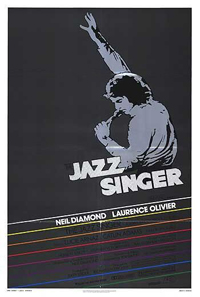
Film Review: The Jazz Singer (dir by Richard Fleischer)


In the 1980 remake of The Jazz Singer, it only takes the film seven minutes to find an excuse to put Neil Diamond in blackface.

Of course, the film was a remake of the 1927 version of The Jazz Singer, which featured several scenes of Al Jolson performing in blackface.  In fact, Al Jolson in blackface was such a key part of the film that it was even the image that was used to advertise the film when it was first released.  Back in the 20s, Jolson said that wearing blackface was a way of honoring the black artists who created jazz.  (As shocking as the image of Al Jolson wearing blackface is to modern sensibilities, Jolson was considered a strong advocate for civil rights and one of the few white singers to regularly appear on stage with black musicians.)  Regardless of Jolson’s motives, less-progressively minded performers used blackface as a way to reinforce racial stereotypes and, to modern audiences, blackface is an abhorrent reminder of how black people were marginalized by a racist culture.  You would think that, if there was any element of the original film that a remake would change, it would be the lead character performing in blackface.

But nope.  Seven minutes into the remake, songwriter Jess Robin (Neil Diamond) puts on a fake afro and dons blackface so that he can perform on stage at a black club with the group that is performing his songs.  The group’s name is the Four Brothers and, unfortunately, one of the Brothers was arrested the day of the performance.  Jess performs with the group and the crowd loves it until they see his white hands.  Ernie Hudson — yes, Ernie Hudson — stands up and yells, “That’s a white boy!”  A riot breaks out.  The police show up.  Jess and the three remaining Brothers are arrested and taken to jail.  Jess is eventually bailed out by his father, Cantor Rabinovitch (Laurence Olivier).  The Cantor is shocked to discover that his son, Yussel Rabinovitch, has been performing under the name Jess Robin.  He’s also stunned to learn that Yussel doesn’t want to be a cantor like his father.  Instead, he wants to write and perform modern music.  The Cantor tells Yussel that his voice is God’s instrument, not his own.  Yussel returns home to his wife, Rivka (Caitlin Adams), and tries to put aside his dreams.

But when a recording artist named Keith Lennox (Paul Nicholas) wants to record one Yussel’s songs, Yussel flies out to Los Angeles.  As Jess Robin, he is shocked to discover that Lennox wants to turn a ballad that he wrote into a hard rock number,  Jess sings the song to show Lennox how it should sound.  The arrogant Lennox is not impressed but his agent, Molly (Lucie Arnaz) is.  Soon, Jess has a chance to become a star but what about the family he left behind in New York?  “I have no son!” the Cantor wails when he learns about Jess’s new life in California.

I’ve often seen the 1980 version of The Jazz Singer referred to as being one of the worst films of all time.  I watched it a few days ago and I wouldn’t go that far.  It’s not really terrible as much as its just kind of bland.  For someone who has had as long and successful a career as Neil Diamond, he gives a surprisingly charisma-free performance in the lead role.  The most memorable thing about Diamond’s performance is that he refuses to maintain eye contact with any of the other performers, which makes Jess seem like kind of a sullen brat.  It also doesn’t help that Diamond appears to be in his 40s in this film, playing a role that was clearly written for a much younger artist.  Still, when it comes to bad acting, no one can beat a very miscast Laurence Olivier, delivering his lines with an overdone Yiddish accent and dramatically tearing at his clothes to indicate that Yussel is dead to him.  Olivier was neither Jewish nor a New Yorker and that becomes very clear the more one watches this film.  It takes a truly great actor to give a performance this bad.  Diamond, at least, could point to the fact that he was a nonactor given a starring role in a major studio production.  Olivier, on the other hand, really had no one to blame but himself.

Still, I have to admit that ending the film with a sparkly Neil Diamond performing America while Laurence Olivier nods in the audience was perhaps the best possible way to bring this film to a close.  It’s a moment of beautiful kitschThe Jazz Singer needed more of that.

6 Good Films That Were Not Nominated For Best Picture: The 1920s


The Academy Awards, 1929

They’ve been giving out Oscars for 91 years and, since the beginning, good films have often been snubbed.

Sometimes, a film is snubbed because it was too groundbreaking to be embraced at the time of its initial release.  Sometimes, a film is snubbed because it was directed by the wrong person or it dealt with subject matter that was considered to be too controversial for the Academy to embrace.  Sometimes, a film is snubbed because of a lack of publicity or a studio that failed to launch an effective awards campaign.  And, sometimes, a good film is snubbed because it’s been a very good year and there’s only so many available slots.

There’s a lot of reasons but what it all come down to is that good films sometimes don’t get nominated for best picture.

So, in honor of those films, I’m going to take a decade-by-decade look at some of the best films that were not nominated for best picture.  We’ll start with the 1920s, with the founding of the Academy in 1927.  Here are 6 good films from the 20s that were not nominated for best picture!

It (1927, dir by Clarence G. Badger))

One of my favorite silent films of all time, It featured not only one of Clara Bow’s greatest performances but also a storyline that, at the time, was considered to be rather daring.  Clara plays a shopgirl who never allows her love for her boss to interfere with her efforts to protect both her roommate and her roommate’s baby from two meddling welfare workers.  Though It was not nominated for Best Picture, Clara Bow did star in very first film to win the top award, Wings.

Metropolis (1927, dir by Fritz Lang)

Having been released in the United States in January of 1927, this visionary German film was eligible to be nominated for best picture but it sadly went unnominated.  Science fiction was a genre that long-struggled to get any meaningful recognition from the Academy.  Fortunately, that appears to have changed a bit over the past few years.

The Jazz Singer (1927, dir by Alan Crosland)

The Jazz Singer has not aged particularly well and it’s impossible not to cringe when Al Jolson shows up in blackface.  However, it was the first commercially successful film to incorporate sound recording and, as such, it pretty much changed cinematic history.  In fact, it was such a game changer that legend has it that the Academy ruled it ineligible to compete for best picture because it was felt it would be unfair to all of the silent nominees.  Instead, The Jazz Singer was given a special honorary award.

The General (1927, dir by Clyde Bruckman and Buster Keaton)

Though Buster Keaton’s Civil War epic was made and screened in 1926, it didn’t receive a wide release until 1927, making it eligible for the first Academy Awards.  However, since the initial critical and commercial reaction to the film was rather middling, The General was snubbed.  Only later would the film be reevaluated and recognized as a classic screen comedy.

The Road to Ruin (1928, dir by Norton S. Parker)

This low-budget, independently made and distributed film became the second highest grossing movie of 1928, therefore showing that a film made outside the studio system could be a success.  With its storyline about a teenage girl who gets caught up in a world of drugs, sex, and general decadence, it established many of the exploitation film tropes that are still in use today.  The Road to Ruin was a Lifetime film before Lifetime.  For that alone, it should have been nominated.

Pandora’s Box (1929, dir by G.W. Pabst)

G.W. Pabst’s classic melodrama is another film that wasn’t appreciated when it was originally released and therefore, both it and Louise Brooks were snubbed by the Academy.  It wouldn’t be until the 1950s that Pandora’s Box finally started to receive the acclaim that it deserved.

Up next, in an hour or so, the 1930s!

Clara Bow in It (1927)

The Lost Best Picture Nominee: The Patriot (dir. by Ernst Lubitsch)


So, in case you hadn’t noticed, I’ve got a love for film trivia in general and Oscar trivia in particular.  I also love to make lists.  Last night, these twin loves led to me staying up way too late making a list of every single film ever nominated for best picture.  As I looked down at that list, I thought to myself, “That’s not even a 1,000 movies.  Why it would only take a few years for me to see and then review every single film ever nominated.”  So, I am now a woman on a mission.  Well, actually, I’m on several missions but this is definitely one of them.

Unfortunately, there is one nominee that its doubtful that I — or anyone else will ever see — and that is 1928’s The Patriot.  Not only was it the last silent film to be nominated for best picture but it’s also the only nominee to subsequently become a “lost” film.  With the exception of a few publicity stills and the film’s trailer, all trace of The Patriot has vanished.  Maybe there’s a copy of it sitting in the corner of someone’s attic.  It has happened in the past, after all.  More likely though, the Patriot is simply gone. 

Here’s the trailer:

The Patriot was based on the 1801 assassination of Tsar Paul I of Russia.  Paul was played by Emil Jannings who, the previous year, had won the very first Academy Award for Best Actor for his performance in The Last Command.  Paul’s assassin — the patriot of the title — was played by character actor Lewis Stone who later played almost everyone’s father in the 1930s.  Director Lubitsch was, like Jannings, a relatively recent arrival from Germany.

The Patriot was an expensive, “prestige” presentation that was pretty much doomed the moment that Al Jolson spoke in The Jazz Singer.  With audiences now obsessed with “talking pictures,” the silent Patriot was a box office bomb.  Paramount hastily withdrew the film from circulation, added a few sound effects (though no dialogue because of Jannings’s thick German accent), and then re-released the film with the little success.  The Patriot — the last silent film nominated — lost to the first sound film to win Best Picture, Broadway Melody.

The box office failure of The Patriot pretty much drove the last nail into the coffin of the silent film era.  Jannings reacted to the coming of sound by returning to his native Germany and continuing his film career there.  He co-starred with Marlene Dietrich in Josef von Sternberg’s The Blue Angel.   As Germany’s most distinguished actor, Jannings was a supporter of Adolf Hitler and he appeared in several Nazi propaganda films during World War II.  In 1945, following the fall of the Third Reich, Jannings reportedly carried his Oscar with him as he walked through the streets of Berlin.  He died in Austria in 1950 at the age of 65. 

Lewis Stone, meanwhile, prospered in sound films and was a busy character actor until he died of a heart attack in 1953.  Reportedly, he dropped dead while chasing some neighborhood children who had been throwing rocks at his garage.

Ernest Lubitsch also had a very succesful career in Hollywood and specialized in sophisticated romantic comedies and musicals.  While Jannings was making propaganda films for Hitler, Lubitsch was directing the anti-Nazi comedy, To Be Or Not To Be.  He died of a heart attack in 1947, reportedly while having sex with a starlet who was auditioning for a role in his latest film.

The Patriot remains lost.