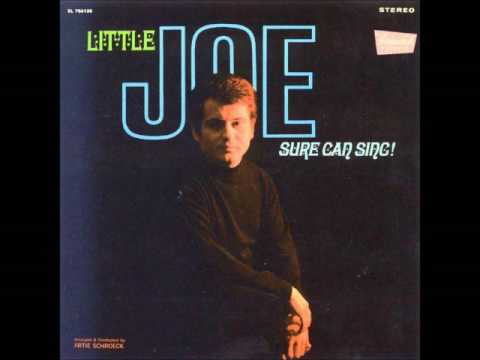
It’s often forgotten that, before he became an award-winning actor, Joe Pesci pursued careers as both a stand-up comedian and a singer. Here he is, performing a lounge version of The Beatles’ Fool On The Hill for his 1968 album, Little Joe Sure Can Sing!
The latest entry in the “Greatest Guitar Solos Series” comes courtesy of The Beatles and one of the best songs, if not the best one, from their 1969 album, Abbey Road.
The song is the George Harrison penned “Something” and its been acknowledged by musicians and critics to be the greatest love song that doesn’t have the mention the word love (on a serious note, it is the greatest love song).
The guitar solo is performed by George Harrison and arrives as part of the song’s outro.
Something
[Verse 1] Something in the way she moves Attracts me like no other lover Something in the way she woos me
[Chorus] I don’t want to leave her now You know I believe and how
[Verse 2] Somewhere in her smile, she knows That I don’t need no other lover Something in her style that shows me
[Chorus] I don’t want to leave her now You know I believe and how
[Bridge] You’re asking me, will my love grow? I don’t know, I don’t know You stick around, now, it may show I don’t know, I don’t know
Continuing our series of greatest guitar solo series, I present “While My Guitar Gently Weeps” by The Beatles.
The song was written by George Harrison and was composed at a time after the band had just returned from a trip and stay in India to study Transcendental Meditation. Harrison, inspired by his stay in India, re-discovered his passion for the guitar and began to write songs with it as his main instrument. Thus begins an era of The Beatles and George Harrison as a maturing songwriter than made a huge contribution to the band becoming more than just the global rock phenomena pre-1968 and one where the group began to release songs and albums that reflected their new world views.
Yet, as great as the song has become since its release on November 22, 1968, it’s also well-remembered as the song that began a series of collaborations between George Harrison and Eric Clapton (a close friend) who plays lead guitar on the song. It is Clapton’s lead guitar work on “While My Guitar Gently Weeps” that has mesmerized listeners throughout the decades.
Clapton plays two guitar solos, the first occurring during first bridge section of the song, and the second the song’s outro. Both solos accentuates and focuses on the song’s lyrical tradition styling where the musical instrument provides the emotions that propel the song.
The outro guitar solo has also reached a new level of immortality in 2004 when Harrison was posthumously inducted into the Rock and Roll Hall of Fame. The collaboration of artists that included Tom Petty, Jeff Lynne, Steve Winwood, Marc Mann, Dhani Harrison, Prince, Steve Ferrone, Scott Thurston, Jeff Young, and Jim Capaldi. It was Prince’s extended performance of the outro solo that’s become legendary.
While My Guitar Gently Weeps
I look at you all, see the love there that’s sleeping
While my guitar gently weeps I look at the floor and I see it needs sweeping Still my guitar gently weeps
I don’t know why nobody told you how to unfold your love I don’t know how someone controlled you They bought and sold you
I look at the world and I notice it’s turning While my guitar gently weeps With every mistake we must surely be learning Still my guitar gently weeps
[guitar solo]
I don’t know how you were diverted You were perverted too I don’t know how you were inverted No-one alerted you
I look at you all, see the love there that’s sleeping While my guitar gently weeps Look at you all…… Still my guitar gently weeps
I look at you all, see the love there that’s sleeping While my guitar gently weeps I look at the floor and I see it needs sweeping Still my guitar gently weeps
I don’t know why nobody told you how to unfold your love I don’t know how someone controlled you They bought and sold you
I look at the world and I notice it’s turning While my guitar gently weeps With every mistake we must surely be learning Still my guitar gently weeps
I don’t know how you were diverted You were perverted too I don’t know how you were inverted No-one alerted you
I look at you all, see the love there that’s sleeping While my guitar gently weeps Look at you all…… Still my guitar gently weeps
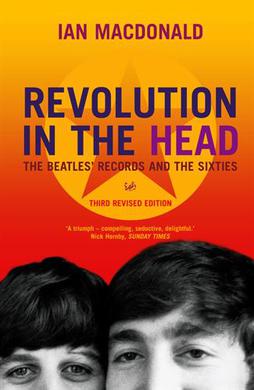
Since today would have been the 84th birthday of John Lennon, I want to take a minute to recommend a book called Revolution In The Head.
First published in 1994 and subsequently revised two more times, Revolution In The Head is both a chronological history of the songs that the Beatles recorded and a cultural history of the 60s. By examining the recording of each song, Ian MacDonald not only describes how each song reflects (or doesn’t reflect) what was happening in the group at the time but also how the Beatles’s changing sound reflected what was happening in the world at the time. Author Ian MacDonald was clearly a Beatles fan but, more importantly, he was not an apologist and, in the book, he’s just as quick to criticize as he is to praise. While he praises the majority of the band’s recordings, there’s more than a few that he totally dismisses. It’s a well-researched and passionately argued book, one that makes interesting reading for both fans of the group and history nerds like myself.
As for the Beatles themselves, they come across as fully developed people. MacDonald neither idealizes nor demonizes the group and instead focuses on the idea of them as working musicians who usually collaborated well together as a group but sometimes feared and resented that they were losing their individual identities. Neither Lennon nor Paul McCartney are presented as being saints and MacDonald doesn’t shy away from showing how frayed their relationship had become by the time the group split up. (They’re portrayed as developing a classic love/hate relationship with each other.) But both are also presented as being talented artists who were capable of creating beautiful music that would survive the test of time. For all the conflict and for all the times that Lennon complained about McCartney’s commercial sensibilities and for all the times that McCartney complained that Lennon was not committed to keeping the Beatles going, they were still capable of creating songs like Eleanor Rigby and A Day In The Life.
A lot of Beatles fans will probably disagree with MacDonald’s opinions. He’s surprisingly dismissive of a lot of George Harrison’s songs, including the wonderful While My Guitar Gently Weeps. But that’s okay! There’s nothing wrong with having differing opinions. It’s actually a good thing.
The 1970 documentary Let It Be, which is now streaming on Disney+ after being impossible to see for decades, follows the Beatles as they record music, occasionally argue, occasionally laugh, collaborate on songs, and ultimately play the famous rooftop concert that was eventually ended by the London police. Paul McCartney smiles and laughs and jokes but he also obsesses over every little musical detail and often seems to be talking in order to keep anyone else from getting a cross word in. John Lennon dances with Yoko Ono and occasionally smiles but often seems like his mind is elsewhere. George Harrison smiles whenever he know that the camera is on him but, when glimpsed in the background, he doesn’t seem happy at all. Ringo patiently waits for his chance to perform, sometimes bored and sometimes amused but always the most likable of the bunch. He and George work on Octopus Garden and it’s a charming moment, if just because it’s obvious that both men would rather be there than in the studio.
Even if you haven’t seen Peter Jackson’s The Beatles: Get Back (which was constructed out of material that was shot for but not used in this documentary), Let It Be is often time one of the most depressing behind-the-scenes documentaries ever made. The more the individual members of the Beatles smile and perform for the camera, the more one can see the cracks that have formed in their relationships. With Lennon spending most of his time with Yoko, it’s Paul who dominates the documentary. Paul comes across as being charming and talented but his habit of nonstop talking gives the impression of someone who is desperately trying to hold together a sinking ship. At one point, George snaps that he’ll play the guitar however Paul tells him to and it’s obvious that, for George and probably the others as well, being the world’s most popular band has gone from being a thrill to just being another job. When Paul and John talk about how much fun they had when they first started playing live in Hamburg, it’s obvious that the conversation is at least partially staged to set up the rooftop concert but there’s a genuine sadness to their voices. Even as they write and record new songs, they’re realizing that all things must pass.
But then the Beatles give a rooftop concert and they bring London to a halt and, for a few minutes, it seems like everything is going to be alright. Standing on the roof and performing a wonderful version of Get Back, the Beatles are suddenly a band just having fun and it’s delightful to see. Later, John Lennon gets a devilish gleam in his eyes as he sings the raunchy (for 1969) lyrics for I’ve Got A Feeling. Even George looks happy for a few moments. People gather in the street below to watch and the camera is quick to show us that both young and old love the Beatles. Of course, eventually, the police show up and shut down the show. (Of course, being British police, they’re very polite about it. One has to breathe a sigh of relief that the Beatles didn’t try to do their rooftop show in New York or Los Angeles.) It’s a reminder that nothing lasts forever. Eventually, every concert comes to an end.
It’s interesting to compare Let It Be to another 70s documentary about a famous British rock band. InGimme Shelter, the Altamont Free Concert ends with a murder as Mick Jagger pleads with the crowd to stop fighting and just sit down. In Let ItBe, things end with a random joke from John Lennon, who would himself be murdered in just ten years. Both Gimme Shelter and Let It Be are about the end of an era and both are full of regret and a longing for a simpler and more idealistic era. For those of us who want to understand history, they’re essential.
Today, the Shattered Lens wishes a happy birthday to Joe Pesci! A favorite of Scorsese’s, an fascinating interview subject, and the star of the short-lived series Half-Nelson, Joe Pesci has become a true American institution.
It’s often forgotten that, before he became an award-winning actor, Pesci pursued careers as both a stand-up comedian and a singer. Here he is, performing a lounge version of The Beatles’ Fool On The Hill for his 1968 album, Little Joe Sure Can Sing!
This is my second favorite Beatles song, right after A Day In The Life. I think the reason I like this song is because it feels like it could have been written about so many different people who I know. According to Wikipedia, this song was written as the result of Paul McCartney’s aunt daring him to write a song that wasn’t a love song. (Of course, Paperback Writer is kind of a love song. It’s the story of an author who loves money enough to write a dirty story about a dirty man.)
This video was filmed outside of the Chiswick House in London. Michael Lindsay-Hogg went on to direct the Beatles’s final film, Let It Be.
Ok, so it’s 1972. Rock music dominated the airwaves, until a nearly fifty year old English gent named Hurricane Smith blew into America with a British Music Hall-styled #1 hit called “Oh, Babe, What Would You Say” (take it away, Johnny Carson!):
Who was Hurricane Smith, you ask? Well, first of all, his name isn’t really Hurricane, but Norman Smith, born in 1923. Young Norman served in the RAF during WWII as a glider pilot, and upon war’s end set out to make a go of things as a jazz musician, without much success. By 1959, Norman found steady employment working as a sound engineer for Britain’s EMI Records, located on London’s Abbey Road.
In 1962, EMI signed four lads from Liverpool who had some potential. The Beatles recorded “Please Please Me”, and the song took the U.K. by storm:
The Beatles became a phenomenon in America two short years…
When I was doing my research for today’s music video of the day, I was sorry to discover that the 80s pop group Breakfast Club was not named after the famous John Hughes film.
Instead, they were formed in New York City in 1979 and they went through several different lineups before they signed with ZE Records. At one time, a young Madonna was their dummer but she left the band long before they released their first (and only) album in 1987.
Breakfast Club’s biggest hit was Drive My Car, a cover of a song that had previously been made famous by The Beatles. The cover appeared on the soundtrack of License to Drive, which is actually one of the better films to co-star Corey Haim and Corey Feldman. It’s no Lost Boys but it is better than Dream A Little Dream and Heather Graham’s in it.
The video is the usual combination of clips from the film and scenes of the band acting crazy. Since they were already covering a Beatles song, it made sense to go ahead and put Breakfast Club in a 1980s version of Hard Day’s Night and have them spend most of the video trying to escape their obsessed fans. While the Beatles had to outrun their fans, Breakfast Club was lucky enough to own an invisible car. I don’t know who edited it but this video does do a good job of integrating the scenes of the band with the clips from the film.
Things worked out better in the video than they did in real life. Breakfast Club split up shortly after the release of License to Drive.
Beatle fans will have a blast watching THE BEATLES: EIGHT DAYS A WEEK – THE TOURING YEARS, director Ron Howard’s 2016 rock doc covering the Fab Four’s career from their earliest club days through the height of Beatlemania, until they stopped touring for good in 1966. The film features rare and classic footage of The Beatles live in concert around the globe, juxtaposing their rise with news events of the day and interviews with all four members.
Howard conducted brand-new interviews with Paul McCartney and Ringo Starr, and included archival interviews with the late John Lennon and George Harrison. Through these and behind the scenes clips and press conferences, we get a sense of what it was like to be at the center of all the Beatlemania madness. Ringo says it best: “We just wanted to play… playing was the only thing” far as these talented musicians were concerned, but…



 Through the Shattered Lens