Film Review: Save The Tiger (dir by John G. Avildsen)


1973’s Save The Tiger tells the story of Harry Stoner (Jack Lemmon).

When Harry was a young man, he loved baseball and he felt like he could conquer the world.  He saw combat in World War II and spent the final part of the war on the Island of Capri, recuperating after being wounded in battle.  Harry went on to partner up with Phil Greene (Jack Gilford) and they started a clothing company in Los Angeles, Capri Casuals.

Now, Harry is a middle-aged man who is still haunted by nightmares about the war.  He’s married.  He has a daughter attending school in Switzerland.  He’s respected in the industry.  He lives in a nice house in Beverly Hills.  And he’s totally miserable.  He wakes up every day and wonders what is happening to the country.  He talks about witnessing a wild pitch at a baseball game, missing the days when something like that could seem like the most important thing in his life.  He spends all of his time at work, cheating to balance the books and keeping clients happy by setting them up with a sophisticated prostitute named Margo (played, with a weary cynicism, by Lara Parker).

Save The Tiger covers just a few days in the life of Harry Stoner, as he searches for some sort of meaning in his life.  He gives a ride to a free-spirited hippie (Laurie Heineman) who offers to have sex with him.  (Harry replies that he’s late for work.)  He accepts an award at an industry dinner and, as he tries to give his acceptance speech, he is haunted by the sight of dead soldiers sitting in the audience.  With Phil, he debates whether or not to balance the books by setting fire to one of their warehouses in order to collect the insurance.  Harry sees a poster imploring him to “Save the Tigers.”  Who can save Harry as he finds himself increasingly overwhelmed by the realities of his life?

As I watched Save the Tiger, I found myself thinking about two other films of the era that featured a middle-aged man dealing with a midlife crisis while searching for meaning in the counterculture.  In Petulia and Breezy, George C. Scott and William Holden each found meaning in a relationship with a younger woman.  And while Petulia and Breezy are both good films, Save The Tiger is far more realistic in its portrayal of Harry’s ennui.  There is no easy solution for Harry.  Even if he accepted the hippie’s offer to “ball” or if he acted on the obvious attraction between himself and Margo, one gets the feeling that Harry would still feel lost.  Harry’s problem isn’t that he’s merely bored with his life.  Harry’s problem is that he yearns for a past that can never be recaptured and which may only exist in his imagination.  If George C. Scott and William Holden were two actors who excelled at playing characters who refused to yield to the world’s demands, Jack Lemmon was an actor who played characters who often seemed to be desperate in their search for happiness.  Save The Tiger features Lemmon at his most desperate, playing a character who has yielded so often and compromised so much that he now has nowhere left to go.

It’s not exactly a cheerful film but it is one that sticks with you.  Jack Lemmon won his second Oscar for his performance as Harry and he certainly deserved it.  Lemmon does a wonderful job generating some sympathy for a character who is not always particularly likable.  Many of Harry’s problems are due to his own bad decisions.  No one forced him to use “ballet with the books” to keep his business open and no one is forcing him to hire arsonist Charlie Robbins (Thayer David, giving a performance that is both witty and sinister at the same time) to burn down not only his warehouse but also an adjoining business that belongs to an acquaintance.  Harry could admit the truth and shut down his business but then how would he afford the home in Beverly Hills and all the other symbols of his success?  Harry yearns for a time when he was young and his decisions didn’t have consequences but that time has passed.

This isn’t exactly the type of film that many would expect from the director of Rocky but director John G. Avildsen does a good job of putting the viewer into Harry’s seedy world.  I especially liked Avilden’s handling of the scene where Harry hallucinates a platoon of wounded soldiers listening to his awards speech.  Instead of lingering on the soldiers, Avildsen instead uses a series of a quick cuts that initially leave the audience as confused as Harry as to what Harry is seeing.  Both Rocky and Save The Tiger are about a man who refuses to give up.  The difference is that perhaps Harry Stoner should.

“You can’t play with us, mister!” a kid yells at Harry when he attempts to recreate the wild pitch that so impressed him as a youth.  In the end, Harry is a man trapped by his memories of the past and his dissatisfaction with the present.  He’s made his decisions and he’ll have to live with the consequences but one is left with the knowledge that, no matter what happens, Harry will be never find the happiness or the satisfaction that he desires.  The tigers can be saved but Harry might be a lost cause.

Sudden Death (1977, directed by Eddie Romero)


Ed Neilson (Ken Metcalf) is a business executive who just wants to spend the weekend grilling with his family but then a bunch of gunmen show up and, in a surprisingly violent sequence that even shows children being shot in slow motion, massacre his entire family.

Ed barely survives and begs his old friend, a former CIA agent named Duke Smith (Robert Conrad), to find out who murdered his family.  Duke would rather hang out on the beach with his wife (Aline Samson) and daughter (Nancy Conrad) and he refuses to help Ed.  But then Ed gets blown up in his car and Duke and his former partner (Felton Perry) come out of retirement to get justice.  Duke’s investigation leads to a corrupt businessman (Thayer David), a murderous government official (John Ashley, who also produced), and a ruthless hitman (Don Stroud).

Filmed in The Philippines and directed by Eddie Romero, Sudden Death is a violent and brutal thriller with a twisty the plot that is nearly impossible to follow.  It seems like a lot of killing for no particular reason.  The thing that sets Sudden Death apart from other action films is its willingness to violently kill off anyone, regardless of age, gender, or relative innocence.  The 70s was a decade known for downbeat endings but, even by the standards of that decade, Sudden Death‘s ending is shockingly abrupt and bleak.  In the lead role, Robert Conrad shows off the ruthless intensity that made him the most feared of all of the coaches on Battle of the Network Stars.

Originally, the sidekick role was offered to Jim Kelly.  When Kelly dropped out, the role was given to the far more laid back Felton Perry.  I think if Kelly had stayed with the film, it would probably be a cult classic today.  Instead, it’s an obscurity that reminds us of how bleak even exploitation films were in the 70s.

Retro Television Reviews: The Secret Night Caller (dir by Jerry Jameson)


Welcome to Retro Television Reviews, a feature where we review some of our favorite and least favorite shows of the past!  On Sundays, I will be reviewing the made-for-television movies that used to be a primetime mainstay.  Today’s film is 1975’s The Secret Night Caller!  It  can be viewed on YouTube!

Though the show pretty much guaranteed that he would forever be a part of the American pop cultural landscape, Robert Reed was not a fan of The Brady Bunch.  Onscreen, Reed played Mike Brady, the stern patriarch who always knew the right thing to do and who, as a result, was named father of the year by the local chamber of commerce.  (Of course, even though she was responsible for him getting the reward, Mike still grounded Marcia for sneaking out to mail in his nomination forms.)  Offscreen, Reed was notoriously difficult, complaining that the scripts for the show were juvenile and shallow.  Reed was correct and it should be noted that all of the actors who played the Brady kids have said that Reed never took out his frustration on the cast and actually became a bit of a surrogate father to all of them.  Still, you have to wonder what Reed was expecting when he signed up for a show that was created by the man responsible for Gilligan’s Island.

The Brady Bunch was cancelled in 1974, temporarily setting Robert Reed free from the burden of playing Mike Brady.  (Of course, he would later return to the role in The Brady Bunch Hour and we all know how that turned out.)  One of the first post-Brady movies that Reed starred in was The Secret Night Caller.   

In this film, Reed plays a seemingly mild-mannered IRS (booo!) agent named Freddy Durant.  Freddy has a good career and a nice home but he’s deeply unsatisfied.  He barely communicates with his wife, Pat (Hope Lange).  He freaks out over his teenage daughter, Jan (Robin Mattson), wearing a bikini.  He fantasies about hitting on almost every woman that he sees.  He hangs out at a strip club and, when he’s really feeling unsatisfied, he makes obscene phone calls!  Because this is a made-for-TV movie from the 70s, we never actually get to hear what Freddy says on the phone but he manages to disgust and/or horrify everyone who has the misfortune to answer his call.  He even calls a woman who works in his office, scaring Charlotte (Arlene Golonka) so much that she subsequently has an auto accident.  Unfortunately, for Freddy, one of his victims, a stripper named Chloe (Elaine Giftos), recognizes his voice and tries to blackmail him.  Freddy’s life is falling apart.  Can his psychiatrist (played by Michael Constantine) help him put it all back together again?

Freddy Durant is obviously meant to come across as being the exact opposite of Mike Brady.  (Of course, many of us who have seen The Brady Bunch have our suspicions about what Mike was actually doing in his office….)  Whereas Mike Brady was the perfect father, Freddy is cold, distant, and repressed.  Reed is convincingly uptight as Freddy and he’s surrounded by a fine supporting cast, including Sylvia Sidney as his disapproving mother-in-law.  That said, it’s still impossible to watch this show without thinking to yourself, “There’s Mike Brady making an obscene phone call.”  That’s the difficulty of typecasting unfortunately.  For all of his efforts to escape the shadow of the Brady Bunch, it’s impossible not to associate Robert Reed with the show, even when he’s talking dirty on the phone.

Great Moments In Television History #27: The Final Scene of Dark Shadows


After five years of enthralling audiences with the story of Barnabas Collins and his family, Dark Shadows came to an end on April 2nd, 1971.  By this point, the show itself had tried to return to its gothic roots by setting its latest storyline in 1841.  During the show’s final episodes, Jonathan Frid played not Barnabas but instead, Bramwell Collins.  Unfortunately, this didn’t help the show’s once strong ratings and ABC abruptly canceled Dark Shadows in 1971.

When the show ended, it did so in typical tongue-in-cheek fashion.  With Bramwell and his love, Catharine Harridge, preparing to leave Collinsport, news suddenly came that there had been a vampire attack!

Or was it?

Previous Moments In Television History:

  1. Planet of the Apes The TV Series
  2. Lonely Water
  3. Ghostwatch Traumatizes The UK
  4. Frasier Meets The Candidate
  5. The Autons Terrify The UK
  6. Freedom’s Last Stand
  7. Bing Crosby and David Bowie Share A Duet
  8. Apaches Traumatizes the UK
  9. Doctor Who Begins Its 100th Serial
  10. First Night 2013 With Jamie Kennedy
  11. Elvis Sings With Sinatra
  12. NBC Airs Their First Football Game
  13. The A-Team Premieres
  14. The Birth of Dr. Johnny Fever
  15. The Second NFL Pro Bowl Is Broadcast
  16. Maude Flanders Gets Hit By A T-Shirt Cannon
  17. Charles Rocket Nearly Ends SNL
  18. Frank Sinatra Wins An Oscar
  19. CHiPs Skates With The Stars
  20. Eisenhower In Color
  21. The Origin of Spider-Man
  22. Steve Martin’s Saturday Night Live Holiday Wish List
  23. Barnabas Collins Is Freed From His Coffin
  24. Siskel and Ebert Recommend Horror Films
  25. Vincent Price Meets The Muppets
  26. Siskel and Ebert Discuss Horror

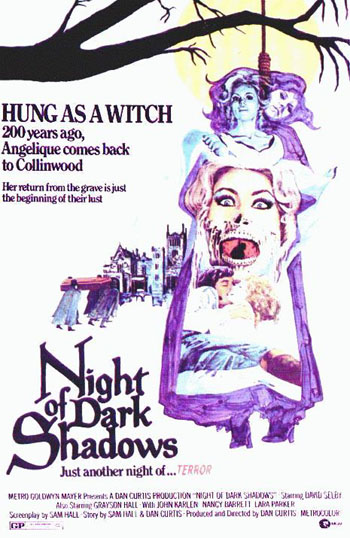
Horror Film Review: Night of Dark Shadows (dir by Dan Curtis)


Since I just reviewed House of Dark Shadows, it only makes sense to now take a look at 1971’s Night of Dark Shadows today!

While Night of Dark Shadows is not a direct sequel to the first film, it is still definitely a part of the same cinematic universe.  There may not be any vampires in this film but it does take place in the same house and it features two members of the family that was decimated over the course of the previous film.  At one point, it’s mentioned that Joan Bennett’s character from House of Dark Shadows died after the first film but no one goes into any details.  I guess a vampire in the family is something that’s simply not discussed amongst polite company.

Night of Dark Shadows deals with Quentin (David Selby) and Tracy Collins (Kate Jackson).  Quentin is an artist who confesses that he wasn’t particularly nice before he married Tracy.  When they move into the Collins mansion, they bring two friends with them, Alex (John Karlen) and Claire (Nancy Barrett.)  Interestingly enough, Karlen and Barrett both played different characters in House of Dark Shadows.  Grayson Hall, who played Dr. Hoffman in House of Dark Shadows, also returns for Night of Dark Shadows.  This time Hall is playing Carlotta Drake, the creepy housekeeper.  (Needless to say, all mansions comes with a creepy housekeeper.)

Soon after everyone moves in, Quentin starts acting strangely.  He becomes obsessed with the painting of a beautiful woman who was named Angelique (Lara Parker) and with the story that Angelique was hanged when it was discovered that she was having an affair with Quentin’s ancestor, Charles.  (For his part, Charles was apparently walled up in the mansion.  That sounds a bit extreme to me but I guess that’s the way they did things in the 19th century.)  Quentin starts to have visions and nightmares involving his ancestor who, it turns out, looked exactly like him!  Meanwhile, Carlotta and the groundskeeper, Gerard (Jim Storm), seem to be determined to make sure that Tracy doesn’t feel welcome in her new home.  It’s almost as if they’re trying to drive everyone but Quentin away from the house.

Night of Dark Shadows is a much more polished film than House of Dark Shadows but it also unfolds at a far more leisurely pace.  It lacks the relentless energy that distinguished House of Dark Shadows.  This wouldn’t be as much of a problem if the plot itself wasn’t so totally predictable.  From the minute that Quentin first sees that portrait of Angelique, you know that he’s going to get possessed and start acting strangely.  There are a few atmospheric scenes but, for the most part, the film just doesn’t grab the viewer’s attention the way that House of Dark Shadows did.

On the plus side, David Selby is properly intense and brooding in the dual roles of Quentin and Charles Collins while Lara Parker does an equally good job as the wonderfully evil Angelique.  Grayson Hall, who tended to go overboard in House of Dark Shadows, gives a much better and far more menacing performance here.  Night of Dark Shadows isn’t a bad film.  It’s just not a particularly memorable one.

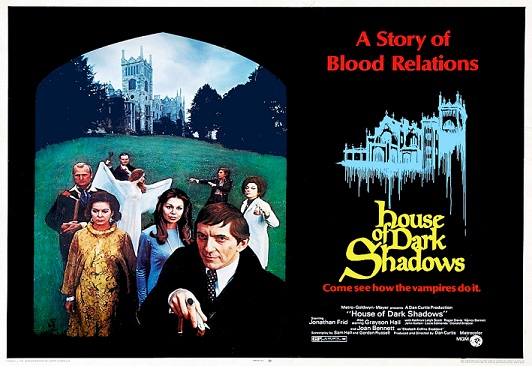
Horror Film Review: House of Dark Shadows (dir by Dan Curtis)


There’s a lot that you can say about this vampire film from 1970 but I think it can all be summed up with one word: relentless.

A lot of this is because House of Dark Shadows is a film adaptation of a daytime drama.  Over the course of six sesons, Dark Shadows ran for a total of 1,220 episodes.  That’s a lot of story to cram into a 97-minute film but director Dan Curtis does just that.  The end result is an incredibly busy film and I mean that in the best way possible.

Seriously, there are so many twists and turns in this film’s plot that it’s difficult to even know where to begin.  This is one of the most incident-filled horror films that I’ve ever seen.  No sooner does one plotline resolve itself than another begins.  Meanwhile, a surprisingly large cast wanders through the shadows and tries not to get transformed into a vampire.  Most of them do not succeed.

See if you can keep all of this straight:

In Maine, a lowlife handyman named Willie (John Karlen, giving the film’s best performance) breaks into a mausoleum and approaches a coffin that’s covered with chains.  Willie thinks that there’s a treasure hidden in the coffin but, after he removes the chains, he instead discovers that he’s stumbled across the home of a vampire!  Barnabas Collin (Jonathan Frid, who perfectly combines old world manners with thinly veiled menace) has spent 175 years trapped in that coffin and now that he’s been released, he’s not in a very good mood.

Soon, Barnabas has introduced himself to his descendants (including Joan Bennett, as Elizabeth, the family matriarch) as a cousin from England.  Everyone is impressed with Barnabas’s charm and courtly style.  Of course, some people are a little bit skeptical.  Prof. Stokes (Thayer David) notices that Barnabas doesn’t seem to know much about London while Dr. Hoffman (Grayson Hall) flat out accuses Barnabas of being a vampire.  Barnabas admits that this is true but fear not!  Dr. Hoffman’s fallen in love with him and wants to help cure him.

Meanwhile, everyone in town is growing concerned about all of the bloodless bodies that are showing up.  They especially get worried after Elizabeth’s daughter, Carolyn (Nancy Barrett), dies and then promptly comes back to life, complete with her own set of fangs….

While the town concerns itself with what to do about Carolyn, Barnabas has fallen in love with a nanny named Maggie (Kathryn Leigh Scott), who he thinks is the reincarnation of his former lover.  Unfortunately, Maggie already has a boyfriend named Jeff (Roger Davis) but when has the ever been a problem for a vampire?  Far more of a problem than Jeff is the fact that Willie is also in love with Maggie and Dr. Hoffman is so jealous of Barnabas’s love for Maggie that she’s willing to inject him with a formula that causes him to transform into an elderly man….

And all that’s just in the first hour!

Needless to say, it all leads to one final, gore-filled confrontation.  When I say that this film is gory, I mean just that.  Blood isn’t just spilled in House of Dark Shadows.  Instead, it flows like water busting out of a cracked dam.  When Barnabas bites a victim, he doesn’t just leave two neat little puncture marks.  Instead, he literally rips their neck to shreds.  Just how savage Barnabas and Carolyn get in this film is one of the things that sets House of Dark Shadows apart from other vampire films.  As opposed to the type of tragic figure who shows up in so many vampire films, Barnabas is ruthless, cruel, and unforgiving.  He’s a genuinely frightening creation.

House of Dark Shadows is a chaotic movie but it’s also a lot of fun.  This is one of those films that you watch in amazement as it just keeps going and going, piling on one incident after another.  Does the film always make sense?  No, but it doesn’t have to.  Quickly paced and featuring nonstop gore and fog, the film has a dream-like feel to it.  Curtis and the cast attack the material with such unbridled enthusiasm that it doesn’t matter if the plot occasionally doesn’t always add up or if the dialogue is occasionally a bit clumsy.  It’s impossible not to get swept along with the film’s insanity.

Probably because of its television roots, House of Dark Shadows is often dismissed by critics.  (I’ve never seen any old episodes of the show so I can’t say how the movie compares to it.)  Well, those dismissive critics are wrong.  House of Dark Shadows is one of my favorite vampire films and it’s definitely one that deserves to be rediscovered.

(And yes, it’s a helluva lot better than that movie that Tim Burton made with Johnny Depp….)

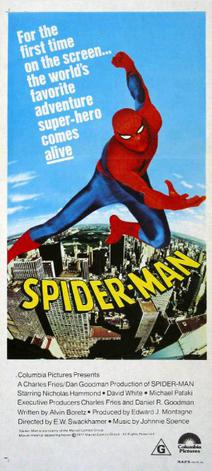
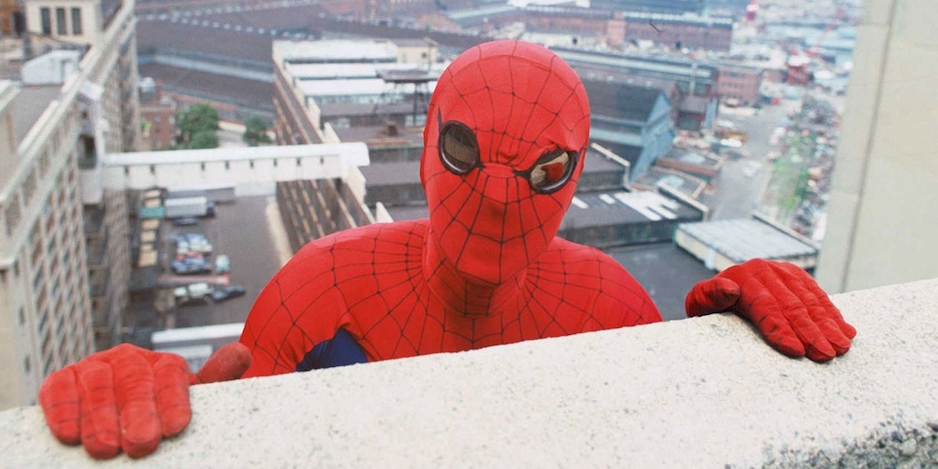
Spider-Man (1977, directed by E.W. Swackhemer)


When a college student named Peter Parker (Nicholas Hammond) is bitten by a radioactive spider, he’s stunned to discover that he can now do everything that a spider can.  He can climb walls.  He has super strength.  He has super senses.  And, once he invents a sticky web serum, he can shoot webs and swing around the city!  All he has to now is sew himself a red and blue costume and he’ll be ready to fight crime in New York City!

It’s not a minute too soon because New York is dealing with a crime wave that only Spider-Man can deal with.  Seemingly ordinary people are suddenly going into hypnotic trances, stealing money and committing suicide.  An extortionist sends words that, unless he’s paid a lot of money, he’s going to unleash a wave hypnotic chaos on the city.  Could it have anything to do with a sinister New Age guru and hypnotist named Edward Byron (Thayer David)?

Though it was released theatrically in Europe, Spider-Man was produced for television and it served as the pilot for a short-lived CBS television series.  Along with The Incredible Hulk, this was one of the first attempts to build a television series around one of Marvel’s characters.  Unfortunately, the series only last 14 episodes before being canceled.  Though it can be hard to believe nowadays with the nonstop hype around every single comic book movie, there was a time when television and film executives were actually weary about trying to bring super heroes like Spider-Man and Captain America to life.  According to Stan Lee (who served as a consultant on Spider-Man), CBS wanted to distance their version of Spider-Man from its comic book origins.  While both the pilot and the series features Peter Parker crawling up walls and shooting webs, there’s no Uncle Ben.  There’s no talk about how with great power comes great responsibility.  Worst of all, there are no members of Spider-Man’s famed rogue’s gallery.  No Electro, no Sandman, no Green Goblin, and certainly no Dr. Octopus.  CBS wanted the show to feature down-to-Earth villains, which is an interesting strategy for a show about a grad student who can climb walls.

The television version of Peter Parker isn’t as insecure and angsty as either the comic book version or even the movie versions.  Hammond is likable and sincere in the role but he is also almost too self-assured as Parker, proof that CBS didn’t understand that a huge part of Spider-Man’s appeal was that he was never as confident as Superman or Captain America.  Instead, much like many of the people who read his comic, Peter was frequently worried and consumed with self-doubt.  The comic book version of Spider-Man was always wracked with guilt for not stopping the thief who eventually killed Ben.  The television version was more worried about selling enough selfies to The Daily Bugle to be able to go on a date with his professor’s daughter.

At least the pilot film featured a villain who wouldn’t have felt out of place in an issue of The Amazing Spider-Man, though he probably would have had a cool villain name, like the Mesmerizer, if he had appeared in the comic.  Thayer David played a lot of smug villains in the 70s, not to mention the fight promoter in Rocky.  In Spider-Man, David goes all in as the villain and he’s got the perfect posh accent for delivering threats and sarcastic put-downs.  Unfortunately, this version of Peter Parker is not the wise-cracking machine that he was in the comic books and he never really gets a chance to verbally put Byron in his place.

If you can overlook its deviations from the comic book, the pilot isn’t a bad made-for-TV adventure.  Though miscast and playing a far different version of Peter Parker than we’re used to, Nicholas Hammond does his best to make Peter and his transformation credible.  Thayer David, as always, is a good villain and the story, with ordinary people suddenly turning into ruthless criminals, isn’t bad.  Though there are a few convincing shots of Spider-Man web-slinging, most of the special effects are lousy but they’re really not any worse than what you would expect to see in a 70s made-for-TV movie.  Though the series ultimately didn’t work, the pilot is still an enjoyable precursor to what, decades later, would become the Marvel Cinematic Universe.

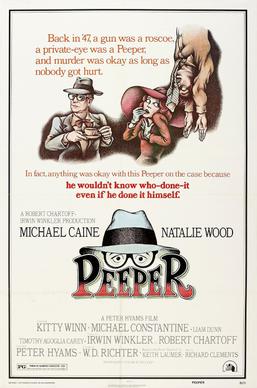
Peeper (1975, directed by Peter Hyams)


Peeper gets off to a good start, with a Humphrey Bogart look alike standing on a dark street corner and reading the opening credits in a reasonable approximation of Bogart’s unmistakable voice.  It all goes down hill from there.

Peeper stars Michael Caine as Leslie C. Tucker, a cockney private detective who is working in Los Angeles in the late 40s.  Tucker is hired by a shady businessman named Anglich (Michael Constantine).  Anglich explains that he knows that he has a daughter but he doesn’t know who or where she is.  He wants Tucker to track her down.  It doesn’t take much time for Tucker to conclude that Anglich’s daughter might be a member of the wealthy and quirky Pendergrast family.  In fact, Tucker thinks that Anglich’s daughter might be Ellen Pendergrast (Natalie Wood, who seems to be bored with the role).  It should be a simple enough case to solve but there are numerous complications along with two thugs (played by Timothy Carey and Don Calfa) who, for some reason, are out to get Anglich and Tucker.

It’s hard to know what to make of Peeper.  It’s meant to be an homage to the detective films of the 40s but it also tries to parody the genre.  Unfortunately, Peter Hyams has never been a director known for his light touch and, in this film, his idea of comedy is to have everyone shout their lines.  (Michael Constantine is the worst offender.)  Michael Caine is also miscast in the lead.  The film tries to get some comedic mileage out of Caine delivering Bogart-style dialogue in his cockney accent but it’s a joke that’s never as funny as the film seems to think.

Peeper was a critical and box office failure but fortunately, there were better things in store for both Michael Caine and Peter Hyams.  Hyams went on to direct Capricorn One while Michael Caine established himself as one of the most durable character actors around.

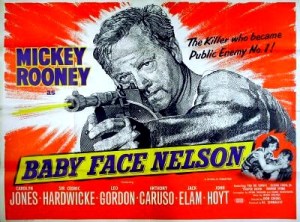
A Movie A Day #126: Baby Face Nelson (1957, directed by Don Siegel)


The place is Chicago.  The time is the era of Prohibition.  The head of the Chicago Outfit, Rocca (Ted de Corsia), has arranged for a career criminal named Lester Gillis (Mickey Rooney) to be released from prison.  A crack shot and all-around tough customer, Gillis has only two insecurities: his diminutive height and his youthful appearance.  Rocca wants to use Gillis as a hit man but Gillis prefers to rob banks.  When Rocca attempts to frame Gillis for a murder, Gillis first guns down his former benefactor and then goes on the run with his girlfriend, Sue Nelson (Carolyn Jones).  Because they are both patients of the same underworld doctor (played by Sir Cedric Hardwicke), Gillis eventually meets public enemy number one, John Dillinger (Leo Gordon).  Joining Dillinger’s gang, Gillis becomes a famous bank robber and is saddled with a nickname that he hates: Baby Face Nelson.
While it is true that Lester “Baby Face Nelson” Gillis was an associate of John Dillinger’s and supposedly hated his nickname, the rest of this biopic is highly fictionalized.  The real Baby Face Nelson was a family man who, when he went on the run, took his wife and two children with him.  While he did get his start running with a Chicago street gang, there is also no evidence that Nelson was ever affiliated with the Chicago Outfit.  (The film’s Rocca is an obvious stand-in for Al Capone.)  In real life, it was Dillinger, having just recently escaped from jail, who hooked up with Nelson’s gang.  The film Nelson is jealous of Dillinger and wants to take over the gang but, in reality, the gang had no leader.  Because Nelson killed three FBI agents (more than any other criminal), he has developed a reputation for being one of the most dangerous of the Depression-era outlaws but, actually, he was no more violent than the typical 1930s bank robber.  Among the era’s outlaws, Dillinger was more unique for only having committed one murder over the course of his career.  In this film (and practically every other film that has featured Baby Face Nelson as a character), Nelson is a full on psychopath, one who even aims his gun at children.

Baby Face Nelson may be terrible history but it is still an excellent B-movie.  Don Siegel directs in his usual no-nonsense style and Mickey Rooney does a great job, playing Baby Face Nelson as a ruthless but insecure criminal with a perpetual chip on his shoulder.  As his fictional girlfriend, Carolyn Jones is both tough and sexy, a moll that any gangster would be lucky to have waiting for him back at the safe house.  B-movie veterans like Thayer David, Jack Elam, Elisha Cook Jr., and John Hoyt all have colorful supporting roles but the most unexpected name in the cast is that of Cedric Hardwicke, playing an alcoholic surgeon with broken down dignity.

Don’t watch Baby Face Nelson for a history lesson.  Watch it for an entertaining B-masterpiece.


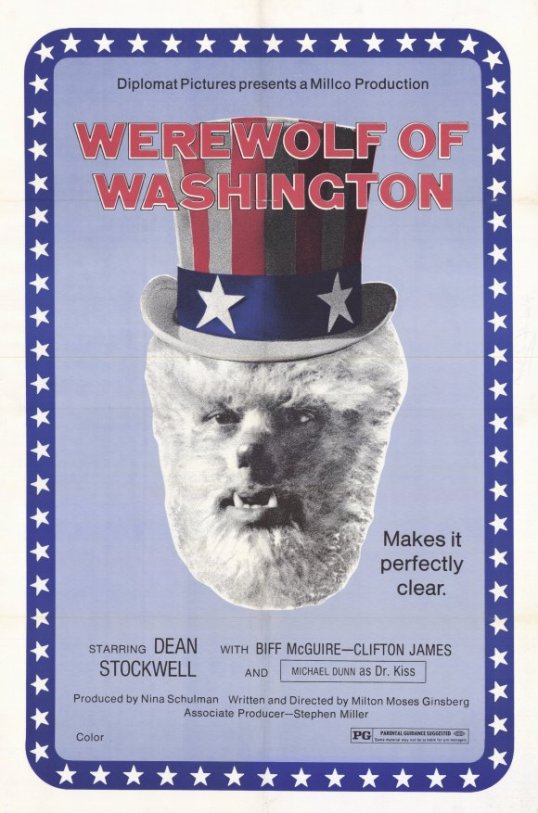
Shattered Politics #32: The Werewolf of Washington (dir by Milton Moses Ginsberg)


Werewolf of Washington (1973)

First released in 1973, The Werewolf of Washington is one of those obscure films that always seems to pop up in Mill Creek box sets.  That’s largely because Werewolf of Washington has slipped into the public domain and anyone can release and sell a copy of it.  (It’s also been uploaded to YouTube by a few hundred different users.)  It’s a film that I’ve actually watched quite a few times, largely because it is so easily available.

Which doesn’t necessarily mean that it’s any good.  I have to admit that, in between viewings, I always seem to convince myself that The Werewolf of Washington is a better film than it actually is.  The idea behind the film sounds clever.  The President’s press secretary (played by Dean Stockwell) is a werewolf.  When the full moon shines, he transforms and wrecks havoc on the streets on D.C.  Stockwell still wears his suit, even when he’s a wolfman.  The President (played by Biff McGuire) is a total idiot who spends a lot of time bowling.  The Attorney General (Clifton James) is a paranoid fascist who is quick to blame the werewolf’s murders on outside agitators.  For no particular reason, a dwarf mad scientist (Michael Dunn) shows up.

Yes, the idea is clever but the execution … actually, the execution is not terrible.  Dean Stockwell gives a good performance and there’s a funny scene where he starts to turn into a werewolf while bowling with the President.  Stockwell’s fingers swell up and get stuck in the bowling ball and Stockwell totally freaks out.  And then there’s a scene where the werewolf attacks a woman in a phone booth and it’s actually rather suspenseful and almost scary.  Plus, Biff McGuire is great and all too plausible as the vapid President.

And yet, overall, the film itself is never as good as you want it to be.  I think a large part of the problem is that the film opens with a long voice over from Dean Stockwell, which explains why his character ended up in Budapest (that would be where he gets bitten by the werewolf) and why the President subsequently named him press secretary.  It’s so much backstory that you get the feeling that the opening narration must have been added in post production in order to cover up scenes that either did not work or that the film’s director never got a chance to shoot.

And really, the entire film is like that.  The film is a collection of scenes that never really flow together or establish any sort of steady pace.  And, when it comes to both horror and comedy, pace is key.

The Werewolf of Washington is a clever idea.  I just wish the execution had been just as clever.

And I’ll probably continue to wish that the next time that I rewatch it.

The_Werewolf_of_Washington_FilmPoster