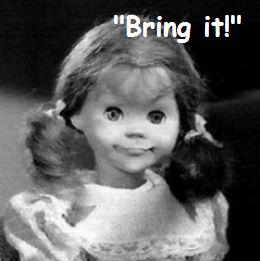
Today’s televised horror is the Living Doll episode of The Twilight Zone. This memorably creepy episode takes a look at what happens when a suburban jerk of a father (played by Telly Savalas) gets into a fight with his daughter’s doll, Talky Tina (voiced by June Foray). Things do not end well for one of them.
Seriously, don’t mess with Talky Tina.
This episode was directed by Richard Sarafain, written by Charles Beaumont, and originally broadcast on November 1st, 1963.
Pretty Maids All In A Row, which — as should be pretty obvious from the trailer above — was originally released in 1971, is a bit of a historic film for me. You see, I love movies. And, as a part of that love, I usually don’t give up. Regardless of how bad a movie may turn out to be, once I start watching, I stick with it. I do not give up. I keep watching because you never know. The film could suddenly get better. It could turn out that what originally seemed like a misfire was actually brilliant satire. If you’re going to talk or write about movies, you have an obligation to watch the entire movie. That was a rule that I had always lived by.
And then, one night, Pretty Maids All In A Row popped up on TCM.
Now, I have to admit that I already knew that Pretty Maids was going to be an extremely 70s film. I knew that it was probably going to be more than a little sexist. I knew all of this because the above trailer was included on one of my 42nd Street Forever DVDs. But I still wanted to see Pretty Maids because the trailer hinted that there might be an interesting hiding underneath all of the cultural baggage. If nothing else, it appeared that it would have some sort of worth as an artifact of its time.
(If you’re a regular reader of this site, you know how much I love my cinematic time capsules.)
So, the film started. I logged onto twitter so that I could live tweet the film, using the hashtag #TCMParty. And from the moment the film started, I knew it wasn’t very good. It wasn’t just that the film’s camerawork and music were all extremely 70s. After all, I like 70s music. I don’t mind the occasional zoom lens. And random psychedelic sequences? WHO DOESN’T LOVE THOSE!? No, my dislike of the film had nothing to do with the film’s style. Instead, it had to do with the fact that there was absolutely nothing going on behind all of that style. It wasn’t even style for the sake of style (which is something that I usually love). Instead, it was style for the sake of being like every other “youth film” that came out in the 70s.
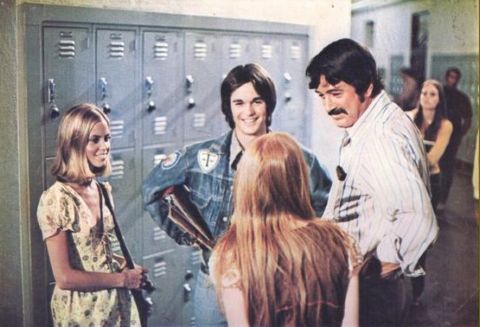
And then there was the film’s plot, which should have been interesting but wasn’t because director Roger Vadim (who specialized in stylish decadence) had no interest in it. The film takes place at Oceanfront High School, where the only rule is that apparently nobody is allowed to wear a bra. We meet one student, Ponce De Leon Harper (played by an amazingly unappealing actor named John David Carson), who is apparently on the verge of having a nervous breakdown because, at the height of the sexual revolution, he’s still a virgin.
(Because, of course, the whole point of the sexual revolution was for losers like Ponce to finally be able to get laid…)
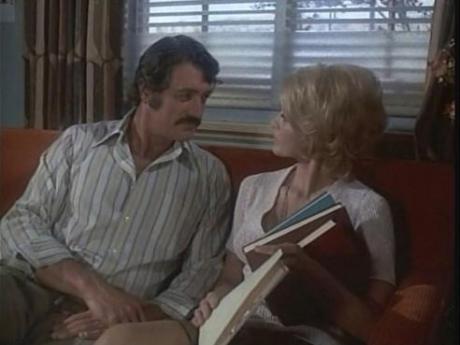
Ponce is taken under the wing of high school guidance counselor Tiger McDrew (Rock Hudson, complete with porn star mustache). Quickly figuring out exactly what Ponce needs, Tiger sets him up with a teacher played by Angie Dickinson. However, Tiger has other concerns than just Ponce. Tiger, it turns out, is a sex addict who is sleeping with nearly every female student at the school. But, American society is so oppressive and puts so much pressure on the American male that Tiger has no choice but to kill every girl that he sleeps with…
This is one of the only film I can think of that not only makes excuses for a serial killer but also presents him as being a heroic character. And, while it’s tempting to think that the film is being satirical in its portrayal of Tiger and his murders, it’s actually not. Don’t get me wrong. The film is a very broad comedy. The high school’s principal (Roddy McDowall) is more concerned with the football team than with all of the girls turning up dead at the school. The local sheriff (Keenan Wynn) is a buffoon. The tough detective (Telly Savalas) who investigates the murders gets a few one liners.
But Tiger, most assuredly, is the film’s hero. He’s the only character that the audience is expected to laugh with, as opposed to at. He is the character who is meant to serve as a mouthpiece for screenwriter Gene Roddenberry’s view on America’s puritanical culture. If only society was less hung up on sex, Tiger wouldn’t have to kill. Of course, the film’s celebration of Tiger’s attitude towards sex is not extended towards the girls who sleep with him. Without an exception, they are all presented as being empty-headed, demanding, shallow, and annoying, worthy only of being leered at by Vadim’s camera until Tiger finally has to do away with them.
(The film’s attitude towards women makes Getting Straight look positively enlightened.)
Rock and Angie
ANYWAY! I spent about 40 minutes watching this movie before I gave up on it. Actually, if you want to be technical about it, I gave up after 5 minutes. But I stuck with it for another 35 minutes, waiting to see if the film was going to get any better. It didn’t and finally, I had to ask myself, “Why am I actually sitting here and wasting my time with this misogynistic bullshit?” So, I stopped watching and I did so with no regrets.
What I had forgotten is that I had set the DVR to record the film while I was watching it, just in case I later decided to review it. So, last week, as I was preparing for this series of Back to School posts, I saw Pretty Maids All In A Row on my DVR. I watched the final 51 minutes of the film, just to see if it ever got better. It didn’t.
However, on the plus side, Rock Hudson does give a good performance in the role of Tiger, bringing a certain seedy desperation to the character. (I’m guessing that this desperation was Hudson’s own contribution and not an element of Roddenberry’s screenplay, which more or less presents Tiger as being a Nietzschean superman.). And beyond that, Pretty Maids serves as evidence as to just how desperate the Hollywood studios were to makes movies that would be weird enough to appeal to young people in the early 70s.
Watching the film, you can practically hear the voices of middle-aged studio executives.
“What the Hell are we trying to do with this movie!?” one of the voices says.
“Who cares!?” the other voice replies, “the kids will love it!”
Last night, the temperature plunged here in Texas. When I woke up this morning, I was confronted with a world that was literally frozen. Needless to say, nobody in Dallas went to work today. Instead, we all sat in our houses and tried to keep ourselves entertained. I kept myself occupied by watching a film that was initially released way back in 1978 and which takes place in my home state.
The name of that film was Capricorn One and it’s the latest entry in the 44 Days of Paranoia.
Capricorn One begins with three astronauts preparing to take the fist manned space flight to Mars. James Brolin is the stoic leader. Sam Waterston is the guy who has a joke for every occasion. And O.J. Simpson is … well, O.J. really doesn’t have much of a personality. He’s pretty much just along for the ride.
However, it turns out that there really isn’t going to be a ride. Just as the countdown begins, the astronauts are ordered to leave the capsule. They are then transported to secret base in the Texas desert. It’s here that they have a meeting with the Head of NASA, who is played by Hal Holbrook. (It’s simply not a 70s conspiracy film if Hal Holbrook isn’t somehow involved). Holbrook proceeds to deliver a stirring monologue where he talks about how he and Brolin have always dreamed of sending a manned flight to Mars. However, as Holbrook explains, the life support system on the crew’s ship was faulty. If Holbrook had allowed them to be launched, they would have died as soon as they left the Earth’s atmosphere. However, if the mission had been canceled then there was a chance that the President would use that cancellation as an excuse to cut NASA’s funding.
So, as Holbrook explains, an empty spaceship has been launched into space. As far as the American public is concerned, the three astronauts are currently on their way to Mars. Now, in order to save the space program, they are going to have to fake the mission. In a studio, a fake alien landscape has been set up and it’s from that studio that Brolin, Waterston, and Simpson will pretend to explore Mars.
Brolin, Waterston, and Simpson reluctantly agree to cooperate with the plan. However, after doing the first fake broadcast, Brolin starts to have second thoughts. Realizing that he can’t trust the three astronauts to keep a secret, Holbrook announces that the capsule’s heat shields failed during re-entry and that the crew of Capricorn One is now dead. Now, all he has to do is have the three of them killed for real.
Meanwhile, a NASA technician (Robert Walden) stumbles onto evidence of the deception. He subsequently vanishes but not before he tells reporter Elliott Gould about his suspicions. While the three astronauts try to escape from Holbrook’s agents, Gould tries to find out what really happened to Capricorn One.
It’s probably half-an-hour too long, the plot is full of holes (the least of which being why Holbrook waited until after he had announced the fake deaths to order the real deaths), and director Peter Hyams allows a few scenes to run on and on while others seem to end with a jarring abruptness. However, for the most part, Capricorn One is a well-acted and solidly entertaining film. However, there are two things that make Capricorn One especially memorable.
First off, Capricorn One features one of the most exciting action sequences that I have ever seen. It occurs while Gould is investigating Walden’s disappearance. After visiting Walden’s apartment and discovering that it’s inhabited by a woman who claims to have never heard of his friend, Gould is driving away when he discovers that his brakes have been disabled. The car then starts to accelerate and Gould finds himself desperately trying to regain control as the car careens through the streets of Houston. The scene is shot almost entirely from Gould’s point-of-view and, for five minutes, we watch as everything from other cars to unlucky pedestrians come hurtling towards the car. For those few minutes, when the viewer and Gould become one, Capricorn One is not only exciting but it feels genuinely dangerous as well.
Secondly, Capricorn One features some of the oddest dialogue imaginable. Peter Hyams not only directed the film but he also wrote the screenplay as well. Watching the film, one gets the feelings that Hyams was so in love with his dialogue and with all of his quirky characters that he simply could not bring himself to cut anything or anyone. As a result, the film is full of lengthy monologues. When the characters speak to each other, they don’t have conversations as much as they trade quips. Characters like Gould’s ex-wife (played by Karen Black) and his editor (David Doyle) show up for a scene or two, deliver monologues that are only tangibly related to the film’s plot, and then vanish. Sam Waterston ends up telling the world’s longest joke while he climbs a mountain in the desert. Towards the end of the film, Telly Savalas (who was in my favorite Mario Bava film, Lisa and the Devil) shows up as a foul-tempered crop duster and engages in a long argument with Gould who, despite being a reporter, never bothers to question why Savalas would have a crop dusting business in the middle of the desert.
But here’s the thing — it works. As odd as some of the dialogue may be and as superfluous as some of the action is to the overall plot, it still all works to the film’s benefit. The constant quirkiness works to keep the audience off-balance and to give Capricorn One its own unique rhythm.
Capricorn One — see it now before Michael Bay remakes it.
By the time Sean Connery was done with You Only Live Twice, he grew tired of being Bond. After all, he’d played the role since 1962 and the ‘70s were on their way. Five movies would do that to you. After that film was done (or near the end of filming it), Connery made it known that he was done with the character and wouldn’t be returning for another installment. Imagine the impact of that. That’s like Daniel Radcliffe having said “You know what? Potter is a tosser and I’ve had it.”, Leaving right after the Order of the Phoenix. That’s not an easy role to fill.
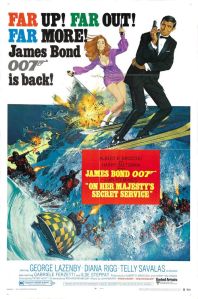
This was the challenge that Albert Broccoli and Harry Saltzman faced in getting On Her Majesty’s Secret Service made. Before watching the movie, I watched one of the documentaries on the casting. It turns out that among the individuals that they wanted to play Bond, Timothy Dalton was offered the role. However, since he was only about 22 at the time, he felt he was too young to play the suave secret agent. The producers eventually went with George Lazenby, who was famous in Australia for commercials, but had the look they were shooting for.
To help push the changes, the marketing team concentrated on everything being “different” and “new”. The idea was that you were still getting James Bond and everything within his universe, but that the kind of Bond you were getting was something awesome. This is evidenced in the trailer and many of the promotion materials.
Broccoli and Saltzman did a search for a leading lady that would be able to support Lazenby. To this end, they recruited The Avengers star Diana Rigg. Her role as Emma Peel (which was later played by Uma Thurman in the box office adaptation) was well-known, and was used as the basis of her ability to work on an action / drama piece like Bond 6. Her character, Countess Teresa di Vicenzo remains one of the best Bond Girls on film (to me, anyway), because of how cold she is from the start of the film. he same could be said of Pussy Galore in Goldfinger, but then again, Lazenby’s Bond is somewhat different from Connery’s. Additionally, Savalas’ Blofeld came across as very dynamic, and between the two, they help to keep the story exciting when Lazenby’s talking lulls others (like the women at his dinner table) to sleep. I don’t think it’s Lazenby’s fault too much. All of the other Bonds either starred in films, like Daniel Craig or television shows, like Moore and Brosnan. For someone who just came off of commercials, Lazenby did a better than expected job, but after 5 Connery films, it’s a hell of a feat to try to take that place in people’s minds.
On Her Majesty’s Secret Service is the story of how James Bond sought out Ernst Starvo Blofeld and managed to fall so head over heels in love that he got married. That’s basically it. In between, there’s beautiful snow in Switzerland, but OHMSS is at it’s heart very much a love story. It should also be noted that as this is the first film without Connery, there’s a lot of references to Connery’s tenure as Bond and some of these are smile inducing. Right from the start, when Lazenby’s Bond tries to save the countess from drowning herself, he gets caught up in a fight. By the time he’s able to defeat the thugs, she’s run off. No running into his arms, no “Oh..James!” embrace. All of this leads him to look at the camera and exclaim that this type of thing “never happened to the other fellow”. I liked that, I have to admit. There’s also an interesting scene where Bond decides to resign from MI6 and packs his suitcase. The items that he takes out of this drawer are ones from the first 3 films, complete with the musical cues to match them. Much of the first half of the movie works on paying homage to what was done before while trying to get everyone situated with Lazenby.
The movie moves from the beach to where he finds the Countess. After a little 60s coercion (“Talk!” *smack*), She reveals who she is and spends the evening with him, but by the next morning, she’s run off. That morning, on leaving the hotel, he’s kidnapped and is taken to the Countess’ father. The father explains to Bond that like Merida in Pixar’s Brave, Teresa is a bit spirited and that she should be wed. He even goes so far to offer Bond a million dollars, but Bond states that he enjoys the Bachelor’s taste of freedom, but does decide to follow through if the father can provide information on the whereabouts of Blofeld. This leads Bond to an office and an elaborate safe cracking sequence, the results of which give him information on genealogy. Impersonating the person who’s office he was in, he manages to sneak into an establishment in Switzerland that studies about allergies and how to cure them (but may be doing more nefarious deeds).
One cute part about the genealogy is that we’re shown the Bond Family Crest, which comes complete with the family motto “Orbis Non-Suffici”, which translates into “The World is Not Enough” This would later become the title of a future Brosnan film.
We come to find that what Blofeld really is doing is that he’s brainwashing the women he has at the center for use in planting biological weapons around the world. After an escape on skis and a snowy car chase, Bond is eventually able to stop Blofeld and his henchwoman (or at least wound him, anyway). This all leads up to one of the best endings ever devised for a Bond film, because it catches you completely off guard. If there’s any reason to keep this film on your shelf to watch, it’s because it was daring enough to avoid giving the audience the Bond ending you always see, with him heading off with the girl for one that’s ultimately more emotional and/or meaningful. To date, I feel that only Craig’s Casino Royale (which in essence owes a lot to OHMSS) comes close to actually providing something similar. It only falters in that Royale has Bond’s loss focusing him on the notion that he can’t have anyone in his life out of a lack of trust. On Her Majesty’s Secret Service gives the better reason that Bond simply has too many enemies in his life to warrant the connections others have, which makes him almost a sad character in a way.
Lazenby’s performance as Bond is a mix of hit and miss. From an action point of view, I thought he was pretty good. From an acting point of view, he played it a little too much by the book for me, which made me think that he wasn’t really the most exciting Bond there was. He didn’t have Timothy Dalton’s sense of darkness, Roger Moore’s wit, Brosnan’s narcissism or Craig’s coldness. He was just a guy who knew a lot and could punch you in the face if the need arose. Where Lazenby excelled were his interactions with Rigg. As a love story, OHMSS works just fine. As a Bond film, it’s like drinking coffee without any milk in it. You’re still given the same flavor, but it doesn’t quite taste the same. Perhaps this is why he didn’t stick around for Diamonds are Forever, which the producers did have him in mind for.
Musically, John Barry was back on board, and having to come up with something that defined the “New Bond”, he came up with an entirely new theme song. The music for On Her Majesty’s Secret Service is actually pretty damn good, and actually serves to became as much of an Official Theme as “007”, used in From Russia With Love – which actually happens to be my 2nd favorite Bond theme next to “A View to a Kill”.
Tomorrow, the Shattered Lens tackles Connery’s return to form in Diamonds are Forever. Below is the vocal theme for On Her Majesty’s Secret Service, “All the time in the World” by Louis Armstrong. Enjoy.

 Through the Shattered Lens