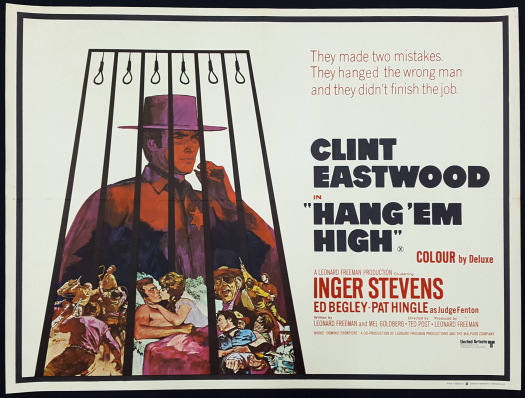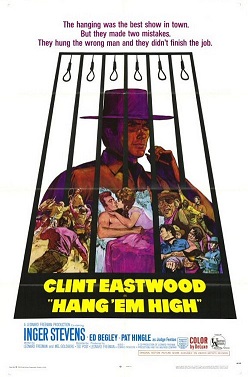
Hang ‘Em High (1968, directed by Ted Post)


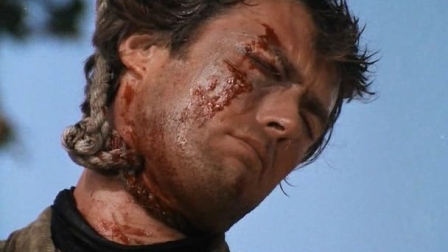
1889.  The Oklahoma Territory.  A former lawman-turned-cattleman named Jed Cooper (Clint Eastwood) is falsely accused of working with a cattle thief.  A group of men, led by Captain Wilson (Ed Begley) lynch him and leave Cooper hanging at the end of a rope.  Marshal Dave Bliss (Ben Johnson) saves Cooper, cutting him down and then taking him to the courthouse of Judge Adam Fenton (Pat Hingle).  Fenton, a notorious hanging judge, is the law in the Oklahoma territory.  Fenton makes Cooper a marshal, on the condition that he not seek violent revenge on those who lynched him but that he instead bring them to trial.  Cooper agrees.

An American attempt to capture the style of the Italian spaghetti westerns that made Eastwood an international star, HangEm High gives Eastwood a chance to play a character who is not quite as cynical and certainly not as indestructible as The Man With No Name.  Cooper starts the film nearly getting lynched and later, he’s shot and is slowly nursed back to health by a widow (Inger Stevens).  Cooper is not a mythical figure like The Man With No Name.  He’s an ordinary man who gets a lesson in frontier justice as he discovers that, until Oklahoma becomes a state, Judge Fenton feels that he has no choice but to hang nearly every man convicted of a crime.  (Judge Fenton was based on the real-life hanging judge, Isaac Parker.)  Over the course of this episodic film, Cooper becomes disgusted with frontier justice.

HangEm High is a little on the long side but it’s still a good revisionist western, featuring a fine leading performance from Clint Eastwood and an excellent supporting turn from Pat Hingle.  The film’s episodic structure allows for Eastwood to interact with a motley crew of memorable character actors, including Bruce Dern, Dennis Hopper, L.Q. Jones, Alan Hale (yes, the Skipper), and Bob Steele.  HangEm High has a rough-hewn authenticity to it, with every scene in Fenton’s courtroom featuring the sound of the gallows in the background, a reminder that justice in the west was often not tempered with mercy.

Historically, Hang ‘Em High is important as both the first film to be produced by Eastwood’s production company, Malpaso, and also the first to feature Eastwood acting opposite his soon-to-be frequent co-star, Pat Hingle.  Ted Post would go on to direct Magnum Force.
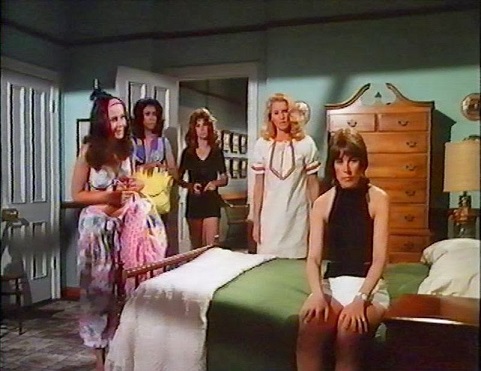
Retro Television Reviews: Five Desperate Women (dir by Ted Post)


Welcome to Retro Television Reviews, a feature where we review some of our favorite and least favorite shows of the past!  On Sundays, I will be reviewing the made-for-television movies that used to be a primetime mainstay.  Today’s film is 1971’s Five Desperate Women!  It  can be viewed on YouTube!

Five women, who all went to college together, reunite for the first time in five years.  They’re planning on spending a weekend at a cabin on a private island.  Lucy (Anjanette Comer) is the alcoholic who talks too much.  Dorian (Joan Hackett) is the pill popper who lies about having a handsome husband and two beautiful children.  Joy (Denise Nicholas) is the former activist turned trashy model.  Gloria (Stefanie Powers) is bitchy and self-centered.  And Mary Grace (Julie Sommars) is the one with the mentally ill mother who refuses to speak to her.  Upon reuniting on the dock, the five women all immediately gather in a circle sing an old sorority song.  It’s going to be one of those weekends!

The private island is lovely and the women believe that they have it to themselves, with the exception of the two men who are also on the island.  Wylie (Robert Conrad) is the caretaker and he seems to be a trustworthy gentleman and exactly the type of guy who you would want to be stranded on an island with.  And then there’s Meeker (Bradford Dillman), who drove the boat to the island and who is the type of overbearing jerk who has to be specifically told not to bother the women.  While the women stay in the main house, the men stay in the nearby caretaker’s cottage.

From the start, it proves to be a stressful weekend.  All of the women have secrets and long-buried resentments that come out at the slightest provocation.  Not helping the fact is that there’s a murderer on the island, one that goes from killing a dog to strangling Dorian while the rest of the women are at the beach.  The woman, figuring that the murderer has to be either Meeker or Wylie, lock themselves into their house for the night but it turns out that it’s going to take more than a locked door to defeat a killer.

Five Desperate Women has an intriguing premise but it also has an extremely short running time.  With only 70 minutes to tell its story and 7 major characters to deal with, the film doesn’t leave much room for character development and, as a result, each woman is only given one personality trait and each actress ends up portraying that trait as broadly as possible.  As a result, it doesn’t take long for the movie to go from being Five Desperate Women to Five Annoying Women.  As for Robert Conrad and Bradford Dillman, the two of them give effective performances but anyone with a hint of genre savvy will be able to guess who the killer is going to turn out to be.  There is one unintentionally funny moment where the desperate women attempt to fight off the killer by throwing rocks at him and none of the rocks come close to reaching their target but otherwise, Five Desperate Women is not particularly memorable.

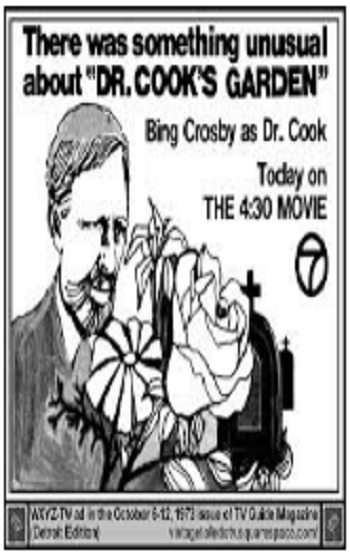
Retro Television Reviews: Dr. Cook’s Garden (dir by Ted Post)


Welcome to Retro Television Reviews, a feature where we review some of our favorite and least favorite shows of the past!  On Sundays, I will be reviewing the made-for-television movies that used to be a primetime mainstay.  Today’s film is 1971’s Dr. Cook’s Garden!  It  can be viewed on YouTube!

Everyone loves Dr. Leonard Cook.

Played by Bing Crosby, Dr. Cook has been the doctor in the small town of Greenfield for as long as anyone can remember.  He has delivered almost the entire town.  He’s the friendly face that everyone sees whenever they have an ache or a pain.  He’s the somber source of comfort whenever the time comes from someone to pass.  Dr. Cook has lost some patients but he’s saved even more and no one doubts that Dr. Cook always does his best.  As admired as Dr. Cook is as a doctor, he’s almost equally admired for the beautiful garden outside of his office.  Cook maintains the garden by always pulling out any plants that he feels would not serve the best interest of the garden.  That’s Dr. Cook.  He’s always doing whatever needs to be done to make the world a nicer place.

Unfortunately, Dr. Cook is getting old and he’s slowed down a bit.  He has a heart condition and he can no longer be as physically active as he once was.  Dr. Cook’s former student, Jimmy Tennyson (Frank Converse), returns to Greenfield so that he can help out his former mentor.  Dr. Tennyson is going to help ease Dr. Cook into retirement and then eventually take Cook’s place as the town doctor.  Dr. Cook may say that he’s not planning on retiring anytime soon but it’s obvious that he has faith in Dr. Tennyson’s ability to eventually replace him.

Or, at least, Cook feels that way until Dr. Tennyson starts asking about some of Cook’s patients who have died over the years.  Tennyson discovers that many of Cook’s patients died despite not being seriously ill and that Dr. Cook also has a surprisingly large supply of poisons.  When it’s mentioned that no one in town has ever wondered why Dr. Cook has lost so many patients because only the “mean” patients tend to die, Dr. Tennyson realizes that Dr. Cook has been doing his bit to make sure the town of Greenfield stays a nice place.  Dr. Cook calls it “community service.”  Dr. Tennyson calls it murder but can he turn on his former mentor and the most beloved man in town?  And when Tennyson starts to pressure Cook to stop practicing medicine and playing God, Dr. Cook starts to make his own plans to put his former student in his place.

An adaptation of a stage play by Ira Levin, Dr. Cook’s Garden is a suspenseful and short made-for-TV movie.  Director Ted Post does a good job of opening up the action and preventing the film from becoming overly stagey.  The main reason the film succeeds is due to the performance of Bing Crosby in the role of Dr. Cook.  Crosby’s kindly and cheerful demeanor keeps the viewer off-balance but, once Dr. Cook decides to target his former student, the friendly surface evaporates and Dr. Cook is revealed to be just as ruthless and cruel as those who he targets.  This is the type of film that will inspire you to wonder just what exactly your neighbors may be hiding in their gardens.

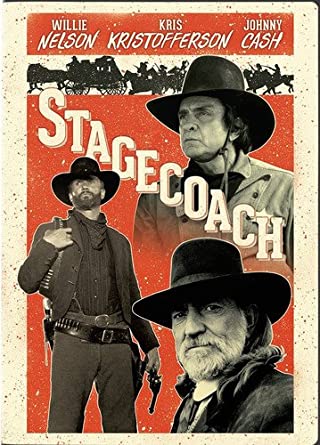
Stagecoach (1986, directed by Ted Post)


The year is 1880 and Geronimo and his Apaches are on a warpath against the people who have taken their land.  Despite the warnings of the local Calvary officers, one stagecoach tries to make the long journey from Arizona to New Mexico.  The seven passengers may start out as strangers but they’re going to have to work together to survive the journey.  The most famous passenger is dentist-turned-gunslinger Doc Holliday (Willie Nelson).  The most infamous is the Ringo Kid (Kris Kristofferson), an outlaw who has recently escaped from prison and who is looking for revenge against the men who framed him for a crime that he didn’t commit.  Henry Gatewood (Anthony Fraciosa) is a banker who has embezzled money and is looking to make a quick escape.  Foppish Trevor Peacock (Anthony Newley) sells liquor.  Dallas (Elizabeth Ashley) is a former prostitute looking to start a new life.  Mrs. Mallory (Mary Crosby) is nine months pregnant and traveling to reunite with her husband, an officer in the Calvary.  Finally, Hatfield (Waylon Jennings) is a chivalrous gambler.  Riding atop the stagecoach is Buck (John Schneider), who gets paid 8 dollars a month to risk his life taking people through Apache country, and Curly (Johnny Cash), the tough-but-fair town marshal who plans to arrest the Ringo Kid as soon as they reach civilization.

Made for television, Stagecoch is an adequate remake of the John Ford classic.  The story remains basically the same, with the main difference being that the majority of the characters are now played by country-western singers who are a few years too old for their roles.  Doc Holliday, who died of “consumption” when he was in his 30s, is played by Willie Nelson, who doesn’t look a day under 70.  The Ringo Kid is played by Kris Kristofferson, who, despite having literally played Billy the Kid a decade earlier, still doesn’t look like he’s ever been called a “kid” at any point in his life.  Compared to their original counterparts, the remake’s characters have been slightly tweaked so that they fit with the outlaw country images of the singers playing them.  Doc Holliday sympathizes with Geronimo and says that his use of whiskey is “medicinal.”  Kristofferson’s Ringo Kid is more openly contemptuous of authority than John Wayne’s.  Waylon Jennings is less of a cynic in the role of Hatfield than John Carradine was and Johnny Cash sits atop the stagecoach like a man on a holy mission.

The cast is the main reason to watch this version of Stagecoach.  The film can’t match the original but Nelson, Kristofferson, Jennings, and Cash obviously enjoyed playing opposite each other and, even if Nelson and Kristofferson are miscast, all of them bring some needed country-western authenticity to their roles.  As for the non-singers, Mary Crosby, Elizabeth Ashley, and John Schneider all make the best impressions while both Franciosa and Newley seem too 20th Century for their western roles.  Director Ted Post does a good job with the action scenes and keeps the story moving, even if the remake’s status as a TV production keeps him from capturing visual grandeur of Ford’s original.  Stagecoach is a respectful remake of a classic, one that can be appreciated when western fans on its own merits.

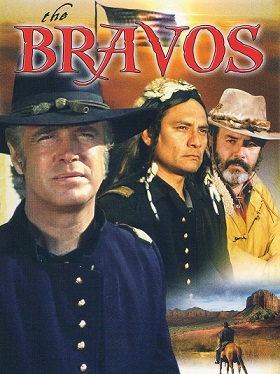
The Bravos (1972, directed by Ted Post)


Major John David Harkness (George Peppard) is the commander of Fort Bravo, a small and ill-equipped frontier fort.  Despite having only 77 soldiers and not many supplies, Harkness has managed to keep an uneasy peace between the local Indian tribes and the settlers who move through the area.  The peace, however, is disturbed when an arrogant wagon master (Pernell Roberts) kills the son of the tribal chief.

That’s not all that Harkness has to worry about.  A German outlaw (Bo Svenson) is hiding out at the camp.  His head scout (L.Q. Jones) suspects that something is forcing the local tribes out of the area.  Two settlers from Missouri (played by Barry Brown and Belinda Montgomery) are at the fort and trying to decide whether they should continue westward or return to Missouri.  Finally, Harkness’s 12 year-old son, Peter (Vincent Van Patten), has been expelled from his New England boarding school and is being sent to Fort Bravo to live with his father.  When Major Harkness refuses to turn the wagon master over to the Indians, they kidnap his son instead.

The Bravos was made for television and originally aired on ABC in 1972.  It was apparently meant to serve as the pilot for a television series, one that would have followed the daily adventures of the Major, his son, and all of the men at Fort Bravo (who were played by television mainstays like Dana Elcar, Randolph Mantooth, and George Murdock.)  For all intents and purposes, Pernell Roberts, Bo Svenson, Belinda Montgomery, and Barry Brown are all “special guest stars” and are meant to serve as examples of the type of television-friendly actors who would visit Fort Bravo on a weekly basis.  That the pilot didn’t lead to a series isn’t surprising.  TV westerns may have dominated the ratings in the 50s and the 60s but they quickly went out of fashion in the 70s as networks realized that they could make more money selling ad space for Norman Lear sitcoms and cop shows.  In the 70s, the people that advertisers were wanting to reach were watching Archie Bunker and Starsky and Hutch, not George Peppard.

Because of its TV origins, The Bravos is a fairly bland western.  It would be a few years before George Peppard would reinvent himself as a grizzled character actor and he’s sincere but fairly dull here.  Pernell Roberts is more effective as the headstrong wagon master and perhaps The Bravos would have worked better if Roberts and Peppard had switched roles.  In the end, the main reason to see the film is for the chance to see L.Q. Jones play a heroic role for once.  A member of Sam Peckinpah’s stock company, Jones brings some authentic grit to his role as the fort’s only scout.  Jones played a lot of villains but I always preferred him as one of the good guys.

The Bravos ends with a few major subplots unresolved.  Maybe they would have been resolved during the show’s first season but it was not to be.

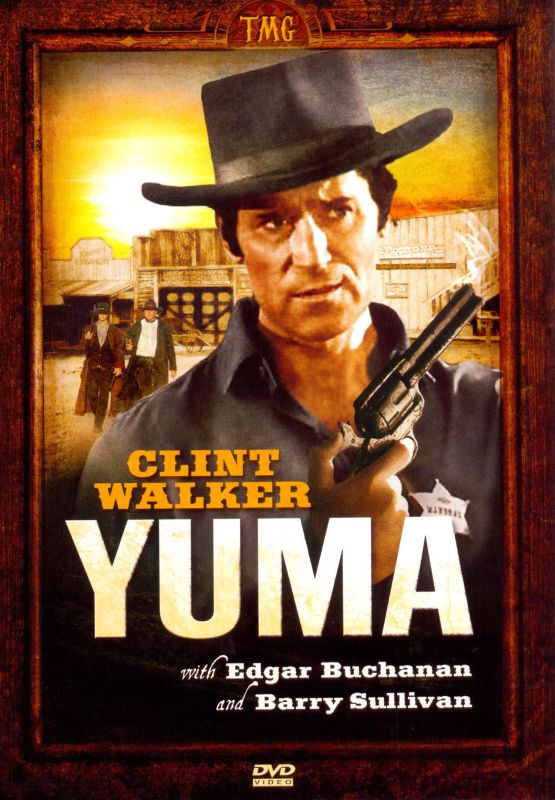
Yuma (1971, directed by Ted Post)


At the start of this made-for-TV western, experienced lawman Dave Harmon (Clint Walker) has just been appointed the new marshal of Yuma.  He’s served as the marshal of several towns, all of which were near rowdy army bases.  He’s a laconic, no-nonsense lawman who is quick with a gun and smart enough to negotiate with the local Indian tribes.

As soon as Harmon rides into town, he comes across the King Brothers (Bruce Glover and Bing Russell) making trouble.  He kills one of the brothers in a saloon and then takes the other one to jail, where he’s mysteriously gunned down during a midnight jailbreak.  It turns out that there’s a third Harmon brother, cattle baron Arch King (Morgan Woodward), and he rides into town looking for revenge.  He gives Harmon a set amount of time to find and arrest his brother’s killer or Arch and his men are going to return to town and kill Harmon.

Fortunately, Harmon has a witness to the jailbreak murder.  Andres (Miguel Alejandro) is a young, Mexican orphan who sleeps at the jail.  He witnessed the murder but he only saw that the killer was wearing what appeared to be army boots.  Harmon’s investigation brings him into conflict with the local army base’s commandant (Peter Mark Richman) and also leads to the discovery of a plot to defraud the local Indians.

The main problem with Yuma is that it was clearly designed to be a pilot for a weekly television series and, as a result, it introduces a lot of characters who don’t get much to do.  There’s a lot of talk about how Harmon is searching for the men who earlier killed his family but that subplot is never resolved.  (If Yuma had been picked up as a weekly show, maybe it would have been.)  Yuma has to set up the premise for a potential show and tell a complete story in just 70 minutes.  That’s a lot to handle and Yuma ends up feeling rushed and incomplete.

As a B-western for undemanding fans of the genre, it’s acceptable.  Clint Walker was a convincing lawman and the film was directed by Ted Post, who knew how to stage a gunfight.  But it’s not really a western that you’re going to remember for long after you watch it.

4 Shots From 4 Horrific Family Films: Spider Baby, The Baby, The Texas Chainsaw Massacre, Amityville II: The Possession


4 Shots From 4 Films is just what it says it is, 4 shots from 4 of our favorite films. As opposed to the reviews and recaps that we usually post, 4 Shots From 4 Films lets the visuals do the talking.

Today, we have 4 shots from 4 films that all feature horrific families!

4 Shots From 4 Horrific Family Films

Spider Baby (1964, dir by Jack Hill)

The Baby (1973, dir by Ted Post)

The Texas Chainsaw Massacre (1974, dir by Tobe Hooper)

Amityville II: The Possession (1982, dir by Damiano Damiani)

Dead Man Walking: Clint Eastwood in HANG ‘EM HIGH (United Artists 1968)


gary loggins's avatarcracked rear viewer

Clint Eastwood  returned to America after his amazing success in Sergio Leone’s Man With No Name Trilogy as a star to be reckoned with, forming his own production company (Malpaso) and filming HANG ‘EM HIGH, a Spaghetti-flavored Western in theme and construction. Clint was taking no chances here, surrounding himself with an all-star cast of character actors and a director he trusted, and the result was box office gold, cementing his status as a top star.

Clint plays ex-lawman Jed Cooper, who we meet driving a herd of cattle he just purchased (reminding us of his days on TV’s RAWHIDE). A posse of nine men ride up on him and accuse him of rustling and murder, appointing themselves judge, jury, and executioner, and hang him. He’s left for dead, until Marshal Dave Bliss comes along and cuts him down, taking Jed prisoner and transporting him to nearby Ft. Grant. Evidence…

View original post 603 more words

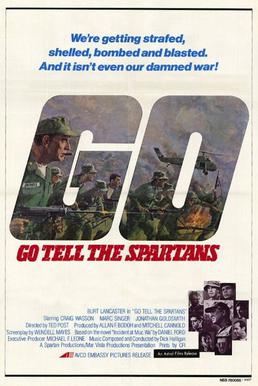
A Movie A Day #305: Go Tell The Spartans (1978, directed by Ted Post)


One of the best films ever made about Vietnam is also one of the least known.
Go Tell The Spartans takes place in 1964, during the early days of the Vietnam War.  Though the Americans at home may not know just how hopeless the situation is in South Vietnam, Major Barker (Burt Lancaster, in one of his best performances) does.  Barker is a career military man.  He served in World War II and Korea and now he’s ending his career in Vietnam, taking orders from younger superiors who have no idea what they are talking about.  Barker has been ordered to occupy a deserted village, Muc Wa.  Barker knows that occupying Muc Wa will not make any difference but he is in the army and he follows orders.

Barker sends a small group to Muc Wa.  Led by the incompetent Lt. Hamilton (Joe Unger), the group also includes a drug-addicted medic (Dennis Howard), a sadistic South Vietnamese interrogator (Evan C. Kim) who claims that every civilian that the men meet is actually VC, a sergeant (Jonathan Goldsmith) who is so burned out that he would rather commit suicide than take command, and Cpl. Courcey (Craig Wasson).  Courcey is a college-educated idealist, who joined the army to do the right thing and is now about to discover how complicated that can be in South Vietnam.  At Muc Wa, the soldiers find a cemetery containing the graves of French soldiers who died defending the hamlet during the First Indochina War.  The inscription as the cemetery reads, “Go tell the Spartans, stranger passing by, that here, obedient to their laws, we lie.”  

Because the film strives for realism over easy drama, Go Tell The Spartans has never gotten the same attention as some other Vietnam films.  Unlike The Deer Hunter, Platoon, Coming Home, and Born on the 4th of July, Go Tell The Spartans received no Oscar nominations.  It is still a brilliantly acted and powerful anti-war (but never anti-soldier) film.  It starts out as deceptively low-key but the tension quickly builds as the soldier arrive at Muc Wa and discover that their orders are both futile and impossible to carry out.  Vastly outnumbered, the Americans also find themselves dealing with a land and a culture that is so unlike their own that they are often not even sure who they are fighting.  Military discipline, as represented by Lt. Hamilton, is no match for the guerilla tactics of the VC.  By the film’s end, Vietnam is revealed to be a war that not even Burt Lancaster can win.

Cleaning Out The DVR Yet Again #38: The Baby (dir by Ted Post)


(Lisa recently discovered that she only has about 8 hours of space left on her DVR!  It turns out that she’s been recording movies from July and she just hasn’t gotten around to watching and reviewing them yet.  So, once again, Lisa is cleaning out her DVR!  She is going to try to watch and review 52 movies by the end of Thursday, December 8th!  Will she make it?  Keep checking the site to find out!)

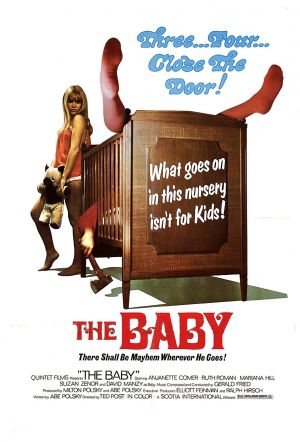
poster_of_the_movie_the_baby

On October 30th, I recorded The Baby off of TCM.

First released back in 1973, The Baby is a seriously strange little movie.  It’s about a 21 year-old man named Baby (played by David Manzy).  Why is he called Baby?  Because he lives in a crib.  And he wears a diaper that occasionally needs changing.  And he sounds exactly like a baby.  (Whenever he opens his mouth, the sound of an actual baby is dubbed in.)  When he’s alone with his babysitter, he eagerly sucks on her breast, half-nursing and half-perving.

Baby is the only son of Mrs. Wadsworth (Ruth Roman, giving a chillingly evil performance).  Mrs. Wadsworth was abandoned by her husband shortly after Baby was born and the film implies that she’s taken a lot of her hatred towards her ex out on her son.  Despite not liking her son, Mrs. Wadsworth is determined to hold onto him.  She gets a weekly welfare check from the state.  The money is supposed to be used to take care of Baby but Mrs. Wadsworth uses it to take care of herself and her two daughters.

Who are her daughters?  Alba Wadsworth (Suzanne Zenor) is an implied nymphomaniac who has a way with a cattle prod.   Germaine Wadsworth (Marianna Hill) is an actress and model who, it’s suggested, has incestuous designs on her brother.

That’s right — they’re a messed up family!  However, they do throw great parties, the type that are full of all the typical characters who you would expect to appear in a low-budget film from 1973.  Hippies, hipsters, aspiring disco dancers, they all show up.  Michael Pataki shows up as well!  You my not know the name but if you’re a fan of 70s exploitation films like me, you’ll immediately recognize Michael Pataki.

In order to continue receiving money from the government, the Wadsworths have to impress their case worker.  They’ve moved through several social workers and, for the most part, they’ve survived by being so strange that no one wants to spend too much time dealing with them.  However, their case has just been assigned to Ann Gentry (Anjanette Comer) and she actually takes an interest in Baby and his life with the Wasdworths.

Ann says that she thinks Baby could benefit from going to a special school.  The Wadsworths suggest that she mind her own business.  Ann, however, has no intention of doing that.  Ann refuses the give up on giving Baby a chance at a better life.

Sounds heart-warming, right?

Well, no.

At first, Ann seems like just another concerned do-gooder.  But, at the film progresses, we start to suspect that Ann might have some secrets of her own.  We’re told that she lost her husband in a car accident but the details are left intentionally vague.  What we do know is that Ann lives in a huge house with her mother-in-law (Beatrice Manley Blau) and we find ourselves wondering why, if her husband is gone, are the two of them still living together.

We also fin ourselves wondering: Does Ann have Baby’s best interests in mind?  For that matter, does anyone?

Being a 70s movie, it all ends with a violent home invasion that’s followed by a surprise twist.  The twist caught me totally off-guard and forced me to reconsider everything that I had previously seen.  It was shocking, it was borderline offensive, it was just a little bit ludicrous, and it was rather brilliant in its odd way.

The same can be said for The Baby as a whole.  This is one weird movie and you’ll never see another like it.  For that reason alone, The Baby is worth seeing at least once.