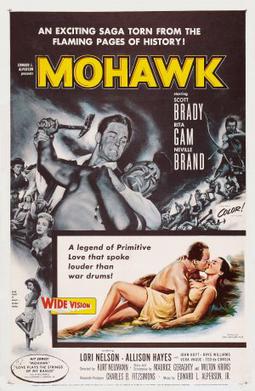
 In the late 18th century, Boston socialite Cynthia Stanhope (Lori Nelson) travels to Fort Alden in upstate New York to visit her fiancé, a painter named Jonathan Adams (Scott Brady), who has been commissioned to paint the local scenery. As soon as Cynthia and her mother arrive, they are shocked to discover that not only Jonathan has been painting pictures of the members of the Native local tribes but that he is also now flirting with a barmaid named Greta. Greta is played by Allison Hayes so who can blame him? Cynthia wants to return to their normal upper class life in Boston but Adams has fallen for the untamed wilderness of the frontier.
When Onida (Rita Gam), the daughter of Iroquois chief Kowanen (Ted de Corsia) is captured during a raid on the fort, Adams is assigned to escort her back to her tribe. Leaving behind Cynthia and Greta, Adams falls in love with Onida over the course of the journey. When he meets the Iroquois, he earns the respect of her father and the entire tribe when he agrees to paint the chief’s portrait.
Meanwhile, a haughty settler named Butler (John Hoyt) is trying to play the army and the Iroquois against each other, feeding both of them false information in an attempt to spark a war. Butler is hoping that a war will lead to both sides wiping each other out so that he can once again have the valley to himself. When it turns out that his words might not be enough to spark a war, Butler resorts to murder. When Kowanen’s son is killed, the Iroquois prepare for war while Adams is framed for the crime and finds himself tied to a stake.
Mohawk is a standard B-western, with a plot that is largely lifted from John Ford’s Drums Along The Mohawk. Unfortunately, Adams is about as sympathetic hero as you would expect someone manipulating three different women to be and, when it comes to depicting the Iroquois, Mohawk resorts to too many clichés. This is one of those westerns where the Native characters speak broken English, even when they are just talking to each other.
Mohawk does have three things to recommend it. Number one, John Hoyt was a master at playing haughty villains and Butler is easy to root against. You will look forward to seeing him get his comeuppance. Number two, Allison Hayes was a force of nature and that’s true even in this film, where she’s not given nearly enough to do. Number three, one of Iroquois braves is played by Neville Brand. A highly decorated World War II veteran, Brand built a long career playing tough guys. In Mohawk, it only takes one look at Neville Brand to know that this isn’t someone you want to mess with. Anyone watching would want to stay on Neville Brand’s good side.
Otherwise, Mohawk is forgettable. Two years after it was released, Mohawk’s director Kurt Neumann, would be responsible for the much more memorable The Fly.


 The place is Chicago. The time is the era of Prohibition. The head of the Chicago Outfit, Rocca (Ted de Corsia), has arranged for a career criminal named Lester Gillis (Mickey Rooney) to be released from prison. A crack shot and all-around tough customer, Gillis has only two insecurities: his diminutive height and his youthful appearance. Rocca wants to use Gillis as a hit man but Gillis prefers to rob banks. When Rocca attempts to frame Gillis for a murder, Gillis first guns down his former benefactor and then goes on the run with his girlfriend, Sue Nelson (Carolyn Jones). Because they are both patients of the same underworld doctor (played by Sir Cedric Hardwicke), Gillis eventually meets public enemy number one, John Dillinger (Leo Gordon). Joining Dillinger’s gang, Gillis becomes a famous bank robber and is saddled with a nickname that he hates: Baby Face Nelson.
 Through the Shattered Lens