Lisa Reviews an Oscar Winner: The Sting (dir by George Roy Hill)


Earlier tonight, as a part of their 31 Days of Oscar, TCM aired The Sting, the film that the Academy selected as being the best of 1973.  I just finished watching it and what can I say?  Based on what I’ve seen of the competition (and there were a lot of great films released in 1973), I would not necessarily have picked The Sting for best picture.  However, the movie is still fantastic fun.

The Sting reunited the director (George Roy Hill) and the stars (Robert Redford and Paul Newman) of Butch Cassidy and the Sundance Kid and told yet another story of likable criminals living in the past.  However, whereas Butch Cassidy largely satirized the conventions of the traditional Hollywood western, The Sting is feels like a loving homage to the films of 1930s, a combination of a gritty, low-budget gangster film and a big budget musical extravaganza.  The musical comparison may sound strange at first, especially considering that nobody in The Sting randomly breaks out into song.  However, the musical score (which is famously dominated by Scott Joplin’s The Entertainer) is ultimately as much of a character as the roles played by Redford, Newman, and Robert Shaw.  And, for that matter, the film’s “let-pull-off-a-con” plot feels like an illegal version of “let’s-put-on-a-show.”

The film takes place in the 1936 of the cultural imagination, a world dominated by flashy criminals and snappy dialogue.  When con artists Johnny Hooker (Robert Redford) and Luther Coleman (Robert Earl Jones) inadvertently steal money from a gangster named Lonnegan (Robert Shaw), Lonnegan has Luther murdered.  Fleeing for his life, Hooker goes to Chicago where he teams up with Luther’s former partner, veteran con man Henry Gondorff (Paul Newman).  Gondorff used to be one of the great con artists but he is now living in self-imposed obscurity, spending most of his time drinking and trying to avoid the FBI.  Hooker wants to get revenge on Lonnegan by pulling an elaborate con on him.  When Gondorff asks Hooker why, Hooker explains that he can either con Lonnegan or he can kill him and he doesn’t know enough about killing.

The rest of the film deals with Hooker and Gondorff’s plan to con Lonnegan out of a half million dollars.  It’s all very elaborate and complicated and a bit confusing if you don’t pay close enough attention and if you’re ADHD like me.  But it’s also a lot of fun and terrifically entertaining and that’s the important thing.  The Sting is one of those films that shows just how much you can accomplish through the smart use of movie star charisma.  Redford and Newman have such great chemistry and are so much fun to watch that it really doesn’t matter whether or not you always understand what they’re actually doing.

It also helps that, in the great 70s tradition, they’re taking down stuffy establishment types.  Lonnegan may be a gangster but he’s also a highly respected and very wealthy gangster.  When Newman interrupts a poker game, Lonnegan glares at him and tells him that he’ll have to put on a tie before he’s allowed to play.  Lonnegan may operate outside the law but, in many ways, he is the establishment and who doesn’t enjoy seeing the establishment taken down a notch?

As entertaining as The Sting may be and as influential as it undoubtedly is (Steven Soderbergh’s Ocean films may be a lot more pretentious — which makes sense considering that Soderbergh is one of the most pretentious directors in film history — but they all owe a clear debt to The Sting), it still feels like an unlikely best picture winner.  Consider, for instance, that The Sting not only defeated American Graffiti and The Exorcist but Ingmar Bergman’s Cries and Whispers as well.  On top of that, when you consider some of the films that were released in 1973 and not nominated — Mean Streets, Badlands, The Candy Snatchers, Day of the Jackal, Don’t Look Now, Jesus Christ Superstar, and The Long Goodbye — it’s debatable whether The Sting should have been nominated at all.  That’s not a criticism of The Sting as much as it’s an acknowledgement that 1973 was a very good year in film.

So, maybe The Sting didn’t deserve its Oscar.  But it’s still a wonderfully entertaining film.  And just try to get that music out of your head!
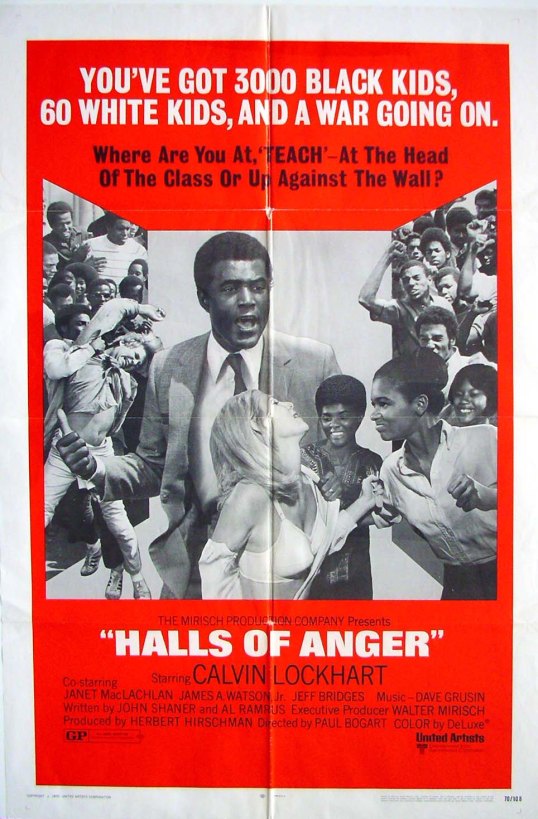
Back to School #8: Halls of Anger (dir by Paul Bogart)


Halls Of Anger

Everybody loves Jeff Bridges.

Last month, the Democratic senator from Montana, John Walsh, announced that he wouldn’t be running for reelection because, much like Lianne Spiderbaby, he had been caught plagiarizing.  (Incidentally, I was one of the many bloggers caught up in Lianne’s web of thievery.  If you have ever read Lianne’s review of Mario Bava’s Black Sabbath, you were essentially reading my review of Black Sabbath.)  Unfortunately, for the Montana Democratic Party, Walsh had already won the Democratic primary.  So, the Montana Democrats held an emergency meeting to select a new nominee.

Governors, ranchers, former congressmen — nearly every prominent Democrat in Montana announced that he didn’t want the nomination.  It looked like all hope was lost but then a petition appeared online, asking the Democrats to nominate Jeff Bridges for the U.S. Senate!  This petition made national headlines and, in just a few hours, it had received thousands of signatures.  For a few brief days, everyone was truly excited about the prospect of U.S. Sen. Jeff Bridges.  I even signed the petition myself, despite the fact that 1) I don’t live in Montana and 2) I’m not even a Democrat!

(I’m a member of the Personal Choice Party.  PCP in 2016!)

Ultimately, he announced that he had no interesting running and wasn’t even sure if he was registered to vote but, until that happened, why were so many of us excited about Jeff Bridges running for the Senate?

Because, in this time of division and conflict, everybody loves Jeff Bridges!

He’s just an incredibly likable actor.  Even when he’s playing a villain, like in Iron Man, he still comes across like someone you would want to live next door to.  He’s everyone’s perfect hippie uncle, the guy that even people who don’t smoke weed want to get stoned with.  If you ever watch any of his early films — and Bridges has been making movies for nearly 50 years now — you’ll discover that this unique and likable charm is something that Jeff Bridges has always possessed.

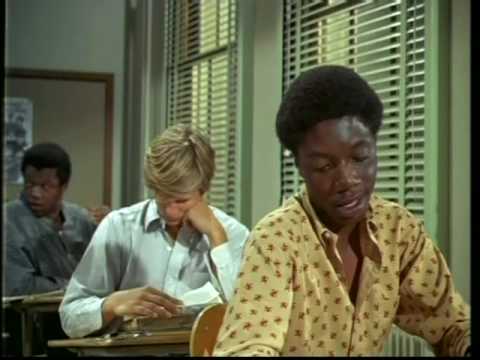
It’s certainly present in 1970’s Halls of Anger.  This was Jeff Bridges’s film debut, made at a time when he could still pass for a high school student.  He was 20 when he made this film and I have to say that for those of us who best know him as the Dude, Rooster Cogburn, and whoever he was playing in Crazy Heart, it’s always interesting to see just how handsome Jeff Bridges was when he was young.

Jeff Bridges, hiding his face in Halls of Anger

Jeff Bridges, hiding his face in Halls of Anger

In Halls of Anger, he plays Doug, one of 60 white kids who have been transferred to a majority black inner city high school in an attempt to integrate it.  Of all the new white students, Doug is probably the most confident and the most open-minded.  He’s also the most friendly.  His attempt to join the high school basketball team upsets the other students but — even after getting beaten up — Doug sticks with it.  You knew that he would because, after all, he’s played by Jeff Bridges.

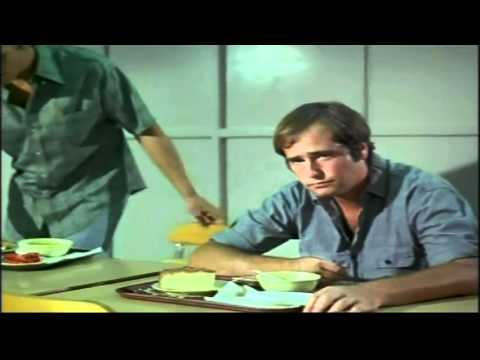
Of course, Doug’s story is just one of the many stories told in Halls of Anger.  Another one of the transfers — a weak-willed and balding racist named Leaky (played by future director Rob Reiner!) — tries to provoke a fight with a black student, hoping that he’ll be sent back to his old school for his own protection.  White Sherry (Patricia Stich) dates a black classmate and is savagely assaulted as a result.  Newly assigned vice principal Quincy Davis (Calvin Lockhart) tries to both keep the peace and teach a group of functionally illiterate students how to read.  Militant J.T. Walsh (James Edwards) wanders the hallways and speaks of revolution…

Rob Reiner in Halls of Anger

Rob Reiner in Halls of Anger

Actually, I’m probably making Halls of Anger sound a lot more interesting than it actually is.  For the most part, it’s pretty much your standard 1970 social problem film, in that it’s full of good intentions but those good intentions don’t always add up to compelling drama.  Paul Bogart’s direction is often flat (the scene where Davis teaches his students how to read seems to drag on for hours) and the characters don’t so much talk to each other as they make narratively convenient speeches.

That said, Halls of Anger is worth watching just to see Calvin Lockhart’s authoritative performance, Rob Reiner’s hilariously bad performance, and Jeff Bridges’s charismatic debut performance.  He may never be a member of the U.S. Senate but everybody will always love Jeff Bridges.

You can watch Halls of Anger below!

http://www.youtube.com/watch?v=7btGxM2rSCY