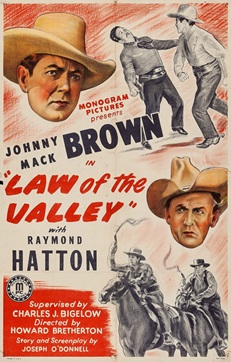
Gun Smoke (1945, directed by Howard Bretherton)


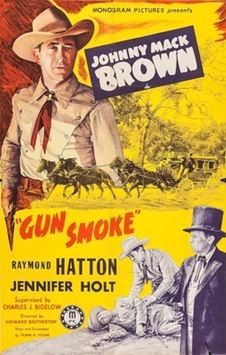
On the frontier, a stagecoach has been overturned and both the passenger and the driver have been killed by outlaws.  The passenger was Hinkley, an archeologist.  Who would want to kill a harmless archeologist?  That’s what Marshals Nevada Jack McKenzie (Johnny Mack Brown) and Sandy Hopkins (Raymond Hatton) set out to discover.  While Nevada Jack asks questions in the nearby town, Sandy disguises himself as a medicine man.

It all links back to an old Indian site that is said to be full of gold relics.  Jane (Jennifer Holt), the daughter of Hinkley’s partner, reveals that the only other person who knows the location of the site is an old Indian named Shag (Dimas Sotello).  Jack and Sandy have to try to track down Shag before he’s found the gang that killed Hinkley.

Yes, it’s another Johnny Mack Brown western.  Despite the title, this has nothing to do with the television series that featured James Arness and Amanda Blake.  Gun Smoke is still a solid western, featuring a determined performance from Johnny Mack Brown and some memorable villains from the usual poverty row western stock company.  Once again, Frank Ellis shows up as a henchman, though the identity of the main villain is actually a little more interesting than was typical for these films.  Johnny Mack Brown is a little more serious than usual, throwing punches with authority.  For fans of B-westerns, Gun Smoke is an above average entry in Johnny Mack Brown’s seemingly endless filmography.

Flame of the West (1945, directed by Lambert Hillyer)


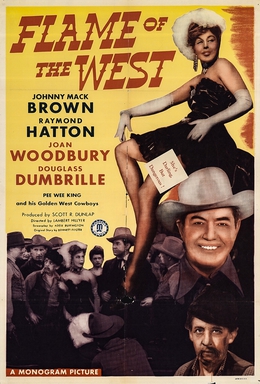
Marshal Tom Nightlander (Douglass Dumbrille) shows up in a lawless frontier town, tasked with bringing peace.  He could sure use the help of Dr. John Poole (Johnny Mack Brown), a former gunslinger who has set his weapons aside and now works as the town doctor.  Dr. Poole has sworn off guns but with corrupt businessman Wilson (Harry Woods) and his gang determined to keep their town lawless, Poole is soon forced to reconsider.

This B-western from Monogram is better than many of the other low-budget, poverty row westerns of the era.  While the plot is another example of a corrupt businessman and his gang making life difficult for peaceful settlers, the characters in Flame of the West are a little more complex than usual.  Brown stands out playing a character who, for once, doesn’t want to fight and believes that it’s better to talk than to shoot.  Of course, this being a B-western, he soon sees the error of his ways.  Dumbrille was usually cast as a villain so this film is a chance to see him in a likable and heroic role and he’s very convincing as a Wyatt Earp-style marshal.

Of course, even a serious B-western is still a B-western so songs and entertainment are provided by the gorgeous Joan Woodbury and Pee Wee King and his Golden West Cowboys.  (Don’t worry, I had never heard of them before, either.)  Joan Woodbury plays a saloon owner who wants to bring a higher class of entertainment to the frontier and she provides the film with enough sex appeal that 1945 audiences probably didn’t mind having to sit through the musical numbers before getting to the inevitable showdown between Johnny Mack Brown and Harry Woods.

Flame of the West is a good B-western that shows what dependable actors like Johnny Mack Brown and Douglass Dumbrille were capable of when given the opportunity.

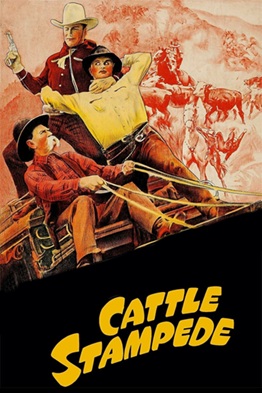
Cattle Stampede (1943, directed by Sam Newfield)


Billy the Kid (Buster Crabbe), that western do-gooder who has been framed for crimes that he didn’t commit, narrowly escapes being captured by a group of bounty hunters.  To thank the man who helped him and his sidekick, Fuzzy Q. Jones (Al  St. John), escape, Billy agrees to help the man’s family make a cattle drive.  It turns out that local ranchers are being targeted by rustlers who cause the cattle to stampede and then buy up what’s left of the herd at a discount.  Even though Mary Dawson (Frances Gladwin) doesn’t trust Billy and initially suspects him of being one of the rustlers, Billy and Fuzzy take over the cattle drive and protect the family from Coulter (Glenn Strange) and Elkins (Frank Ellis).  They even prove their worth by rescuing Mary after she’s kidnapped by the villains.

This is one of the many Poverty Row westerns to feature Billy the Kid not as an outlaw but instead as a hero.  Best-known for playing Tarzan, Flash Gordon, and Buck Rogers, Buster Crabbe was a believable hero even if he was more than a little too old to be nicknamed “the kid.”  Al St. John provides the comedic relief and veteran bad guys Charles King, Glenn Strange and Frank Ellis go through the motions as the villains, much as they did in countless other westerns of the era.  Cattle Stampede is typical of the cheap western programmers that came out of the Poverty Row studios in the 40s.  It was simplistic and predictable but featured enough western action to keep the kids in the audience entertained.  Today, its main selling point is a nostalgic one.

The Billy the Kid films are always strange because they avoid the reason why Billy is being pursued by the law and instead just present him as being another generic western hero.  It seems like a waste of a good legend.

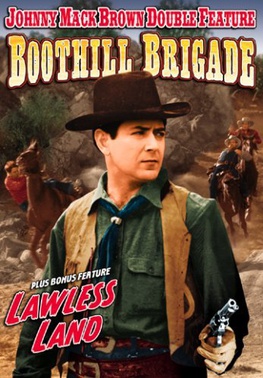
Boothill Brigade (1937, directed by Sam Newfield)


Rancher Jeff Reynolds (Frank LaRue) used to be one of the good guys on the frontier but he’s recently changed.  He fired all of his loyal ranch hands and instead hired a motely crew of outlaws.  He’s buying up land and evicting the squatters who have been living there.  About the only good thing he does is hire Lon Cardigan (Johnny Mack Brown) to be his new herd boss.  Lon is engaged to Reynolds’s daughter, Bobbie (Claire Rochelle).  With the help of Bobbie and comic relief cook Calico Haynes (Horace Murphy), Lon tries to figure out why Reynolds is now doing the bidding of the evil John Porter (Ed Cassidy).

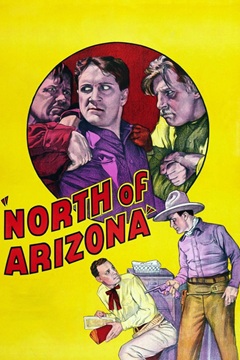
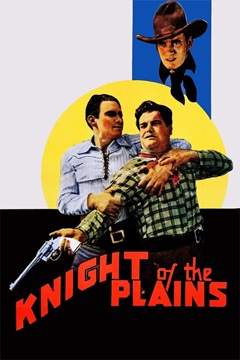
The title is the most exciting thing about this movie, which is one of those old B-movies that puts the “creak” in creaky.  There’s surprisingly little gunplay but there is a lot of horse riding.  For a film that runs less than an hour, a surprising amount of it is just shots of people riding from one location to another.  The horses’ hooves sound impressive on the soundtrack but it’s not exactly exciting.  As always, Johnny Mack Brown is a convincing cowboy.  It’s a good thing he looks like he knows what he’s doing when he’s riding a horse!  The plot was standard B-western fluff.  Johnny Mack Brown appeared in a ton of westerns and almost all of them seemed to feature the same range war.  There are better Johnny Mack Brown movies out there.  This one is for completists only.

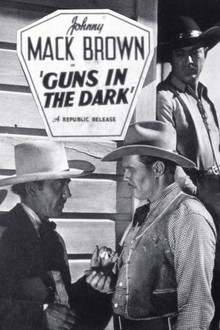
Guns In The Dark (1937, directed by Sam Newfield)


In Mexico, two American cowboys, Johnny Darrel (Johnny Mack Brown) and Dick Martin (Julian Madison) join a poker game to try to win some money and help out their buddy, Oscar (Sid Saylor).  When they discover that cantina owner Manuel Mendez (Ted Adams) has rigged the game, a fight breaks out.  The lights turn off.  In the darkness, several guns are fired.  When the lights come back up, Dick is dead.  Mendez convinces Johnny that he accidentally shot his friend in the fight.  Guilt-stricken, Johnny tosses aside his guns and returns to Texas.

Johnny has sworn that he will never shoot another gun but when he’s hired to work at a ranch owned by Joan Williams (Claire Rochelle), he finds himself in the middle of a range war between Joan and Brace Stevens (Dick Curtis), with Mendez also making an unwelcome return to Johnny’s life.  Even after Johnny discovers the truth about what happened that night at the cantina, he doesn’t pick up a gun.  Instead, Johnny fights the bad guys with lassos and plates.

Guns In The Dark is only 54 minutes long and it features actors who will be familiar to any fan of the old B-westerns.  Sidekcick Sid Saylor’s stuttering schtick gets old quickly but Johnny Mack Brown is as likable as always in Guns In The Dark and he comes across as being an authentic cowboy even when he’s not carrying a gun  Given that this film features even more horse chases than the typical Johnny Mack Brown b-western, it’s good that Brown is so convincing.  What isn’t convincing is how stupid Johnny Darrel is required to be in order for him to fall for Mendez’s lie in the first place.  I appreciated the change of pace from Brown just using a gun to stop the bad guys but I wish the reason behind it had been more convincing.  This isn’t one of Johnny Mack Brown’s more memorable westerns though, as always, it’s easy to see why he was one of the early stars of the genre.


Bonanza Town (1951, directed by Fred F. Sears)


The frontier community of Bonanza Town has been taken over by the corrupt businessman, Krag Boseman (Myron Healey).  No one can stand up to Krag because the local judge (Luther Crockett) is under Boseman’s control.  The judge’s son (Ted Jordan) writes to the Durango Kid and asks him to come to Bonanza Town and lead a group of vigilantes to overthrow Boseman.

The Durango Kid, whose real name is Steve Ramsay (Charles Starrett) somehow receives the letter and heads into town.  As Steve, he gets a job working for Boseman and looks for evidence that Boseman is actually being bankrolled by a notorious outlaw named Henry Hardison (played by the film’s director, Fred Sears).  As the masked Durango Kid, he defuses the vigilante’s violent plan and, with the help of Smiley Burnette, he investigates what Boseman has on the judge.

Charles Starrett played the Durango Kid in 131 films.  In fact, he appeared in so many movies that the majority of Bonanza Town is made up of flashbacks from 1947’s West of Dodge City.  Despite all of the flashbacks, Bonanza Town is one of Starrett’s better films, featuring an interesting story and good performances from both Fred Sears and Luther Crockett.  Sears shows some imagination with his staging of the many gunfights and, as always, Starrett is convincing riding a horse and carrying a gun.

Bonanza Town is a fairly serious film and Smiley Burnette’s trademark comedic relief feels out of place but the kids in 1951 probably enjoyed it.  While everyone else is shooting guns and committing murder, Smiley is running his barber shop and turning a potato into a musical instrument.  While the Durango Kid dispenses frontier justice, Smiley sings a song and leaves his customers bald.  They were a good team.

Black Hills (1947, directed by Ray Taylor)


Times are hard and rancher John Hadley (Steve Clark) is running the risk of losing his ranch. When Hadley finds gold on his property, he think that all of his problems have been solved. He makes the mistake of revealing the existence of the gold to his friend, Terry Frost (Dan Kirby). Terry’s not much of a friend because he shoots and kills Hadley and then, working with a corrupt county clerk (William Fawcett), he tries to steal Hadley’s property away from the rancher’s children and rightful heirs.

Luckily, singing cowboy Eddie Dean (played by real-life singing cowboy Eddie Dean) rides up and, with the help of his comic relief sidekick (Roscoe Ates), helps to get things sorted out. Even with Terry trying to frame Eddie for a murder he didn’t commit, Eddie still finds time to sing a few songs.

This was Eddie Dean’s final feature film before he moved into television. Black Hills is better than Romance of the West, the Eddie Dean movie that I reviewed yesterday. The plot actually has a few interesting twists and, though it doesn’t appear that he was ever much of an actor, Eddie Dean appears to be more comfortable with his role here than he was in Romance of the West. Black Hills emphasizes that Eddie could throw a punch just as well as he could sing and veteran western actor Dan Kirby is a credible villain. It makes Black Hills into an entertaining if not exactly memorable western diversion.

One final note about Black Hills: Eddie’s horse, White Cloud, gets second billing in the credits.