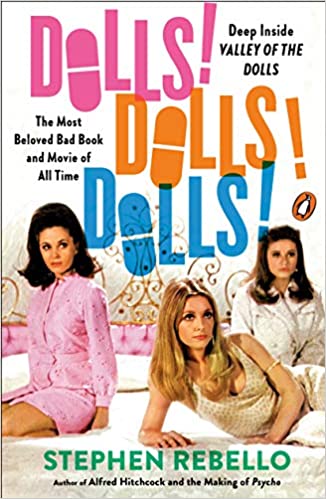
Book Review: Dolls! Dolls! Dolls!: Deep Inside Valley of the Dolls, the Most Beloved Bad Book and Movie of All Time by Stephen Rebello


Do you want to read a very good book about a very bad film?

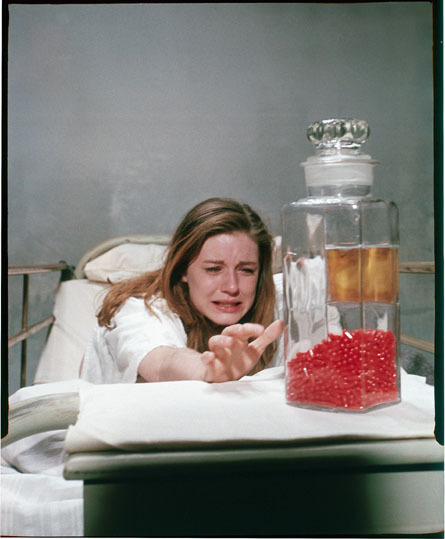
If the answer’s yes, Stephen Rebello’s Dolls! Dolls! Dolls!: Deep Inside Valley of the Dolls, the Most Beloved Bad Book and Movie of All Time tells you just about everything you could possibly want to know about the production of the 1967 cult classic, Valley of the Dolls. Starting with the Jacqueline Susann and her decision to write the book that scandalized America and caught Hollywood’s imagination, Rebello offers up information on every bit of the process that brought Valley of the Dolls to cinematic life. From the search for the right director to the effort to turn Susann’s novel into a filmable script, it’s all here. Everything from casting to recasting to the costumes to the music to the release to the film’s subsequent status as a camp classic, none of it is left out.

Perhaps not surprisingly, to anyone who knows me, my favorite part of the book were the two chapters that dealt with the casting of “the dolls” and “the dopes.” A truly impressive number of performers were considered for the roles that were eventually played by Barbara Parkins, Patty Duke, and Sharon Tate and, as I read about the casting process, I found myself thinking about all of the alternate casts that could have been assembled. Some of the possibilities feel inspired. Others boggle the mind.

Imagine, if you will, the famous fight scene between Patty Duke and Susan Hayward if the roles had been played by Barbra Streisand and Bette Davis. It could have happened! Imagine Raquel Welch as the tragic Jennifer North and Elvis Presley as her talented but simple-minded lover. Again, it could have happened. Among those who make appearances — some extended and some just as cameos — in the casting chapters: Candice Bergen, Ann-Margaret, Debbie Reynolds, Natalie Wood, Lee Remick, Mary Tyler Moore, Marlo Thomas, Shelley Winters, Jane Fonda, Julie Christie, Faye Dunaway, Angela Lansbury, Millie Perkins, Tony Curtis, Christopher Plummer, James Garner, Adam West, James Caan, Martin Sheen, Tom Selleck, James Brolin, Robert Reed, Richard Beymer, Alain Delon, Richard Chamberlain, Anthony Perkins, Kevin McCarthy, and hundreds more. That’s quite an impressive list for a film that no one was apparently expecting to be very good!

The book devotes quite a bit of space to Judy Garland’s casting as Helen Lawson, a character who may have very well been based on her. Garland was infamously fired from Valley of the Dolls and replaced with Susan Hayward. The book explores all of the conflicting accounts about what led to Garland’s firing. On the one hand, if you’re into old Hollywood gossip, you’ll find a lot of it here. At the same time, Rebello shows a good deal of empathy and sensitivity in describing the situation that the phenomenally talented but emotionally insecure Garland found herself in when she was cast as Helen. For all the space that this book focuses on the sometimes unbelievable drama that went on during the shoot, Stephen Rebello is never less than sympathetic to the performers who worked on Valley of the Dolls. Barbara Parkins, Patty Duke, and Sharon Tate are all brought to vibrant life in Rebello’s account. (Rebello is especially to praised for reminding readers that Sharon Tate was more than just the tragic victim of a terrible crime. She was also an actress of great promise and, from everyone’s account, a wonderful human being as well.) In fact, perhaps the only person who really comes across badly in the book’s account of the production is director Mark Robson, who is portrayed as being the type of manipulative showbiz hack that you would expect to find in a sordid, Hollywood roman à clef. Perhaps one like Valley of the Dolls!

Along with telling you everything you could possibly want to know about Valley of the Dolls, the book is also a sometimes humorous and sometimes thought-provoking portrait of Hollywood at the end of the studio system. Trying to keep up with the popularity of television and the permissiveness of European cinema, Hollywood tried to prove that it wasn’t culturally out-of-touch with its version of Valley of the Dolls. Of course, the end result was a film that showed just how out-of-touch Hollywood actually was. That’s one reason why Valley of the Dolls continues to be such a beloved bad film. Stephen Rebello’s informative book tells you everything you could want to know about it. Dolls! Dolls! Dolls! is a must-read for anyone who loves movies or who is interested in the history and development of American trash culture.
Lisa Marie’s 8 Top Non-Fiction Books of 2020


I have to admit that I’m a little bit disappointed in myself.  Considering that I pretty much spent 9 months on lockdown, I didn’t read anywhere near as much as I should have in 2020.

Certainly, when I was first told that I’d be working from home, I thought to myself, “Finally!  I can work my way through my library!”  I thought I was going to read a book a day and watch 100 movies every week.  It didn’t work out that way.  To be honest, I got so frustrated with the whole endless lockdown thing that I often couldn’t focus enough to do anything productive with my time.  I’m sure I’m not alone in that.

That said, I may not have read as much as I was hoping to read but I still read some very good books.  So, without further ado, here are my top eight non-fiction books of 2020!

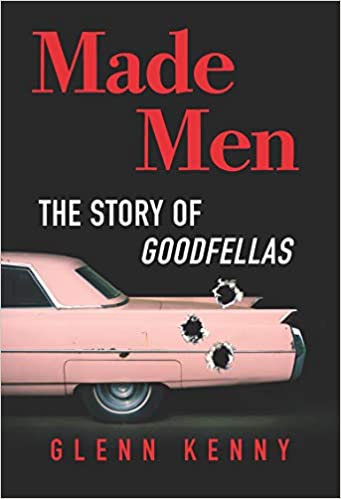
  1. Made Men: The Story of Goodfellas by Glenn KennyGoodfellas is one of the best films of all time and Glenn Kenny’s examination of both the movie and it’s place in pop culture is perhaps one of the best film books of all time.  Kenny not only details the true story behind Goodfellas but he also examines the film scene-by-scene.  This book is full of unexpected insight and behind-the-scenes trivia.  It’s everything you could want from a film book.
  2. Alright, Alright, Alright: The Oral History of Richard Linklater’s Dazed and Confused by Melissa Maerz — This is a frequently fascinating oral history about one of the greatest Texas films of all time, Dazed and Confused.  Maerz was able to interview almost everyone involved with the film and the end result is funny, touching, and thought-provoking look at a classic film.  This is worth it just for the chapters on Shawn Andrews.
  3. Dolls! Dolls! Dolls! Deep Inside Valley of the Dolls, the Most Beloved Bad Book and Movie of All Time by Stephen Rebello — This fun book details everything you could possibly want to know about the film version of Valley of the Dolls.  Especially interesting are the chapters that deal with the actresses and actors who were considered for the film.  There are indeed some surprising names to found.
  4. Taking Shape II: The Lost Halloween Sequel by Dustin McNeill and Travis Mullins — Probably the only thing I like more than a good book about the production of a film is a good book about a film that didn’t go into production.  Taking Shape II is an exhaustive look at all of the sequels that have been proposed for Halloween over the years.  The book not only details what each film could have been but also why they ultimately weren’t produced.  If you’re a horror fan, this is essential reading.
  5. Cinema ’62: The Greatest Year at the Movies by Michael McClellan and Stephen Farber — Was 1962 the greatest year in film?  This book makes a good case that it may have been.
  6. The Big Goodbye: Chinatown and the Last Years of Hollywood by Sam Wasson — This is another fascinating behind-the-scenes look at a classic film.  The Big Goodbye not only tells you everything you could want to know about Chinatown but it also places it in its correct cultural and historical context.
  7. The Office: The Untold Story of the Greatest Sitcom of the 2000s: An Oral History by Andy Greene — This oral history of my favorite sitcom is both a funny tribute to a great show and also a rather sad look at how The Office was often screwed over by NBC.  The only thing keeping this book from being ranked higher is the lack of fresh interviews with Steve Carell, John Krasinski, Jenna Fischer, and some of the other principles.  Indeed, much of the “oral history” is lifted from various DVD commentaries.  Still, Greene does a good job of organizing the information and the book will definitely make you want to sit down and rewatch the show.
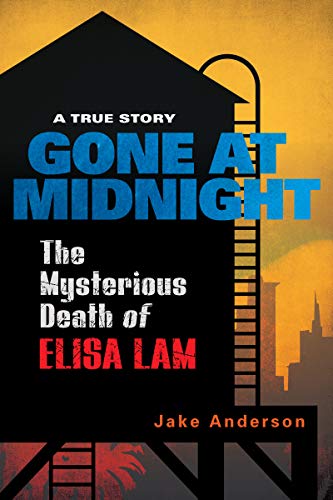
  8. Gone at Midnight: The Tragic True Story Behind the Unsolved Internet Sensation by Jake Anderson — This is a thought-provoking examination of the mysterious death of Elisa Lam and the internet culture that sprung up around the video of her final hours.


TSL Looks Back at 2020:

  1. Lisa Marie’s 20 Favorite Songs of 2020 (Lisa Marie Bowman)
  2. Lisa Marie’s 16 Worst Films of 2020 (Lisa Marie Bowman)
  3. My Top 20 Albums of 2020 (Necromoonyeti)
  4. 25 Best, Worst, and Gems That I Saw In 2020 (Valerie Troutman)
  5. Top 10 Vintage Collections (Ryan C)
  6. Top 10 Contemporary Collections (Ryan C)
  7. Top 10 Original Graphic Novels (Ryan C)
  8. Top 10 Ongoing Series (Ryan C.)
  9. Top 10 Special Mentions (Ryan C.)
  10. Top Ten Single Issues (Ryan C)

Horror Book Review: Alfred Hitchcock and The Making of Psycho by Stephen Rebello


57 years after it was first released, Alfred Hitchcock’s Psycho remains one of the most influential films ever made.

Certainly, every horror film ever released since 1960 owes a debt to Psycho.  The infamous shower scene has been duplicated so many times that I’ve lost count.  Whenever a big-name actor is unexpectedly killed during the first half of a movie, it’s because of what happened to Janet Leigh in that shower.  If not for Psycho, Drew Barrymore would have survived Scream and that shark would never have eaten Samuel L. Jackson in Deep Blue Sea.  Every giallo film that has ended with someone explaining the overly complex psychological reasons that led to the killer putting on black gloves and picking up a scalpel owes a debt to Simon Oakland’s monologue at the end of Psycho.  Psycho is so influential and popular that, decades later, A&E could broadcast a show called Bates Motel and have an instant hit.

What goes into making a classic?  That is question that is both asked and answered by Stephen Rebello’s Alfred Hitchcock and The Making of Psycho.  Starting with the real-life crimes of Ed Gein, Rebello’s book goes on to examine the writing of Robert Bloch’s famous novel and then the struggle to adapt that novel for the screen.

This book is a dream for trivia lovers.  Ever wanted to know who else was considered for the role of Marion Crane or Sam Loomis or even Norman Bates?  This is the book to look to.  Read this book and then imagine an alternate world where Psycho starred Dean Stockwell, Eva Marie Saint, and Leslie Neilsen?

(That’s right.  Leslie Neilsen was considered for the role of Sam Loomis.)

The book also confronts the controversy over who deserves credit for the shower scene, Alfred Hitchcock or Saul Bass.  And, of course, it also provides all the glorious details of how Hitchcock handled the film’s pre-release publicity.  Ignore the fact that this book was cited as being the inspiration for the rather forgettable Anthony Hopkins/Helen Mirren film, Hitchcock.  This is a fascinating read about a fascinating movie and a fascinating director.

First published in 1990 and still very much in print, Alfred Hitchcock and The Making of Psycho is a must-read for fans of film, horror, true crime, history, Alfred Hitchcock, Anthony Perkins, Janet Leigh, and Psycho.