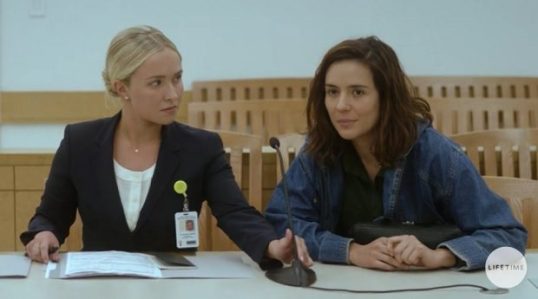
Last night’s Lifetime movie premiere, Custody, didn’t really feel like a Lifetime film.
This was largely because it really wasn’t. Custody was written and directed by the acclaimed theatrical director, James Lapine. The cast features not only Emmy winner Tony Shalhoub and Oscar nominee Catalina Sandino Moreno but also two Oscar winners, Viola Davis and Ellen Burstyn. Unlike most Lifetime films, Custody was not filmed in Canada. There were no Toronto landmarks in the background. (You never realize how much you miss Canada until it’s gone.) Custody played at Tribeca last year. Much like Stockholm, Pennsylvania, Custody was made for a theatrical release but it ended up premiering on television instead. As a result, Custody did not follow the usual Lifetime 8 act pattern. The commercial breaks felt awkward. With a 150 minutes running time, this film tested my four-minute attention span.
The other thing that set Custody apart from most other Lifetime films was that it wasn’t much fun to watch. The great thing about Lifetime movies is that they are almost always fun. It doesn’t matter what serious subject is being examined. It doesn’t matter how dramatic things may get. Lifetime movies are always fun. To use one of my favorite terms, Lifetime movies embrace the melodrama. Lifetime films push the limits. Lifetime films say, “You think we won’t introduce a crazy twin halfway through the movie? JUST WATCH US! You think we won’t toss in a sudden case of amnesia or a cheating husband or a psychotic au pair in lingerie? YOU DON’T KNOW LIFETIME!”
Custody, on the other hand, was a very serious movie about a very serious topic and therefore, it wasn’t much fun to watch. In fact, Custody was a bit of a well-intentioned mess. It followed one case as it worked its way through the family court system. Sara Diaz (Moreno) has been wrongly accused of being an unfit mother. Her attorney is Ally Fisher (Hayden Panettiere), who has just graduated from law school and who comes from a rich family. Ally’s grandmother is played by Ellen Burstyn, largely because everyone’s rich grandmother is played by Ellen Burstyn. Representing the state is Keith (Dan Fogler), who has absolutely horrid taste in ties. The judge is played by Viola Davis and she’s going through a messy divorce from Tony Shalhoub.
I could see what Lapine was going for. Custody juggles several plotlines, showing how everyone involved in the case has their own individual biases and problems to deal with. Will the judge’s dissolving marriage make her more or less sympathetic to Sara? Will the white and privileged Ally ever be able to truly understand Sara’s situation? Will Keith ever learn how to properly select a tie? These issues may seem petty when taken on their own but, when crammed together, they form one big human drama.
Or, at least, that seems to have been the plan. Lapine gets some good performances from his cast but Custody never quite comes together. This is one of those heavy-handed films where characterization is more likely to be advanced by a lengthy monologue than by action. Add to that, Custody is ultimately far too enamored of the family court system. Everyone means only the best and the bureaucracy is your friend.
I will say this. Based on my own experience working as an administrative assistant in a law office, Custody does get one thing very right. Male lawyers are always the worst dressed people at any courthouse. On this count, Dan Fogler played one of the most realistic attorneys ever seen on TV.
 Through the Shattered Lens