I Watched Flashing Spikes (1962, Dir. by John Ford)


When infielder Bill Riley (Patrick Wayne) makes an error that costs his team the game, sports columnist Rex Short (Carleton Young) claims that he witnessed Bill being paid off by Slim Conway (James Stewart).  Slim is a former player who was banned from Major League Baseball after he was accused of taking a bribe from a gambler.

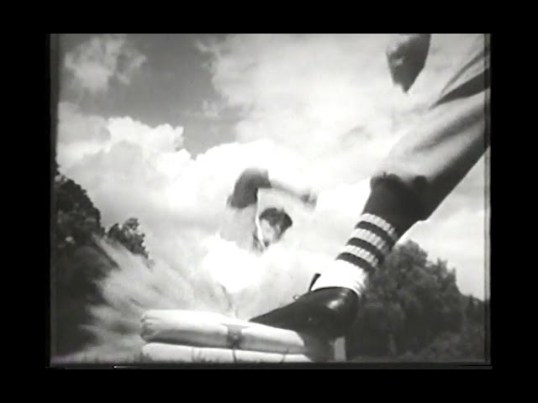
Most the movie is a flashback, showing how Bill first met Slim when Slim was playing for a barnstorming team of former major leaguers.  That was my favorite part of the movie.  Slim and a collection of old, worn-out men stumble out of their bus and even though they might move a little slower and they might need to stretch a little more before swinging a bat, they still show up a cocky team made up of young local players.  Even after the crowd nearly riots when they realize that Slim is one of the players, the old players keep their cool and their eye on the game.  After Bill spikes Slim while sliding into home plate, Bill apologizes.  Slim remembers the young man’s humility and, working with one of the few friends that he has left in the game, Slim helps Bill get his chance in the Majors.

Usually, when my sister yells at me to come watch something because “it’s got baseball!,” I’m prepared for it turn out to just be a movie with one scene of someone holding a bat.  I’m glad that she called me to come watch Flashing Spikes with her because it really is a good and loving celebration of my favorite game.  Even after Slim is treated so unfairly by the press, the League, and even some of the fans, he never stops loving the crack of the bats and the cheers of the crowd.  Flashing Spikes is unabashedly pro-baseball and Slim stands in for every player who was ever unfairly railroaded out of the game by scandal mongers like Rex Short.
Scalplock (1966, directed by James Goldstone)


In this comedic western, gambler Benjamin Calhoun (Dale Robertson) wins big in a poker game.  Not only does he walk away with several thousand dollars but he also now owns his own railroad, the BP;S&D.  Calhoun celebrates the biggest win of his career by tossing ten dollar bills at the townspeople, recruiting a worshipful young assistant (Bob Random), and commandeering a private railcar that belongs to wealthy Burton Standish (John Anderson).  In the car, he finds Marta Grenier (Diana Hyland), a “working woman,” who has been hired to provide company for Standish.

Calhoun and Marta ride off to check out Calhoun’s new railroad.  What he discovers is that the railroad that he won is not only not completed but the workers are striking because they haven’t been paid in two weeks.  The quick-thinking Calhoun offers to make all of the workers part-owners of the railroad.  With construction once again starting, Calhoun tries to figure out how to keep his new business open.  He also meets a strong-headed storekeeper named Joanna Royce (Sandra Smith).

When Standish finally shows up, it turns out that he was originally planning on buying the BP;S&D.  Will Calhoun hold onto the railroad and honor the promise he made to the workers or will he sell out to Standish?

For all the talk about completing the railroad, Scalplock ends with most of the work undone.  That’s because Scalplock was a pilot for The Iron Horse, a television series that lasted for two seasons in the 60s.  Scalplock (and The Iron Horse) is mostly a showcase for Dale Robertson, a low-key but always convincing actor who specialized in westerns.  Usually, Robertson was cast as an upstanding citizen and law enforcement agent.  In Scalplock, he’s playing the type of genial rogue that James Garner played on Maverick and later in The Rockford Files.  Robertson is likable in Scalplock and even convinces us that Calhoun would choose his workers over a quick payday.  Fan of the genre will enjoy Scalplock, as long as they don’t get too invested in witnessing that last track of rail laid into the ground.

Dale Robertson, who started his career in the 40s, continued to act through the 90s, though usually as a guest star instead of a series lead.  Robertson eventually retired to Oklahoma where he owned a ranch that was home to over 200 horses.  He passed away in 2013 at the age of 89.