Review: Ballerina (dir. by Len Wiseman)


“You don’t choose to be a killer, you are chosen.” — The Chancellor

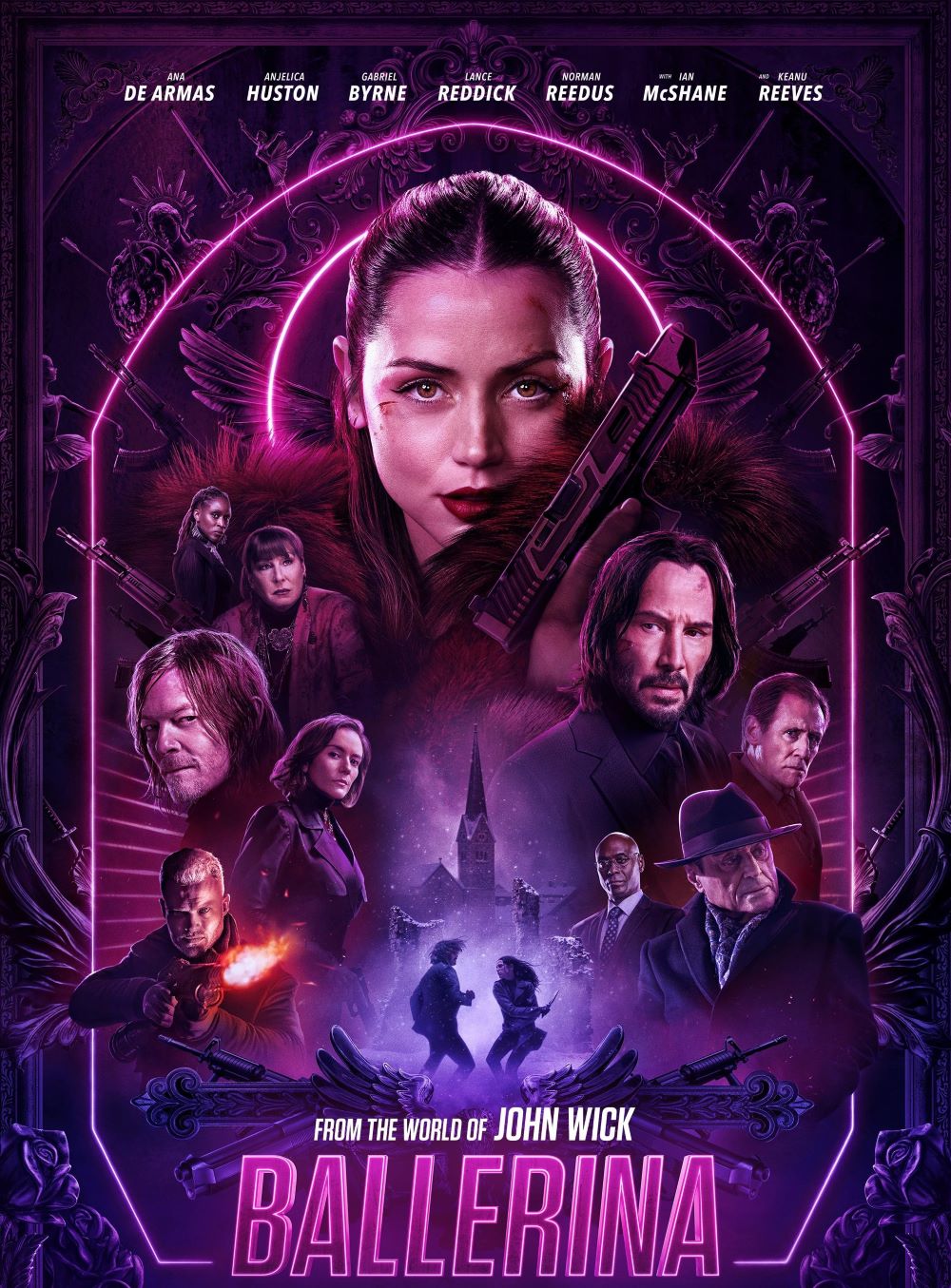
Ballerina lands in theaters feeling like someone finally turned the volume up on the quieter, more balletic side of the John Wick universe. Anchored by Ana de Armas’s poised, ferocious turn, the film doesn’t reinvent the neon‑lit, bullet‑cartoon rules of the franchise so much as rearrange them into a new rhythm. It’s still a very familiar kind of action movie—assassins, codes, bodies on the floor—but it carves out its own niche by centering a woman who’s not just another lethal accessory to John’s world, but someone the world has already trained into a weapon.

At the same time, Ballerina leans hard on the style and flourish of the later John Wick films, and that’s both its main selling point and its biggest limitation. The way shots linger on gun grips, the way the camera circles around bodies mid‑spin, the way every hallway fight feels like stage choreography—it’s all very familiar, very polished, and very much a continuation of the franchise’s visual language. That’s great if you’re here for the aesthetic, but it also means the film sometimes feels more like an extension of the Wick universe’s attitude than a story that confidently stands on its own two feet.

Ana de Armas plays Eve Macarro, a young assassin who grew up in the shadow of the Ruska Roma and the Continental, groomed to kill long before she fully understood what she was doing. The story unfolds in a loose “between films” slot in the Wick timeline, so fans who care about franchise continuity will get their little Easter eggs and cameos, but the film smartly never gets completely bogged down in explaining how this fits into every rulebook. Instead, it leans into the idea that the John Wick universe is big enough that other hunters can walk around in it, following their own grudges and grief. Eve’s motive is straightforward: she wants to track down the people she believes killed her father when she was a child, and along the way she has to square off against both the old guard of her upbringing and the cult‑like killers who seem to operate just outside the established order.

Like a lot of John Wick entries, though, Ballerina is ultimately more interested in expanding the world and reinforcing its rules than drilling deep into its own plot. Eve’s revenge‑driven quest gives the film its spine, but the mechanics of that revenge are often secondary to the chance to show off another assassin enclave, another weird code, or another showdown that feels like a set‑piece first and a character beat second. You can feel the priorities: where she travels, who she bumps into, and how this underworld operates often matter more than whether her arc is especially surprising or emotionally rich. The plotting starts to feel like connective tissue between bigger, more stylized sequences, and that’s where the reliance on franchise style starts to hurt more than help.

The film’s greatest strength is how it employs the language of ballet and violence in the same breath. The title Ballerina might make you expect a lot of literal tutus and pirouettes, and there’s a bit of that in the opening stretches, but the real choreography is in the fight scenes. Eve’s movement is light‑on‑her‑feet one moment—a few spins, a quick sidestep—and then suddenly brutal, close‑quarters savagery the next. The camera doesn’t just document her skills; it dances with them, letting wide‑angle shots show off the architecture of a fight before snapping into tight, impact‑heavy close‑ups. It’s unmistakably a Wick‑style approach, only dialed into a slightly more feminine, almost theatrical register.

De Armas deserves a lot of credit for making Eve feel like a real person, not just a killing machine with a pretty face. She’s cold, yes, but there’s weariness under the surface, the kind that comes from being raised in a world where emotions are a liability. The script doesn’t drown her in backstory; it just lets small moments—a hesitation, a glance at a photo, the way she holds a gun—do the work. When she finally loses her composure and starts to scream, grunt, and visibly struggle during later fights, the effect is more powerful than if she’d been effortlessly killing everyone from minute one. She sweats, she bleeds, she gets thrown around, and that makes her victories feel earned, not just cool.

Stylistically, Ballerina is very much in line with the rest of the franchise: glossy, slightly over‑the‑top, and hyper‑aware of its own aesthetic. The camera work is sleek, the color grading pops, and the score leans into synth textures that feel like a slightly more elegant cousin of the usual Wick pulse. There are also some deliberately playful musical choices—bits of Tchaikovsky and other classical motifs that echo in the background during key scenes—which tie the idea of ballet back to the film’s emotional core. The setting shifts from the familiar New York–style Continental spaces to a quieter, almost fairy‑tale European village that houses a different kind of assassins’ retirement community. It’s a neat trick: the filmmakers give us something that still feels like the same universe but just enough of a different flavor that it doesn’t feel like a rerun.

But that lush style also underlines how much the film is prioritizing world‑building over a tight narrative. Conversations about the Ruska Roma, the Continental, and the cult‑like assassins’ outpost are there less to advance Eve’s inner journey and more to remind us that the John Wick universe is vast, layered, and full of hierarchies. Fans who love the lore will probably eat that up, but if you’re hoping for a more self‑contained narrative, it can start to feel like you’re watching a very expensive lore compendium. The emotional core is there—it just has to fight for space amidst all the visual flexing and mythology maintenance.

Where Ballerina becomes a bit uneven is in its plotting. The basic “one girl, one very long night of revenge” template is solid, but the script doesn’t always give it enough depth or surprise. There are too many conversations where characters explain the rules of the world to each other, or recap what’s already been established, rather than using those moments to add nuance to the characters or relationships. The side figures—like various crime bosses, elders, and reluctant allies—do their jobs entertainingly enough, but they don’t all get the same level of interior life that Eve has. Some of the supporting performances are strong across the board, but the material doesn’t always push them to do anything more than punctuate the action beats.

Keanu Reeves drops in briefly as John Wick, and the cameo is handled with the kind of restraint that makes it feel like a favor rather than a stunt. He doesn’t hang around; he makes a sharp, efficient entrance, has a few quiet exchanges, and then exits, leaving the movie firmly in Eve’s hands. That’s crucial, because one of the criticisms of earlier spin‑off ideas was that they’d feel like vanity detours or glorified cameos. Here, John’s presence actually reinforces the idea that this is someone else’s story now, and that he’s just another player in a much larger ecosystem of killers.

The film’s worst moments are also some of its most visually striking: the bigger, more outlandish set‑pieces that lean fully into the franchise’s “go‑no‑go” action logic. The final third, in particular, is one long, almost goofy crescendo of fights, stunts, and absurdly lethal props. It’s a lot of fun in the moment, but it also underlines how thin the actual plotting can be. When the camera is spinning around a flamethrower‑wielding Eve or a hallway of assassins dropping in from the ceiling, the movie doesn’t always give us enough emotional context to care about who’s living or dying beyond the immediate spectacle. It’s the kind of sequence that will make fans cheer in the theater, but might look a bit clumsier on a second viewing.

One area where Ballerina arguably improves on the core series is its handling of gender dynamics. Eve isn’t fetishized; she’s allowed to be both emotionally grounded and physically dominant without being framed as some kind of fantasy object. The film nods to the idea of “girl power” in the assassin world, but it also lets the character operate within familiar constraints—tradition, hierarchy, and expectation—instead of pretending she’s a one‑woman revolution. She’s tough, but she’s also vulnerable, and that balance keeps the tone from tipping entirely into empty empowerment sloganeering. The way the movie treats her relationships—with her father’s memory, with her mentors, and with the people she’s ordered to kill—adds a layer of emotional sophistication that earlier entries in the franchise often glossed over for the sake of pure momentum.

If you’re coming into Ballerina expecting a radical reinvention of the series, you’ll probably leave a little underwhelmed. It doesn’t rip up the rulebook or deliver a huge thematic twist on what we already know about this universe. Instead, it refocuses the camera on a different kind of protagonist, lets the familiar style breathe a little differently, and proves that the world of John Wick is big enough to house more than just one lone wolf. It’s a stylish, violent, occasionally silly, definitely pulpy action film that knows exactly what it wants to be: a long, bloody ballet in which the lead is a woman who’s finally ready to dance on her own terms—even if the choreography sometimes matters more than the story it’s supposedly telling.

John Wick Franchise (spinoffs)
Horror Review: Fear the Walking Dead S1E04-05 “Not Fade Away” & “Cobalt”


FearTWDS01E04-05

“Sometimes all we can do is not enough.” — Dr. Bethany Exner

[some spoilers]

Fear the Walking Dead has been a mystery to some audiences and critics. If there was something the original series was criticized on it was that it’s writing throughout it’s current run has been uneven. There would be some great episodes and some good ones, but then some go nowhere episodes that stops any sort of momentum a particular season was having. The Walking Dead deserved some of the criticism leveled at it’s writing and how some of it’s characters appeared one-note for too long. Things began to improve once Scott M. Gimple took over a showrunner beginning with season 4. yet, some of the damage had been done by a very uneven first three season.

One thing The Walking Dead was never lacking was it’s creativity when it came to the zombies and the violence around them. Greg Nicotero and his KNB EFX crew never flinched from whatever hellish idea the writers were able to come up with. It’s probably one of the main reasons why the show has succeeded so much despite flaws in the writing and characterization. People were willing to tolerate the soap opera-style character interactions if it meant the flesh-eating and the headshots came a-plenty.

The first half of Fear the Walking Dead didn’t have much of the zombie action. It was a bold decision by the writers to stay on the path that brought the early days of the zombie apocalypse to life. This was a show that didn’t already have zombies taking over and with civilization having fallen by the wayside. It was still a world where everyone went about their daily routines. Sure the first episode gave some hints that something was amiss, but not until the final minutes did we finally see our first zombie. Even after that initial reveal at the end of the pilot the writers kept the zombies more off-screen. When they did appear it was as one or two.

Episodes four and five, “Not Fade Away” and “Cobalt”, continued this trend of keeping the zombies at arm’s length and off-screen. We saw Travis and Madison’s neighborhood turned into a safe zone by the National Guard who had been deployed to help contain and combat the spreading infection. Some took the military’s arrival with optimism (Travis) while others saw their arrival as a sign that things were just going to get worse and that things might already be too late to save (Daniel).

These two episodes were some of the strongest in this shortened first season of Fear the Walking Dead. We got to learn more about every character, but mostly we learned just how differently each parent of the core group reacted to the growing situation. These were reactions that were as varied and complex as any we’ve seen in any of the characters in The Walking Dead.

Each parent tried to do what they thought was best for their immediate family. On one end of the moral spectrum we had Travis who tried to serve as a sort of de facto mayor of the walled-off neighborhood. Become the person that would be the one who dealt with the military liaison when it came to his family’s and, to an extent, the neighborhood’s well-being. So far, throughout the this short first season, Travis has come across as the sort of enlightened, civilized man who tries to reason and talk things out instead of acting out rashly and on instinct. This sort of personality is what we as a society want to keep the wheels of civilization moving along problem-free. But as we’ve seen this has also become a weakness as things progressively begin to get worst. Travis can’t seem to see that the rule of law and reason seem to be fighting a losing battle with the need to survive.

Yet, despite Travis’ coming off as some sort of pacifist we get a hint of logic to his seeming weak-willed madness. He sees the world crumbling around him and as a father and role model he has tried to be that moral center to his circle of family and friends. Even when what he’s seeing chips away at his belief that those in power will protect and save them, Travis tries to remain that strong, moral center.

The opposite seems to be true for the other father in our group, Daniel Salazar. This character has been quite the revelation in this series. We first meet him in episode 2. He comes across as a leery, but good man like any immigrant in the US looking to make a new life for his family. But with each new episode we learn a bit more of what makes Daniel tick. He’s a father whose past history before coming to the US hints at chaos and bloodshed. He has seen how crisis could spiral out of control in a blink of the eye and he sees that now with the arrival of the military. He doesn’t trust too many outside his wife and daughter and when he does, as the case with Madison, he does so begrudgingly. He’s adaptable to the ever-changing situation the way Travis is not. He’s willing to resort to immediate action to solve a problem or to find a solution. There’s a darkness in him that’s the current situation has awoken once more and it terrifies him, but he allows it to emerge nonetheless in order to keep his family safe.

Throughout these two episodes we see the recurring theme of authority in its many forms (parental, civilian and military) trying to do their best to keep the situation from spiraling out of control, but they despite all their efforts they fail due to that basic flaw that humanity can’t seem to shred and that’s the inability to work together at the most dire situation to solve the problem.

Both Travis and Daniel try to do the best they know how to navigate through and around the encroaching apocalypse. They succeed in some way, but in the end all their efforts still don’t amount to much as everything right from the start of the crisis has been stacked against them. All they could do now is try and save those closest to them.

The question now as we head into the season finale is whose path will ultimately be the best one to navigate in this apocalypse.

Will it be the Way of the Open Palm that we seem be getting from Travis?

A path of sticking to one’s moral center and principles. To try and keep oneself from sliding back into one’s darker impulses as we’ve seen signs of in these two episodes.

Or will it be the Way of the Closed Fist that Daniel seem to be following?

A mentality that requires quick thinking and direct action even if it means allowing one’s darker side to take hold in order to survive. It’s a path that looks to be well-suited for this apocalypse, but one that also brings with it a set of unknown dangers.

So, while the series has so far lacked in major zombie action and the gore quotient has been tame in comparison to The Walking Dead, it has one-upped it’s older sibling by allowing for it’s cast to grow as characters. Whether they all turn out for the better remains to be seen, but in the span of 5 episodes they’ve become full-fledged characters and now the finale will see who will remain steadfast and who will break.

Notes

  • “Not Fade Away” and “Cobalt” were directed by Kari Skogland. Meagan Oppenheimer has writing duties on the former with David Wiener being responsible for the latter.
  • It’s been nine days since the events of episode 3 and it looks like both the National Guardsmen and the neighborhood are fraying at the edges. It doesn’t help that the unit commander is a reservist who also happens to be an LAPD policeman on a power-trip.
  • Still no sign of Tobias. It looks like his own place might be located in the unsafe and unwalled “dead zones” the military have been doing sweeping patrols for the past nine days.
  • Sandrine Holt comes in as Dr. Bethany Exner. Not her first time in a zombie production. She was also in Resident Evil: Apocalypse as Raccoon City news reported Terri Morales.
  • Ruben Blades is turning out to be the MVP of the series, so far. I guess being a government torturer in his native El Salvador during it’s time of troubles is turning to be a good skillset in the coming zombie apocalypse.

Season 1

Review: Fear the Walking Dead S1E03 “The Dog”


FearTWDS1E03

“Good people are the first ones to die.” — Daniel Salazar

[some spoilers]

After a two week break we’re finally back to a new episode of Fear the Walking Dead. The show has so far been very consistent in establishing one simple fact about the most of the cast in this companion series. They are, deep down in their hearts, very good people. Travis is very much your typical enlightened man who shows compassion towards his family and others. Madison loves her family no matter the sort of trouble they find themselves in. The show in it’s third episode seem very intent on pushing against their very good-nature to see who will be the first to break.

“The Dog” finds both Travis and Madison separated during what looks like the first major outbreak of the zombie apocalypse. Travis has just found his estranged son and with his ex-wife have had to seek refuge in the boarded up barbershop of one Daniel Salazar and his own family. Madison waits back home in their East L.A. suburban home with her own two children. With such a truncated season the episode doesn’t wait too long to put the families of both Travis and Daniel in danger. The riots which broke out during the last episode have begun to spun out of control and businesses in the neighborhood have begun to get looted and burned. It’s during their attempt to flee the riot zone that we see the extent of the damaged caused by the continuing riots and more signs that rioters won’t be the only danger around these two men’s families.

Back with Madison we see her attempting to shield her daughter from the truth of what she has seen during the day (it’s been less than two days in series timeline since the events of the pilot episode). Her son Nick seems to understand more of what’s truly going on around them and is more than willing to be the one to voice the ugly truth to his mother. If they’re to survive the storm that’s coming then she needs to tell Alicia what she has seen. As with the events around Travis, Madison and her kids must soon flee their own home when an infected and turned neighbor has decided to follow the barking of a dog Nick had let into their  home.

Both sequences were edited with equal amount of tense-filled moments as Travis and Madison must rely on their protective instincts to try and keep their respective families safe. The scenes with Travis and his group fleeing the barbershop have much more of an action tone to them as rioters, looters and police clash all around their group. With the Clark family it’s a sequence that wouldn’t seem out of place from any horror film. We see how resourceful Madison is starting to become since her time during the visit back at her high school in the previous episode. Some of this resourcefulness seem born out of keeping up with her junkie son Nick who has taken the initiative to do the the best thing to keep the family alive.

The writers have so far written up Nick not just as a troubled, loser drug-addict of a son, but as a survivor. His very addiction and time spent out on the streets feeding his habit has given him a sort of advanced survivor instinct that many around him still haven’t developed. It’s very clear from the first half of the season that his sister Alicia is still quite clueless to the events happening around her. She still believes that she must cut loose from her troubled family and be with her boyfriend to start a new life. Even after seeing the results of those infected, one of which happens to be her boyfriend Matt, Alicia still denies what she has seen and heard. Madison, on the other hand, has had some first-hand experience of what’s going on and has begun to fully believe Nick and gradually adapting to the new reality descending on her family and the world.

Travis, on the other hand, continues to cling to his inner goodness. His compassion for his neighbor Peter Dawson, who he finds in Madison’s home eating the remains of the barking dog that attracted him to the house, almost gets him killed if not for the fast thinking of Daniel Salazar. We see contrasting fathers in Travis and Daniel in this sequence. Travis’ good-nature almost gets him killed while Daniel’s more pragmatic approach to the deteriorating situation around them saves everyone. Even the scene where Daniel tries to teach Travis’ son how to handle the shotgun speaks volume on the differences between the two men.

Travis is the enlightened and educated man who abhors guns and violence. Daniel, we learn through some brief exposition, has survived his home country or El Salvador when many of his family didn’t and has carved out a life for his family in a new country. Travis still thinks that those in power will settle things and get everything back to normal. He even comments in the end of the episode that the cavalry has arrived when the National Guard pulls into the neighborhood to search, isolate and destroy the infected. Daniel sees this and knows that whatever has begun with the riots has spun out of control and too late for everyone still hoping for a peaceful resolution.

Fear the Walking Dead has had a tough task of making itself feel both new and familiar to fans. On the one hand, the series does feel new from the fact that this is a world still inhabited mostly by the living. It’s a world still unaware of the storm bearing down on it. Yes, we’ve seen instances of zombies making an appearance, but never in the large numbers audiences have become used to from it’s parent series The Walking Dead. The familiarity comes from the audience seeing the chaos caused by these first moments of the zombie apocalypse. We as an audience has seen the result once civilization finally broke down. We know the rules of this world even if most of the characters in the show are oblivious or slowly learning about them.

It’s that very familiarity that could make or break the series. So far, the series writers have made each character’s reaction to the events these past couple days range from dangerously naive (Alicia) to hard survivor (Tobias) and everyone in-between. While for some viewers the very naivete that some characters exhibit despite what they’ve seen or heard could become frustrating, it does sow the seeds in filling in the blanks of why civilization fell. Mistrust helps in the populace not believing what those in power has been telling them. Yet, it looks like misguided optimism and compassion also might have had a hand in speeding up the zombie apocalypse.

We’re now halfway through the first season of Fear the Walking Dead and things have begun to move along faster than it’s parent series did with it’s first season. We still have slower scenes with people just talking, but the writers never linger too long before ramping up the tension. This companion series has had the advantage of working with a world still learning the rules which makes for some dread-inducing scenes which the parent series rarely had. With the back-end episodes of series set to start it’ll be interesting to see if the writers will continue to mine the theme and focus of this first season.

Will the good people be the first to die and if they don’t then how will these horrific events change them? Will it be for the better or for the worst?

We will just have to tune in the next three Sundays and see what happens.

Notes

  • Tonight’s episode was written by Jack LoGiudice and directed by Adam Davidson.
  • Nice sequence after fleeing the barbershop as Travis and his group slowly drive past a hospital and see the chaos unfolding as zombies (looking like both patients and healthcare workers) were confronted by responding LA police and SWAT. Earlier in this sequence we even see a brief glimpse of a doctor who looks to be a zombie staggering amongst the fleeing civilians and responding police yet remaining unnoticed by both.
  • The rioting, once we see it in full, doesn’t show whether the chaos is due just to the rioting or to the zombies amongst the rioters and riot police causing their own form of disturbance.
  • Neighbor Pete Dawnson being put down by Daniel Salazar with both barrels from an over-under Turkish shotgun marks the arrival of the series’ first gory moment. Some very nice work by the effects gurus from KNB EFX.
  • The point-blank headshot of Pete via shotgun blast was a nice homage to a similar shotgun blast to the head in the original Dawn of the Dead.
  • Funny how even though people heard the two shotgun blasts and the screams of their neighbors from the night earlier, some of them seem to still have to take the garbage out in the morning. I guess living in the city with it’s constant sounds of gunshots and screams have become routine for these Los Angelinos.
  • I guess the neighbor who had the party for their girl the day before and who was being attacked by neighbor Pete Dawson didn’t survive the night uninfected if the markings left by the National Guard was to be believed.

Season 1

Review: Fear the Walking Dead S1E02 “So Close, Yet So Far”


FearTWDS1E02

“I’m about to step into a world of shit. You know that, right?” — Nick Clark

[some spoilers]

Is watching a zombie apocalypse unfold during it’s early days something that fans of the original series, The Walking Dead, want to actually watch happen? That was probably the least important question asked by AMC producers when they were brainstorming about how to take advantage of the pop-culture phenomena they had in their hands with The Walking Dead. This was a show that consistently beat every show it went up against and even manages to surpass some Sunday Night Football games in viewership.

The show enjoys viewership ratings of every type of metric one can think of that only the biggest network shows today can pull. Yet, the question remained of whether a second series exploring the world that Robert Kirkman created in his Image Comics title of the same name would have a similar reaction from fans. If the numbers brought in by the pilot episode of Fear the Walking Dead would be of any indication then the answer was a resounding yes.

The pilot episode of this new series introduced viewers to a cast of characters that wouldn’t look out of place from any family drama on network tv, cable or even the big-screen. It’s a world focused on the densely-packed Los Angeles area with all it’s different neighborhoods from glitzy and glamorous Hollywood and Beverly Hills to it’s surrounding middle-class areas like East L.A. and Venice Beach. One could substitute any major American city as location and we’ll still be able to relate to the opening narrative beats of an apocalypse descending on an unprepared populace.

Witnessing a zombie apocalypse in it’s early stages has it’s drawbacks and for some fans it’s the lack of the very zombie mayhem which made the original series so “must-see” that has become this companion series’ own weak point. Yet, there’s a logic and reason to the lack of zombies. It is the early days and the lack of zombies doesn’t mean the show lacks in tension and dread-building moments.

As Madison Clark’s drug-addict son succinctly says during the second episode, and could mean for the rest of the cast in the show, they’re all about to step into a world of shit.

“So Close, Yet So Far” jumps into literally right after both Madison Clark and Travis Manawa sees the truth in Nick’s words about what he witnessed in the drug den during the pilot episode. Their disbelief still governs some of their rash decisions (like splitting up to find other family members), but it also gives them a leg up on some of their neighbors and most everyone of the Greater Los Angeles area. Outside of Travis and Madison we’re given glimpses of others like Tobias (Madison’s paranoid but well-informed student), a next door neighbor looking to stock up and flee the city right up to a cop on-duty stocking up on water supplies. The city and the surrounding seem oblivious to the hell about to land on everyone, but that primordial part of everyone’s brain the says something is wrong seem to be working more efficiently for some.

The episode finds both Madison and Travis and their respective families split up when it looks like the zombie apocalypse is finally hitting it’s stride. Police actions turn into riots as civilian bystanders witness cops shooting (many, many times) and killing who look like innocent homeless people. As an audience we know better and it’s that knowing the rules of the game while those in the series are still so uneducated to the changes in this world of theirs which gives Fear the Walking Dead a fresher look at Robert Kirkman’s world.

This advance knowledge of this new world’s rules make for both a exhilarating and frustrating show. We wait for when the rest of the cast catch up in how to deal with the zombie apocalypse, but we also worry that some characters may not get the time spent during this shortened first season to survive. Rick Grimes was the lone babe in the woods in The Walking Dead. His family, best friend and the other survivors he has met with since he awoke from his coma already knew the basics on how to survive in this post-apocalyptic world. Madison, Travis, Nick, Alicia and the rest do not have the luxury of knowing what’s happening. They’ve seen examples of what’s coming, but they’re still dealing with it as if it’s your typical natural disaster. That everything will sort itself out in the end.

Tobias, our on-screen oracle, knows better and in just two episodes have become the audience’s proxy for a series cast full of babes in the woods. His very insular nature of spending way too much time on-line has given him an insight to this current calamity that everyone else around him seem oblivious and/or not extremely worried about. Whether Tobias survives the season has been left up in the air and with 4 episodes left in this inaugural season there’s not much time to dwell on who will live or who will die.

As we saw with Madison stopping Alicia from running out of the house to help a neighbor being attacked by another neighbor (the same one Travis saw earlier that day planning to get out of the city but already sick and infected) zombified, some have begun to worry about just protecting those closest to them and leaving the rest to fend for themselves.

Fear the Walking Dead has navigated a narrative that could get frustratingly old and stale with some great character work from it’s cast. Yes, even the annoying way the teenage children of the two leads have been written. The series has chosen to focus on the lives of your typical American family of the 21st century and that includes the annoyances and warts of parents and children.

Will fans continue to tune in without the zombies showing up more often? That will depend on whether show’s writers slows things down just as the apocalypse is hitting or just press the pedal to the floor and ride the zombie apocalypse wave and hope it lands with a bang instead of a whimper.

Notes

  • Tonight’s episode was written by Marco Ramirez and directed by Adam Davidson.
  • The episode’s cold opening of the high school principal walking the grounds of an empty high school made for an eerie sequence.
  • While it seems like instances of zombie attacks have been concentrated in the more densely populated city area of LA, we still saw some signs of it hitting the outer areas like East LA. Alicia’s boyfriend Matt being one on the way to turning.
  • Interesting way for the writers to incorporate the current climate of distrust the public have with law enforcement into the series with civilians protesting then rioting over cops shooting what they think were innocent people. Audiences know better and we see how this civil disturbance look like it’s adding to the chaos that helps the zombie apocalypse take a foothold in the city.
  • Always nice to see Ruben Blades on-screen.

Season 1

Review: Fear the Walking Dead S1E01 “Pilot”


FearTWDS1E01

“We’re safer in numbers.” — Tobias

There’s a scene early on in the pilot episode of Fear the Walking Dead that really helps set the tone for what could be the running theme for this first season. We have the awkward high school student Tobias getting caught by his school guidance counselor (Madison Clark played by Kim Dickens) with bringing a knife to school. His reasoning after some prodding from Ms. Clark is that he didn’t bring the knife for protection from the school bully. He never outright says what, but his rambling about viruses, microbes, people dying and that it’s a situation that is spreading even sets Ms. Clark aback. Tobias truly believes that there’s a storm coming and that everything he has been preparing for will fall by the wayside. It’s not just his plans, but everyone’s.

Fear the Walking Dead has the difficult task of satisfying not just the legion of fans that make up the prequel series’ parent show, but also set it separate with it’s own identity from The Walking Dead. This show takes us, the viewers, back to the beginning when zombie apocalypse hadn’t landed on the world’s lap. It’s a look into the days gone bye that were only hinted and talked about in the The Walking Dead. Rick Grimes still in a coma, Glenn’s still delivering pizzas in Atlanta and Herschel still has an empty barn.

We find the world still turning and turning with it’s people oblivious of the storm looming over in the horizon. The worry about a prequel series is that as an audience who has seen five seasons of The Walking Dead we’ve learned how this encroaching world operates. We know that anyone who dies becomes a zombie (or walker, biter, etc) who will attack anyone living and propagate the outbreak. The writers of this new series must now try and convince this audience that the actions of the cast are not born out of stupid horror tropes, but on uneducated decisions during situations that they’re not prepared for.

The series focuses on the lives of what would be considered a typical American family. Two families trying to combine into one with children either resentful or apathetic to their parents’ attempts to create a new family from two broken ones. We witness the opening stages of The Walking Dead zombie apocalypse through their eyes as they go about the normal routine of their lives. Whether it’s going to school as a student or as a guidance counselor or a English teacher. This world we recognize as something we see everyday of our own lives.

The question the pilot begins to raise through some tense moments of dialogue is whether the world is prepared for the apocalypse that’s coming. In this world, as in the world of The Walking Dead, the term zombies and the rules governing them don’t exist. There’s no George A. Romero zombie films or Italian zombie knock-offs to help educated the masses through the years. This world has no analogue for the horror descending on them which should explain why some of their behaviors might seem frustrating to those who have watched horror and zombie films.

Yet, it’s through the characters’ very naivete about the crisis happening around them that looks to be a strength for the show. There’s no Rick Grimes, Shane, Daryl or Michonne to come in guns blazing and blade slicing to save the day. These characters must adapt quickly to this encroaching nightmare world or die. It’s as simple as that: adapt or die.

If tonight’s pilot episode stumbles a bit it’s through some of the backstory sequences that episode was trying to dump wholesale to the audience. The one major criticism that the original series continue to get from fans and detractors alike was how so many characters in the original series have been left underdeveloped. Pilot episode writers Robert Kirkman and David Erickson seem too intent on not making that same mistake with this series premiere, but it did lead to some major expositions that, at times, put the breaks on the episode’s forward momentum. It’s understandable to try and flesh out these characters before the zombie mayhem arrive in full-force, but the adage of showing rather than telling still goes a long way even when the intentions are good.

The zombie mayhem that fans of The Walking Dead have become used to appear quite sparse in this pilot episode. We see what we could call as “Patient Zero” for this series in the episode’s tense-filled first three minutes. We see glimpses of them in parks and from amateur video footage on the net. They’re not as spread out and coming at our cast in horde-like numbers. These people have nothing to fear from the walking dead. Yet, we sense throughout the episode that this outbreak has already started randomly all over the country (most likely around the world) and the very institutions meant to protect the population doesn’t have that very population’s trust. Misinformation and mistrust of institutions make for a dangerous recipe that the student Tobias knows full well.

Fear the Walking Dead has the luxury of having a built-up audience courtesy of the massive success of The Walking Dead. The question looming over the series is whether it will be able to use that head start and distinguish itself from it’s older brother series. We have five episodes left in this shortened first season (just like The Walking Dead) and we shall see if these characters will get tossed into the deep end as the crisis grows and grows. One thing Fear the Walking Dead shouldn’t do is to be deliberate. It’s the one mistake that The Walking Dead made during it’s first two seasons that it’s still trying to fix as we near the start of season 6.

Random Notes

  • Tonight’s premiere pilot episode was written by series creator Robert Kirkman and showrunner David Erickson with directing duties handled by Adam Davidson.
  • It’s great to see two veteran actors such as Cliff Curtis and Kim Dickens as the leads of a major project as Fear the Walking Dead. They’re definitely the anchor and foundation that this show will revolve around.
  • We get two shout outs to recent zombie films during the episode.
  • First one was the traffic jam when Travis and Maddy were trying to drive home only to have them stuck in traffic with helicopters overhead and police motorcycles driving past dangerously close to Travis’ truck. A scene similar to 2014’s World War Z.
  • Second one scene was of the faculty staff and some of the students watching videotaped footage of fire department personnel and police responding to the cause of the traffic jam only to have the supposed dead victim come back to life and bite one of the firemen. The scene looks eerily similar to footage from George A. Romero’s fifth zombie film, Diary of the Dead.
  • I do believe that was Lynn Chen from the Buzzfeed videos that was playing the nurse when Nick’s elderly roommate patient went into Code Blue.

Fear The Walking Dead Season 1 Trailer


FearTWD

“When civilization ends…it ends fast.”

It was just a matter of time before AMC decided to mine their massive hit of a show, The Walking Dead, with spin-off to maximize it’s dominance over the tv landscape. We’ve been getting teasers leading up to San Diego Comic-Con where AMC released the first official trailer for this spin-off series titled Fear The Walking Dead.

This spin-off series will pull back time from the original series and have it set in the very beginning of the zombie outbreak which leads to the fall of civilization by the time Rick awakes from his weeks-long coma. It will also have it’s location as far and different from the backwoods and backroads of Georgia to Virginia where The Walking Dead is set. Instead this new series will have sunny Los Angeles as the setting. What better location than one of the most densely populated areas in the United States to show the first days and weeks of The Walking Dead timeline.

Unlike some who seem to be getting tired of the zombie craze of the past decade or so, I and a few others here at Through the Shattered Lens still enjoy this zombie apocalypse renaissance. Maybe it’s the inner doomsday preppers in some of us here in TSL that makes these types of shows and stories appealing.

Will Fear The Walking Dead succeed just as much as it’s older sibling? We shall find out when it premieres this August 23rd.