No, Netflix did not remake the Alfred Hitchcock classic. Instead, this is an animated film about a headstrong girl who accidentally turns her parents into monsters and has to figure out how to turn them back. It’s a good thing that this film is from the director of Shrek, who should know a thing about turning monsters into humans and vice versa.
Spellbound was the lead single off of Siouxsie and the Banshee’s fourth studio album, Juju. In later interviews, Siouxsie would describe Juju as being an accidental concept album as all of the songs dealt with dark themes and subject manner. Juju was a horror-themed album but the horror was psychological and not supernatural. As a sign of that theme, Spellbound was named after an Alfred Hitchcock film about a man who is troubled by disturbing dreams.
Clive Richardson directed several videos from Siouxsie and the Banshees. He also worked with Depeche Mode, Steve Winwood, Big Country, and Tears for Fears.
The 1945 Best Picture nominee, Spellbound, tells the story of Dr. Constance Petersen (Ingrid Bergman), a psychoanalyst at a mental hospital in my least favorite state, Vermont.
Constance has fallen in love with a man (Gregory Peck) who she believes to be Dr. Anthony Edwardes, the newly appointed director of the hospital. Dr. Edwardes is youngish and handsome and idealistic and authoritative …. well, he’s Gregory Peck. However, he also has an intense phobia about seeing any set of parallel lines. Curious to discover the reason for Edwardes’s phobia, Constance does a little digging on her own and discovers that Dr. Anthony Edwardes is not a doctor at all! Instead, he’s a guilt-stricken amnesiac who is convinced that he murdered Dr. Edwardes and took his place!
Constance, however, doesn’t believe that the Amnesiac is a murderer. She thinks that he is suffering from some sort of deep-rooted guilt that had led him to believe that killed the doctor. She wants a chance to psychoanalyze him and discover the truth about his background. Unfortunately, the police do think that the Amnesiac is a murderer and their determined to arrest him.
Constance and the Amnesiac go on the run, heading to the home of Constance’s mentor, Dr. Alexander Brulov (Michael Chekhov, the nephew of Anton Chekhov). With Brulov’s help, Constance analyzes a dream that the Amensiac had, one involving curtains decorated with eyes, the faceless proprietor of a casino, and a man falling off a mountain. Can Constance and Brulov solve the mystery of the Amnesiac’s identity before the police take him away to prison?
Spellbound was the last of the four Hitchcock best picture nominees and it was also the last film that Hitchcock made for producer David O. Selznick. Selznick was quite a fan of psychoanalysis and he insisted that Hitchcock not only make a movie about it but that he also use Selznick’s own therapist as a technical advisor on the project. Hitchcock, for his part, was able to bring in the surrealist Salvador Dali to help design the Amnesiac’s dream sequence but Selznick felt that the 20-minute sequence was too long and too weird and, as a result, it was cut down to two minutes for the final film. All this considered, it’s not a surprise that, despite the fact that Spellbound was a hit with critics and audiences, Hitchcock himself didn’t care much for it and considered it to be more of a Selznick film than a Hitchcock film. And it is true that the film’s total faith is psychoanalysis feels more like something one would expect to hear from a trendy producer than from a director like Hitchcock, who was known for both his dark wit and his rather cynical attitude towards anyone in authority.
For a film like Spellbound to truly work, there has to be some doubt about who the Amnesiac is. For the suspense to work, the audience has to feel that there’s at least a chance, even if it’s only a slight one, that the Amnesiac actually could be a murderer, despite the attempts of Constance and Brulov to prove that he’s not. And Spellbound is full of scenes that are meant to leave the audience wondering about whether or not the Amnesiac should be trusted. However, because the Amnesiac is played by Gregory Peck, there’s really no doubt that he’s innocent. Hitchcock was not particularly happy with Gregory Peck as his leading man. Peck projected a solid, middle-American integrity. It made him ideal for heroic and crusading roles but made him totally wrong for any role that required ambiguity. It’s difficult to believe that the Amnesiac is suffering from a guilt complex because it’s difficult to believe that Gregory Peck has ever done anything for which he should feel guilty. Cary Grant could have played the Amnesiac. Post-war Jimmy Stewart could have done an excellent job with the role. But Peck is just too upstanding and stolid for the role. In a role that calls from neurosis, Peck is kind of boring.
That said, the rest of the cast is fine, with Ingrid Bergman giving one of her best performance as Constance and Michael Chekhov bringing some needed nuance to a role that could have turned into a cliché. Leo G. Carroll has a small but pivotal role and he does a good job keeping the audience guessing as to his motivation. Even at a truncated two minutes, the Dali dream sequence is memorably bizarre and the famous shot of a gun pointed straight at the camera still carries a kick. This is a lesser Hitchcock film but, that said, it’s still a Hitchcock film and therefore worth viewing.
As I mentioned previously, this was the last of Hitchcock’s films to be nominated for Best Picture. Ironically, his best films — Rear Window, Vertigo, and Psycho among them — were yet to come. Spellbound was nominated for six Oscars but only won for Miklos Rozsa’s score. (Ingrid Bergman was nominated for Best Actress that year, not for her role in Spellbound but instead for The Bells of St. Mary’s.) The big Oscar winner that year was Billy Wilder’s The Lost Weekend.
4 Or More Shots From 4 Or More Films is just what it says it is, 4 shots from 4 of our favorite films. As opposed to the reviews and recaps that we usually post, 4 Shots From 4 Films lets the visuals do the talking!
This October, I’m going to be doing something a little bit different with my contribution to 4 (or more) Shots From 4 (or more) Films. I’m going to be taking a little chronological tour of the history of horror cinema, moving from decade to decade.
Today, we take a look at the 1940s.
8 Shots From 8 Horror Films: The 1940s
The Devil Bat (1940, dir by Jean Yarbrough, DP: Arthur Martinelli)
The Wolf Man (1941, dir by George Waggner, DP: Joseph Valentine)
Cat People (1942, dir by Jacques Tourneur, DP: Nicholas Musuraca)
I Walked With A Zombie (1943, dir by Jacques Tourneur, DP: J. Roy Hunt)
The Leopard Man (1943, dir by Jacques Tourneur, DP: Robert De Grasse)
House of Frankenstein (1944, dir by Erle C. Kenton, DP: George Robinson)
Spellbound (1945, dir by Alfred Hitchcock, DP: George Barnes)
The Picture of Dorain Gray (1945, dir by Albert Lewin, DP: Harry Stradling)
4 Shots From 4 Films is just what it says it is, 4 shots from 4 of our favorite films. As opposed to the reviews and recaps that we usually post, 4 Shots From 4 Films lets the visuals do the talking!
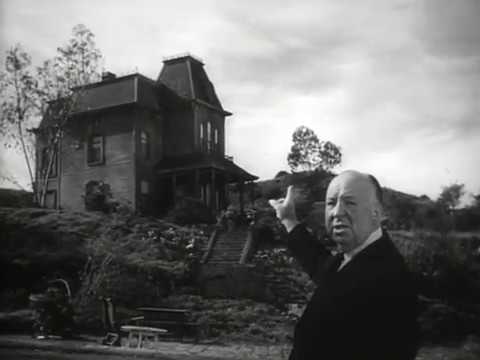
121 years ago today, the master of suspense, Alfred Hitchcock, was born!
In honor of the most influential director all time, here are….
VGM Entry 05: SID comes to life
(Thanks to Tish at FFShrine for the banner)
1985 was the year that changed video game music forever, and this transpired primarily through the mediums of the Commodore 64 and the Nintendo Entertainment System. At a glance it can seem a lot easier to discuss the latter, what with Koji Kondo’s classics being performed around the world in symphonies today. The former still lacks a formalized history. Where people will readily make the bold and overpresumptuous claim that Super Mario Bros. revolutionized NES music, or even all game music, you don’t really hear the same claim being made about Monty on the Run. This is good, because neither are entirely true. The main difference I suppose is that Super Mario Bros. was undeniably the most popular game of its day, while you may well have never even heard of Monty on the Run. I don’t know if its priority over other Commodore 64 works stems from greater marketing success in 1985 or from a later acknowledgement that it was probably the best among a whole lot of excellent songs.
Let’s focus on the Commodore 64 first. The C64 sound revolution required a lot of programming innovations. The sort of sounds Rob Hubbard, Martin Galway, and the like were able to produce weren’t preset to the click of a button, and they weren’t at all obvious. Hubbard was most certainly the first prolific composer for the system, and a lot of SID programming innovations were his in origin, but to what extent C64 musicians influenced each other at this point in time is hard to say.
Monty on the Run (Gremlin Graphics, 1985) is probably Rob Hubbard’s most famous work, granted it was one of many he composed in 1985, and the improvement here over C64 examples from previous years is certainly staggering. I mean, games like 3D Skramble in 1983 may serve as fine examples of the SID’s naturally appealing tones, but they certainly don’t predict a chip and roll epic. With Rob Hubbard in 1985, and with Monty on the Run as the hallmark, we can really mark the end of serious technological limitations for home gaming sound. Programming sound for the Commodore 64 was a painstaking process no doubt, but its sound capacity was not so limiting as to physically deny quality in anything but the obscure/avantgarde. It took sound programmers a while to catch on, and perhaps, in light of the fact that they were not previously expected to compose great music for home game systems, it took a while for developers and real musicians to partner up. But three years after the release of the Commodore 64 and its legendary SID chip, home gaming music really came into its own.
Despite both making their first major waves in 1985, western and Japanese sound programming probably developed independently at first. Early game composers tended to stay within their regional spheres of influence. The European movement was not exclusive to the SID, but rather to local systems. Rob Hubbard for instance composed for the ZX Spectrum as well as the Commodore 64 early on, scoring such games as Spellbound (Mastertronic, 1985), but he never really branched out to Japanese gaming mediums. The Commodore 64, ZX Spectrum, and Amstrad CPC formed a fairly isolated pocket of platforms. Similarly, Koji Kondo composed exclusively for Nintendo, and Nobuo Uematsu’s non-NES works were all on computers of Japanese origin, such as the PC-8801 and MSX. A few British musicians, notably Tim Follin and Neil Baldwin, would later turn to the Nintendo, but the language barrier proved daunting. Some of Neil Baldwin’s best works were never commercially released due to communication difficulties between British developers and Japanese producers.
The most interesting indicator of what was going on with the Commodore 64 might be “Synth Sample” by Georg Feil. Composed in 1984 or 1985, it was a widely distributed file in the early days of the internet and had no affiliation with any sort of commercial enterprise. No one needed to ‘invent’ game music. It wasn’t discovered; it didn’t come to the first sound programmer as a sort of epiphany. It was the natural result of improvements in sound chips. Once the potential for good music was out there, it would happen with or without support from major game developers. The SID sounded great, it still sounds great, and it was an inspirational instrument in its own right. Hubbard and others might have been lucky enough to be paid a pittance for their works, but I like to think of them as musicians more so than ‘composers’ in the commercial sense.




 Through the Shattered Lens