Trail to Laredo (1948, directed by Ray Nazarro)


On the frontier, everyone has gold fever.  People are trying to find gold and steal gold and it falls to brave Treasury agents like Steve Ellison (Charles Starrett) and Smiley Burnette (played by Smiley Burnette) to keep things safe.  When Steve needs to find out who is trying steal gold, he puts on his mask and assumes the identity of The Durango Kid.

Near Laredo, a shipment of government gold has been stolen.  Dan Parks (Jim Bannon) is arrested after the gold is found in his wagon but Steve knows that the Durango Kid earlier warned Dan about traveling with gold.  Durango and Smiley set out to prove that Dan was set up by his business partner, Fenton (Hugh Prosser).

This yet another Durango Kid movie where Steve gets a job working for the bad guy while Durango works to thwart his plans.  (Remarkably, no one ever puts two and two together and notices that Steve, Smiley, and Durango always seem to show up in town at the same time.)  Fenton is just one of a long line of corrupt businessmen and land barons that Durango has had to deal with.  Fenton is not above threatening Dan’s young son (Tommy Ivo) to get Dan to do what he wants.  Given that Dan is just trying to make a good life for his family in a rough world, it’s satisfying when Fenton gets his comeuppance.

Almost every Durango Kid film featured at least one good fight scene.  In Trail to Laredo, the big fight takes place in a saloon and it’s pretty exciting.  Not only does the saloon get trashed but there’s a moment where one of the bad guys actually seem to fly through the air.  Even Virginia Maxey, playing Classy the saloon singer, gets in on it.

Both Virginia Maxey and Smiley Burnette get to sing a few songs.  As always, there enough gunfights and horse chases to keep fans of the genre happy.  Charles Starrett was a great cowboy.
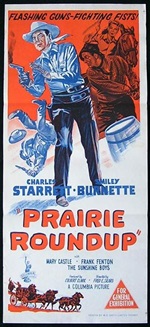
Prairie Roundup (1951, directed by Fred F. Sears)


Steve Carson (Charles Starrett) is wanted for murdering the Durango Kid!

I know that sounds confusing because Steve Carson is the Durango Kid.  The bandit that Carson shot was just disguised as the Durango Kid but actually, he was just a dim-witted outlaw who was set up by Buck Prescott (Frank Fenton), a rustler who was run out of Texas by Steve and who was trying to find a way to stop Steve from investigating his new scheme to cheat a bunch of ranchers in Santa Fe.

Steve is taken to jail but luckily, Smiley Burnette is around to help him break out.  Smiley and Steve head to Santa Fe, where they get jobs working as cowhands at the Eaton Ranch and work to expose Prescott and his gang as being responsible for a series of stampedes.  Smiley sings some songs and Steve resurrects the Durango Kid from the dead.

This was one of the later Durango Kid films.  The range war plot is one that showed up in many Durango Kid films but Prairie Roundup adds something new to the formula but having Steve framed for murdering himself.  Steve could prove his innocence by revealing that he’s actually the Durango Kid but Steve is determined to maintain his secret identity.  I’ve seen several Durango Kid films and I still don’t really understand why Steve felt he needed a secret identity in the first place.  But Prairie Roundup shows the extent to which he’ll go to keep it.

There’s plenty of fight and horse chases, more than enough to keep western fans happy.  Smiley Burnette gets to throw some punches along with singing all of his usual songs.  It’s also nice to see the lovely Mary Castle in the role of Toni Eaton, the daughter of one of the ranchers who has been targeted by Prescott.  Featuring less stock footage than usual, Prairie Roundup is a worthy entry in the Durango Kid series.

The Rough Tough West (1952, directed by Ray Nazarro)


Steve Holden (Charles Starrett) is hired by an old friend, Jack Mahoney (played by Jock Mahoney), to serve as the sheriff of a frontier town.  Steve soon discovers that his old friend has been corrupted by power and is plotting to cheat the locals out of their land and the gold that the land holds.  Despite their friendship, Steve knows that Jack has to be stopped and made to see the errors of his way.  It’s a good thing that Steve is secretly the Durango Kid and that his old sidekick, Smiley Burnette, is the town’s police chief.  But even if Jack Mahoney does eventually see the error of his ways, will it be soon enough to stop his out-of-control henchmen?

This was one of the last of the Durango Kid films and it’s heavy on stock footage and Smiley Burnette musical numbers.  It has all of the usual horse chases and gunfights but making the villain an old friend of the Durango Kid adds a little more emotional weight to this entry than some of the other Durango Kid films.  As always, Charles Starrett is a strong western hero and Smiley Burnette’s antics are nowhere nearly as annoying as the antics of some of the other western sidekicks who were populating matinee movie screens in 1952.  Western fans should enjoy this fast-paced and undemanding film.

This is not the first time that Jock Mahoney played a friend of the Durango Kid who is named Jack Mahoney, though I think the Jack Mahoney who appeared in Pecos River, Junction City, Smokey Canyon, The Hawk of Wild River, and The Kid From Broken Gun was meant to be a different character than the one who appeared in The Rough, Tough West.  If Smiley Burnette could have a rotating cast of musicians who followed him from town-to-town, then the Durango Kid could very well have known multiple Jack Mahoneys.


The Lone Hand Texan (1947, directed by Ray Nazarro)


Oil’s been discovered on the Texas frontier and Sam Jason (Fred Sears) has got the rights to several wells.  Someone in town keeps sabotaging his operations and blowing up his oil wells.  Sam sends a telegram to his old friend, Steve Driscoll (Charles Starrett).  Steve shows up in town to help Sam set up his business.  Meanwhile, Steve’s alter ego, the masked Durango Kid, works to discover who has been targeting Sam.

This is actually more of a Smiley Burnette movie than a Durango Kid film.  As always, Smiley is the Kid’s sidekick in the movie.  Smiley owns a general store and he’s the towns postmaster.  Everywhere Smiley goes, he is followed by two musicians, Mustard and Gravy.  Smiley sings even more songs than usual in this movie and he even has a brief romance with the local widow (Mary Newton), who unfortunately is also behind the efforts to drive Sam out of business.  Smiley may be the sidekick but he gets more screentime than the Durango Kid in The Lone Hand Texan and he does a mighty fine job with it.

One of the curious things about The Lone Hand Texan is that one of the bad guys also decides to wear a mask and claim to be The Durango Kid.  I wish the movie has done more with that because I have never really understood why Steve feels like he has to pretend to be Durango in the first place.  It’s not as if it’s difficult to recognize Steve, even when he’s wearing a mask.  I have never understood why no one in his movies ever notices that you never see Steve and the Durango Kid in the same place at the same time.  Even Lois Lane should have been able to figure out Durango’s secret identity.

The Lone Hand Texas is a standard Durango Kid outing, albeit not as dependent on stock footage as some of Durango’s other films.  Smiley gets to do more than usual, which is the only thing that really sets it apart.  As with most of the Durango Kid films, it will be best appreciated by those who are already fans.

Cyclone Fury (1951, directed by Ray Nazarro)


Brock Masters (Mark Roberts) has been awarded a contract to supply the army with horses.  Corrupt businessman Grat Hanlon (Clayton Moore) wants that contract for himself so he sends his henchmen to kill Brock.  Because Brock has no known relatives, Grat believes that both the horses and the contract will soon be his.

However, Brock does have an heir!  He adopted an Indian child named Johnny (Louis Lettieri).  Johnny inherits the contract and both the Durango Kid (Charles Starrett) and Smiley Burnett are going to make sure that Johnny is able to deliver the horses.  Smiley is also going to find some time to sing some songs that have even less to do with the story than usual.

Cyclone Fury was one of the later entries in the Durango Kid series.  By the time it was made, Colombia was no longer willing to spend much money on the series so that majority of the film’s action scenes are lifted from other Durango Kid movies.  If you’ve never seen another Durango Kid movie, the action scenes are exciting and feature some impressive stunts.  If you have seen another Durango Kid movie, this one is going to seem really familiar.

For western fans, the main appeal here will be seeing Clayton Moore playing a bad guy.  Moore had already played The Lone Ranger when he appeared in this movie.  At the time Cyclone Fury was made, Moore had been unceremoniously fired from his most famous role and The Lone Ranger was being played by John Hart.  Hart would only last a season and Moore would subsequently be invited back to play the role that defined his career.  As for Cyclone Fury, Moore is convincing as Grat, though the character himself is just a typical Durango Kid bad guy.  The Durango Kid was always going up against seemingly respectable businessmen who were actually outlaws.

One final note: Moore’s Lone Ranger co-star, Jay Silverheels, appears in this film but only in archival footage from an early adventure of The Durango Kid.

Law of the Canyon (1947, directed by Ray Nazarro)


When a gang of outlaws starts hijacking freight wagons and then ransoming them back to their owners, government agent Steve Langtry (Charles Starrett) is sent to investigate.  He both goes undercover as an inexperienced traveler and as the masked Durango Kid.  As always, he is accompanied by Smiley Burnette.  In this installment, Smiley tries to invent a machine that can find silver and he also sings a few songs.  His backing band, The Lone Star Cowboys, follow him everywhere that he goes but they don’t actually get involved in the action.

This is another Durango Kid movie, with all of the usual horse chases and shootouts.  The same action montage that started Phantom Valley also starts this movie.  As always, Charles Starrett is convincing when riding a horse or shooting a gun.

What sets this Durango Kid movie apart from the others is the main villain.  Dr. Middleton (played by a regular member of the Durango Kid stock company, Fred F. Sears) appears to be a kindly man who serves as a middleman between the citizens and the outlaws.  Actually, he is working with the outlaws and receives a commission of every ransom that he negotiates.  The reason he can get away with it is because he’s drugged the Sheriff (George Cheseboro)!  He attempts to drug Durango too but luckily, Smiley drinks the water instead.

While it won’t convert anyone who isn’t already a fan of the genre or the character, this is another entertaining outing for the Durango Kid.

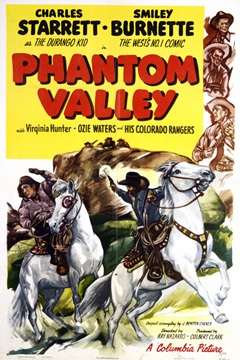
Phantom Valley (1948, directed by Ray Nazarro)


There’s trouble in Phantom Valley.  The ranchers who founded the town are increasingly at odds with the newly arrived homesteaders.  Each side blames the other for the tensions.  Marshal Steve Collins (Charles Starrett) is sent to investigate who is responsible for all of the trouble but, when two people are murdered, it is up Steve’s alter ego, the masked Durango Kid, to investigate and solve the murders.  Helping him out is his ever-loyal sidekick, Smiley Burnette.  Smiley compares himself to Sherlock Holmes, walks around with a magnifying glass, and sings a few songs.

This Durango Kid film opens with a exciting montage of cattle stampedes, shoot-outs, floods, and horse chases.  Even though it’s almost all stock footage that appeared in a countless number of other B-movies, it’s still exciting to watch.  Despite the opening montage, there’s still less stock footage than usual in Phantom Valley.  The emphasis is instead on the Durango Kid as a detective, trying to solve a stone-cold whodunit.  It makes for an interesting change of pace and the Durango Kid gets to show off his intelligence along with his shooting and horse riding skills.  Charles Starrett is convincing as a detective.  Even if he is trying to solve the case a century before finger printing, The Durango Kid knows that hand-writing is just as easy a way to identity a culprit.  Smiley Burnette, as usual, handles the comedic relief and the singing.  I could have done without the songs but Smiley trying to use a magnifying glass and losing his temporary position as the town’s marshal to a child will always be good for a laugh.

Phantom Valley was a welcome change of pace for the Durango Kid.  Western fans will find much to appreciate.

Streets of Ghost Town (1950, directed by Ray Nazarro)


Years ago, Bill Donner (George Cheseboro) double-crossed the other members of the Selby Gang and ran off with all of their stolen gold.  Now, Donner is blind and half-crazy.  When he says that he hid the gold in the ghost town of Shadeville, the Durango Kid (Charles Starrett), Smiley Burnette, and Sheriff Dodge (Stanley Andrews) ride off to find it.

Shadeville is long abandoned and, as the three men spend the night in a deserted saloon, Smiley is worried about ghosts.  The Durango Kid tells the story of the first time he met the Selby Gang.  The next morning, they discover that they are not the only ones who have come to Shadeville to look for the gold.

Like many of the later Durango Kid movies, Streets of Ghost Town is mostly made up of stock footage to Starrett’s earlier films.  This was a cost-cutting technique on the part of Columbia Pictures but it actually works because the flashbacks were always to the horse chases and the gunfights that the audience came to see in the first place.  In the days before home video and cable, those scenes were probably still new to many of the people sitting in the theater.

Starrett always made for a good hero and Smiley Burnett’s comic relief never took away from the films’s storylines.  This outing features a great scene where Durango shoots a skull in the dark just to let anyone watching him know that he’s a good shot.  I also enjoyed George Cheseboro’s manic performance as a man who really loves his gold.  Despite all of the stock footage, Streets of Ghost Town is still an above average Durango Kid film, predictable but entertaining if you’re a fan of the genre.

Bonanza Town (1951, directed by Fred F. Sears)


The frontier community of Bonanza Town has been taken over by the corrupt businessman, Krag Boseman (Myron Healey).  No one can stand up to Krag because the local judge (Luther Crockett) is under Boseman’s control.  The judge’s son (Ted Jordan) writes to the Durango Kid and asks him to come to Bonanza Town and lead a group of vigilantes to overthrow Boseman.

The Durango Kid, whose real name is Steve Ramsay (Charles Starrett) somehow receives the letter and heads into town.  As Steve, he gets a job working for Boseman and looks for evidence that Boseman is actually being bankrolled by a notorious outlaw named Henry Hardison (played by the film’s director, Fred Sears).  As the masked Durango Kid, he defuses the vigilante’s violent plan and, with the help of Smiley Burnette, he investigates what Boseman has on the judge.

Charles Starrett played the Durango Kid in 131 films.  In fact, he appeared in so many movies that the majority of Bonanza Town is made up of flashbacks from 1947’s West of Dodge City.  Despite all of the flashbacks, Bonanza Town is one of Starrett’s better films, featuring an interesting story and good performances from both Fred Sears and Luther Crockett.  Sears shows some imagination with his staging of the many gunfights and, as always, Starrett is convincing riding a horse and carrying a gun.

Bonanza Town is a fairly serious film and Smiley Burnette’s trademark comedic relief feels out of place but the kids in 1951 probably enjoyed it.  While everyone else is shooting guns and committing murder, Smiley is running his barber shop and turning a potato into a musical instrument.  While the Durango Kid dispenses frontier justice, Smiley sings a song and leaves his customers bald.  They were a good team.