Embracing the Melodrama #1: Where Are My Children? (dir by Phillips Smalley and Lois Weber)


Where Are My Children

I love melodrama, don’t you?

Well, I hope you do because, for the next 10 days, I’m going to be taking a chronological look at fifty of the best (and worst) film melodramas of all time!  I’m going to start with a silent film that’s nearly 100 years old.  Written and directed by Lois Weber, one of the first female filmmakers, Where Are My Children? is a melodramatic look at an issue that is just as controversial today as it was when this film was first released in 1916.

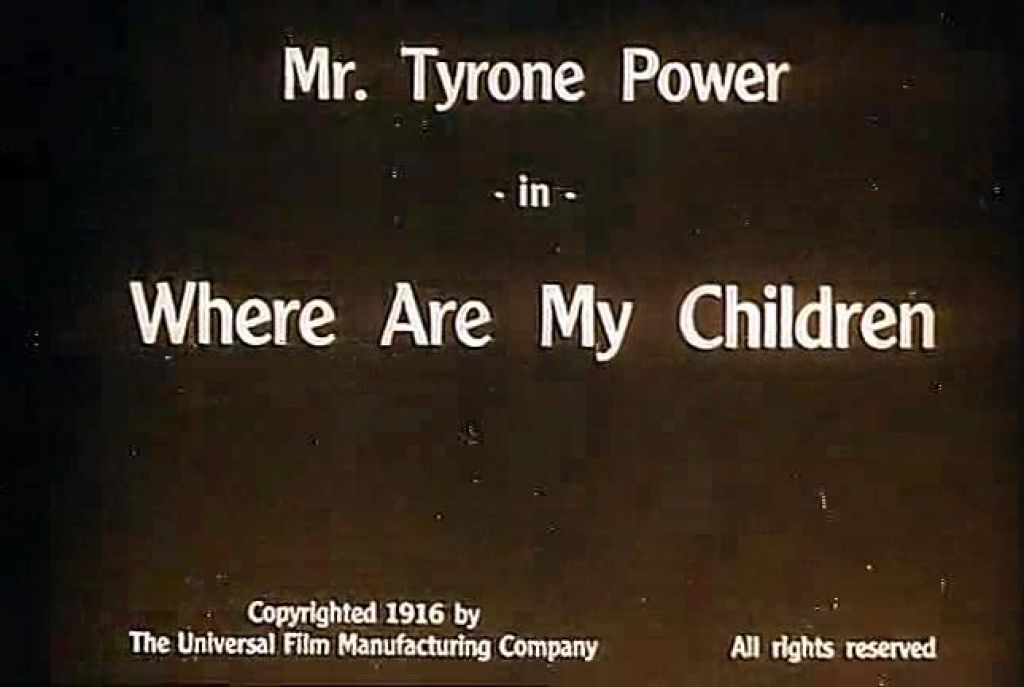
Where Are My Children? tells the story of John Walton (played by Tyrone Power, Sr.), a upright district attorney who feels that all crime could be prevented if only there was a way to stop irresponsible and morally lax people from reproducing.  Walton’s only regret in life is that he and his wife have never had any children of their own.  While Walton is busy dealing with the prosecution of a medical practitioner who has been arrested for distributing pro-birth control literature, his wife is hiding a secret from him.  Because they would rather have social lives than families, she and her friends have been secretly getting abortions…

One of the great secrets of American film history is just how weird much of silent cinema truly was.  I think we tend to assume that because silent movies are old, they also have to be primitive, corny, silly, slow, and out-of-touch.  And, often times, they are!  But, if you’re a serious student of film, you owe it to yourself to watch as many silent movies as you can.  It’s important to know the history of what you love and a film like Where Are My Children? is quite definitely a part of that history.  Add to that, for every five silent films that have been rendered almost unwatchable by the passage of time, there’s going to be one — like Where Are My Children? — that has held up fairly well.  There’s an undeniable pleasure to discovering a silent film that still — despite all the odds — remains interesting.  And, finally, there’s the fact that silent films are often odd in ways that you’d never expect.

Let’s take Where Are My Children? for instance.  This is one of those films that literally opens in Heaven, with a lengthy explanation of how there are three different levels of babies — the “chance” children, the “unwanted” (who, we are told, are constantly sent back to Heaven and have been marked with the “sign of the serpent,”), and then finally there’s the select few children who have been blessed ahead of time “by the almighty.”  Creepy, no?  As the film progresses, it becomes obvious that Where Are My Children? is a pro-eugenics film.  Eugenics, of course, is the horrific idea that only certain, elite people should be allowed to have children, because of course undesirable adults will just have undesirable children who will eventually grow up to undesirable things.

Needless to say, a lot of very evil people have used eugenics to justify doing a lot of very evil things but what is often forgotten (or not even acknowledged) is that during the early 20th century, eugenics was considered to be a very progressive concept.  For all the good work that Margaret Sanger did towards promoting birth control and sex education, she was also a supporter of eugenics.  It was her 1916 arrest and trial for distributing contraception that inspired Phillips Smalley and Louis Weber to make Where Are My Children?

Ironically enough, this film — which, with its pro-sex education message, would probably be considered quite liberal by the cultural standards of 1916 — is probably now best known for being strongly anti-abortion, with Weber and Smalley going as far as to use double exposure (which was quite an advanced technique back in 1916) to show us the children that will never be born to the film’s characters.  It’s the sort of thing that would never happen in a mainstream movie today.  It’s also the sort of thing that a lot of modern progressive audiences will undoubtedly find to be incredibly offensive.  But, speaking as someone who strongly believes in my right to make my own decisions about what I do with my body, I find films like Where Are My Children? to be fascinating.  It has nothing to do with politics and everything to do history.  Where Are My Children? is a valuable time capsule.

Watch it below!
Ghosts of Christmas Past #1: A Christmas Carol (dir by J. Searle Dawley)


Happy Holidays!

Some are celebrating Christmas.

Some are celebrating Hanukkah.

Some are celebrating Kwanzaa.

Some people are celebrating nothing and won’t shut up about it.

For me personally, this is my favorite time of year.  Admittedly, a lot of it is because I love getting presents.  But even beyond that, there’s always been something special about the holiday season.

Last October, for Halloween, we shared some old horror-themed television episodes and short films from the past and the reaction we got was pretty good.  So, why not do the same for the month of December?  From tonight until the end of 2013, I will be sharing a visions of Christmas past.  I hope you enjoy them!

Let’s start things out with this short, silent adaptation of Charles Dickens’ A Christmas Carol.  First released in 1910, this may very well be the very first film adaptation of the tale of Ebenezer Scrooge.  It was directed by J. Searle  Dawley, who, that same year, also directed the first film adaptation of Frankenstein.  The same actor who played Frankenstein’s Monster in that film, Charles Ogle, shows up here as Bob Cratchit.  Scrooge is played by Marc McDermott.

As for the film itself, it’s obviously a very condensed telling of Dickens’ famous tale but the special effects are rather impressive for 1910.  Even better, there’s no Tiny Tim.  Seriously, Tiny Tim always annoyed me.

Enjoy!

In Honor of Alice Guy Blaché: Fallen Leaves (dir by Alice Guy-Blaché)


Alice Guy Blache

When we talk about the pioneers of silent film, we usually end up talking about men like D.W. Griffith, Rex Ingram, Fritz Lang, Cecil B. DeMille, Charles Chaplin, and William Desmond Taylor.  And it is true that these men were essential to creating the language through which future filmmakers would tell stories of their own.

However, for every important silent filmmaker who continues to be celebrated, there are hundreds of just as important directors who are no longer remembered.  When you combine the tendency of the public to automatically dismiss any film made before the advent of sound with the fact that many of the best silent films are now lost films, it’s both understandable and unfortunate that several pioneering directors have been forgotten.

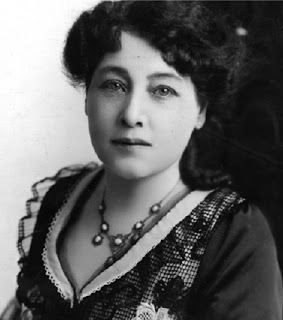
Alice Guy-Blaché may be a forgotten director but, in her way, she is just as important to the development of film as Griffith and DeMille.  The French-born Alice Guy directed her first film in 1896, when she was only 23 years old.  She is considered, by most film historians, to be the first female director and she was also one of the first directors to experiment with ways to use film to tell a narrative story.  (Narrative is something that we now take for granted but, when the movies were still in their infancy as an art form, the idea of using the techniques of filmmaking to tell a story was truly revolutionary.)

Alice Guy married Herbert Blaché in 1907 and moved with him to the United States.  It was here that she made the majority of her films.  She eventually founded the New York-based Solax Company, which was the largest film studio in pre-Hollywood America.  As of this writing, she remains the first and only woman to have owned her own film studio.

Below, you’ll find Alice Guy Blaché’s 1912 film, Fallen Leaves.  With a running time of 11 minutes, Fallen Leaves tells the story of a young woman stricken with tuberculosis and her younger sister’s desperate attempts to save her life.  This is one of my favorite silent films because it is just such an incredibly emotional and sweet-natured story.  Tears come to my eyes whenever I see the little sister starting to gather up her leaves.  So, put on some properly dramatic music and enjoy Fallen Leaves.

An Appreciation of It


Annex - Bow, Clara (IT)_01

(Spoilers below)

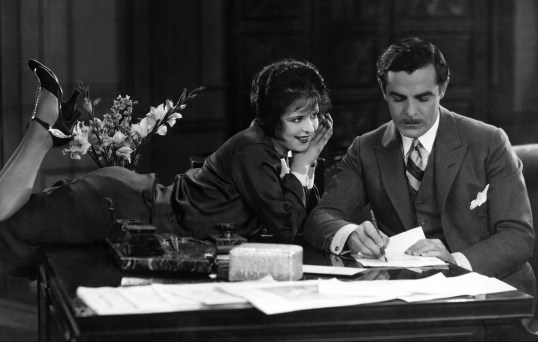
If I could be any character from a silent film, I would want to be Betty Lou Spence, the heroine of the classic 1927 film, It.

As played by the beautiful Clara Bow, Betty has It.  What is It, you may ask?  That’s the question that this film sets out to answer.  The movie starts out with a title card that read, “That quality possessed by some which draws all others with its magnetic force. With ‘It’ you win all men if you are a woman and all women if you are a man. ‘It’ can be a quality of the mind as well as a physical attraction.”  Throughout the film, every man who sets his eyes on Betty automatically says that she has “it.”   Though the film never explicitly says so, it’s pretty obvious that “It” is a combination of sensuality, intelligence, and inner strength.

It is sex.

And yes, since she’s played by Clara Bow, Betty Lou Spencer definitely has ‘it’ and she knows what to do with it as well.

However, one thing that Betty doesn’t have is a lot of money.  Instead, she’s a proud and poor shopgirl who sets her sights on her wealthy and handsome employer, Cyrus Waltham (played by Antonio Moreno).  Realizing that the uptight Cyrus will never notice her while at work, Betty accepts a date with Cyrus’s irresponsible best friend Monty (William Austin).  Knowing that Cyrus and his girlfriend will also be there, Betty asks Monty to take her to a fancy restaurant.  While Monty orders their food, Betty stares shocked at the high prices on the menu.  Why just the appetizers cost $2.00!

Ah, 1927.

Eventually, Betty does manage to get Cyrus’s attention.  After spending a day slumming with her down on Coney Island, Cyrus attempts to kiss Betty.  Betty responds by slapping him and telling him, “So, you’re one of those minute men — the minute you meet a girl, you think you can kiss her!”

The next day, things get a bit more complicated when Betty discovers that two social workers have shown up at the apartment of her best friend, Molly (Priscilla Bonner).  Molly is a single mother and the social workers have shown up to take away her baby.  Betty boldly steps forward, claiming that she is the baby’s true mother and that, since she has a job, the social works have no reason to take away her baby.

One of the snooty social workers (who, needless to say, does not have it) stares down here nose at Betty and asks, “And where is your husband?”

Betty stares straight back at her and replies, “That’s none of your business.”

Seriously, nobody tells Betty Lou Spence what to do.

Since this movie was made in 1927, everyone is scandalized.  Cyrus, obviously miffed that he couldn’t even get a kiss from an unwed mother, dumps her.  Betty responds by quitting her job.  A title card informs us that Betty may have needed the money but her pride was far more important to her.  What makes this movie unique, especially when compared to even some contemporary films, is that Betty is not punished for putting her pride before money or romance.  Instead, the film celebrates her independence.

The rest of the film deals with her getting her own brand of vengeance on Cyrus.  In the end, Betty gets her man but she gets him on her own terms.  Again, take a minute to consider that this film, made nearly 90 years ago, not only features a liberated woman but celebrates her as well.

After this film, Clara Bow became known as the “It Girl,” and it’s easy to see why.  In the role of Betty Lou Spence, Bow epitomizes the perfect combination of outward sensuality and inward strength.  Whether she’s sarcastically telling off a rude customer, defending her best friend, or saving the life of her romantic rival, Clara Bow epitomizes both sex and independence.  In the end, she pursues her man not out of obligation but out of desire.  When she does find her happy ending, she finds it on her own terms.

Those of us in 2013 have a lot to learn from the It Girl of 1927.

Film Review: The Racket (dir. by Lewis Milestone)


Originally released in 1928 and produced by Howard Hughes, The Racket was one of the first films to ever be nominated for an Oscar.  It was also one of the first films to miss out on its chance to claim Oscar glory as the first statuette for Best Picture was given to the producers of Wings.

Like many films that were made in during the silent era,  The Racket subsequently sunk into obscurity and, for several decades, it was considered to be a lost film.  After the death of Howard Hughes, the last remaining copy of The Racket was discovered hidden away in his vast film collection.  This print has been preserved at the University of Nevada, Las Vegas.  After several years of restoration, the film made its first appearance on TCM in 2004 and it has since been frequently broadcast on that network.  That’s how I first saw it way back in 2012.

Based on a play by Bartlett Cormack, The Racket is a gangster film.  Nick Scarsi (played by Louis Wolheim) is a powerful and politcally-connected bootlegger.  He’s pursued by one of the few honest cops in town, Captain McQuigg (Thomas Meighan).  When McQuigg proves to be incorruptible, Scarsi uses his political influence to get McQuigg transferred to a precinct in the suburbs.  However, when Scarsi’s younger brother is arrested for a hit-and-run in McQuigg’s new precinct, the captain uses the incident to launch a complex plan to bring down both Scarsi and the corrupt public officials that allow him to run the city.

Seen today, The Racket is an almost quaintly traditional gangster film.  According to the film’s title cards, everyone in the film speaks in hard-boiled slang and the characters — from the honest cop to the cynical reporters to the nightclub singer played by Marie Prevost — will all seem very familiar to anyone who has ever seen a classic Warner Bros. crime film.  That said, The Racket is still a lot of fun to watch and director Lewis Milestone keeps the story moving at a good pace.  At the very least, it’s interesting to see a gangster film that was actually made during the gangster era.  Nick Scarsi was based on Al Capone and, perhaps not surprisingly, the film was banned in Chicago when it was originally released.

The film shows up frequently on TCM and it’s also available on YouTube.  And it can be watched below!

Lisa Marie Invites You On A Trip To The Moon (dir. by Georges Melies)


As we wait for me to find the strength to actually review some of the movies I’ve seen recently, why not pass the time with a classic film that came out 109 years ago?

Directed and written by Georges Melies, A Trip to The Moon is often cited as the first sci-fi film and the image of the capsule crashing into the eye of the man in the moon is one of the most iconic in film history.  Seen today, the film seems both charmingly innocent and remarkably ahead of its time. 

For me, it always takes a minute or two to adjust to the aesthetic of early films.  We’ve grown so used to all the editing tricks that modern filmmakers use to tell their stories that these old silent films, with their lack of dramatic camera movement and obvious theatrical origins, often take some effort to get used to.  Still, the effort is often worth it.

Here then is Georges Melies 1902 science fiction epic, A Trip To The Moon.

Quickie Review: Un Chien Andalou (dir. by Luis Buñuel)


 The first 20-30 years of the 20th century was an ever-changing time for the burgeoning film industry not just in North America but in Europe. Many filmmakers in Europe began to take the motion picture camera and began to use them in ways which went beyond just capturing motion and sound then selling them to the masses as a new form of entertainment.

In Germany, we had the rise of German Expressionist movement with such luminaries as F.W. Murnau, Robert Weine, Fritz Lang and Paul Wegener. Over in France the 20’s saw the rise of a new movement in cinema that would quickly become the Surrealist movement which would include such filmmakers as Jean Cocteau, Germaine Dulac and René Clair. There is one filmmaker who made a major impact on French Surrealist cinema during the 20’s and he was actually a Spaniard whose first film became a major sensation then and continues to be one to this day: Luis Buñuel.

Buñuel’s first film was actually a short film he had made with the help of Spanish surrealist painter Salvador Dalí. Un Chien Andalou (An Andalusian Dog) is a 16-minute film well-known for Buñuel’s use of disjointed chronology to give the film that very surreal quality we tend to attribute to our dreams. The film has Dalí’s influence in almost every scene and one of which would go down in film history as one of the more shocking visual sequences ever put on film. I would describe it but it’s better to just see it for yourself below.

Un Chien Andalou doesn’t really make much sense when one tries to watch it in a purely structured narrative. The film’s inherent genius comes from the fact that it’s chaotic in how it unfolds with scenes chronologically moving back and forth with no impact on the characters within them. Some have called this film a perfect example of dream logic in that while the scenes in themselves do not make any sense when looked at individually they do seem to share particular traits when seen as a whole.

It’s difficult to say whether this film was entertaining. For someone looking to learn more about the craft of filmmaking, especially the part on storytelling, then Un Chien Andalou is quite an eye-opener. But In the end, Luis Buñuel’s first film has less to do with trying to entertaining and more of one filmmaker’s attempt to put into film the very intangible quality and nature of one’s dreams.

Un Chien Andalou is what I’d call the anti-Inception. Where Nolan’s film about dreams still retained a surreal quality to them they were still very much structured with order in mind. Buñuel’s short film is all about the chaos nature of dreams and no one has done it better since the day he released this classic in 1929.

A Quickie With Lisa Marie: Frankenstein (dir. by J. Searle Dawley)


There’s literally been hundreds of film adaptations of Mary Shelley’s novel Frankenstein, or the Modern Prometheus.  Everyone from James Whale to Terrence Fisher to Paul Morrissey to Kenneth Branagh to Marcus Nispel has taken a shot at interpreting the legend and the monster’s been played by everyone from Boris Karloff to Christopher Lee to Robert De Niro to Srdjan Zelenovic (who was pretty freaking hot and yummy for a creature stitched together out of random corpses in Flesh for Frankenstein).

However, the very first cinematic version of Frankenstein came out in 1910.  Produced by Thomas Edison’s film company, this 10-minute, silent film starred an actor named Charles Ogle as the monster.  Frankenstein, himself, was played by Augustus Phillips while his fiancée was played by Mary Fuller.  The film was directed by a fellow known as J. Searle Dawley.  Dawley reportedly directed over a hundred silent films and most of them are lost to history.

For about 6 decades, it was assumed that Dawley’s Frankenstein was lost as well.  However, in the mid-70s, it turned out that one remaining print of the film still existed and was apparently sitting up in someone’s attic in Wisconsin.  It also turned out that the film was still in viewable condition.

And now, thanks to a combination of YouTube and the fact that every movie made before 1922 is now in the public domain, I’ve had the opportunity to see this movie for free and even better, here’s your chance to see it for free.  Understand that when I say better, I’m speaking from the point of view of someone who is fascinated by history in general and cinematic history in specific.  In many ways, this film epitomizes everything that makes it difficult for modern audiences to appreciate the excitement once generated by silent film.  The acting is overly theatrical and watching the film makes you appreciate the eventual development of the dolly shot and the zoom lens even more.  Add to that, the music that was selected to accompany this video is way too obvious and heavy-handed.  I would suggest, before watching, that you mute the video and put your own preferred music on instead.

Still, the film does have a lot of historic interest.  I don’t think you can truly judge and appreciate the films of today unless you know something about the films of the past.  Watching a movie like the 1910 Frankenstein not only makes you realize how far films have come as an art form but also how much of the medium’s inherent earnestness has been lost with each advance in technology. 

Anyway, with all that said, here is the 1910 version of Frankenstein

The Lost Best Picture Nominee: The Patriot (dir. by Ernst Lubitsch)


So, in case you hadn’t noticed, I’ve got a love for film trivia in general and Oscar trivia in particular.  I also love to make lists.  Last night, these twin loves led to me staying up way too late making a list of every single film ever nominated for best picture.  As I looked down at that list, I thought to myself, “That’s not even a 1,000 movies.  Why it would only take a few years for me to see and then review every single film ever nominated.”  So, I am now a woman on a mission.  Well, actually, I’m on several missions but this is definitely one of them.

Unfortunately, there is one nominee that its doubtful that I — or anyone else will ever see — and that is 1928’s The Patriot.  Not only was it the last silent film to be nominated for best picture but it’s also the only nominee to subsequently become a “lost” film.  With the exception of a few publicity stills and the film’s trailer, all trace of The Patriot has vanished.  Maybe there’s a copy of it sitting in the corner of someone’s attic.  It has happened in the past, after all.  More likely though, the Patriot is simply gone. 

Here’s the trailer:

The Patriot was based on the 1801 assassination of Tsar Paul I of Russia.  Paul was played by Emil Jannings who, the previous year, had won the very first Academy Award for Best Actor for his performance in The Last Command.  Paul’s assassin — the patriot of the title — was played by character actor Lewis Stone who later played almost everyone’s father in the 1930s.  Director Lubitsch was, like Jannings, a relatively recent arrival from Germany.

The Patriot was an expensive, “prestige” presentation that was pretty much doomed the moment that Al Jolson spoke in The Jazz Singer.  With audiences now obsessed with “talking pictures,” the silent Patriot was a box office bomb.  Paramount hastily withdrew the film from circulation, added a few sound effects (though no dialogue because of Jannings’s thick German accent), and then re-released the film with the little success.  The Patriot — the last silent film nominated — lost to the first sound film to win Best Picture, Broadway Melody.

The box office failure of The Patriot pretty much drove the last nail into the coffin of the silent film era.  Jannings reacted to the coming of sound by returning to his native Germany and continuing his film career there.  He co-starred with Marlene Dietrich in Josef von Sternberg’s The Blue Angel.   As Germany’s most distinguished actor, Jannings was a supporter of Adolf Hitler and he appeared in several Nazi propaganda films during World War II.  In 1945, following the fall of the Third Reich, Jannings reportedly carried his Oscar with him as he walked through the streets of Berlin.  He died in Austria in 1950 at the age of 65. 

Lewis Stone, meanwhile, prospered in sound films and was a busy character actor until he died of a heart attack in 1953.  Reportedly, he dropped dead while chasing some neighborhood children who had been throwing rocks at his garage.

Ernest Lubitsch also had a very succesful career in Hollywood and specialized in sophisticated romantic comedies and musicals.  While Jannings was making propaganda films for Hitler, Lubitsch was directing the anti-Nazi comedy, To Be Or Not To Be.  He died of a heart attack in 1947, reportedly while having sex with a starlet who was auditioning for a role in his latest film.

The Patriot remains lost.