Let’s celebrate October by taking a trip to the moon with classic film that came out 123 years ago?
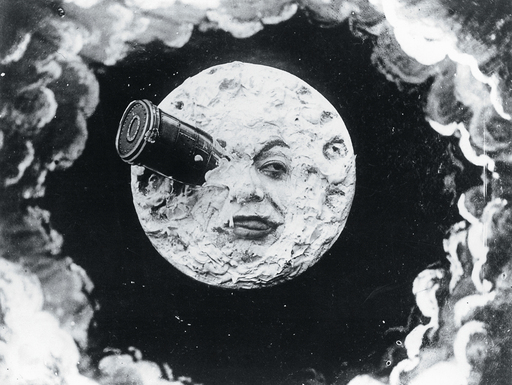
Directed and written by Georges Melies, A Trip to The Moon is often cited as the first sci-fi film and the image of the capsule crashing into the eye of the man in the moon is one of the most iconic in film history. Seen today, the film seems both charmingly innocent and remarkably ahead of its time.
For me, it always takes a minute or two to adjust to the aesthetic of early films. We’ve grown so used to all the editing tricks that modern filmmakers use to tell their stories that these old silent films, with their lack of dramatic camera movement and obvious theatrical origins, often take some effort to get used to. Still, the effort is often worth it.
Here then is Georges Melies’s 1902 science fiction epic, A Trip To The Moon.
On October 1st, Case reviewed Moon. What better way to celebrate October 31st than taking a trip to the moon with classic film that came out 120 years ago?
Directed and written by Georges Melies, A Trip to The Moon is often cited as the first sci-fi film and the image of the capsule crashing into the eye of the man in the moon is one of the most iconic in film history. Seen today, the film seems both charmingly innocent and remarkably ahead of its time.
For me, it always takes a minute or two to adjust to the aesthetic of early films. We’ve grown so used to all the editing tricks that modern filmmakers use to tell their stories that these old silent films, with their lack of dramatic camera movement and obvious theatrical origins, often take some effort to get used to. Still, the effort is often worth it.
Here then is Georges Melies’s 1902 science fiction epic, A Trip To The Moon.
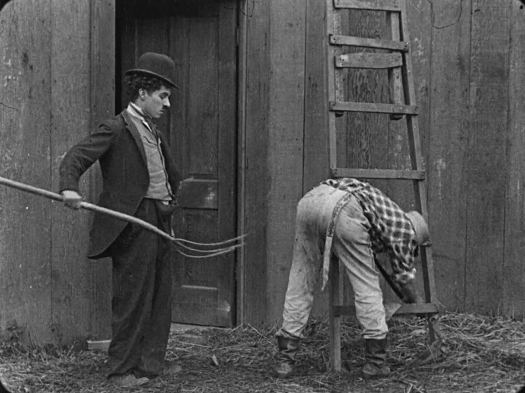
Today we celebrate the birthday of the immortal Charlie Chaplin , born on this date 130 years ago. Chaplin made his film debut 105 years ago this year, and the world hasn’t stopped laughing since! His silent comedies featuring the endurable character “The Little Tramp” (or as Chaplin called him, “The Little Fellow”) have stood the test of time, and his mix of humor and pathos elevated slapstick comedy to high art. The compilation film CHAPLIN’S ART OF COMEDY highlights Chaplin’s early efforts at Essanay Studios from 1914-15, and contains some of his best work.
The success of Robert Youngson’s 1959 film THE GOLDEN AGE OF COMEDY (spotlighting silent luminaries like Laurel & Hardy, Ben Turpin, and others) had spawned a whole host of imitators over the next decade utilizing low-to-no cost silent footage and repackaging it into a new feature film. Some were good, others lackadaisically put together, most…
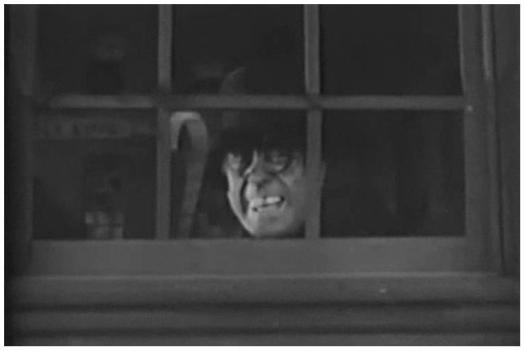
Who was the First Universal Monster? Was it Bela Lugosi as Count Dracula? Lon Chaney Sr. as The Hunchback? No – it was King Baggot in the dual role of Robert Louis Stevenson’s immortal DR. JEKYLL AND MR. HYDE way back in 1913! Baggot, considered the first Hollywood “superstar”, essayed the part in this two-reel effort, and was directed by Herbert Brenon, whose silent resume includes a pair of Betty Bronson vehicles (PETER PAN and A KISS FOR CINDERELLA), DANCING MOTHERS with Clara Bow, and Chaney’s LAUGH, CLOWN, LAUGH. I hope you enjoy this slice of Hollywood Horror History as the all-but-forgotten King Baggot stars in DR. JEKYLL AND MR. HYDE:
Tonight, as a part of my effort to get all of our readers into the holiday spirit, I present to A Christmas Accident, a silent film from 1912! That’s right — this movie is 103 years old! When this movie was first released, William Howard Taft was still President and the Ottoman Empire was still a thing!
Anyway, A Christmas Accident tells the story of rich and miserly Mr. Gilton. Mr. Gilton shares a duplex with a large and impoverished family. Mr. Gilton may be rich but he’s definitely not happy. He spends his time arguing with his wife and harassing the local shop owner. However, he reserves most of his anger for his neighbors. When his dog dies, he accuses them of poisoning it. When his wife’s meatloaf disappears, he accuses them of stealing it.
But then, on Christmas, something happens that causes Mr. Gilton to understand the true meaning of the holidays…
As I’ve stated many times here, I am a huge history nerd and films like A Christmas Accident fascinate me. It’s amazing to see, firsthand, how people lived in 1912. Add to that, A Christmas Accident holds up pretty well for a 103 year-old film. William Wadsworth does a pretty good job as the Scrooge-like Mr. Gilton and, as the most prominent of the poor children, Edna Hammel is the epitome of the saintly (if poverty-stricken) children who dominated popular culture at the turn of the 20th Century.
Yesterday, in order to help some of our readers get into the holiday spirit, I shared a film from 1905. Well, tonight’s film was made four years before The Night Before Christmas! Produced by R.W. Paul and directed by Walter Booth, Scrooge (or Marley’s Ghost) was produced in 1901 and it is apparently the oldest known cinematic adaptation of Charles Dickens’s A Christmas Carol.
Of course, when watching, it’s important to remember that this movie was made during the infancy of film. If it seems primitive, that’s because it is. However, it’s also a true piece of history and you know how much I love history!
(Also keep in mind that, while this 6-minute film looks surprisingly good for its age, it’s reportedly incomplete. It also greatly condenses the original story. Let’s just say that Marley ends up doing a lot more in this film than he does in others.)
From 1901, we present to you Scrooge (Or Maley’s Ghost)!
I love the holiday so much and it’s not just because I usually get lots of presents, though I do love the excitement of waking up on the morning of the 25th and looking at all those wrapped presents sitting underneath the tree I also love getting to spend time with my family and friends. For me, the holidays are all about love, happiness, togetherness, and everything else that should be observed all year, as opposed to just one day.
Plus, sometimes, it snows! I love snow.
So, are you in the Holiday spirit yet? I know that TSL contributor Patrick Smith is because he’s been tracking down scary Christmas films for me and the other members of the Late Night Movie Gang to check out. Seriously, just try to watch Santa and the Ice Cream Bunnyor whatever it’s called. Agck!
Well, if you’re not in the spirit yet, don’t worry! I’m here to help! This week, I will be sharing 6 holiday classics that just happen to be on YouTube! For instance, check out the adorable film below. The Night Before Christmas was made 110 years ago, in 1905. It was directed by film pioneer Edwin S. Porter and it’s based on the famous poem. In this 11-minute silent film, we watch as both Santa and a family get ready for Christmas. Watching this film, it’s amazing to see how little Christmas tradition has changed.
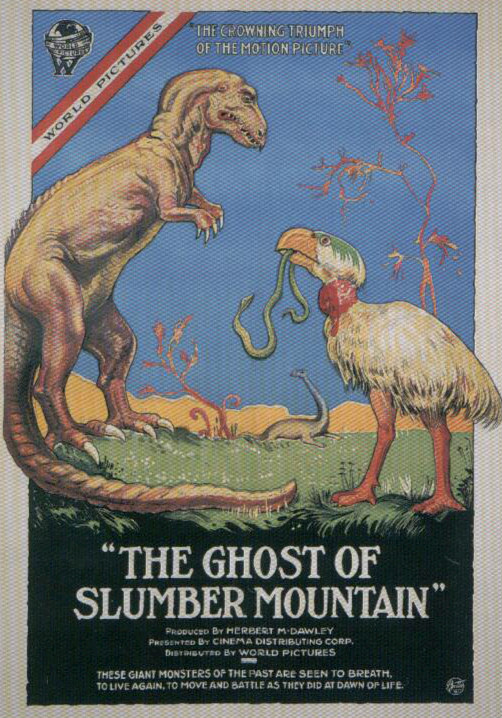
Directed by special effects pioneer Willis O’Brien (who would later do the special effects for the original King Kong), The Ghost of Slumber Mountain tells the story of an explorer and writer named Holmes (Herbert M. Dawley). When his nephews ask him to tell them a story, Holmes tells them about the time that he explored Slumber Mountain and met the ghost a prospector named Mad Dick (played by O’Brien himself). The ghost instructs Holmes to look through a telescope. Upon doing so, Holmes finds himself starting into prehistoric times. He not only sees a fight between a Tyrannosaurus and a Triceratops but then apparently gets sent though time himself as he soon finds himself being chased by the surviving dinosaur.
Now, there are a few things that I should make clear about The Ghost of Slumber Mountain. It’s a silent film, which means that watching it requires modern audiences to adapt to a far different narrative experience than they may be used to. As well, the film originally ran 30 minute but the current print clocks in at 19 minutes. As a result, most of the film’s non-dinosaur plot is unknown.
With all that in mind, The Ghost of Slumber Mountain is still a fascinating and fun slice of cinematic history. This was the first film to show live actors and stop-motion creatures together on the screen. And while the special effects are primitive when compared to today’s CGI monsters, there’s also an undeniable charm to them.
Today, of course, we tend to take special effects for granted. One of the great things about watching a movie like The Ghost of Slumber Mountain is that it gives you a chance to travel back to a time when special effects truly were special and unexpected. There was once a time when film magic truly did seem to be like magic and sometimes, it’s fun to hop into a cinematic time machine and try to imagine being in that 1918 audience and being truly amazed by what we are seeing.
So, why not hop into that time machine and watch The Ghost of Slumber Mountain?
Last year, I published 60 film reviews under the heading of Embracing the Melodrama. Embracing the Melodrama was one of the first review series that I had ever done and I had so much fun doing it that I figured, “Why not try it again?”
In other words, welcome to Embracing the Melodrama, Part II!
Over the next three weeks, I will posting, in chronological order, 128 reviews of films that embrace the melodrama. As before, these reviews will be in chronological order and they will include everything from Oscar winners to grindhouse exploitation to made-for-television dramas. It should be fun!
And, considering that we’re talking about 128 reviews here, it should at least help me make a dent in my goal to see every single movie that has ever been made.
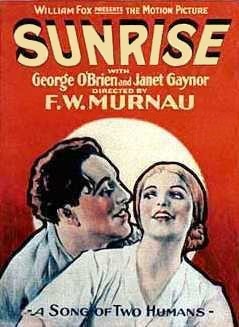
Let’s start things off by taking a quick look at the 1927 silent film, Sunrise. Directed by German expressionist F.W. Murnau, Sunrise is widely considered to be one of the greatest films ever made and for once, popular opinion is correct. The film tells a simple story. The Woman From The City (Margaret Livingston) takes a vacation out in the country. (We know she’s dangerous because she wears black lingerie.) She stands outside of a farmhouse and whistles. Soon, the Man (George O’Brien) steps out of the farmhouse and joins the Woman. Inside the farmhouse, the Wife (Janet Gaynor) can only dream of what life was like when she and the Man first fell in love.
The Man and the Woman meet at the edge of the lake and kiss as the moon shines down on them. They’re having an affair, though the film — in its dream-like way — leaves it ambiguous as to just how long the affair has been going on. (Indeed, the film almost seems to suggest that The Woman has sprung from the Man’s subconscious, a creation of his darkest desires.) The Woman wants the Man to murder his wife and come back to the city with her. At first, the Man refuses but, as the Woman talks to him, he starts to visualize the city. And, make no mistake about it — the city that the man visualizes is a scary place that resembles the dreamworld of The Cabinet of Dr. Caligari. But, at the same time, it’s also a lot more fun than the farm.
Now, you may be wondering why this familiar sounding tale is considered to be one of the best films of all time. The story itself is simple and deliberately allegorical. The film is less about the story and more about how Murnau tells it. Murnau fills the screen with hauntingly surreal images that are both beautiful and frightening at the same time. When the title cards appear on-screen, the lettering literally fades in and out and adds to the entire movie’s dream-like feel. Watch the scene below where the Woman first suggests killing the Wife and the Man visualizes the city:
Infatuated with the Woman, the Man plans to drown the Wife but, at the last minute, has a change of heart. The Wife, however, flees to the city herself. The Man follows her and attempts to win back her love. The city itself changes when the Man and the Wife are in it together. What seemed dark and threatening under the influence of the Woman is now revealed to be fun and vibrant. The film transforms from being an early example of film noir to being a screwball comedy.
How many other films can you think of that feature both a murderous femme fatale and a drunk pig?
And yet, as much joy as the Man and the Wife find in the city, both the farm and the Woman await their eventual return. And there’s a storm coming…
Interestingly enough, at the first Oscar ceremony, two awards were given for Best Picture of the year. The first award — for Outstanding Production — went to Wings, a big budget action spectacular about World War I. The other award — for Unique And Artistic Presentation — went to Sunrise. I’ve read a lot of speculation about which film the Academy meant to name the best of the year but, to me, it’s fairly obvious that the Academy meant for Outstanding Production to honor the year’s big blockbusters while Unique and Artistic Presentation would honor the “art” films.
And, to be honest, I think that, way back in 1928, the Academy had the right idea. Why should they only give out one award for best picture, as if all films can be judged by only one standard? Why not give out separate awards for the best comedy or the best thriller or the best film made for a certain amount of money? Why not bring back the Oscar for Unique and Artistic Presentation?
For whatever reason, the Academy discontinued the Unique and Artistic Presentation Award after the 1st ceremony and, in the future, only one film would be named best of the year. Since Outstanding Production eventually become known as Best Picture, Wings has been immortalized as the first film to win best picture.
And, nothing against Wings, but the Academy would have been smarter to have gone with Sunrise. Certainly, it would have won them the respect of future film students.
Let’s continue to embrace the melodrama with the 1925 silent “race” film, Body and Soul.
Body and Soul was directed by Oscar Micheaux, who may not be a household name but who is still a very important figure in the development of American film. Though he may be forgotten today, Micheaux was the first major African-American filmmaker. At a time when the major studios were only willing to use black actors as comic relief, Micheaux made films that attempted to seriously deal with race relations and provide a realistic portrait of black life in America. As a result, Micheaux’s films serve as a historical record of a community that, for most of the 20s, was either ignored or condescended to by the majority of American films. While Micheaux is believed to have directed 26 silent films, only 3 are known to have survived. Of those three, Body and Soul is the best known and the most acclaimed.
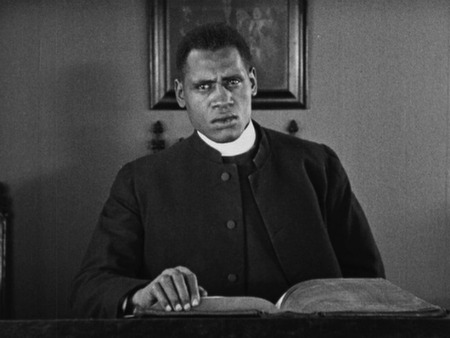
In Body and Soul, Paul Robeson plays an escaped prisoner who, upon finding himself in the predominantly black town of Tatesville, Georgia, takes on the false identity of the Rt. Rev. Isaiah T. Jenkins. While the majority of the citizens in town take one look at Jenkins’s collar and assume that he must actually be a man of God, Jenkins spends his private time drinking and coming up with schemes to swindle his congregation out of their money. Jenkins also pursues a member of his congregation, Isabelle (Julia Theresa Russell), despite the fact that Isabelle is in love with the poor but decent Sylvester (who also happens to be Jenkins’ brother and who is also played by Robeson). It all leads to tragedy, death, murder. Indeed, for a film that was made and released in 1925, Body and Soul is surprisingly critical of organized religion. Or, at least, it is until the awkwardly uplifting ending, which is best ignored.
For those of us who were raised on special effects and sweeping camera movements, there’s always a moment of adjustment that comes whenever we start to watch a silent film. We tend to take cinematic magic for granted and, as a result, we are often surprised by the largely stationary camera, the minimal sets, and the overly theatrical style of performance that largely typifies the silent era. All of these elements are present in this film but, once you adjust to the style of a different era, Body and Soul actually hold up fairly well. If nothing else, the film’s portrait of a corrupt and decadent clergy is just as relevant today as it probably was in 1925. But, to be honest, the film is mostly worth watching for Paul Robeson’s wonderful lead performance. While he’s a bit on the dull side as Sylvester (but, then again, Sylvester is a dull character), Robeson turns Rev. Jenkins into a charismatic and magnetic force of corruption. Whereas a lot of other actors (especially in the silent era) would have gone far too overboard with Jenkins’ villainy, Robeson plays up the reverend’s sinister charm. As a result, Body and Soul remains both a valuable piece of cinematic history and a watchable melodrama.

 Through the Shattered Lens