Eager to get away from her abusive father (Sig Ruman), Connie Heath (Jane Bryan) keeps making the mistake of hanging out with the ultimate bad friend, Hilda Engstrom (Sheila Bromley). Hilda steals a dress from where they work and when the dress is torn, Hilda lets Connie take the blame. When the dress’s owner (Susan Hayward, making her film debut) insists on pressing charges, insurance investigator Neil Dillon (Ronald Reagan) helps Connie get off the hook and out of jail.
Having not learned her lesson, Connie continues to hang out with Hilda and her new boyfriend, Tony Rand (Anthony Averill). This time, Connie gets caught up in a bank robbery. Will Neil be able to get her out of another jam?
63-minutes long, Girl on Probation is a Warner Bros. B-movie. Ronald Reagan is surprisingly mellow as someone falling in love with a woman who keeps getting framed for his crimes she didn’t commit. Sheila Bromley steals the show as the out-of-control dangerous blonde who tells a priest, “I’m about to meet your boss.” The main problem with the film is that Connie is incredibly stupid. How many times can one person be framed? Jane Bryan, who played Connie, ended her acting career when she got married but she and her millionaire husband later helped to bankroll Reagan’s first political campaign and both of them were members of his unofficial “kitchen cabinet” when he was governor of California.
The movie has never been released on DVD and is hard to find. It plays on TCM occasionally, which is where I saw it. Online, the only place it appears to be streaming, ironically enough, is on a Russian site.
In the 1942 film, Berlin Correspondent, Dana Andrews plays Bill Roberts.
Bill is an American journalist, working out of Berlin. Because the film takes place before America’s entry into World War II, Bill pretends to report only what the Germans want him to report. Even while there are bombs exploding outside of the studio, Bill and his fellow correspondents report that everyone in Berlin is happy and that the German government is doing a great job.
However, Bill fills his reporting with code words, which are then interpreted by listeners in the American Intelligence service. They understand that when Bill says that the people are happy, that means that they’re actually miserable. When Bill says that the weather in Berlin is cloudy, that means that there is dissent brewing in the government.
Still, Captain Von Rau (Martin Kosleck) comes to suspect that Bill might be sending out secret messages and he decides to send someone to not only compromise Bill but to also discover who is feeding Bill information. Von Rau sends his own fiancée, Karen Hauen (Virginia Gilmore), to seduce Bill. Little does Von Rau suspect that Bill’s source of information is Karen’s own father (Erwin Kalser) and that Karen herself is going to end up falling in love with Bill.
Berlin Correspondent is typical of the films that were made to try to build support for the American war effort during the Second World War. The hero is a tough and cynical American who pretends to not care about what is happening in the rest of the world but who eventually reveals himself to be an idealist with a strong sense of right and wrong. Bill may say that he’s only in Berlin to report the news but, when Karen’s father is sent to a concentration camp, Bill proves himself to be willing to risk his own life to help the older man make it to Switzerland. Karen’s father stands in for the members of the German resistance who worked from the inside to bring down the Nazis. Bill and Karen’s love serves as a reminder that the world can come back together but only after Hitler has been defeated.
The two main Nazi villains are played by Martin Kosleck and Sig Ruman, two German actors who immigrated to the United States to escape the real-life Nazis. Kosleck and Ruman play their characters as being buffoonish bullies who are easily outsmarted by street smart Americans like Bill. It’s the film’s way of saying to the audience, “Are you really going to let these idiots think that they can defeat America?” Still, a scene is included in which a crippled girl is described as being someone who should be put to death. It’s a necessary reminder that the Nazis may be idiots but they’re also a legitimate threat.
Berlin Correspondent clocks in at a brisk 70 minutes and it features a typically strong leading performance from Dana Andrews. If you needed someone to fight for America, 40s-era Dana Andrews would definitely be a good pick to go with. It’s a joy to watch him outsmart the Nazis.
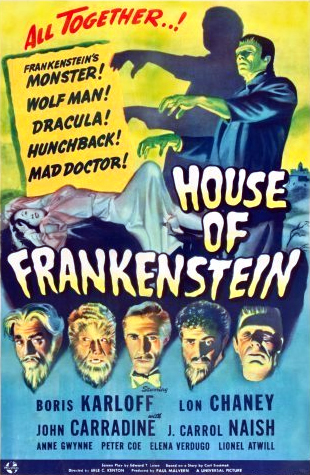
House of Frankenstein opens in a prison. Dr. Gustav Neimann (Boris Karloff), the bother of one of Baron Frankenstein’s assistants, has been convicted of robbing graves and attempting to carry on the Baron’s work. Dr. Neimann’s faithful assistant is the hunchback, Daniel (J. Carroll Naish). Daniel is loyal to Neimann because Neimann has promised to someday place Daniel’s brain in a stronger body.
When a sudden earthquake allows Neimann and Daniel to escape, they waste no time in getting revenge on Neimann’s enemies. First, they murder a traveling showman named Prof. Lampini (George Zucco) and steal both his identity and his mobile horror exhibit. Included in the exhibit is a coffin that Lampini claimed held the skeleton of Dracula. (There’s even a stake sticking out of the skeleton’s chest.) When Neimann returns to his original hometown, he removes the stake from the skeleton so that he might use it on the Burgomaster, Hussman (Sig Ruman). The skeleton transforms into Dracula (John Carradine). Because he is relieved to have been brought back to life, Dracula does not attack Neimann but instead agrees to help Neimann get revenge on Hussman in return for Neimann looking after his coffin. Dracula soon learns that he should have thought twice before trusting either Neimann or Daniel.
Neimann moves on, stopping off at Frankenstein’s village and recovering the bodies of both Frankenstein’s Monster (Glenn Strange) and Larry Talbot (Lon Chaney, Jr.) from the frozen chamber in which they were trapped at the end of Frankenstein Meets The Wolf Man. Revived from suspended animation, Larry immediately starts whining about how much his life sucks. (I love The Wolf Man but subsequent films turned Larry into the whiniest of the Universal monsters.) Neimann promises to put Larry’s brain in a new body if he helps to revive the Monster. Larry agrees. Meanwhile, Daniel falls in love with a gypsy girl named Ilonka (Elena Verdugo) while Ilonka falls in love with Larry. Daniel wants Neimann to put his brain in Larry’s body, Larry won’t stop whining about the approaching full moon, and the villagers are getting suspicious!
House of Frankenstein has never been a favorite of critics or horror historians and the film does have its share of flaws. For instance, though it would have been fun to see Bela Lugosi return to his signature role, John Carradine seems like ideal casting for Dracula. Unfortunately, Dracula is only in the film for about ten minutes and he comes to an end that really doesn’t feel worthy of a character of his stature. The film reduces Larry Talbot to just being a dumb lug who won’t stop feeling sorry for himself. Finally, Glenn Strange has the right physique for the Monster but, much as with John Carradine, he is underused.
That said, I still enjoyed House of Frankenstein. A lot of that is because of Boris Karloff, who brings a lot of sly humor to his performance as the mad scientist. (That said, Karloff himself later said that he did the role solely for the money and was bored with the whole thing.) J. Carroll Naish turns Daniel into a rather sympathetic henchman, one who is so desperate to be “normal” that he’s willfully blinded himself to the fact that Neiman really doesn’t care about anyone other than himself. (In many ways, he’s the equivalent of the hapless characters that Michael Ripper later played for Hammer Films.) Finally, Elena Verdugo brings a lot of life to the stock role of the dancing gypsy girl who falls in love with Larry Talbot despite the fact that Larry is kind of a dumb lug.
For a modern viewer, the main appeal of House of Frankenstein is that it is one of the original Universal horror films, even if it came out long after the first Dracula and Frankenstein films. As such, it has all the things that we associate with and love about those films. There’s a ruined castle. There’s angry villagers. The cast is full of Universal horror mainstays, including Lionel Atwell and Anne Gwynne. And, yes, the film features a mob descending on the castle with torches. Flaws and all, House of Frankenstein is an enjoyable time capsule. It’s a horror film from a far more innocent age and it’s one that remains a fun watch.
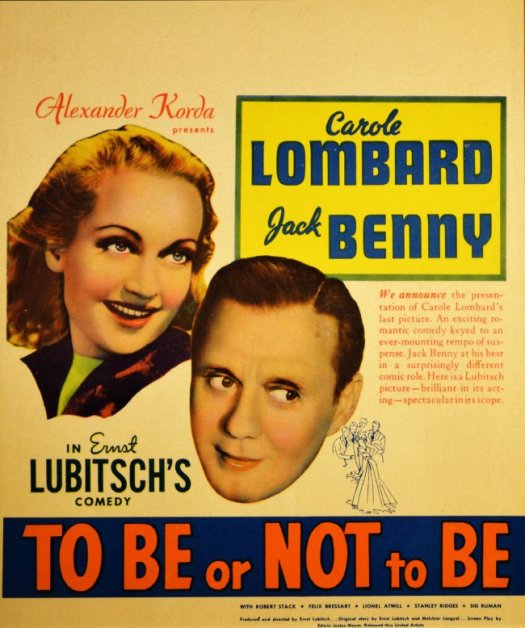
Comedian Jack Benny got a lot of mileage (and a lot of laughs) making fun of his movie career, especially THE HORN BLOWS AT MIDNIGHT . While that film isn’t half as bad as Jack claimed it was, even better was Ernst Lubitsch’s TO BE OR NOT TO BE, a topical (at the time) tale of a band of Polish actors taking on the invading Nazis during WWII. Jack’s got his best film foil here, the marvelous Carole Lombard, and the movie’s got that wonderful “Lubitsch Touch”, a blend of sophistication and sparkling wit evidenced in classic films ranging from THE MERRY WIDOW and DESIGN FOR LIVING to NINOTCHKA and HEAVEN CAN WAIT.
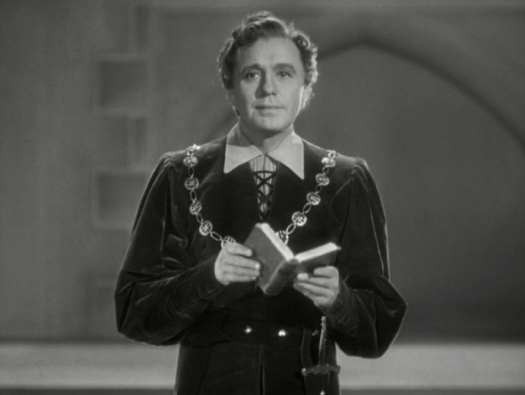
Benny plays Joseph Tura, the self-proclaimed “greatest actor in the world”, and Lombard is his bantering wife Maria. Together, they lead a troupe of actors in Warsaw in a production of “Hamlet”, but every time Tura begins…
The 35th film in Mill Creek’s Fabulous Forties box set was — wait a minute? I’m on my 35th Fabulous Forties review? Let’s see — there’s 50 films in the box set so that means that I only have 15 more of these to write and I’ll be done! And then I can move onto the Nifty Fifties, the Sensation Sixties, the Swinging Seventies, and the Excellent Eighties! YAY!
Anyway, where was I?
Oh yeah, the 35th film.
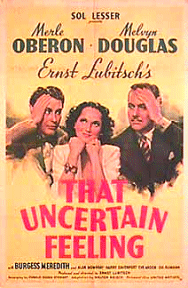
First released in 1941, That Uncertain Feeling is a movie about sophisticated people doing silly things. Socialite Jill Baker (Merle Oberon) gets the hiccups whenever she gets nervous or irritated. Her trendy friends suggest that she try the new big thing: seeing a psychoanalyst! At first, Jill is reluctant but eventually, she gives in to the pressures of high society and she goes to visit Dr. Vengard (Alan Mowbray). Dr. Vengard tells her that her hiccups are a result of her marriage to Larry (Melvyn Douglas) and suggests that the best way to cure them would be to get a divorce.
At first, Jill is horrified at the suggestion. Whatever will people think if she gets a divorce!? However, Larry is kind of a condescending jerk. (Or, at least, he comes across as being a jerk when viewed by 2016 standards. By 1941 standards, I imagine he’s supposed to be quite reasonable.) And Jill happens to meet another one of Vengard’s patients, an outspoken pianist named Alexander Sebastian (Burgess Meredith).
Soon, Jill is not only contemplating getting a divorce from Larry but perhaps marrying the eccentric Sebastian as well! When Larry realizes that Jill is dissatisfied with their marriage and that she is attracted to Sebastian, he gives her a divorce. He even pretends to be an abusive husband so that she can file for divorce on grounds of cruelty. (It’s funnier than it sounds.) Jill and Sebastian get engaged but, once Larry starts to date again, Jill realizes that she’s not quite over her ex…
I was really excited when I saw that The Uncertain Feeling was an Ernst Lubitsch film. Lubitsch directed some of my favorite Golden Age comedies, films like Ninotchka and Heaven Can Wait. But That Uncertain Feeling is not quite up to the standard of the other Lubitsch films that I’ve seen. As played by Burgess Meredith, Sebastian never comes across as being a realistic rival to Larry. The character is so cartoonishly eccentric that it becomes impossible to see what Jill sees in him. At the same time, Larry comes across as being such a chauvinist that it’s far easier to understand why Jill would divorce him than why she would ever want to take him back. The end result is a rare Lubitsch misfire.
However, as long as we’re talking about Lubitsch, make sure to see The Smiling Lieutenant if you get the chance. Now, that’s a good Lubitsch film…
(For those following at home, Lisa is attempting to clean out her DVR by watching and reviewing 38 films by the end of today!!!!! Will she make it? Keep following the site to find out!)
Oh my God, I love this movie!
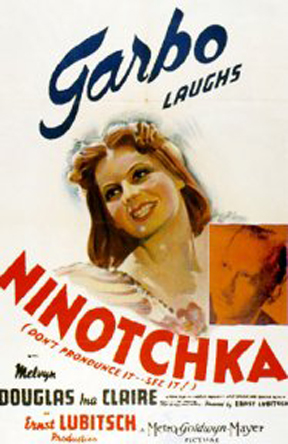
First released in 1939, Ninotchka is many things. It’s a love story. It’s a comedy. It’s a story of international intrigue. It’s a political satire. It’s a celebration of freedom. And, perhaps most importantly, it’s a showcase for one of the greatest actresses of all time, the one and only Greta Garbo!
But you know what? As great as Garbo is, she’s not the only worthy performer in this film. Melvyn Douglas plays Garbo’s love interest and his performance is full of charm and class. And guess who plays the main villain? BELA LUGOSI! That’s right — this was one of Lugosi’s few roles that did not require him to play a variation on his famous Dracula. And, even if he doesn’t have a lot of scenes, Lugosi does a pretty good job in Ninotchka. It’s interesting to see Lugosi playing an all-too real monster for once.
Ninotchka opens in Paris. Three Russians are in town and they’re trying to sell some jewelry that was confiscated by the government during the revolution of 1917. That’s right — they’re communists! When they first show up in Paris, they make a big deal about hating the decadence of capitalism. But then they meet Count Leon d’Algout (Melvyn Douglas), who proceeds to introduce them to the wonders of the free market. Soon, the three of them are holed up in their luxurious hotel, ordering room service and having a nonstop party.
(Leon, incidentally, is working for the original owner of the jewelry. The jewelry, as you’ve probably guessed, is what Hitchock would have called a macguffin.)
Once it becomes obvious that the first three Russians have been corrupted by western society, Ninotchka (Greta Garbo) is sent to bring them back to Moscow. Ninotchka is a “special envoy” and, from the minute that she meets Leon, it’s obvious that she’s going to be a lot more difficult to corrupt. For all of Leon’s charm, he cannot get Ninotchka to smile or drop her “all Marxist business” attitude.
Of course. from the minute that she first appears, we all know that Ninotchka is eventually going to loosen up and come to love both the west and Melvyn Douglas. But what makes Garbo’s performance truly special is that we like and sympathize with Ninotchka even before she embraces decadence. Even when Ninotchka is reciting Marxist-Leninist dogma, there’s a playfulness to the way Garbo delivers the lines.
That’s one reason why it’s so much fun to watch as Ninotchka (and Garbo) starts to actually relax and enjoy both Paris and life. Wisely, the film doesn’t suggest that Paris has changed Ninotchka. Instead, it merely shows that being in Paris and getting to know Leon has finally allowed her to act like the person that she was all along.
(Before her appearance in Ninotchka, Garbo was known for playing very dramatic roles. Not only is this film about Ninotchka learning to enjoy herself. It’s also about Garbo proving that she could play comedy just as well as she could play melodrama.)
Of course, eventually, Ninotchka and the three Russians are forced to return to Moscow and director Ernst Lubitsch does a wonderful job contrasting the glamour of freedom-loving Paris with the drabness of life under communism. Just when it looks like Ninotchka is going to be forced to spend the rest of her life in her depressing apartment and missing the luxury of being able to wear silk stockings, her boss (Lugosi) tells her that she is being assigned somewhere else. Ninotchka doesn’t want the assignment but, as Lugosi explains, the revolution doesn’t care what the individual wants.
Will Ninotchka and her friends ever find their way back to freedom and Leon? Or will she remain trapped in the bureaucracy? You’ll have to watch the film to find out!
I really liked Ninotchka. Even 77 years after it was first released, it remains a wonderfully romantic and sweet-natured little comedy. If you haven’t seen it, you definitely should!
Ninotchka was one of the many great films to be nominated for best picture of 1939. However, the Oscar went to another famously romantic film, Gone With The Wind.
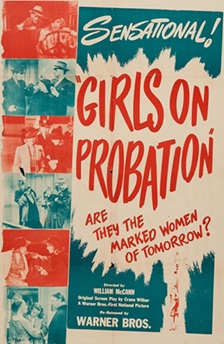 Eager to get away from her abusive father (Sig Ruman), Connie Heath (Jane Bryan) keeps making the mistake of hanging out with the ultimate bad friend, Hilda Engstrom (Sheila Bromley). Hilda steals a dress from where they work and when the dress is torn, Hilda lets Connie take the blame. When the dress’s owner (Susan Hayward, making her film debut) insists on pressing charges, insurance investigator Neil Dillon (Ronald Reagan) helps Connie get off the hook and out of jail.

 Through the Shattered Lens