Though the Academy of Motion Picture Arts and Sciences claim that the Oscars honor the best of the year, we all know that there are always worthy films and performances that end up getting overlooked. Sometimes, it’s because the competition too fierce. Sometimes, it’s because the film itself was too controversial. Often, it’s just a case of a film’s quality not being fully recognized until years after its initial released. This series of reviews takes a look at the films and performances that should have been nominated but were, for whatever reason, overlooked. These are the Unnominated.
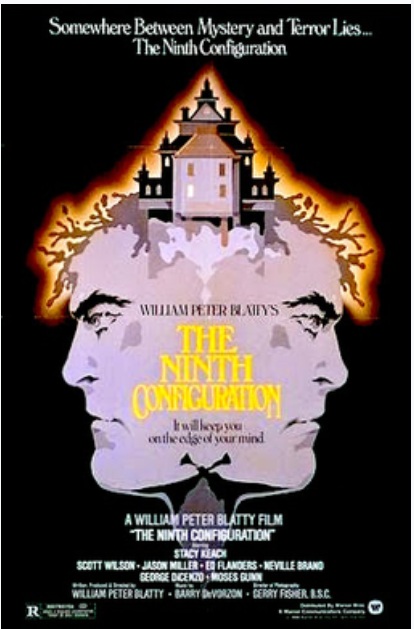
Some films defy easy description and that’s certainly the case with 1980’s The Ninth Configuration.
The film opens with a shot of a castle sitting atop of a fog-shrouded mountain. A voice over tells us that, in the early 70s, the castle was used by the U.S. government to house military personnel who were suffering from mental illness. Inside the castle, the patients appear to be left to their own devices. Lt. Reno (Jason Miller) is trying to teach dog how to perform Shakespeare. Astronaut Billy Cutshaw (Scott Wilson) is haunted by the thought of being alone in space and refuses to reveal why he, at the last minute, refused to go to the moon. The men are watched over by weary and somewhat sinister-look guards, who are played by actors like Joe Spinell and Neville Brand.
Colonel Kane (Stacy Keach) shows up as the new commandant of the the castle. From the first minute that we see Kane, we get the feeling that there might be something off about him. Though he says that his main concern is to help the patients, the man himself seems to be holding back secrets of his own. With the help of Colonel Fell (Ed Flanders, giving an excellent performance), Kane gets to know the patients and the guards. (Despite the objections of the guards, Kane says that his office must always be unlocked and open to anyone who want to see him.) He takes a special interest in Cutsaw and the two frequently debate the existence of God. The formerly religious Cutshaw believes the universe is empty and that leaving Earth means being alone. Kane disagrees and promises that, should he die, he will send proof of the afterlife. At night, though, Kane is haunted by dreams of a soldier who went on a murderous rampage in Vietnam.
The film start out as a broad comedy, with Keach’s smoldering intensity being matched with things like Jason Miller trying to get the dogs to perform Hamlet. As things progress, the film becomes a seriously and thoughtful meditation on belief and faith, with characters like Kane, Billy, and Colonel Fell revealing themselves to be quite different from who the viewer originally assumed them to be. By the time Kane and Cutshaw meet a group of villainous bikers (including Richard Lynch), the film becomes a horror film as we learn what one character is truly capable of doing. The film then ends with a simple and emotional scene, one that is so well-done that it’ll bring tears to the eyes of those who are willing to stick with the entire movie.
Considering all of the tonal shifts, it’s not surprising that the Hollywood studios didn’t know what to make of The Ninth Configuration. The film was written and directed by William Peter Blatty, the man who wrote the novel and the script for The Exorcist. (The Ninth Configuration was itself based on a novel that Blatty wrote before The Exorcist.) By most reports, the studio execs to whom Blatty pitched the project were hoping for another work of shocking horror. Instead, what they got was an enigmatic meditation on belief and redemption. The Ninth Configuration had the same themes as The Exorcist but it dealt with them far differently. (Because he wrote genre fiction, it’s often overlooked that Blatty was one of the best Catholic writers of his time.) In the end, Blatty ended up funding and producing the film himself. That allowed him complete creative control and it also allowed him to make a truly unique and thought-provoking film.
The Ninth Configuration was probably too weird for the Academy. Though it received some Golden Globe nomination, The Ninth Configuration was ignored by the Oscars. Admittedly, 1980 was a strong year and it’s hard to really look at the films that were nominated for Best Picture and say, “That one should be dropped.” Still, one can very much argue that both Blatty’s script and the atmospheric cinematography were unfairly snubbed. As well, it’s a shame that there was no room for either Stacy Keach or Scott Wilson amongst the acting nominee. Keach, to date, has never received an Oscar nomination. Scott Wilson died in 2018, beloved from film lovers but never nominated by the Academy. Both of them give career-best performances in The Ninth Configuration and it’s a shame that there apparently wasn’t any room to honor either one of them.
The Ninth Configuration is not a film for everyone but, if you have the patience, it’s an unforgettable viewing experience.
In 1959, the Clutter Family was murdered in Holcomb, Kansas.
Herbert Clutter was a farmer and was considered to be prosperous by the standards of small-town Holcomb. Neither he nor his wife nor his teenage son and daughter were known to have any enemies. The brutality of their deaths took not just the town but the entire state by surprise. People like the Clutters were not supposed to be brutally murdered. They certainly weren’t supposed to be brutally murdered in a tight-knit community like Holcomb or in a state like Kansas.
The Clutters
The author Truman Capote traveled to Holcomb with his friend Harper Lee, looking to write a story about how the heartland was dealing with such a brutal crime. Six weeks after the murders, while Capote and Lee were still conducting their interviews, two small-time criminals named Dick Hickock and Perry Smith were arrested for the crime. Capote’s proposed article about Holcomb instead became the basis for his best-known book, In Cold Blood. Capote followed the case from the initial investigation to the eventual execution of both Hickok and Smith. He examined the backgrounds of the two criminals, especially Perry Smith’s. (Indeed, there were some who felt that Capote saw something of himself in the mentally-fragile Smith.) In Cold Blood was Capote’s most successful book and it also launched the entire “true crime” genre. It also may have been Capote’s downfall as Capote reportedly spent the rest of his life haunted by the feeling that he would never top the book and that he had potentially exploited Perry Smith while writing it. In Cold Blood may be critical of the death penalty but, if Smith and Hickok hadn’t gone to the gallows, Capote would never have had an ending for the book.
(The writing of In Cold Blood and Capote’s subsequent struggles are dramatized in the excellent Capote.)
When it was published in 1965, In Cold Blood shot up the best seller lists. A film version was an inevitability. Otto Preminger — who had already made films out of Anatomy of a Murder, Exodus, Advice and Consent, and The Cardinal — was eager to turn the book into a film and one can imagine him churning out some epic version with his usual all-star cast. (Sal Mineo as Perry Smith? Peter Lawford as Dick Hickok? With Preminger, anything was possible.) However, Capote sold the rights to Richard Brooks, an independent-minded director who was also an old friend. Brooks decided to duplicate Capote’s “non-fiction novel” approach by actually shooting his film in Holcomb and having several residents of the town play themselves. He also rejected Columbia’s suggestion that Smith and Hickok should be played by Paul Newman and Steve McQueen. Instead, he cast former child actor Robert Blake as Perry Smith and an up-and-coming character actor named Scott Wilson as Dick Hickok. The only “star” who appeared in the film was television actor John Forsythe, who played the Kansas detective who was placed in charge of the investigation.
The story plays out in deliberately harsh black-and-white. (Legendary cinematographer Conrad Hall made his debut with this film.) The opening contrasts scenes of Smith and Hickok, both recently released from prison, meeting up in Kansas with scenes of the Clutter family innocently going about their day. Perry Smith is neurotic and quick to anger, a wannabe tough guy who wears a leather jacket and whose greasy hair makes him look less like a cunning criminal and more like an understudy in a regional production of West Side Story. Dick Hickok is friendly and slick, a compulsive shoplifter who claims that his smile can get him out of anything. In jail, Hickok heard a story that suggested that Mr. Clutter kept a lot of money hidden away in a safe on his farm. Hickok’s plan is to tie up and rob a family of strangers, with the assumption being that, by the time the Clutters get loose and call the police, he and Smith will already be far out of town. Neither he nor Smith seem like natural-born murderers. Smith seems to be too sensitive. Hickok seems like the epitome of someone who brags but doesn’t follow through. And yet, the morning after the robbery, four of the Clutters are discovered murdered in their own home.
The film delves quite a bit into Perry Smith’s background. Throughout the film, he has flashbacks to his abusive father and his promiscuous mother. When Alvin Dewey (played by John Forsythe) investigates Smith’s family, the recurring theme is that Perry never really had much of a chance to become anything more than a criminal. We learn less about Dick Hickok’s background, beyond the fact that he was a popular high school jock who turned mean after a car accident. And yet, despite the fact that the film is clearly more interested in Perry Smith than Dick Hickok, it’s Scott Wilson who dominates the film. It’s not that Robert Blake gives a bad performance. It’s just that Perry is such a neurotic mess and Blake gives a performance that is so method-y that occasionally, you’re reminded that you’re just watching a movie. Scott Wilson, on the other hand, gives a very natural performance as Dick Hickok. There’s nothing particularly showy about his performance and that makes Hickok all the more disturbing as a criminal and a potential murderer. If you’ve spent any time in the country, you’ve met someone like Dick Hickok. He’s the friendly guy who always knows that right thing to say but there’s something just a little bit off about him. He’s likable without being trustworthy.
A few years ago, when I saw that In Cold Blood was going to be airing on TCM, I told my aunt that I was going to watch the film. She replied that I shouldn’t. She saw the film when it was originally released and she described it as being incredibly disturbing. Despite her warning, I watched the film and I have to admit that she was right. Even though it’s nearly 60 years old and not particularly explicit when compared to the true crime films of today, In Cold Blood is still a disturbing viewing experience. Towards the end of the film, we finally see the murders in flashback and the image of Smith and Hickok emerging from the darkness of the farmhouse will haunt you. There’s not a lot of blood. The camera often cuts away whenever the actual murders occur (we hear more gunshots than we see) but the Clutters themselves are sympathetic and innocent victims and their deaths definitely hurt. Indeed, considering that the film falls on the more liberal side of the question of root causes, In Cold Blood deserves a lot of credit for not shying away from the brutality of the crimes. After spending 90 minutes emphasizing Perry Smith’s terrible childhood, it was important to remind the audiences of what he and Dick Hickok actually did.
The murder scene is so nightmarish that it actually makes it a bit difficult to buy into the film’s anti-death penalty argument. The film may end with Smith remorseful and a reporter (Paul Stewart) talking about how revenge is never the answer but the film’s liberal talking points feel hollow after witnessing the murder of four innocent people. (Ironically, it turned out there was no safe so those four people died so Smith and Hickok could steal about forty dollars.) A few years ago, I probably would have been very moved by the film’s anti-death penalty message. While I’m still opposed to the death penalty because I think there’s too much of a risk of a wrongly convicted person being executed, I’m long past having much personal sympathy for the Perry Smiths of the world.
Overall, In Cold Blood remains a powerful and disturbing movie. It was a film that was nominated for several Oscars, though it missed out on Best Picture due to 20th Century Fox’s huge campaign for Dr. Dolittle. Neither Blake nor Wilson were nominated, which is evidence that they were perhaps too convincing as Smith and Hickok for the Academy’s taste. While Robert Blake would go on to have the more storied career, Scott Wilson was a dependable character actor up until his death in 2018. A whole new generation of fans knew him not as Dick Hickok but instead as The Walking Dead‘s beloved Herschel Greene.
One final note: Both the book and the film present the murders as being an aberration, something that neither Smith nor Hickok originally planned. In 2013, new evidence was released that revealed the Smith and Hickok were the number one suspects in the murder of Christine and Cliff Walker and their two children, a crime that occurred in Florida shortly after they fled Kansas. The two of them were questioned at the time and given a polygraph test, which they both passed. The bodies of Smith and Hickok were exhumed for DNA testing, The tests came back inconclusive.
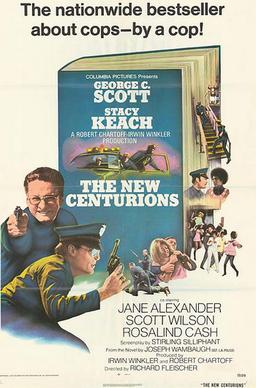
Fresh from the police academy, three rookie cops are assigned to a precinct in East L.A. Gus (Scott Wilson) is a father of three who just wants to do a good job and support his family. Sergio (Erik Estrada) is a former gang member who saw the police academy as a way to get out of his old neighborhood, and Roy (Stacy Keach) is a new father who is going to law school at night. Most of the movie centers on Roy, who goes from being an idealistic rookie to being a hardened veteran and who comes to love the job so much that he abandons law school and eventually loses his family. Roy’s wife (Jane Alexander) comes to realize that Roy will never be able to relate to anyone other than his fellow cops. Roy’s mentor is Andy Kilvinski (George C. Scott), a tough but warm-hearted survivor who has never been shot once and whose mandatory retirement is approaching.
Based on an autobiographical novel by real-life policeman Joseph Wambaugh, TheNewCenturion’s episodic structure allows the film to touch on all the issues, good and bad, that come with police work. Gus is shaken after he accidentally shoots a civilian. Sergio feels the burden of patrolling the streets on which he grew up. Roy becomes a good cop but at the cost of everything else in his life and he deals with the stress by drinking. There are moments of humor and moments of seriousness and then a tragic ending. Just as Wambaugh’s book was acclaimed for its insight and its realistic portrayal of the pressures of being a policeman, the movie could have been one of the definitive portraits of being a street cop, except that it was directed in a workmanlike fashion by Richard Fleischer. Instead of being the ultimate cop movie, TheNewCenturions feels more like an especially good episode of PoliceStory or HillStreetBlues. (TheNewCenturions and HillStreetBlues both feature James B. Sikking as a pipe-smoking, martinet commander.)
George C. Scott, though. What a great actor! Scott only has a supporting role but he’s so good as Kilvinski that you miss him when he’s not around and, when he leaves, the movie gets a lot less interesting. Scott makes Kilvinski the ultimate beat cop and he delivers the closest thing that TheNewCenturions has to a cohesive message. A cop can leave the beat but the beat is never going to leave him.
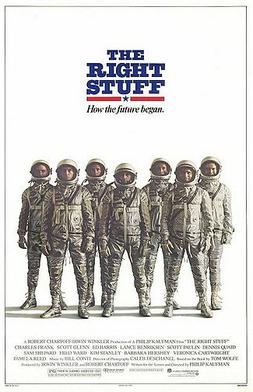
There’s a brilliant scene that occurs towards the end of 1983’s The Right Stuff.
It takes place in 1963. The original Mercury astronauts, who have become a symbol of American ingenuity and optimism, are being cheered at a rally in Houston. Vice President Lyndon Johnson (Donald Moffat) stands on a stage and brags about having brought the astronauts to his supporters. One-by-one, the astronauts and their wives wave to the cheering crowd. They’re all there: John Glenn (Ed Harris), Gus Grissom (Fred Ward), Alan Shephard (Scott Glenn), Wally Schirra (Lance Henrisken), Deke Slayton (Scott Paulin), Scott Carpenter (Charles Frank), and the always-smiling Gordon Cooper (Dennis Quaid). The astronauts all look good and they know how to play to the crowd. They were chosen to be and sold as heroes and all of them have delivered.
While the astronauts are celebrated, Chuck Yeager (Sam Shepard) is at Edwards Air Force Base. Yeager is the pilot who broke the sound barrier and proved that the mythical “demon in the sky,” which was whispered about by pilots as a warning about taking unnecessary risks, was not waiting to destroy every pilot who tried to go too fast or too high. Yeager is considered by many, including Gordon Cooper, to be the best pilot in America. But, because Yeager didn’t have the right image and he had an independent streak, he was not ever considered to become a part of America’s young space program. Yeager, who usually holds his emotions in check, gets in a jet and flies it straight up into the sky, taking the jet to the edge of space. For a few briefs seconds, the blue sky becomes transparent and we can see the stars and the darkness behind the Earth’s atmosphere. At that very moment, Yeager is at the barrier between reality and imagination, the past and the future, the planet and the universe. And watching the film, the viewer is tempted to think that Yeager might actually make it into space finally. It doesn’t happen, of course. Yeager pushes the jet too far. He manages to eject before his plane crashes. He walks away from the cash with the stubborn strut of a western hero. His expression remains stoic but we know he’s proven something to himself. At that moment, the Mercury Astronauts might be the face of America but Yeager is the soul. Both the astronauts and Yeager play an important role in taking America into space. While the astronauts have learned how to take care of each other, even the face of government bureaucracy and a media that, initially, was eager to mock them and the idea of a man ever escaping the Earth’s atmosphere, Chuck Yeager reminds us that America’s greatest strength has always been its independence.
Philip Kaufman’s film about the early days of the space program is full of moments like that. The Right Stuff is a big film. It’s a long film. It’s a chaotic film, one that frequently switches tone from being a modern western to a media satire to reverent recreation of history. Moments of high drama are mixed with often broad humor. Much like Tom Wolfe’s book, on which Kaufman’s film is based, the sprawling story is often critical of the government and the press but it celebrates the people who set speed records and who first went into space. The film opens with Yeager, proving that a man can break the sound barrier. It goes on to the early days of NASA, ending with the final member of the Mercury Seven going into space. In between, the film offers a portrait of America on the verge of the space age. We watch as John Glenn goes from being a clean-cut and eager to please to standing up to both the press and LBJ. Even later, Glenn sees fireflies in space while an aborigines in Australia performs a ceremony for his safety. We watch as Gus Grissom barely survives a serious accident and is only rescued from drowning after this capsule has been secured. The astronauts go from being ridiculed to celebrated and eventually respected, even by Chuck Yeager.
It’s a big film with a huge cast. Along with Sam Shepherd and the actors who play the Mercury Seven, Barbara Hershey, Pamela Reed, Jeff Goldblum, Harry Shearer, Royal Dano, Kim Stanley, Scott Wilson, and William Russ show up in roles both small and large. It can sometimes be a bit of an overwhelming film but it’s one that leaves you feeling proud of the pioneering pilots and the brave astronauts and it leaves you thinking about the wonder of the universe that surrounds our Earth. It’s a strong tribute to the American spirit, the so-called right stuff of the title.
The Right Stuff was nominated for Best Picture but, in the end, it lost to a far more lowkey film, 1983’s Terms of Endearment. Sam Shepard was nominated for Best Supporting Actor but lost to Jack Nicholson. Nicolson played an astronaut.
First released in 1976 and based on a book that had come out ten years previously, The Passover Plot is a film that asks, “What if Jesus was a political revolutionary who faked his own death?”
Even when the film was first released, that wasn’t a particularly novel or new theory. Ever since the Crucifixion, there have been conspiracy theorists who have claimed that the entire thing was staged. Indeed, the early days of the Church were defined by conflicts between different sects debating the true nature of Jesus, with those who believed that he was the son of God and that he had risen from the dead eventually winning out over sects who claimed that Jesus was not divine or that he had actually escaped from the Romans and was instead hiding out in Egypt or even on the island that would eventually become known as Britain. (The fact that so many Gnostics and other heretics were executed by the Church and their texts suppressed only served to lend them credibility with future theorists.) Still, every few decades, some new book or film will claim that Jesus faked his death or married Mary Magdalene and gullible people will act as if this is somehow a new argument. It’s been over 20 years since all of that Da Vinci Code nonsense convinced bored suburbanites across America that they could be experts on both boxed wine and historical conspiracy theories. We’re about due for a new version of the old story.
As for The Passover Plot, it features Zalman King as Yeshua of Nazareth, an angry young man who dreams of the day when Judea will be free of the Romans. Having a knowledge of the prophecies of a messiah and also knowing that he is descended from King David, Yeshua specifically patterns his life after the prophecies and presents himself as being not just another revolutionary but instead as being sent by God. However, he is also aware that it will be necessary for him to “die” and “rise from the dead,” so he goes out of his way to force the hand of Pontius Pilate (Donald Pleasence). Having seen plenty of crucifixions when younger, Yeshua arranges for the local revolutionaries to drug him so that he’ll appear to be dead. When he later wakes up, everyone will believe that he has returned from the dead. The film ends with several title cards, all arguing that the Gospels were written long after Yeshua’s death (“Mark lived in Italy!” one title card proclaims with almost comical indignation) and were subsequently rewritten by “unknown” hands.
The Passover Plot is a weird combination of biblical epic and conspiracy thriller. Scenes of Yeshua preaching feel as if they could have come from any traditional Biblical epic but they are awkwardly placed with scenes of Yeshua having secret, melodramatic meetings with various conspirators. It would make for an interesting contrast if not for the fact that the film itself is so slowly paced and boring. Zalman King, who is best-known for his subsequent career as a softcore filmmaker, spends a lot of time yelling and smoldering intensely but he still doesn’t have the charisma or screen presence necessary to be convincing in the role. In the scene were he’s meant to be passionate, he shrieks with such abandon that he makes Ted Neeley’s performance in Jesus Christ Superstar feel restrained. This film asks us to believe that people would not only abandon their previous lives to follow Yeshua but that they would also take part in an elaborate conspiracy that could have gone wrong at any time. For that to be believable, Yeshua needs to be played by someone who doesn’t come across like the drama student that everyone dreads having to do a scene with. Far more impressive is Donald Pleasence, whose portrayal of a ruthless and unfeeling Pilate is a marked contrast to some of the more sympathetic interpretations of the character that tend turn up in the movies.
On the plus side, the film does look good. It was shot on location in Israel and there is a certain authenticity to the film’s recreation of the ancient world. Along with Pleasence, character actors like Scott Wilson (as Judas!) and Dan Hedaya get a chance to shine. But otherwise, The Passover Plot is too slowly paced and kooky for its own good. Conspiracy theorists never seem to understand that the more elaborate a conspiracy theory becomes, the less convincing it is to anyone who isn’t already a true believer. In the end, how one feels about the film’s conclusions will probably be connected to how one already views Jesus and the Church. The Passover Plot is not a film that’s going to convince anyone who wasn’t already convinced.
Aileen Wurnos was often described as being America’s first female serial killer.
Wurnos was born in 1956, in Rochester, Michigan. From the start, her life was a mess. Her father was both a diagnosed schizophernic and a sex offender who was incarcerated when Aileen was born and who hung himself in his jail cell when Aileen was 13. (Aileen reportedly never met him.) Aileeen’s mother abandoned her children when Aileen was four, leaving Aileen and her younger brother to be raised by their alcoholic grandparents. Aileen later said that she was regularly beaten by both grandparents and sexually abused by her grandfather. Aileen also said that she spent her youth dreaming of being famous and being loved, like Marilyn Monroe.
By the time she was eleven, Aileen was already having sex in return for food, cigarettes, and drugs. She was pregnant at 14, which she later said was the result of being raped by a friend of her grandfather’s. She gave up her son for adoption and dropped out of school when she was 15, the same year that her grandmother died of live failure. Kicked out of the house shortly afterwards, Aileen survived through sex work and lived a semi-nomadic existence. While other people her age were starting high school and looking forward to the future, Aileen was living in the woods and going for days without food.
Aileen Wurnos and her husband
By 1976, she had hitchhiked her way down to Florida and her life briefly seemed to turn around when she met and married a wealthy 69 year-old man named Lewis Fell. Fell was president of a yacht club and prominent enough that his marriage to Aileen was announced in the society pages. That marriage didn’t last, however. Aileen was arrested and served with a restraining order for reportedly beating Fell in much the same way that she later said her grandfather beat her. They were divorced within weeks and, for the next 13 years, Aileen’s life consisted of one arrest after another. She returned to sex work, hitchhiking on the highways. With her looks fading due to her lifestyle, Aileen resorted to carrying around a picture of her adopted sister’s children, showing it to potential customers and telling them that she needed money so that she could go to Miami and be with them, in an attempt to play on her customer’s sympathy. Wurnos was repeatedly raped and beaten by the men who picked her up. By the time she came to fame, she was suffering from PTSD and, in her own words, hated the world and men especially.
Wurnos shot and killed at least seven men in Florida in 1989 and 1990. At her trial, she claimed that every shooting was self-defense. She said that she had been raped and nearly killed by her first victim, who had previously be arrested for rape. She went on to say that all of her subsequent victims had been planning on raping but sh shot them first. Once she was on death row and waiting to be executed, she changed her story several times and said that only the first of the shootings was in self-defense and that the rest were simple robberies. The men, she explained, picked her up. She took their money and then she shot them because she didn’t want them reporting her to the police. Of course, she then later told documentarian Nick Broomfield that all of the killings actually were self-defense but that she changed her story because she hated Death Row and she was eager to die. There were a lot of stories when it came to Wurnos and determining what was true was often difficult.
That said, while Wurnos was undoubtedly a female serial killer, I doubt that she was our first. It depends on what you consider a serial killer to be, with some FBI profilers claiming that Wurnos was unique in that she eventually grew to enjoy killing and that she set out each night looking for someone to kill. That said, throughout history, there have been stories about women who married and murdered multiple men, the infamous black widows. Between 1884 and 1908, Belle Gunness murdered at least 14 people in Illinois and Minnesota. Working with her boyfriend, Martha Beck murdered an estimated 20 people in the late 40s. If so inclined, one could go all the way back to ancient Rome and read about the poisoner Lucasta, whose victims reportedly included at least one emperor.
So, no, Aileen Wurnos was not the first female serial killer but she was the first one to come to prominence after the term was coined. She was the first well-known female serial killer of the post-Ted Bundy era. And because she also committed her crimes at the dawn of the 24-hour media cycle, she achieved a level of fame that was denied to Gunness, Beck, and even Lucasta. Aileen held press conferences as she waited for her execution date. She made the news by alternatively praising and cursing the people who had arrested her and sent her to Death Row. She yelled at judges and threatened reporters. She was, for lack of a better term, good television. She became an icon to some, a sex worker who turned the tables on the potential killers who picked her up. She was also the subject of two documentaries from Nick Broomfield.
That was how I first found out about her. 2003’s Aileen: Life and Death of a Serial Killer used to air on HBO frequently. The film followed the final days of Wurnos’s life and featured an interview with her in which she went from being surprisingly lucid and articulate to being frighteningly unhinged. While a sympathetic Broomfield tried to get her to discuss the circumstances that led to her committing the murders, Wurnos ranted about how the prison was using “sonic pressure” to control her mind. In 2002, when Wurnos was executed, her last words were to compare herself to the “mother ship” from Independence Day and to promise that she would return. With her wild eyes, rotting teeth, and unpredictable anger, Wurnos was frightening but, at the same time, there were brief moments of clarity where Wurnos seemed to understand the gravity of both what she had done and her current situation.
Charlize Theron as Aileen Wurnos
The same year that Broomfield released his documentary and a year after Wurnos was executed, a film called Monster was released. The feature directorial debut of Petty Jenkins, Monster starred Charlize Theron as Aileen Wurnos. Theron, who also signed on as a co-producer, would win her first Oscar for her performance as Wurnos and, indeed, when the film was first released, the majority of the attention centered on how the glamorous Theron transformed herself into the not-so glamorous Aileen Wurnos. Theron famously gained weight and wore prosthetic teeth in order to resemble Wurnos but, as anyone who has seen Broomfield’s documentaries can tell you, she also captured Wurnos’s odd speech patterns and her jittery physical movements. Theron perfectly recreated Wurnos’s trademark wide smile, which somehow managed to be both vulnerable and menacing at the same time. Theron deserved the praise that she got for her performance and she certainly deserved to win that Oscar. And yet, so much attention was paid to Theron’s performance and her physical transformation, that the overall film itself was a bit overshadowed. Along with being one of the saddest films ever made, Monster is a portrait of life on the fringes and of existence in the shadows of conventional American society.
The film opens with Wurnos siting underneath a highway overpass and staring down at a loaded gun, debating whether or not she should just end it all. Occasionally, she provides narration, discussing how she eventually came to find herself homeless and struggling to survive. Her narration frequently switches from being insightful and darkly comedic to being angry and bitter, often in the same sentence. Deciding not to kill herself, she instead goes to a gay bar when she meets another outsider, Selby Wall (Christina Ricci). Selby awkwardly flirts, telling Aileen that she’s the most beautiful woman in the bar. Aileen replies that she’s “not into women.” (Of course, she also lies and claims that she’s only in the bar because her truck broke down and she’s just waiting for a ride.) Yet, before long, Selby and Aileen are in love.
Selby was a heavily fictionalized version of Aileen’s real girlfriend, who didn’t want to have anything to do with Monster and who requested that her real name not be used in the film. In the film’s reimagining of the story, Selby has been exiled to Florida from Ohio, rejected by her religious father. Selby lives with her homophobic aunt but yearns for escape. That’s what Aileen provides for her and, to an extent, Selby provides the same thing to Aileen. There’s an unexpected sweetness to the early scenes between Aileen and Selby, albeit a sweetness that it continually undercut by the fact that we know we’re watching a movie about a serial killer. We watch as they go roller skating together and as they share their first kiss afterwards. We watch as they run off together and as they get their first place together and yet, at the same time, we also watch as Selby pressures Aileen to continue “hooking” so that Aileen will have enough money to support the two of them. As played by Ricci, Selby is a character about whom many viewers will have mixed feelings. When she first appears, it’s hard not to have sympathy for her. She seems to be a naïve outsider. But, as the film continues, she sometimes reveals herself to be just as manipulative as Aileen. Selby may claim to be shocked when she discovers that Aileen has been killing and robbing the men who pick her up but, just like Aileen, we don’t quite buy it. Selby knew what was going on, even if she wasn’t willing to admit it to herself.
In the film, Aileen’s first murder is presented as having been committed in self-defense. The man is a rapist and a sadist and was clearly planning to kill Aileen once he was done with her. Again, as portrayed in both the film and Wurnos’s version of events, he unquestionably got what he deserved. With one notable exception, Aileen’s subsequent murders are presented a bit more ambiguously. The majority of the men that Aileen meets are threatening, even if she shoots most of them before they get a chance to try anything. One can understand why some felt that the film was a bit too sympathetic to Aileen while, at the same time, also acknowledging that the men who would pick up a hitchhiker and expect sex in return are not exactly going to be the greatest group of guys.
Only Aileen’s final victim is presented as being a sympathetic figure. Played by the great Scott Wilson, he picks up Aileen just to get her out of the rain, refuses her offer of sex, and says that he and his wife would be willing to help her get to wherever she needs to go. He picks Aileen up for her own safety but, when Aileen tries to get out of the car, he sees her gun and Aileen kills him to keep him quiet. It’s a powerful scene, brilliantly acted by both Theron and Wilson and it’s hard to watch. (It’s also debatable whether or not it actually happened, which is the danger when it comes to making a movie about someone like Aileen Wurnos.) It’s this scene that shows how far Wurnos has gone. “You don’t need to do this,” he tells her and Wurnos knows that he’s right but, by this point, she’s beyond going back.
The only other truly and unconditionally kind character in the film is Thomas (Bruce Dern), a former biker who allows Aileen to keep her things in his storage locker and who is perhaps the only character to really care about Aileen as a human being. (Even Selby mostly views Aileen as a way to escape her current life.) Thomas is a Vietnam vet, one who suffers from PTSD and who, as a result, understands Aileen’s anger and mood swings. Dern doesn’t get a lot of screen time but he’s a welcome presence whenever he shows up. In the end, though, Aileen knows that even Thomas’s kindness can’t save her from what’s going to happen.
As I said before, it’s a sad film. It’s always watchable because Theron, Ricci, and Dern all give such good performances but it’s still a film that’ll leave you shaken. It’s a trip to the fringes, the corners of existence where there are no exits beyond death. Those who have criticized the film for taking Wurnos at her word do have a point but, at the same time, Theron is often as frightening as she is sympathetic. The viewer may understand why Wurnos does what she does but they still would not want Wurnos anywhere near them. I imagine that, for every viewer who sympathizes with Wurnos, an equal number will breathe a sigh of relief at the knowledge that Wurnos was subsequently executed by the state of Florida. Myself, I’ve always been against the death penalty, regardless of who is sitting on death row or what their motives may have been. At the same time, I can understand why others support it. It’s a frightening world and the death penalty allows people to feel that there are consequences for committing the worst of crimes.
Monster was a critical and, somewhat surprisingly, a commercial hit. Theron won an Oscar and proved herself to be a serious actress. (One doubts Theron would have ever played Furiosa if she hadn’t first played Aileen Wurnos.) Though Patty Jenkins were struggle to get several other projects going, it wasn’t until 2017 that she would make a second film. That film, of course, would be Wonder Woman, a film that was as joyous as Monster was dark.
The 1967 film, In the Heat of the Night, tells the story of two very different men.
Chief Gillespie (Rod Steiger) is the police chief of the small town of Sparta, Mississippi. In many ways, Gillespie appears to the epitome of the bigoted Southern cop. He’s overweight. He loses his temper easily. He chews a lot of gum. He knows everyone in town and automatically distrusts anyone who he hasn’t seen before, especially if that person happens to be a black man or from the north.
Virgil Tibbs (Sidney Poitier) is a black man from the north. He’s a detective with the Philadelphia Police Department and he’s as cool and controlled as Gillespie is temperamental and uncouth. Tibbs has no patience for the casual racism that is epitomized by lawmen like Chief Gillespie. When Gillespie says that Virgil is a “fancy name” for a black and asks what people call Virgil in Philadelphia, Virgil declares, “They call me Mister Tibbs!,” with an authority that leaves no doubt that he expects Gillespie to do the same.
Together …. THEY SOLVE CRIMES!
For once, that old joke is correct. When a Chicago industrialist named Phillip Colbert is discover murdered in Sparta, Chief Gillespie heads up the investigation and, assuming that the murderer must be an outsider, orders Deputy Wood (Warren Oates) to check out the train station for any suspicious characters. When Wood arrives at the station, he discovers Virgil standing on the platform. Virgil is simply waiting for his train so that he can get back home to Philadelphia. However, Wood promptly arrests him. Gilespie accuses him of murdering Colbert, just to discover that Virgil’s a police detective from Philadelphia.
Though neither wants to work with the other, that’s exactly what Gillespie and Virgil are forced to do as they investigate Colbert’s murder. Colbert was planning on building a factory in Sparta and his wife (Lee Grant) makes it clear that, if Sparta wants the factory and the money that comes with it, Virgil must be kept on the case. Over the course of the investigation, Gillespie and Virgil come to a weary understanding as both of them are forced to confront their own preconceived notions about both the murder and life in Sparta. In the end, if it’s impossible for them to truly become friends, they do develop a weary respect for each other. That is perhaps the best that one could have hoped for in 1967.
I have to admit that it took me a few viewings before I really appreciated In the Heat of the Night. Though this film won the Oscar for Best Picture of 1967, it’s always suffered when compared to some of the films that it beat. One can certainly see that the film was superior to Doctor Dolittle and Guess Who’s Coming to Dinner. But was it a better film than The Graduate or Bonnie and Clyde? Did Rod Steiger really deserve to win Best Actor over Dustin Hoffman and Warren Beatty? (Amazingly, Poitier wasn’t even nominated.)
To be honest, I still feel that In The Heat of the Night was probably the 3rd best of the 5 films nominated that year, superior to the condescending Guess Who’s Coming To Dinner but nowhere near as groundbreaking as Bonnie and Clyde or The Graduate. The first time I watched In the Heat of the Night, I thought Steiger blustered a bit too much and the film’s central mystery didn’t really hold together and, to a large extent, I still feel like that.
But, at the same time, there’s a lot to appreciate about In the Heat of the Night. On subsequent viewings, I came to better appreciate the way that director Norman Jewison, editor Hal Ashby, and cinematographer Haskwell Wexler created and maintained an atmosphere that was so thick that you can literally feel the Mississippi humidity while watching the film. I came to appreciate the supporting cast, especially Warren Oates, Lee Grant, Scott Wilson, Anthony James, and Larry Gates. (Gates especially makes an impression in his one scene, playing an outwardly genteel racist who nearly cries when Tibbs reacts to his slap by slapping him back.) I also came to appreciate the fact that, while the white cop/black cop partnership has subsequently become a bit of a cliche, it was new and even controversial concept in 1967.
And finally, I came to better appreciate Sidney Poitier’s performance as Virgil. Poitier underplays Virgil, giving a performance of tightly controlled rage. While Steiger yells his way through the film, Poitier emphasizes that Virgil is always thinking. As in the same year’s Guess Who’s Coming To Dinner, Poitier plays a dignified character but, here, that dignity is Virgil’s way of defying the demands and expectations of men like Gillespie. When Virgil does strike back, it’s a cathartic moment because we understand how many times he’s had to hold back.
In the Heat of the Night may not have been the best film of 1967 but it’s still one worth watching.
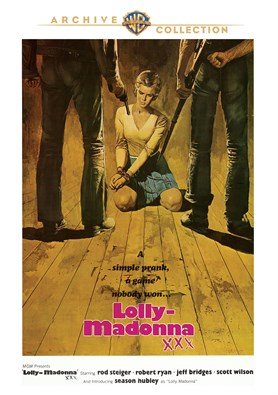
In the backwoods of Hicksville, USA, two families are feuding. Laban Feather (Rod Steiger, bellowing even more than usual) and Pap Gutshall (Robert Ryan) were once friends but now they are committed rivals. They claim that the fight started when Pap bought land that once belonged to Laban but it actually goes back farther than that. Laban and Pap both have a handful of children, all of whom have names like Thrush and Zeb and Ludie and who are all as obsessed with the feud as their parents. When the Gutshall boys decide to pull a prank on the Feather boys, it leads to the Feathers kidnapping the innocent Roonie (Season Hubley) from a bus stop. They believe that Roonie is Lolly Madonna, the fictional fiancée of Ludie Gutshall (Kiel Martin). Zack Feather (Jeff Bridges), who comes the closest of any Feather to actually having common sense, is ordered to watch her while the two families prepare for all-out war. Zack and Roonie fall in love, though they do not know that another Feather brother has also fallen in love with Gutshall daughter. It all leads to death, destruction, and freeze frames.
Lolly-Madonna XXX is a strange film. It starts out as a typical hicksploitation flick before briefly becoming a backwoods Romeo and Juliet and finally ending up as a heavy-handed metaphor for both the Vietnam War and the social upheaval at home. Along with all the backwoods drama, there is a fantasy sequence where Hawk Feather (Ed Lauter) briefly imagines himself as an Elvis-style performer. (Hawk also dresses up in Roonie’s underwear.) Probably the most interesting thing about Lolly-Madonna XXX is the collection of actors who show up playing Feathers and Gutshalls. Along with Steiger, Ryan, Martin, Bridges, and Lauter, everyone from Randy Quaid to Paul Koslo to Scott Wilson to Gary Busey has a role to play in the feud. Lolly-Madonna XXX is too uneven and disjointed to really be considered a good movie but I can say that I have never seen anything else like it.
One final note: Lolly-Madonna XXX was directed by Richard Sarafian, who is best known for another early 70s cult classic, Vanishing Point.
Billy Turner (Judd Nelson) has always been the bad boy but now he just wants to return to his Florida hometown and reconnect with his estranged father. As soon as he rolls into town, Billy gets into a bar brawl and is arrested. The chief of police (Paul Winfield) informs Billy that his father has been murdered and that his stepmother has since married the local gangster, Perry Kerch (Scott Wilson). Everyone knows that Perry murdered Billy’s father but no one can prove it. He is told to get out-of-town but Billy’s not going out like that. Instead, he gets together with his childhood friends, gimpy legged Joey (David Caruso) and Annie (Ally Sheedy), and seeks his revenge.
No, it’s not a picture of Judd Nelson hanging out with the a member of the Heaven’s Gate cult. It’s the DVD cover for Blue City.
An infamous flop, Blue City was meant to show that the members of the infamous Brat Pack could play serious, adult roles. Unfortunately, Blue City was released right at a time when everyone was starting to get sick of the Brat Pack. (Even John Hughes had moved on, casting Matthew Broderick as Ferris Bueller, instead of Anthony Michael Hall.) After countless magazine covers and the monster success of The Breakfast Club and St. Elmo’s Fire, a backlash was brewing and Blue City walked (or, in Joey’s case, limped) straight into it.
It also did not help the film’s prospects that it matched up the least interesting Brat Packer, Judd Nelson, with the member of the Brat Pack most likely to take herself too seriously, Ally Sheedy. Playing roles that would have been played by Alan Ladd an Veronica Lake in the 40s, both Nelson and Sheedy are miscast and, strangely considering this was their third film together, have no chemistry. Nelson, in particular, gives one of the most annoying performances in film history. He never stops smirking, even when there is no reason for Billy Turner to be smirking. With his wide-eyed stare and his attempts to speak like a tough guy, Nelson comes across like John Bender auditioning for West Side Story. The scene where he manages to floor Tiny Lister with one punch is simply beyond belief.
When Judd Nelson can beat you up, there is only one thing left to do:
Thanks, Duke.
On a more positive note, David Caruso, long before he could usher in the Who by simply putting on his sunglasses, is better cast as Joey but there is nothing surprising about what eventually happens to him. The best performance is from Scott Wilson, showing why he used to always play villains before reinventing himself as Herschel on The Walking Dead. Wilson was so good that I realized, halfway through Blue City, that I actually would not have minded if he succeeded in killing Billy.
The most disappointing thing about Blue City is that it is a Florida noir from the 80s that somehow does not feature even a cameo appearance by Burt Reynolds. Couldn’t Judd have taken just a few seconds during the filming of Shattered: If Your Kid’s On Drugs to convince Burt to drop by Blue City?
It’s Burt Reynolds vs. Cliff Robertson. Cliff has got the money but Burt’s got the mustache and the toupee.
Robertson plays Charles Delaney, a wealthy businessman who, with the help of a mercenary army, has bought nearly all the land in a small Oregon town. Only the owner of a local gas station, Paul Barlow (Scott Wilson), has refused to sell. Delaney and his men think that they can intimidate Paul into selling but what they do not realize is that Paul has a houseguest. Richard Malone (Burt Reynolds) was driving through town when his car broke down. While waiting for it to get fixed, he has been staying with Paul and his teenage daughter, Jo (Cynthia Gibb). What no one knows is that Malone used to be an assassin for the CIA.
If ever there was a film that demanded the talents of Charles Bronson, it is Malone. The tough and ruthless title character would have been a perfect Bronson role, especially if Malone had been made twenty years earlier. Instead, the role went to Burt Reynolds, who was on the downside of his career as an action hero. Sometimes, Burt tries to play the role as serious and emotionally guarded. Then, in other scenes, Burt will suddenly smile and wink at the camera as he briefly turns back into the Bandit. This is not one of Burt’s better performances. He gets good support from the entire cast, including Lauren Hutton as his CIA handler, but, in most of his scenes, Burt comes across as being tired and his toupee makes him look like The Brady Bunch‘s Robert Reed. Burt was 51 when he made Malone and he looked like he was at least ten years older, making the scenes where Jo comes onto him even more improbable.
Where Malone succeeds is in the action scenes. Along with Burt’s final assault on Delaney’s compound, there is also a classic showdown in a barbershop. Malone had a budget of ten million dollars. How many blood squibs did that buy? Pay close attention to the scene where two hitmen attempt to surprise Malone in his room and find out.
Malone is may not feature Burt at his best but it is still a damn sight better than some of the other films that awaited Burt once his starpower started to diminish. Mad Dog Time, anyone?




 In the backwoods of Hicksville, USA, two families are feuding. Laban Feather (Rod Steiger, bellowing even more than usual) and Pap Gutshall (Robert Ryan) were once friends but now they are committed rivals. They claim that the fight started when Pap bought land that once belonged to Laban but it actually goes back farther than that. Laban and Pap both have a handful of children, all of whom have names like Thrush and Zeb and Ludie and who are all as obsessed with the feud as their parents. When the Gutshall boys decide to pull a prank on the Feather boys, it leads to the Feathers kidnapping the innocent Roonie (Season Hubley) from a bus stop. They believe that Roonie is Lolly Madonna, the fictional fiancée of Ludie Gutshall (Kiel Martin). Zack Feather (Jeff Bridges), who comes the closest of any Feather to actually having common sense, is ordered to watch her while the two families prepare for all-out war. Zack and Roonie fall in love, though they do not know that another Feather brother has also fallen in love with Gutshall daughter. It all leads to death, destruction, and freeze frames.


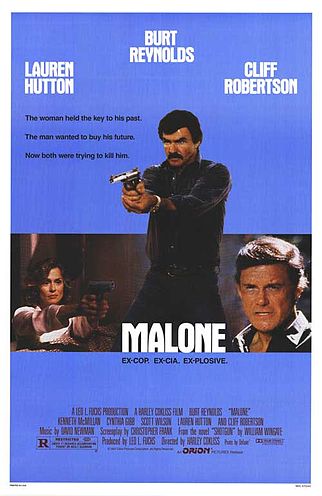 It’s Burt Reynolds vs. Cliff Robertson. Cliff has got the money but Burt’s got the mustache and the toupee.
 Through the Shattered Lens