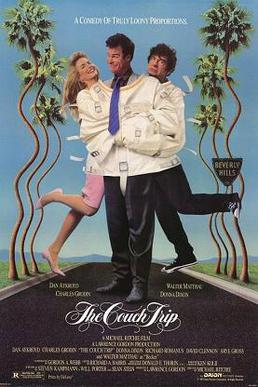
The Couch Trip (1988, directed by Michael Ritchie)


When renowned radio psychiatrist George Matlin (Charles Grodin) has a nervous breakdown, he takes a trip to Europe with his wife (Mary Gross) to both recover and also work on his marriage.  (Matlin’s breakdown was the result of an extramarital affair.)  Needing someone to host Dr. Matlin’s radio show, his producers call Dr. Lawrence Baird (David Clennon), who oversees a mental facility in Chicago.  They assume that Dr. Baird is just dumb enough that they won’t have to worry about him overshadowing Dr. Matlin while he’s guest-hosting.  However, when they call, Dr. Baird is out of his office and the phone is answered by John Burns (Dan Aykroyd), a con artist who has been pretending to be insane so that he can avoid serving time in prison.  Pretending to be Baird, Burns accepts their offer and then escapes from the asylum and heads to Beverly Hills.  The real Dr. Baird, not knowing about the offer, goes on vacation in Europe.  Though Burns had originally only been planning on doing the radio job long enough to get paid enough money to head to Mexico, he soon becomes a celebrity with his non-nonsense, blunt advice.

There’s a lot of talented people in The Couch Trip, including Walter Matthau as a former priest-turned-kleptomaniac and Aykryod’s wife, Donna Dixon, as Matlin’s colleague and Burns’s eventual love interest.  Director Michael Ritchie was responsible for some of the best films of the 70s and radio psychiatry is certainly a ripe subject for satire.  Why, then does, The Couch Trip fall flat?  Some of it is because the movie never seems to know if it wants to be wacky farce or a dramedy about a criminal who finds a new life helping people.  The other big problem is that the talented Dan Aykroyd is miscast as the type of unapologetic smartass that Bill Murray could play in his sleep.  (In a version where Murray played John Burns, Aykroyd would have been perfect casting as George Matlin.)

Aykroyd was one of the most talented members of the original Not Ready For Prime Time Players.  (His impersonations of Nixon and Jimmy Carter were second-to-none.)  Sadly, Hollywood has never figured out what to do with his off-center talent.  The Couch Trip is a prime example of that.


Retro Television Review: Fantasy Island 6.18 “The Devil Stick/Touch and Go”


Welcome to Retro Television Reviews, a feature where we review some of our favorite and least favorite shows of the past!  On Tuesdays, I will be reviewing the original Fantasy Island, which ran on ABC from 1977 to 1984.  Unfortunately, the show has been removed from most streaming sites.  Fortunately, I’ve got nearly every episode on my DVR.

It’s time to go back to the Island.  Smiles, everyone, smiles!

Episode 6.18 “The Devil Stick/Touch and Go”

(Dir by George McCowan, originally aired on March 19th, 1983)

I had mixed feelings about this episode.

On the one hand, we do learn a little bit about Tattoo’s past in this episode.  We discover that he lived in Paris before coming to Fantasy Island and becoming Roarke’s assistant and we learn that he may have been a taxi driver.  At one point, his life was saved by a woman named Susan Henderson (Georgia Engel).  To repay her, Tattoo arranges for Susan to come to the Island so that she can pursue her fantasy of getting concert pianist Carter Ransome (Bernie Kopell — who I love on The Love Boat but who is just plain miscast here) to fall in love with her.  Even though Roarke says it will only be for the weekend, Susan is okay with that.  Of course, things get complicated.  Roarke also asks Tattoo how he plans to pay for the fantasy.  Since when does Roarke care about money?  Seriously, after all of the free fantasies that he’s handed out!?  Give Tattoo a break, Roarke!

On the other hand, this fantasy featured Georgia Engel.  Georgia Engel was an actress who specialized in playing very nice women who rarely spoke above a whisper.  Ever since I’ve started doing these retro television reviews, I’ve watched countless episodes featuring Georgia Engel as quirky women who refuse to speak above a whisper.  At first, it didn’t bother me.  Then I watched Jennifer Slept Here, a short-lived sitcom co-starring Georgia Engel.  It was while watching Jennifer Slept Here that I found myself yelling, “SPEAK UP!” whenever Georgia Engel appeared onscreen.

I feel bad because Georgia Engel, in every role that I’ve seen her play, came across as being a genuinely kind soul but the whispering thing …. oh my God, it just annoys the Hell out of me.  And that was certainly the case with this episode.  It was nice to learn more about Tattoo’s life and I’m glad that everyone found love but I’m sick of having to strain to understand or even hear the dialogue whenever Georgia Engel guest stars on one of these shows.

The other fantasy, I liked a bit more.  Carl Peters (Dean Butler) comes to Fantasy Island to meet a woman who has loved for afar, Hallie Miller (Crystal Bernard).  It turns out that Hallie lives on a village on the other side of the Island.  Roarke warns that it’s a weird village that’s never gotten over the execution of a witch several centuries earlier.  At first, I was like, “Since when is there a town on the other side of the Island?” but then I remembered that, during the first season, there was a whole fantasy that took place in fishing village that happened to be on the Island.  Anyway, this fantasy is supernatural-themed and I always like it when Fantasy Island embraces its supernatural origins.

It was an uneven trip to the Island this week but what can I say?  I like island trips!


Police Academy 4: Citizens on Patrol (1987, directed by Jim Drake)


Long before the end credits of 22 Jump Street imagined Jonah Hill and Channing Tatum going to culinary school, the flight academy, and into outer space, the Police Academy films bravely tested just how far one already thin premise could already be stretched.

In Police Academy 4, Commandant Eric Lassard (George Gaynes) comes up with another plan to make the city safer.  (Since Lassard has been coming up with plans for three years without any success, it may be time to let the old man retire peacefully.)  This time, he wants to institute Citizens on Patrol, which would mean training citizens to act like cops.  It sounds like the type of terrible idea that could get a city sued into bankruptcy but considering that this is a city where a human sound effects machine and the former head of the 16 precinct’s biggest gang can become decorated police officers, I guess it’s as good an idea as any.

As usual, Carey Mahoney (Steve Guttenberg) and the gang are ready to help Lassard.  Bruce Mahler’s Fackler is no longer a part of the ensemble but Bubba Smith, Bobcat Goldthwait, Michael Winslow, David Graf, Tim Kazurinsky, Marion Ramsey, and Brian Toschi are all back.  Also returning, after skipping out on the first two sequels, is Capt. Harris (G.W. Bailey).  Harris wants to see Lassard fail so that he can take over the police academy.  It’s the same thing as the first three films.  As in previous Police Academy films, there’s a visit to the Blue Oyster leather bar and a last minute crime wave to give the Citizens on Patrol a chance to prove they belong in the program.  The Citizens on Patrol include Billie Bird, Brian Backer, David Spade, wrestler Tab Thacker, and Corrine Bohrer as a love interest for Bobcat Goldthwait.  Sharon Stone also makes an appearance, playing a journalist and improbably falling for Steve Guttenberg.  Watching the film, it is obvious that the idea was that, in future Police Academy films, the Citizens on Patrol could replace any of the regular cast members who wanted too much money to return.  As a result, almost every veteran of the cast has a doppelganger in the Citizens on Patrol.  Brian Backer could replace Steve Guttenberg.  Tab Thacker is there to put Bubba Smith on notice that no one is irreplaceable.  Is Bobcat Goldthwait being difficult?  Just remind him that David Spade can play a crazy eccentric too.

Police Academy 4 is the most crowded of the Police Academy films and, even by the franchise’s undemanding standards, most of the jokes fall flat.  Jim Drake took over as director after the director of the previous two films, Jerry Paris, died of a brain tumor and Drake struggles to balance low comedy with police action.  Guttenberg and company don’t have the same energy in this installment as they had in the previous three and the new cast members all feel as if they’re out place sharing scenes with the veterans, like a group of underclassmen who have been invited on the senior trip.

This would be the final Police Academy film for Steve Guttenberg.  Would the franchise be able to survive without him?  Check here tomorrow to find out with my review of Police Academy 5!

Police Academy 3: Back in Training (1986, directed by Jerry Paris)


Police Academy 3 opens with a state in the middle of a fiscal crisis.  Money has to be saved somewhere and the governor (Ed Nelson) has decided that it’s not necessary for the state to have two police academies.  I am not sure why the governor would be the one to make that determination since the previous two Police Academy films established that the academies are run by the city but I guess I should remember that I’m watching a Police Academy film and not ask too many questions.

Which academy is going to be closed down?  Will it be the academy run by Commandant Lassard (George Gaynes) or the one run by Commandant Mauser (Art Metrano, returning from the second film)?  Mauser is willing to use any dirty, under-handed trick to keep his academy open.  Meanwhile, Lassard has his most recent graduating class returning to instruct his latest batch of recruits.  Can Mahoney (Steve Guttenberg) and Michael Winslow’s human sound effects machine save the academy?

When I watched Police Academy 3 this weekend, I was surprised to discover that it wasn’t as bad as I remembered.  Maybe it’s because I watched it immediately after the first two films and my senses were dulled but Police Academy 3 turned out to be an amiable and enjoyably stupid comedy. It helped that two of the new recruits were played by Tim Kazurinsky and Bobcat Goldthwait.  Returning to the roles that they first played in the second movie, Kazurinsky and Goldthwait make for a good comedic team.  As for the rest of the Police Academy regulars, they all do their usual comedy bits like pros and without any fuss.  It’s predictable and sometimes, funny.

Police Academy 3 was the first Police Academy film to have a PG-rating and, as a result, the jokes were still as juvenile and crude as the first two movies but, at the same time, Police Academy 3 seems to have made peace with the fact that it’s target audience was a bunch of adolescent boys dropped off at the theater by their mothers.  Mauser is still regularly humiliated but no one gets a blow job while standing in front of a podium.  This is a Police Academy for the entire family, assuming that your family is easily amused and not too demanding.

Police Academy 3 is a dumb movie and the recurring joke about policemen accidentally entering the Blue Oyster Bar is even less funny the third time that it’s used.  There’s also a Japanese recruit who only seems to be included because, back in the 80s, American films were obsessed with making fun of Japan.  Despite all that, Police Academy 3 is still not as bad as the usual Police Academy sequel.

But what about Police Academy 4?  Check in tomorrow to find out if it’s also better than I initially remembered.

(It’s not.)

Police Academy (1984, directed by Hugh Wilson)


God help us, it has come to this.  After a month and a half being locked down, Lisa and I watched the first two Police Academy movies last night.

The first Police Academy takes place in an unnamed city that appears to be in California.  Due to a shortage of officers, the mayor has announced that the police academy will now accept anyone who wants to apply, regardless of their physical or mental condition.  Naturally, this leads to a collection of misfits applying.  Martinet Lt. Harris (G.W. Bailey) is determined to force all of them to drop out of the academy and he has a point because I wouldn’t trust Michael Winslow’s human sound effects guy to investigate any crimes that were committed in my neighborhood.  What’s he going to do?  Make silly noises while I’m trying to figure out who stole my car?

The leader of the recruits is Carey Mahoney (Steve Guttenberg).  Mahoney is being forced to attend the academy because otherwise, he’ll have to go to jail for disturbing the peace.  Police Academy is a film that asks you to believe that a character played by Steve Guttenberg has not only frequently been in trouble with the law but would also make a good cop. Guttenberg doesn’t really do a bad job as Mahoney.  He’s a likable actor, even if his filmography has more duds than hits.  But he’s still miscast in a role that demands someone like Bill Murray, who could be both tough and funny.

The other recruits include Bubba Smith as Hightower and David Graf as the insane gun nut, Tackleberry.  Kim Cattrall is the rich girl who wants to be a cop and who falls in love with Mahoney.  George Gaynes is Commandant Lassard, who is out-of-it but not as out-of-it as he would be in the sequels.

You have to wonder how many parents, in the late 80s and early 90s, allowed their children to rent the R-rated Police Academy from the local video store without realizing the the first Police Academy is considerably more raunchy than the later sequels.  How did mom and dad react when they walked into the room and discovered their children watching Georgina Spelvin giving George Gaynes a blow job from underneath a podium?  Or how about the scene where recruit George Martin (Andrew Rubin) is spied having a threesome in the girl’s dorm?  The first Police Academy film is definitely made from the same mold as Animal House, Caddyshack, and Stripes.  It’s just not as funny as any of those films.

However, it is funnier than every Police Academy film that followed it.  There’s enough solid laughs to make the first Police Academy fun in a stupid way.  For instance, just about every scene involving accident-prone Cadet Fackler (Bruce Mahler) was funny.  Bubba Smith gets a lot of laughs just by being Bubba Smith in a stupid movie.  It’s also hard not to love it when Cadet Hooks (Marion Ramsey) yelled, “Don’t move, Dirtbag!”  Hell, I even laughed at the sound effects guy once or twice.

All of the Police Academy films are now on Netflix.  Tomorrow, we’ll take a look at Police Academy 2: Their First Assignment.

Back to School #27: Fast Times At Ridgemont High (dir by Amy Heckerling)


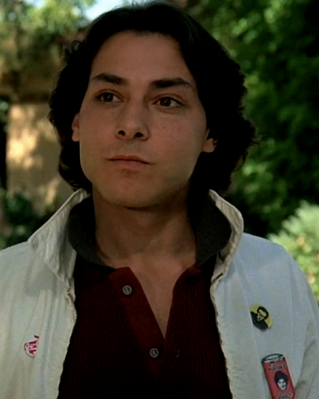
Mike Damone

Mike Damone

Mike Damone, you little prick.

I’ve watched the 1982 high school dramedy Fast Times At Ridgemont High a handful of times.  I’ve reached the point where, every time I watch it, I know exactly what’s going to happen.  I know when stoner Jeff Spicoli (Sean Penn) is going to order pizza.  I know that Charles Jefferson (Forest Whitaker) is going to go crazy during the big game against Lincoln High.  I know that when Stacy (Jennifer Jason Leigh) kisses the sweet but shy Mark Ratner (Brian Backer), he’s going to end up panicking and scrambling for an excuse to go home.  I know that Brad (Judge Reinhold) is going to get caught masturbating.  I even know when Anthony Edwards, Nicolas Cage, and Eric Stoltz are all going to appear in early performances.
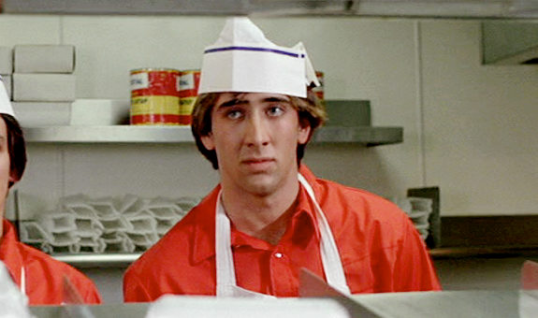
Nicolas Cage, 30 years before he would agree to star in a remake of Left Behind.

Nicolas Cage, 30 years before he would agree to star in a remake of Left Behind.

In other words, I know exactly what’s going to happen.

But, Mike Damone (played, very well, by Robert Romanus, who is only an actor and shouldn’t be held responsible for the actions of a fictional character) — every time, I find myself hoping you’ll do the right thing and every time, you let me down.

Oh sure.  I know that you tried to raise the money to help pay for Stacy’s abortion.  I saw the scene of you on the phone in your bedroom, begging people to finally pay for the tickets that you’d sold them.  I know that you tried but when you couldn’t get the money, where were you?  When Stacy had to ask her older brother, Brad, for a ride to the clinic, where were you?  After Stacy left the clinic, she found Brad waiting for her.  Brad agreed not to ask Stacy who had gotten her pregnant.  He agreed not to tell their parents.  Brad was there for his sister.  Where were you, Mike Damone?

What really upsets me is that, up until you abandoned Stacy, you were one of the more likable characters in Fast Times At Ridgemont High.  I mean, sure — you didn’t get to deliver any classic lines like Spicoli did.  And you weren’t adorably shy like Mark.  But, Mike Damone — I believed in you!  We all believed in you!  (Imagine me doing my best Tyra Banks imitation here.)  You were a cocky guy who spent all of your time selling concert tickets at the mall but you know what?  We all assumed that, underneath all of the attitude, there secretly lurked a good guy.  I mean, we could tell that you sincerely cared about your friend Mark and, because we’re all fools apparently, we even thought that maybe Stacy could bring out the real you.  When Stacy sat there writing “Mrs. Stacy Damone” on her test paper in history class, we understood.  Because, after all, we’ve all had a Mike Damone in our life.
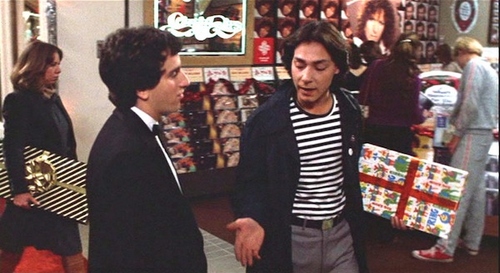
Rat and Mike

Rat and Mike

But then, what happened?  Well, first, you had sex with Stacy despite the fact that you knew Mark liked her.  Of course, for all your bluster and talk, it turned out that sex with Mike Damone amounted to 2 minutes of squirming followed by that classic line, “I think I came.”  And then you left, saying those words that every girl dreams of hearing from someone she’s just been with: “I’ll see you around.”  (Or maybe you said, “I’ll give you a call,” or “I’ve got to go now.”  Either way, it was a pretty shitty thing to say, Damone.)
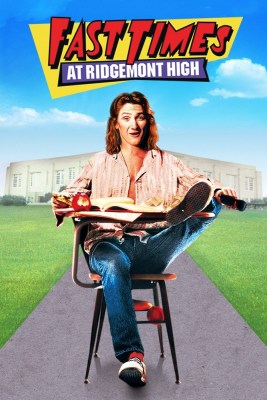
fast-times-at-ridgemont-high.19729

As you may have guessed, Fast Times At Ridgemont High is not your typical teen comedy.  In fact, over three decades since it was first released, it remains one of the best and most perceptive films about teenagers ever made.  Over on the A.V. Club, Keith Phipps refers to Fast Times as being “a Trojan horse of a teen comedy that balanced lowbrow gags with subtle humor, genuine insight .. and pathos,” and that’s such a perfect description that I’m not at all ashamed to repeat it word-for-word here.

Don’t get me wrong.  Though Fast Times At Ridgemont High has a lot more drama than you would expect from a film with the words “Fast Times” in the title, it’s also an undeniably funny film.  It’s just that, unlike so many other teen comedies, the comedy comes from a very real place.  This is one of those rare films where the characters are funnier than the situations that they find themselves in.  You laugh because you relate to the characters.  (Admitedly, you might also laugh at what some of them are wearing.  Mike Damone’s keyboard print scarf comes to mind…)
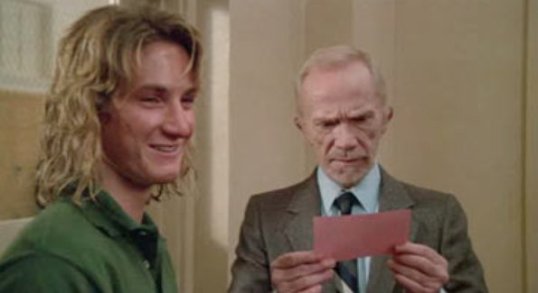
Hey I Know That Guy

Spicoli and Hand

Like many classic teen films — American Graffiti, Fame and Dazed and Confused, to cite just three obvious examples — Fast Times At Ridgemont High is an ensemble piece that follows several different students as they survive a year at Ridgemont High.  Sean Penn’s Jeff Spicoli is the character that everyone always mentions as a favorite and indeed, he does get the best lines and his battles with Mr. Hand (Ray Waltson) are definitely a highlight of the film.  People also always mention Linda (Pheobe Cates), who has a boyfriend in college and who walks in on Brad while he’s fantasizing about her.  And yes, Linda is a memorable character and not just because she bares her breasts during Brad’s fantasy.  She’s also Stacy’s best friend and I think we’ve all had a friend like Linda, someone who we looked up to and assumed had all the answers.  For that matter, Brad is also an interesting character and there’s something undeniably fascinating about watching as he goes from being a carefree, popular teen to being a guy working behind the counter at 7-11.

(If only Brad had not gotten Arnold that job at All-American Burger…)
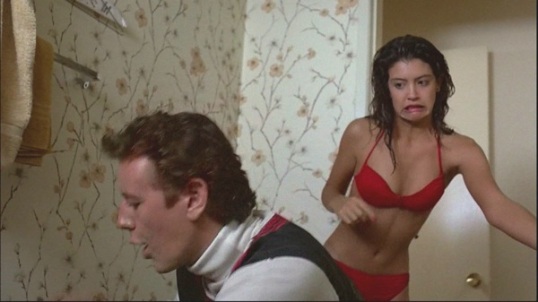
Agck!

Agck!

However, for me, the film will always be about Stacy, if just because she’s the character to which I relate.  I know when I was 15, I felt a lot like Stacy and, every time I watch Fast Times, I feel like some of Stacy’s experiences could have been taken straight out of my diary.  I had the same combination of confidence and insecurity and the same questions about why boys could talk like men but never act like them.  Stacy, of course, is played by Jennifer Jason Leigh who gives a remarkably brave and vulnerable performance in this film.  Off the top of my head, I can’t tell you who won the Oscar for best supporting actress of 1982 but it doesn’t matter.  Jennifer Jason Leigh should have won it.
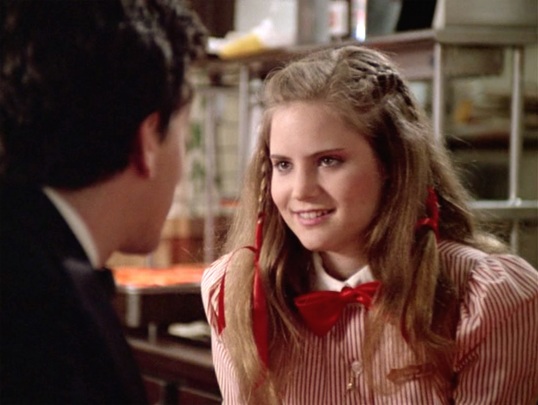
Jennifer Jason Leigh in Fast Times At Ridgemont High

Jennifer Jason Leigh in Fast Times At Ridgemont High

Fast Times is often referred to as being a Cameron Crowe film, largely because Crowe famously went undercover at an actual high school while writing the book that served as the basis for his script.  And yes, Fast Times is filled with scenes and characters that feel undeniably Cameron Crowe-like.  However, Fast Times was directed by Amy Heckerling and thank God for that.  Heckerling brings a sensitive touch to material that a male director would be tempted to play solely for exploitation.  Cameron Crowe may have written the script but it’s definitely an Amy Heckerling film.

And, sorry, Mike Damone — you’re still a little prick.
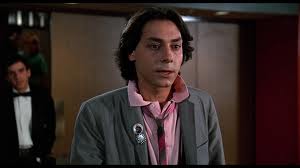
Mike Damone, a.k.a. Little Prick
Mike Damone, a.k.a. Little Prick