Ghosts of Sundance Past: Minari (dir by Lee Isaac Chung)


The Sundance Film Festival is currently underway in Utah.  For the next few days, I’ll be taking a look at some of the films that have previously won awards at Sundance.

First released in 2000, Minari is a classic story of the pursuit of the American dream.

Taking place in the early 80s, the movie follows Jacob Yi (Steven Yeun), a South Korean immigrant who relocates his family from California to Arkansas.  Jacob has purchased a farm and he plans to make a fortune selling Korean produce to restaurants in Dallas.  (Dallas, I should mention, does have a very large Korean population so Jacob’s plan is not a bad one.)  Jacob is enthusiastic and confident that his plan will succeed.  His wife Monica (Han Ye-ri) is a bit less confident.  She doesn’t want to live in a mobile home and she worries about the health of her young son David (Alan Kim), who has a heart murmur.  Monica feels that her husband has dragged them out to the middle of nowhere and that he has no idea what he’s doing.  Jacob is determined to become a success and he even hires his first employee, Paul (Will Patton), a local eccentric who often walks up and down the highway with a cross on his back.

I have to admit that I was initially a bit cautious about watching Minari.  I have family from Arkansas.  When I was growing up, my family sometimes lived in Arkansas.  (When I was growing up, we moved around so much that I used to just think of Arkansas, Oklahoma, New Mexico, Louisiana, Colorado, and Texas as just being one big state that I called home.)  Arkansas is one of those states that is usually not treated particularly kindly in the movies.  For that reason, I was pleasantly surprised by Minari.  Jacob may be an outsider, as both an immigrant and a former Californian, but, for the most part, the people that he meets are kind and willing to help.  Paul is especially an interesting character.  Many movies would have treated Paul as a redneck joke but, in Minari, he’s given a certain dignity.  The cinematography is wonderful, capturing the humid beauty of not just Arkansas but the midwest in general.  Jacob and his family are 20th century pioneers, exploring what for them is a new and untouched land.

Eventually, Monica’s mother, Soon-ja (Youn Yuh-jung), comes to stay with the family.  She shares a room with David and it takes a while for David to get used to his grandmother.  (David complains that she doesn’t act like a grandmother.)  It also takes Soon-ja a while to get used to life in Arkansas.  Youn Yuh-jung won a deserved Oscar for her performance here, playing a stranger in a strange land who ultimately inspires David to find his own inner strength.  The scenes between Youn and Alan Kim are some of the strongest in the film.  Towards the end of the film, Youn has a scene that truly left me in tears.

Minari is about the pursuit of the American dream but it’s also about the strength of family.  Jacob is not always a sympathetic character but he proves himself in the end.  The film ends on an ambiguous note but I choose to believe that Jacob eventually found his fortune.

Minari won the Dramatic Grand Jury Prize and, like many so many Sundance hits in the past, it went on to be nominated for Best Picture.  It lost to Nomadland, despite Minari being a far superior film.  That’s the Academy for you.

The Films of 2024: Horizon: An American Saga: Chapter One (dir by Kevin Costner)


Horizon: An American Saga: Chapter One is the rather unwieldy title of the first part of what Kevin Costner has said will be an epic four-part movie about the settling of the American frontier.

It’s very, very long.

It has a running time of three hours, during which time a lot of characters are introduced and a lot of plotlines are initiated but, because this is the only first chapter, none of them come to a close.  In fact, as the film ends, it’s still a mystery as to how some of the characters are even related.  I watched all three hours and I took my ADD meds this morning so you can be assured that I was actually paying attention.  That said, I still struggled to keep track of who everyone was or even where they were in proximity to each other.  Indeed, it was only towards the end of the film that I realized that several years were supposed to have passed over the course of the first chapter’s running time.

That’s not to say that the film is a disaster.  While it’s not quite the nation-defining epic that Costner obviously envisioned it as being, it’s also not quite the cinematic atrocity that several critics made it out to be.  It’s a throwback of sorts, to the epic westerns of old.  As such, the film features taciturn gunslingers, a woman with a past, dangerous outlaw families, fierce Indian warriors, and a wise Indian chief who has dreamed of the coming of the white man.  The film is full of actors — like Michael Rooker, Sienna Miller, Sam Worthington, Danny Huston, Will Patton, James Russo, Dale Dickey, and Kevin Costner himself — who feel as if they belong to a different era of filmmaking.  Just about everyone in the film is heading to the settlement of Horizon, which sits in Apache territory.  Despite the efforts of the Indians to kill every settler who shows up, they keep coming.  As one army officer explains it, the Indians have made the mistake of thinking that the settlers will come to believe the land is cursed while the settlers, all of whom are full of American optimism, instead chose to believe that the previous settlers were unlucky but that the next wave of settlers will make it work.  Costner has the right visual sensibility for a western.  The film reveals a director who is obviously in love with the Western landscape and the film is at its best when it simply frames the characters against the beauty of the frontier.  But when it comes to actually telling a compelling story, he struggles.  There are a lot of moving parts to the first chapter of Horizon and the problem is not that they don’t automatically connect but instead that Costner never gives us any reason to believe that they’ll ever connect.  There are no visual clues or bits of dialogue to assure the viewer that everything they’re watching is going to eventually pay off.  Costner asks his audience to have faith in him and remember that he directed Open Range and Dances With Wolves while forgetting about The Postman.

The first hour, which features a brutal raid on the settlement by a group of Indians, is the strongest.  It really drives home the brutality of what we now call the old west.  In the style of Michael Cimino’s The Deer Hunter, Costner closely observes the individual customs of the film’s settlers and carefully introduces several appealing characters who leave the viewer feeling as if they’ve met a very special and very unique community of people.  That makes it all the more devastating when the majority of those characters are subsequently wiped out with casual cruelty in a raid led by the Indian warrior Pionsenay (Owen Crow Shoe).  (Later — much later — a tracker played by Jeff Fahey will show similar brutality while wiping out a group of Apaches.)  The first hour establishes the frontier as being beautiful but also dangerous and it also drives home the mix of determination, desperation, and even madness that led so many to follow Horace Greeley’s advice and “Go west!”  Though the film was shot in early 2023, the brutality of the raid brought to mind the terrible images of the October 7th attacks on Israel.  The subsequent scenes in which Pionesenay and his followers ridiculed those in the tribe who wanted peace mirrored the current schism that’s driving apart the worldwide Left.  The U.S. Army, for their part, arrives a day late and can only offer up not-so subtle condescension.  The surviving settlers, however, remain determined to make a home for themselves.

The second hour focuses on Hayes (played by Costner), who rides into a mining town and gets involved with a family of outlaws who are looking for the woman who shot their father.  The second hour is a bit more of a traditional western than the first hour, though some of the violence is still shockingly brutal.  (Even being comedic relief won’t save you in this film.)  Abbey Lee gives a good performance as the woman with a past and a baby and Kevin Costner is  …. well, he’s Costner.  He could play this type of role in his sleep.

The third hour is a mess, introducing a wagon train and featuring a miscast Luke Wilson as the leader of the settlers and Jeff Fahey giving a strong performance as a ruthless tracker.  The third hour meandered as a whole new set of characters were introduced and I was left to wonder why the film needed new characters when the characters from the first two hours were perfectly adequate.  It was during the third hour that I started to really get impatient with the film and its leisurely approach to storytelling.

The film ends with a montage of what we can expect from the next few chapters of Horizon and I will say that the montage actually looked pretty cool.  That’s because the montage was almost totally made up of action scenes, with none of the padding that caused Chapter One to last an unwieldy three hours despite only having 90 minutes worth of story.  Still, one has to wonder if we’ll actually get to see the next three chapters.  The first chapter bombed at the box office and didn’t exactly excite critics.  Costner is producing and financing the films himself and I doubt he’ll give up on them.  The Horizon saga will be completed but will it made it to theaters or will it just end up on streaming?  Personally, I think the whole thing would work best as a miniseries but who knows?  (If Horizon was airing on Paramount, it would probably be a Yellowstone-style hit.)  All I really do know is that Chapter Two has yet to be released.  And that’s a shame because, for all of Chapter One‘s flaws, I’d still like to see how the story turns out.

Film Review: Venom (dir. by Ruben Fleischer)


VenomPosterAbout 20 years ago, a friend and I walked out of a movie theatre for some pizza. On the way to the Pizzeria, I raved about the movie we just watched.  The effects were awesome, and the main character was bad ass. My friend didn’t share the same sentiment, and over the dinner, he went on to explain everything that was wrong with the film. Bad CGI (for its time), 2 Dimensional Characters, and a pretty simplistic plot. By the end of my dinner, all of my joy was sucked away. I wanted to believe, deep down that I walked into a quality production, but there was so much room for improvement.
That film was Mark Dippe’s Spawn.

I mention this because after seeing Ruben Fleischer’s Venom, Spawn was the first film that came to mind. That makes sense, given that a lot of Venom’s genesis is from artist Todd McFarlane, who also created Spawn (and gave Spider-Man some of the best webbing I’ve ever known). There are parts of Venom I truly enjoyed, and I can say that there isn’t much of a problem with the acting on anyone’s side.  However, the levels of boredom in the film’s first hour will have you wanting to bring in a highly caffeinated drink to sip on, just to stay awake. The lady next to me yawned, which made me yawn and it just cycled through the audience. The good sequences are already visible in the trailers.

Here’s a clip of Venom from the Ultimate Spider-Man Video Game (easily recommended) to give you a rough idea of how he is.

From a plot standpoint, Venom does a good job in giving us a story for how Eddie Brock and his Symbiote meet without factoring in Spider-Man at all. Comic readers remember the Secret Wars, where Spider-Man lost his suit and picked up a symbiote replacement. When the Symbiote proved dangerous, Peter Parker got rid of it and it fell into the hands of his former Daily Bugle nemesis, Eddie Brock. Together, they formed Venom, a beast with all of Spider-Man’s powers and Brock’s hatred of Parker. Venom plagued Spider-Man, who was incredibly dangerous because he was one of the few villains that didn’t set of Parker’s Spidey Sense. He could sneak up on him at any time, assume the likenesses of other people, and Parker would never see him coming.

The Sony Spider-Man series changed this up in Spider-Man 3, replacing the Secret Wars with more of a Blob-like story. Symbiote crashes to Earth, finds Parker. Parker decides to rip it off and it finds Brock.  In this new version of Venom, symbiotes already exist in space, and a corporation lead by Carlton Drake (Riz Ahmed) are trying to bring them to Earth to intermingle with humans. When investigative reporter Eddie Brock (Tom Hardy) stumbles on the corporation’s evil plans, he accidentally joins with a symbiote and finds himself with a near insatiable hunger for the living.

You have the best 2 in 1 team up since Leigh Wannell’s Upgrade. I would not be opposed to a sequel for this if they tightened up the writing. Maybe that’s my problem. Both Upgrade and Venom are similar, but only one had an interesting character that looked like Tom Hardy (sorry, but Logan Marshall-Green does bear a resemblance).

Ruben Fleischer’s (Zombieland, Gangster Squad) direction is okay here. With Cinematographer Matthew Libatique (Iron Man, Black Swan) at his side, Venom doesn’t have many problems there. With the exception of the final confrontation, the shots aren’t too blurry or hard to track when the action starts. Even though Venom is a visibly dark character, I couldn’t complain that scenes weren’t well-lit.

For me, the problem with Venom is that at an hour and 52 minutes, it feels like the first hour is just waiting for that symbiosis to occur. Eddie Brock doesn’t really become interesting until Venom appears (also voiced by Hardy), and that’s a rough thing to say, given the cast involved. We’ve both seen Hardy, Ahmed and Michelle Williams in better roles, but they really aren’t given any real meat here. The dialog is a little shaky in some places. Hardy pushes himself hard here, and you see how disjointed Brock gets as he adjusts to the changes. Brock as a character, however, doesn’t really have a lot going for him. Neither did Peter Parker or maybe even Steve Rogers, but there were elements about who they were that helped you to appreciate who they be became as superheroes.  Steve Rogers was a weakling with a good spirit, which made him a better Captain America. Peter Parker was a chemical whiz kid and came up with his own web-fluid. Brock just…well, reports. There’s a lot of boredom in that first hour. The best scenes are the interactions between Venom and Brock, full of cute banter. It’s like having an unwelcome guest wanting to meet your parents. It just took so long to get to that point. When it does, however, the movie improves. They do manage to get a lot right about what Venom can do.

The CGI in Venom is definitely good in some places. It stands as the best argument for another remake of The Blob. The symbiotes are creepy in their design and motion, slithering up walls and making their way through vents. Venom, in all it’s glory, is quite a sight to behold, towering over humans. It goes a little overboard over the last 3rd of the film. I can’t say I knew for sure what it was I was looking at, but that’s to be expected with some superhero films.

If you see the film, stay for the mid-credits scene, which teases a future character. Also stay for a near 5 minute sneak peek into Spider-Man: Into the Spiderverse.

Overall, if you feel you have to see it in a theatre, by all means, do so. If you can wait for it to come out on Digital, that may be the best route.

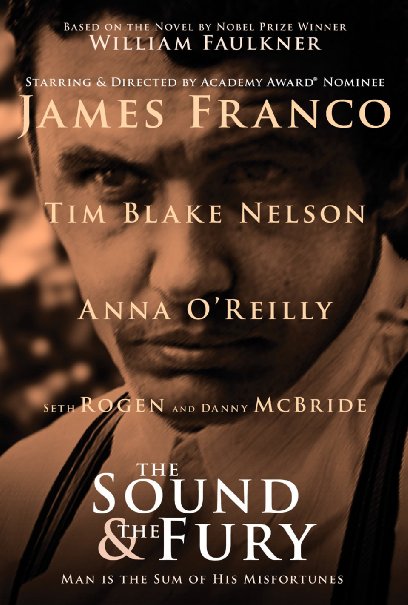
Cleaning Out the DVR Yet Again #37: The Sound and the Fury (dir by James Franco)


(Lisa recently discovered that she only has about 8 hours of space left on her DVR!  It turns out that she’s been recording movies from July and she just hasn’t gotten around to watching and reviewing them yet.  So, once again, Lisa is cleaning out her DVR!  She is going to try to watch and review 52 movies by the end of Thursday, December 8th!  Will she make it?  Keep checking the site to find out!)

the_sound_and_the_fury_2014_film

James Franco’s 2015 adaptation of William Faulkner’s classic novel, The Sound and The Fury, aired on Starz on November 2nd.

You know what?  Haters are going to hate but James Franco does more in an hour than most people do in a month.  Not only is James one of the most consistently interesting actors working today but he’s also a writer, a painter, a teacher, an activist, and a film director.

Indeed, it’s his work as a director that might be the most overlooked part of James’s prolific career.  Since making his directorial debut in 2006, with The Ape, James Franco has directed over 30 movies, television episodes, and short films.  As a director, James Franco has shown a talent for strong visuals and a willingness to take on difficult material.

For instance, can you imagine any other director who would have the guts to try to make a film out of The Sound and The Fury, the classic novel that may be the most unfilmable literary work this side of Finnegan’s Wake?

Told through the perspective of four related but very different characters, The Sound and The Fury details the fall of both the once mighty Compson family and the old South that the Compsons represent.  Benjy Compson is developmentally disabled and sees the world in a disjointed, nonlinear style.  Quinton Compson is fragile and sensitive and, while his section of the book starts in a fairly straight-forward enough manner, it quickly becomes nearly incoherent as Quinton’s mental state starts to deteriorate.  Jason Compson is cruel and evil but, because of his ruthless and self-centered personality, his section is the most straight-forward and the easiest to follow.  And finally, there’s Dilsey, the Compson family servant who is the only person to understand why the Compsons are in decline.  Faulkner utilized stream-of-consciousness throughout the entire novel, to such an extent that readers and critics are still debating just what exactly is happening and what Faulkner is actually saying.

In short, it takes courage to adapt a novel like The Sound and The Fury.  It takes even more courage when you’re an actor-turned-director who has his share of jealous haters.

Now, I should admit that James Franco was not the first director to attempt to make a film out of The Sound and The Fury.  In 1959, Martin Ritt made a version of the film, which reportedly did away with the nonlinear structure and centered the film around the straight-forward Jason.  (I haven’t seen the 1959 version.)  James Franco, on the other hand, not only adapts The Sound and The Fury but also adapts Faulkner’s style.

James Franco replicates the novel’s nonlinear structure and even takes on the role of Benjy himself.  It makes for a film that is occasionally frustrating and difficult to follow but which is also undeniably fascinating.  Filled with haunting images, James Franco’s The Sound and The Fury is a visual feast, one that perfectly captures the atmosphere of a decaying society.  The South, in this film, is trapped between the possibly imagined glories of the past and the harsh reality of the future.  There’s a dream-like intensity to the film.  It sticks with you.

As well, James Franco does an excellent job casting his film.  Tim Blake Nelson brings an enigmatic combination of grandeur and threat to the role of Mr. Compson and Jacob Loeb is haunting as the fragile Quentin.  Scott Haze dominates the film as the cruel Jason.  Though you never sympathize with Jason, you can understand how he became the man that he is.  Jason may not be a good man but, unlike the rest of the Compsons, you never doubt that he’s going to survive in one way or another.

James Franco took a big chance directing The Sound and The Fury and he succeeded.