October True Crime: Dr. Crippen (dir by Robert Lynn)


Dr. Hawley Harvey Crippen

In 1910, a homeopath named Dr. Hawley Harvey Crippen was executed by hanging in the UK.

An American by birth, Dr. Crippen had come to London in 1897 with his second wife.  (His first wife died of a stroke and Crippen sent his only son to live with his grandparents.)  Cora Crippen was a former music hall singer who hope to continue her career in London and who did manage to make friends with several prominent members of the city’s theatrical community.  Dr. Crippen was widely regarded as a meek man who was dominated by his rage-prone wife.  Crippen struggled to hold down a regular job and eventually ended up as a manager at the Druet Institute for the Deaf.  By at least 1905, Dr. Crippen was having an affair with a young typist named Ethel Le Neve.

Cora disappeared in early 1910.  When her friends stopped by the house to ask for her, Dr. Crippen said that his wife had left him for another man and had returned to America.  Later, he claimed that Cora had subsequently died in California.  When Ethel was spotted wearing Cora’s jewelry, the London police launched their own investigation into Cora’s disappearance.  After Crippen was interviewed by the police, he and Ethel fled to Brussels and then boarded an ocean liner heading for Canada.  After Crippen and Ethel disappeared, the police searched Crippen’s home and found a torso buried in the basement.  It was assumed that the torso was all that was left of Cora.

(As some have pointed out, it didn’t seem to make much sense for Crippen to dispose of Cora’s head, legs, and arms but to keep her torso.  Apparently, at that time, it was common for human torsos to show up in the Thames, the result of people jumping in the river and then having their body split apart by the current.  As such, the Thames also became a popular place to dump murder victims.  One wonders why Crippen wouldn’t have done the same.)

Meanwhile, on the ocean liner heading to Canada, the captain noticed that one passengers looked like a freshly shaven Dr. Crippen and that the “boy” he was traveling with was obviously a young woman in disguise.  The captain sent a wireless telegram to London.  Chief Inspector Walter Dew boarded a faster liner and actually managed to reach Canada before Crippen.  When Crippen and Ethel arrived in Canada, Walter Dew was waiting for them.

Fate simply wasn’t on Crippen’s side.  If Crippen had bought third class tickets instead of sailing first class, it’s probable the captain would have never seen him during the voyage.  If Crippen had taken a boat to his native United States instead of Canada (which was then still a British dominion), Dew would not have been able to take him back to the UK without an extradition hearing and it’s entirely possible that the evidence would have been ruled insufficient.  Instead, Crippen was promptly returned to London and put on trial for murdering his wife.

During the heavily-covered four-day trial, Crippen’s defense was that Cora had returned to America and that there was no way to prove that the torso was Cora’s.  Though the jury found Crippen guilty in just 22 minutes and he was hanged a month later, there were many who felt that Crippen was innocent or, at the very least, that his guilt had not been proven.  I imagine that one reason why so many people doubted Dr. Crippen’s guilt was because he just didn’t look or act like a murderer.  He wasn’t Jack the Ripper, a shadowy figure moving through the night.  Instead, he was a short, balding, and rather owlish looking man who wore glasses and who, in most photographs, has a quizzical expression on his face.

In short, Dr. Crippen seems as if he was literally destined to eventually be played by Donald Pleasence.

The 1963 film, Dr. Crippen, takes a rather straight-forward approach to telling the story of the doctor.  It opens with Crippen (Donald Pleasence, naturally) on trial for the murder of his wife and it largely tells the story through flashbacks.  Cora (Coral Browne) is portrayed as being a no-talent narcissist who regularly cuckolds her husband while Ethel Le Neve (Samantha Eggar) is portrayed as being a naive young woman who truly loves Dr. Crippen.  The film leaves open the question of whether or not Crippen killed his wife, though it seems to strongly suggest that Crippen was innocent of the crime and the only reason he fled London was because he wanted to be with Ethel.  Donald Pleasence is excellent as Dr. Crippen, playing him with just enough ambiguity that the viewer is left to wonder whether he did it or not.  Pleasence turns Crippen into a sympathetic figure while still holding back just enough to suggest that emotional darkness that could have led even the meek Dr. Crippen to becoming a murderer.  Nicolas Roeg’s black-and-white cinematography captures both the harshness of Crippen’s life in prison and the fleeting romance of his brief time with Ethel.

As for the real life Crippen, both his guilt and his subsequent execution continue to be controversial, with some claiming that DNA testing proved that the torso did not belong to Cora.  (Other have quite reasonably pointed out that the sample used had degraded quite a bit over a hundred years.)  There have been many attempts to win Dr. Crippen a posthumous pardon but all have failed and will probably continue to fail unless Cora’s remains are somehow discovered in a grave somewhere in California.

Shortly before his execution, in his final letter to Ethel Le Neve, Crippen wrote, “Face to face with God, I believe that facts will be forthcoming to prove my innocence.”  After Crippen was hung, Ethel spent three years in Canada before returning to London.  She changed her name, worked as a typist, and eventually married and had two children.  She died in 1967, fifty-seven years after Dr. Crippen.
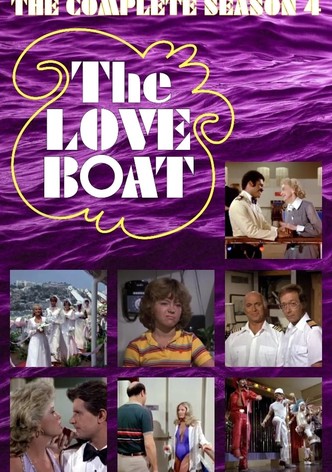
Retro Television Review: The Love Boat 4.19 “The Return of the Ninny/Touchdown Twins/Split Personality”


Welcome to Retro Television Reviews, a feature where we review some of our favorite and least favorite shows of the past!  On Wednesdays, I will be reviewing the original Love Boat, which aired on ABC from 1977 to 1986!  The series can be streamed on Paramount Plus!

This week, a familiar face sets sail for adventure.

Episode 4.19 “The Return of the Ninny/Touchdown Twins/Split Personality”

(Dir by Roger Duchowny, originally aired on February 14th, 1981)

Oh hey, it’s Charo!

It seems like just yesterday that I was watching her on Fantasy IslandOh wait, it was!

Charo returns to The Love Boat in her regular role as April Lopez.  The former stowaway-turned-singer-turned nanny boards the ship so that she and her two charges — Gayle (Rachel Jacobs) and Jerry (Alex Woodard) — can say goodbye to their father and April’s employer, Ty Younger (Larry Linville).  Ty is taking a vacation with his materialistic girlfriend (Arlene Martel), whom April dislikes.  Ty is looking forward to getting away from the kids for a while but — whoops! — April and the kids don’t get off the boat in time and soon, they’re intruding on Ty’s vacation.  It turns out to be a good thing because, after April learns that Ty’s girlfriend wants to send the kids away to a private school, she’s able to break up Ty’s relationship and keep the entire family together.  Yay!

Frank (Vincent Van Patten) boards the boat with college football teammate, Billy (Phillip Burns).  Billy can’t wait to hit on all the women who are his own age but Frank has decided that he’s in love with Billy’s mom, Meg (Samantha Eggar).  Captain Stubing likes Meg to but Frank shoves him out of the way on the dance floor and says that Meg is officially his MILF.  Billy gets upset and blames Frank …. no, actually, that would make too much sense.  Instead, Billy accuses his mother of leading on his best friend!  (Nobody mentions that Frank himself has spent the entire cruise acting like an unhinged stalker.)  It all works out in the end, of course.  Frank realizes that Meg doesn’t share his feelings and he decides to start dating women his own age.  Billy realizes that his mom is not a tramp.  Meg says she’s proud of the man that Billy has become.  (A man who accuses his own mom of being a tramp?  That kind of man?)  Stubing, once again, fails to get anywhere in his romantic pursuits and Vicki misses out on another potential stepmother.  Yay, I guess?  This story was actually kind of depressing.

Finally, Nick (Michael Lembeck) is an old college friend of Gopher’s.  Nick wants to be executive vice president of a company that it owned by the conservative and stodgy Arnold Hamilton (Ralph Bellamy).  When he’s with Arnold, Nick dresses like Arnold and he claims to agree with everything that Arnold says.  Nick also wants to marry a passenger that he just met, Linda (Laurette Spang).  Linda is almost a parody of a limousine liberal so when Nick is with her, he agrees with everything she says about oppression and the evils of money and he talks about his time as a labor organizer.  Nick is lying to both of them but it’s not like they’ll ever meet …. except, LINDA IS ARNOLD’S DAUGHTER!  Fear not, it all works out in the end.  Nick tells Arnold that he needs to change with the times and he tells Linda that she knows nothing about the working man.  Nick gets his promotion and a girlfriend.  Yay!

This was a pretty forgettable episode, even with Charo running around the ship in a panic over the children.  The storyline that worked best was the one with Michael Lembeck, Ralph Bellamy, and Laurette Sprang, though Bellamy was perhaps a bit too naturally likable to be totally convincing as a ruthless businessman.  (Even in old age, Bellamy had the simple, nice guy aura that always led to him losing the girl to Cary Grant.)  For the most part, this was a serviceable but not particularly memorable cruise.

Demonoid (1981, directed by Alfredo Zacarias)


Demonoid has a great title and it had a good one sheet but don’t be fooled.  The sword-wielding devil is barely in the move and the women at his feet may have appeared on the cover of every heavy metal album in the 80s but they’re not in the movie.

Exploring a recently uncovered tomb in Mexico, Jennifer (Samantha Eggar) and Mark Baines (Roy Jenson) are intrigued by a number of bodies that are missing their left hand.  Their guide explains that, centuries ago, men, women, and children were sacrificed to the Devil by having their left hands cut off.  When Mark and Jennifer discover a casket with a severed hand, they decide to take it back to the hotel with them.  Of course, the hand is not dead.  It springs from its casket and possesses Mark.  This leads to Mark fleeing back to the United States, trying to find a way to get rid of his possessed hand.  Unfortunately, the hand has a mind of its own and, even after Mark ends up getting set on fire, the hand continues to live and possess one person after another.  Jennifer teams up with Father Cunningham (Stuart Whitman), trying to bring an end to the hand’s reign of terror and giving the audience a chance to wonder how these two actors went from being Oscar nominees to co-starring in Demonoid.

Demonoid is a strange film that starts out as a leisurely travelogue of Mexico and then suddenly turn into a cinematic Grand Guignol, with person after person trying to figure out how to chop off their left hand without doing permanent damage to themselves.  Because the hand is immortal, it has no problem trying to kill whoever it is currently attached to, which leads to not only several scenes of actors fighting with themselves but also several detached hands running across the screen.  A detached but moving hand is creepy the first time you see it but it becomes progressively less so the more time that you spend with it.  The plot is ridiculous enough to be initially intriguing but ultimately, Demonoid is a handsy bore.

Retro Television Reviews: Fantasy Island 3.7 “The Wedding”


Welcome to Retro Television Reviews, a feature where we review some of our favorite and least favorite shows of the past!  On Tuesdays, I will be reviewing the original Fantasy Island, which ran on ABC from 1977 to 1986.  Almost entire show is currently streaming is on Youtube!

This week, Mr. Roarke gets married!

Episode 3.7 “The Wedding”

(Dir by Earl Bellamy, originally aired on November 3rd, 1979)

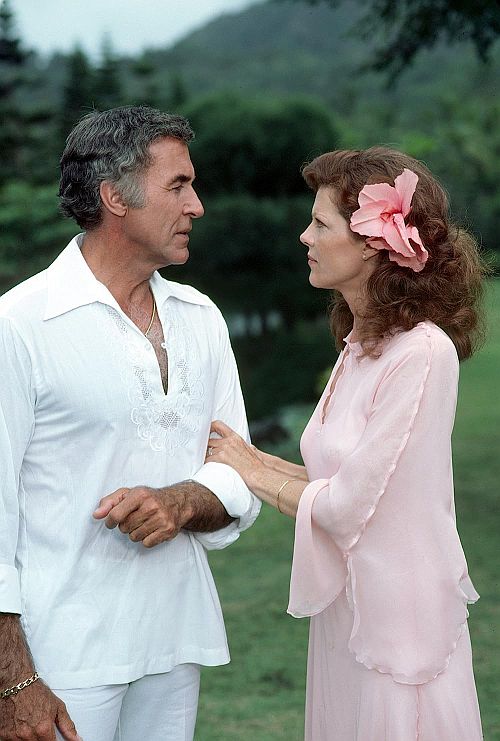
Helena Marsh (Samantha Eggar) and her son, Jamie (Paul John Balson), return to Fantasy Island!

The last time Helena visited the Island, she and Mr. Roarke ended up falling in love but Helena ended up leaving the Island so that she could return to the clinic that her late husband started in India.  However, Helena has now come back to the Island and she has only one fantasy.  She wants to marry Mr. Roarke!  Mr. Roarke is going to make her fantasy come true.  He’s so happy that he doesn’t even yell at Tattoo during this episode.

The entire Island is excited about the wedding.  However, Tattoo grows concerned when he hears Helena’s parents (played by Laraine Day and Joseph Cotten) talking about how unfair it is that Helena is dying and probably won’t even survive the honeymoon.  Tattoo goes to Mr. Roarke and discovers that Roarke knows that Helena is dying.  Mr. Roarke assures Tattoo that Helena has one of those television diseases where death comes with little to no suffering.  Unfortunately, Jamie does not yet know that his mother is ill.

The Hawaiian-style wedding goes off without a hitch.  Mr. Roarke and Helena honeymoon on the other side of the island and, for the first time since this series began, Ricardo Montalban actually gets to wear something other than a white tuxedo.  While Jaimie helps Tattoo train Chester the Chimpanzee to stop stealing things, Helena enjoys her last few days with Mr. Roarke.  Unfortunately, the honeymoon is cut short as Helena grows ill.  From his grandfather, Jamie learns that his mother is dying.  “If life were fair,” Mr. Roarke says with tears in his eyes, “there would be no need for Fantasy Island.”

Awwwww!  Seriously, what a terrifically sweet and sad episode this turned out to be.  Ricardo Montalban and Samantha Eggar had fabulous chemistry together and Montalban, in particular, really seemed to be energized by the chance to do something other than act mysterious and enigmatic.  In this episode, Mr. Roarke finally gets to show his emotions and when he cries, you’ll want to cry too.  Helena dies peacefully on the island, in the arms of Mr. Roarke.  Her final fantasy has been granted.

As for Jamie, he decides that he can’t stay on the Island.  He has to go back to school so that, someday, he can become a doctor just like his mother.

Oh my God, I’m like seriously tearing up just writing this recap.

This episode was Fantasy Island at its sentimental and emotional best.  This was a great episode, featuring outstanding performances from Ricardo Montalban and Samantha Eggar.  Would you believe that an episode of Fantasy Island could make a reviewer cry?  Well, this episode did.

Retro Television Reviews: The Love Boat 2.23 “A Funny Valentine/The Wallflower/Home is Not a Home”


Welcome to Retro Television Reviews, a feature where we review some of our favorite and least favorite shows of the past!  On Wednesdays, I will be reviewing the original Love Boat, which aired on ABC from 1977 to 1986!  The series can be streamed on Paramount Plus!

After the past few cruises, I think we’re overdue for a good episode of The Love Boat.  Let’s see if this week’s episode can deliver!

Episode 2.23 “A Funny Valentine/The Wallflower/Home is Not a Home”

(Dir by George Tyne, originally aired on March 3rd, 1979)

Julie has decided that this week’s voyage is going to have a carnival theme and, in order to get everyone in the mood, she’s hired a fortune teller!  Mary Louise (Samantha Eggar) claims that she can read palms but she’s even more interested in the art of phrenology, the study of heads.  When she sees that Captain Stubing is bald, she can’t wait to see what the top of his shiny head says about his romantic future.  Unfortunately, Stubing is in one of his depressed moods and says that fortune telling is for the young.  He explains that he’s old and he already knows that he’s destined to spend the rest of his life alone.

Awwwww!

Luckily, Mary Louise has other ideas!  The Captain is soon won over by Mary Louise’s free-spirited ways and her joi de vivre.  But the Captain also realizes that, unless he holds a carnival every cruise, there’s really not much place for a fortune teller on the ship.  The best that he can offer Mary Louise is a job in the gift shop.  Realizing that their lives are just too different, Mary Louise leaves the boat without saying goodbye the Captain …. but then she returns to tell the Captain that maybe she will take that gift shop job.

Awwwwww!

But then the Captain tells her that she would be miserable working in a gift shop.  (Hopefully, none of the other gift shop employees overheard him.)  The Captain and Mary Louise part ways.

Again, awwwwwww!

It was a simple story but I have to say that Samantha Eggar and Gavin MacLeod had a surprising amount of chemistry and both of them gave really heartfelt performances in this episode.  I found myself caring about them as a couple and hoping that things would work out.  Of course, I knew things couldn’t work out because then the show would have to find a new captain.

While all that is going on, shy Sylvia (Patty Freedman) has finally taken the advice of her neighbor, Gopher.  She has booked a cruise on the Love Boat!  However, Sylvia is painfully shy and doesn’t even realize that there’s a passenger named Monroe (Zane Lasky) who has a crush on her.  (Of course, Monroe is pretty shy himself.)  Gopher decides that Sylvia needs a confidence boost so he sends her a rose at dinner and tells her it’s from a secret admirer.  Unfortunately, Sylvia becomes so obsessed with finding her secret admirer that she continues to fail to notice Monroe trying to talk to her.  When Sylvia returns to her cabin, she discovers hundreds of roses.  When she tells Gopher about it, Gopher is confused because he didn’t send any roses to her cabin.  For some reason, Gopher assumes that Sylvia is now delusional and that she only thought she saw all of the flowers in her cabin.  Seeking to restore her sanity, Gopher confesses that he sent Sylvia the rose.  Sylvia assumes that Gopher means that he sent all of the roses so, when Monroe confesses to sending the flowers to her cabin, she assumes that Monroe is making fun of her and….

AGGGGGGGGGGGGGGGGGGGG!

Yes, this is another story where all of the problems could have been easily resolved by everyone not acting like an idiot.  But you know what?  As much as stories like this usually tend to drive me crazy, I actually enjoyed this one.  Patty Freedman and Zane Lasky both gave charming performances, even if their characters did things that didn’t always make sense.  I was happy when they finally got together.  This was a rare case where two passengers really did seem perfect for each other.

Finally, the third storyline featured Arthur Godfrey and Minnie Pearl as Ned and Molly, two seniors who were eloping.  Looking to stop the marriage was Ned’s son, Francis (Warren Berlinger), and Molly’s daughter, Rowena (Elinor Donahue).  Of course, Francis and Rowena fell in love and the episode ended with everyone planning to get married in a big double wedding.  This story was pretty predictable and Berlinger and Donahue went a little bit overboard playing their characters as being uptight prudes in their first few scenes.  But, still, at least everyone got a happy ending.

I liked this episode.  The crew was likable, the passengers were charming, and everyone found love.  Yay!

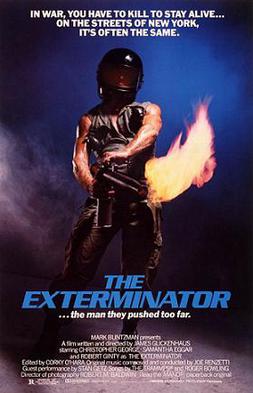
The TSL Grindhouse: The Exterminator (dir by James Glickenhaus)


First released in 1980, The Exterminator begins during the Vietnam War.

Two soldiers, John Eastland (Robert Ginty) and Michael Jefferson (future Cannon Film mainstay Steve James) have been captured by the Viet Cong and can only watch as a third soldier is beheaded by his captors.  (The graphic beheading, in which the camera lingers on the head slowly sliding off the neck, is an early warning of what this film has in store for its audience.)  Jefferson manages to free himself from his bonds and kills most of the enemy soldiers.  After Jefferson frees him, Eastland fires a bullet into the still twitching body of the VC commander.

The film jumps forward to 1980.  Living in New York City, Jefferson and Eastland are still best friends and co-workers at a warehouse.  For a second time, Jefferson saves Eastland’s life when the latter is attacked by a gang calling themselves the Ghetto Ghouls.  When the Ghouls get their revenge by tracking down Jefferson and piecing his spine with a meat hook, Eastland gets his revenge by killing …. well, just about everyone that he meets.

Though The Exterminator was obviously inspired by Death Wish, a big difference between the two films is that Eastland doesn’t waste any time before starting his anti-crime crusade.  In the original Death Wish, Paul Kersey (played by Charles Bronson) starts out as a self-described “bleeding heart” liberal who was a conscientious objector during the Korean War.  Even after his wife and daughter are attacked (and his wife killed) by Jeff Goldblum, Kersey doesn’t immediately pick up a gun and start shooting muggers.  Indeed, it’s not until the film is nearly halfway over that Kersey begins his mission and, in one of the film’s more memorable moments, he reacts to his first act of violence by throwing up afterwards.  While one could hardly call Death Wish an especially nuanced film, it does at least try to suggest that Kersey’s transformation into a vigiliante was a gradual process.

The Exterminator, on the other hand, goes straight from Eastland informing Jefferson’s wife about the attack to Eastland threatening a tied-up Ghetto Ghoul with a flame thrower.  When did Eastland kidnap the Ghetto Ghoul?  Why does Eastland have a flame thrower?  Where exactly has Eastland tied up the Ghetto Ghoul?  None of this is explained and the film’s abruptness gives it an almost dream-like feel.  The film plays out like the fantasy of everyone who has ever been mugged or otherwise harassed.  Magically, Eastland suddenly has the skills and the resources to outsmart not just the criminals but also the police who have been assigned to stop him.  Even the CIA is assigned to take down Eastland because his anti-crime crusade is inspiring people to wonder why the President hasn’t been able to reduce crime.  The film plays out like the type of daydreams that Travis Bickle had when he wasn’t driving his taxi.

Eastland is ruthless in his kills but fortunately, everyone he kills is really, really bad.  The Ghetto Ghouls clubhouse is decorated with a poster of Che Guevara but Che’s revolutionary rhetoric isn’t worth much when the Exterminator’s after you.  A mob boss makes the mistake of not telling Eastland about the Doberman that’s guarding his mansion so into the meat grinder he goes.  New Jersey loses a state senator when Eastland discovers him torturing an underage male prostitute.  The film was shot on location in New York City and the camera lingers over every grimy corner of the city.  A scene where Eastland walks through Times Square takes on a cinéma-vérité feel as people jump out at him and try to entice him to take part in everything the city has to offer.  If Death Wish suggested that Paul Kersey’s actions were saving New York, The Exterminator suggests that we should just let John Eastland burn the whole place down.

With his youthful face, Robert Ginty looks more like a mild-mannered seminarian than a hardened veteran of both Vietnam and the mean streets of New York but, ultimately, that works to the film’s advantage.  If anything, it explains why everyone who meets him trends to underestimate what he’s capable of doing.  B-movie vet Christopher George overacts in his usual amusing way as he plays the detective who has been assigned to catch The Exterminator.  Samantha Eggar plays a doctor who starts dating George for no discernible reason.  The scenes featuring George and Eggar often seems as if they belong in a different film but they do provide some relief from the rather grim and gruesome scenes of The Exterminator killing almost everyone who he meets.

The Exterminator was controversial when it was originally released and it still retains the power to shock.  It’s easy to laugh at some of the film’s more melodramatic moments but there were still more than a few scenes that I watched with my hands over my eyes.  The film’s hard edge grabs your attention from the start and the idea of the CIA sending assassins to take out a neighborhood vigilante is so over the top and ridiculous that it’s kind of hard not to appreciate it.  That the film totally buys into its paranoid worldview (“Washington will be pleased.”) makes the whole thing far more compelling than it should be.

As ludicrous as it all is, The Exterminator is a film that defies you to look away.

Retro Television Reviews: Fantasy Island 2.8 “Return/The Toughest Man Alive”


Welcome to Retro Television Reviews, a feature where we review some of our favorite and least favorite shows of the past!  On Tuesdays, I will be reviewing the original Fantasy Island, which ran on ABC from 1977 to 1986.  The entire show is currently streaming on Tubi!

This week, Mr. Roarke falls in love!

Episode 2.9 “Return/The Toughest Man Alive”

(Dir by Earl Bellamy, originally aired on November 11th, 1978)

As usual, this episode of Fantasy Island starts out with a little Tattoo drama.  After announcing the arrival of the plane, Tattoo informs Mr. Roarke that someone has stolen Tattoo’s car.  Mr. Roarke has his doubts that anyone would steal a car on Fantasy Island but Tattoo points out that his designated parking space is empty.

Mr. Roarke informs Tattoo that he must be mistaken and that his car will eventually show up.  And yes, the car does eventually show up.  About halfway through the episode, two chimpanzees drive by in it.  It’s a bizarre little scene, one that is neither explained nor really resolved at the end of the episode.  I guess the chimpanzees just decided that they liked Tattoo’s car.  To be honest, this entire plotline made me feel bad for Herve Villechaize as the joke’s punch line seemed to be that Herve was so small that even a chimpanzee could drive his car.  From what I’ve read. Villechaize was often times not happy on the set of Fantasy Island and I imagine that jokes like that undoubtedly had something to do with it.

But enough about Tattoo’s car!  It’s time to learn who is having a fantasy this week!

Usually, the show’s fantasies are thematically connected but that’s not the case this week.  Indeed, neither one of the fantasies seems to go with the other and I actually found myself wondering if maybe the two fantasies had been meant for different episodes but, for whatever reason, were instead edited into this episode.

The first fantasy involves Samantha Eggar as a fashion designer who returns to Fantasy Island after having previously visited four years ago.  During her first visit, Eggar’s fantasy was to become a designer and to fall in love.  While she became a designer, she did not end up with the man of her dreams so Roarke is giving her a second chance.  The twist is that she’s in love with Mr. Roarke!  And Roarke is in love with her!  To Tattoo’s shock, the two of them plan to get married on the Island.  But then, the designer realizes that she has responsibilities in the real world and apparently, marrying Mr. Roarke means staying on the Island.  So, the marriage is called off.  Mr. Roarke’s heart is broken …. or is it?  As I watched the episode, I found myself wondering if Mr. Roarke really loved her or if he was just giving her a chance to have her fantasy.  Ricardo Montalban’s enigmatic performance kept things ambiguous.

One thing that bothered me about this fantasy is that Mr. Roarke potentially getting married felt like a pretty big plotline to be confined to just half of a one-hour show.  It seemed like this should have been a special episode with just one fantasy.  Instead, because there’s a second fantasy, there’s several odd scenes of Roarke taking a break from planning his wedding so that he can encourage Red Buttons to defeat a bunch of pirates.  Buttons is cast as an engineer who wants to be a hero in the style of Clint Eastwood and Charles Bronson.  Roarke gives him super-strength, which is not something that Eastwood or Bronson ever had.  But whatever!  Buttons is recruited to protect a bunch of islanders from some pirates.  But Roarke abruptly takes away Buttons’s super strength and, instead, Buttons has to use his engineering knowledge to defeat the pirates.  It’s kind of silly, to be honest.

This episode raised a lot of questions about the nature of the Island and Roarke himself.  Mr. Roarke rules over the island and apparently, he has to remain on the Island.  But, at the same time, he apparently can’t be bothered to stop a bunch of pirates from harassing the native’s inhabitants and instead, he gives temporary super strength to an otherwise meek engineer.  Maybe the engineer could have gotten Tattoo’s car away from those chimpanzees.  While all of this is going on, Roarke also ends up falling in love with a mortal who never stops to ask, “Hey, are you an angel or something?”  It’s an odd episode and a vaguely disappointing one, as neither one of the stories is that deeply explored.

Oh well!  There’s always next week!

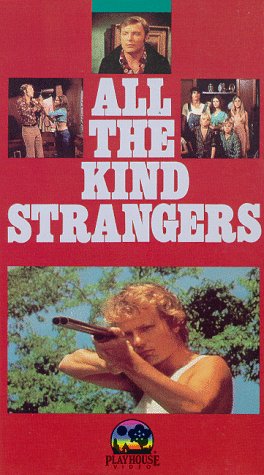
Horror Film Review: All The Kind Strangers (dir by Burt Kennedy)


This 1974 made-for-television movie opens with photojournalist Jimmy Wheeler (Stacy Keach) driving down an isolated country road.  He’s driving across America, heading towards California.  However, when he sees a young child walking on the side of the road and struggling to carry two bags of groceries, Jimmy pulls over and offers the child a ride.

That’s a big mistake.  As Jimmy soon discovers, the child lives on an isolated farmhouse in the middle of nowhere.  He resides with his six brothers and sisters.  The family is led by Peter (John Savage), the oldest sibling.  Jimmy discover that there’s only one other adult on the farm.  The children refer to her as being their mom and Carol Ann (Samantha Eggar) certainly does seem to be busy, cooking dinner and keeping the house clean.  It’s only when the children leave the kitchen that Carol Ann finally tells Jimmy the truth.  She’s not related to the children.  Instead, she is someone who made the same mistake that Jimmy did.  She gave one of the kids a ride home and she’s never been allowed to leave.

It turns out that the children’s parents died a few years ago but, because the family lives so far away from town, no one has ever noticed.  Peter has been in charge of the family but he’s reaching the point where he no longer wants to spend his entire life on the farm.  He wants to experience Mardi Gras and then visit California.  So, Peter has been sending out the children to tempt random adults to come to the house, where Peter auditions them to see if they would be good parents.  Peter has decided that Carol Ann can be the mother.  Now, he just needs to find someone to serve as the father.

Jimmy seems like a good candidates, except for the fact that he doesn’t want to spend the rest of his life in the middle of nowhere and raising a bunch of odd children.  Unfortunately, Jimmy soon discovers that it won’t be easy to escape.  The farm is guarded by a pack of dogs and Peter has a way of taking care of all the kind strangers who fail their audition….

Even though it’s only 75 minutes long, All The Kind Strangers is a bit of a slow film and often, it seems like it can’t decide whether it wants to be a straight horror film or a family melodrama.  Add to that, one of the kids is played Robby Benson, who showed up in a lot of 70s films, always playing awkward teenagers.  Benson gives such a bizarrely over the top performance that it’s hard to take him or any situation in which he’s involved seriously.  (Benson also sings the film’s easy listening theme song.)  That said, the film still manages to create and maintain an effectively creepy atmosphere and Stacy Keach, Samantha Eggar, and John Savage all give good performances.  The fact that the kids aren’t evil as much as they’re incapable of understanding the consequences of their actions actually serves to make them even creepier than the typical demented children who appear in films like this.

All The Kind Strangers has its moments, even if it doesn’t make a huge impression.

International Horror Film Review: The Brood (dir by David Cronenberg)


O Canada!
Our home and native land!
True patriot love in all of us command.
With glowing hearts we see thee rise,
The True North strong and free!
From far and wide,
O Canada, we stand on guard for thee.
God keep our land glorious and free!
O Canada, we stand on guard for thee.

Canada!  It always seems like such a nice country until you watch a David Cronenberg film.  Hailing from Toronto, Cronenberg started his film career with two satirical, black-and-white science fiction shorts and then went on to become one of Canada’s best-known filmmakers.  At a time when most people associated Canada with politeness and maple syrup, Cronenberg made visceral and often-disturbing films, ones that often mixed sexuality with graphic body horror.  At a time when the genre was being dominated by Italian filmmakers, Cronenberg brought a uniquely Canadian sensibility to horror.

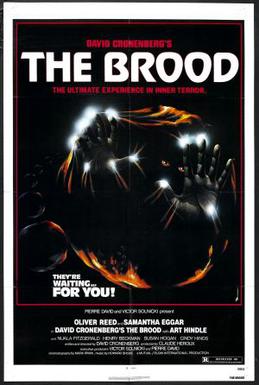
Take 1979’s The Brood, for instance.

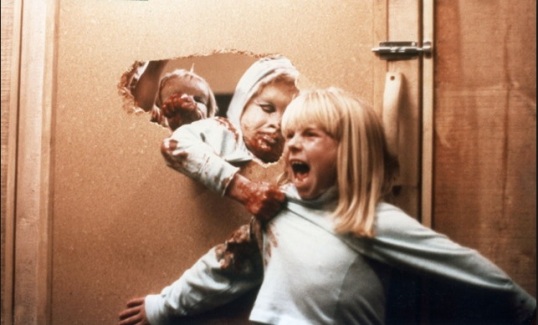
The Brood tells the story of one very doomed marriage.  Frank (Art Hindle) and Nola (Samantha Eggar) Carveth are fighting for custody of their five year-old daughter, Candice (Cindy Hinds).  (Not coincidentally, Cronenberg was going through his own custody battle when he first came up with the idea for The Brood.)  Nola, who has been emotionally scarred by both her alcoholic parents and her troubled marriage to Frank, is a patient at Somafree Institute.  Her psychotherapist, Dr. Hal Raglan (Oliver Reed), practices a technique called “psychoplasmics.”  Though it’s not easy to describe (and, wisely, Cronenberg doesn’t spend too much time trying to justify the science of it), it basically involves channeling anger and suppressed emotions into body modification.  What you or I might consider to be a hive or a welt is what Dr. Raglan would call a major breakthrough.

Frank is skeptical about Dr. Raglan’s theories but he still takes Candice to visit her mom.  However, when Candice returns from one visit bruised and scratched, Frank is convinced that Nola has been abusing her.  Hoping to both win custody of Candice and prove that Dr. Raglan’s methods are dangerous, Frank starts his own investigation into just what exactly has been happening at the Somafree Institute.

That’s when the children start to show up.  The children are small, with pale skin and light hair and oddly featureless faces.  They never smile.  They never speak.  They show up without any warning and violence always seems to follow them.  They attack both Nola’s mother and father.  When Nola suspects that Frank might be having an affair with Candice’s teacher, two of the children suddenly appear in her classroom.  Candice is scared of the children but still seems to have some sort of connection to them…

Even if you didn’t know this was a Cronenberg film, it would take just one look at the snow-covered landscape to identify The Brood as being a Canadian film.  As was often the case with Cronenberg’s early horror films, the imagery is frequently cold and chilly.  However, The Brood is not a cold film.  With its look at dysfunctional families and its emphasis on Frank’s attempts to protect his daughter, The Brood is actually one of Cronenberg’s most emotional films.  It’s a film about not only anger but also how people deal with that anger.  The killer kids are both literally and metaphorically children of rage.

Even by the standards of Cronenberg, things get grotesque.  Fortunately, the film’s talented cast keeps you interested, even when the bloody visuals might make you want to find a nice comedy to watch instead.  Art Hindle and Cindy Hinds are sympathetic as the father and daughter.  Oliver Reed keeps you guessing as to what exactly Dr. Raglan is actually trying to accomplish.  Nicholas Campbell and Robert A. Silverman, two members of the Cronenberg stock company, both make an impression in smallish roles.  And Samantha Eggar totally throws herself into her role, turning Nola into an absolutely terrifying monster.

Though it never quite reaches the flamboyant heights of either Scanners or ShiversThe Brood is still an effective horror film.  As opposed to some of his other films of the period, Cronenberg actually seems to not only care about the characters in the film but it also comfortable with encouraging us to care about them as well.  As a result, The Brood becomes about more than just trying to shock the audience.  The Brood is a film that sticks with you.

The Brood (1979, dir by David Cronenberg DP: Mark Irwin)

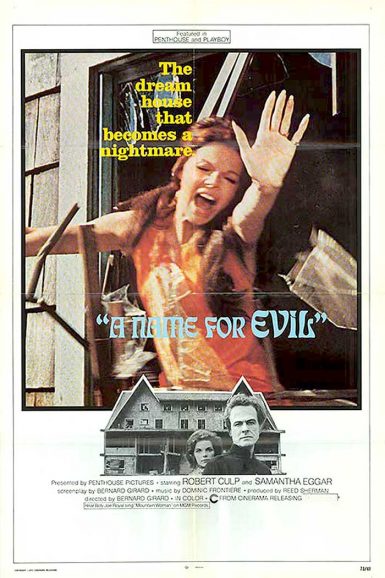
The TSL’s Horror Grindhouse: A Name For Evil (dir by Bernard Girard)


So, this is an odd one.

First released in 1973 but reportedly filmed several years before, A Name For Evil tells the story of John Blake (Robert Culp) and his wife, Joanna (Samantha Eggar).  John is a successful architect who lives in the big city.  He used to be a passionate rebel but now he’s just a boring corporate man.  Even his wife is bored with him.  John knows that he has to make some changes.  Since this movie was made in 1973, those changes start with throwing a TV out of a window.

(Trust me.  If you watch enough films from the early 70s, you will see so many TVs get tossed through so many windows that it will no longer surprise you.  Apparently, being a rebel in 1973 meant destroying a TV.  According to Wikipedia, the top five TV shows in 1973 were, in order, All In The Family, Sanford and Son, Hawaii 5-0, Maude, and the NBC Sunday Night Mystery Movie.  I choose to believe that the NBC Saturday Night Mystery Movie is what drove everyone over the edge.  Anyway…)

Anyway, John decides to quit his high-paying job and instead move up to New England and live in his grandfather’s mansion.  (His grandfather, by the way, was known as The Major.)  Joanna is reluctant to accompany him and she’s even more upset when it turns out that 1) the house is a total wreck and 2) the last tenant died under mysterious circumstances.

John, however, grows somewhat obsessed with the house.  This is despite the fact that John doesn’t seem to really like the house or the inhabitants of the nearby town that much.  For instance, there’s a scene — which might be a dream — in which John crashes the funeral of a local boy who died in Vietnam and he starts to laugh uncontrollably when the minister praises the boy for sacrificing himself for his country.  I think we’re supposed to like John during this scene but John laughs so long and so hard and he just keeps going and going that, by the end of it, I think even the most dedicated peace activist would look at him and say, “What an asshole.”

At the house, John keeps seeing strange shadows and hearing weird noises.  Occasionally, he sees someone who looks like the long-dead Major riding a white horse.  He hears voices coming from the walls and he accuses Joanna of being behind it.  Joanna tells him that he’s being paranoid.  Of course, Joanna herself is slowly coming to appreciate the house, especially after a ghost kisses her hand…

Suffering from ennui, John does what anyone in 1973 would do.  He tracks down the local hippies and he takes part in a down-with-the-establishment orgy.  Are the hippies real or are they figments of his imagination?  Is the house real or is it a figment of John’s imagination?  Is John real or is he just a figment of his imagination?  A Name For Evil does not seem to really know but you can be sure that we’ll get another shot of that TV falling out of that window before the movie ends.

On the one hand, A Name For Evil is a standard haunted house/spiritual possession type of film.  But, on the other hand, it’s obvious that A Name For Evil was trying to make some sort of grand statement about life in America in 1973.  How else do you explain the hippies, the funeral scene, and that TV flying out the window?  Robert Culp spends the entire movie so pissed off that there’s no way he wasn’t meant to be some sort of generational spokesman.  It makes for a very strange, only-in-the-70s hybrid type of film.

Now, I should mention that I actually did a little research before writing this review.  I discovered that A Name for Evil was originally produced by MGM but it spent years on the shelf until Penthouse (the magazine) bought the film and re-cut it for theatrical release.  Apparently, the first version was clear about being an attempt at social satire with a little horror and nudity thrown in.  The version that was actually released was edited to emphasize the horror and the nudity.  That probably explains why the film feels like such a strange mishmash of genres and attitudes.

If you ever get the chance, I’d recommend watching A Name For Evil.  It’s not that good but it’s just too strange not to watch.