Not surprisingly, a lot of people have assumed that Julian Lennon was singing about his father, John Lennon, in this song. Julian, himself, has denied that interpretation, saying that this song was just his way of dealing with a breakup and nothing more.
Like yesterday’s video, Too Late For Goodbyes was directed by Sam Peckinpah, the notorious director behind The Wild Bunch, Straw Dogs, and Pat Garrett and Billy The Kid. It was directed at a time when Peckinpah’s Hollywood career was nearly over, having been sabotaged by too many fights with the studios and too many rumors about his drug and alcohol-intake. His two videos for Julian Lennnon would be Peckinpah’s final work as a director. He died just a few months after they were released.
In the UK, Too Late For Goodbyes was Julian Lennon’s first single and was followed by Valotte. In the United States, the order was reversed and Too Late For Goodbyes came out after Valotte. To date, Too Late For Goodbyes is the most successful single that Julian Lennon has ever released. It reached #1 on the U.S. Adult Contemporary Chart and stayed there for two weeks.
I am as shocked as anyone to discover that this sedate video was directed by the director who was known (affectionately or not) as Bloody Sam but indeed it was.
Valotte was the first U.S. single from Julian Lennon, a musician whose talent was often overshadowed by the fact that he was the son of John and Cynthia Lennon. John divorced Cynthia, leaving her for Yoko Ono, when Julian was only five years old and, by his own admission, Julian’s feelings towards his father have often been mixed. (Paul McCartney reportedly wrote what would become Hey Jude in an attempt to console Julian after the divorce.) When Julian Lennon pursued his own musical career, many reviewers spent more time discussing Julian’s physical and vocal resemblance to his father than his music.
As for the song, it was a ballad about finding love and not, as many have incorrectly assumed, a song about Julian’s relationship with John. The song was initially written at a French chateau known as the Manor de Valotte, which is how the song got its name. The single was subsequently recorded at Muscle Shoals Sound Studio in Alabama. The line, “Sitting on a pebble by the river playing guitar” is a reference to the location of the studio.
As for Sam Peckinpah, both his career and his health were in decline when he directed this video. Peckinpah made a huge impression in the late 60s and early 70s with films like The Wild Bunch and Straw Dogs but, by the time the 80s came around, the critics had turned on him and his abuse of drugs and alcohol had become so notorious that he couldn’t get a job in Hollywood. Peckinpah directed both this video and Lennon’s follow-up, Too Late For Goodbyes. His work on the videos was critically acclaimed but unfortunately, Peckinpah would pass away shortly after they were released.
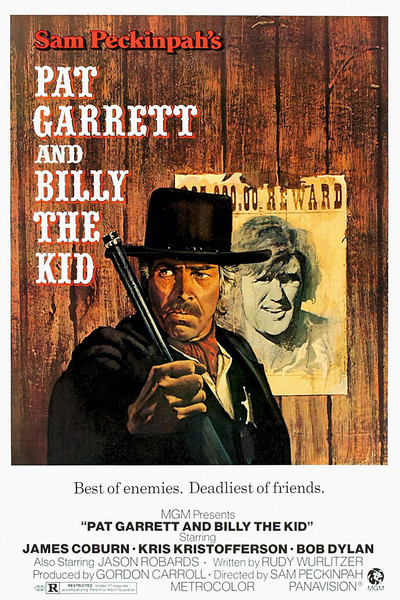
(PAT GARRETT AND BILLY THE KID airs tonight at 11:45 EST on TCM. Do yourselves a favor… watch it!)
PAT GARRETT AND BILLY THE KID was director Sam Peckinpah’s final Western, and as usual it’s about more than just the Old West. It’s about the new breed vs the old establishment, about the maverick auteur vs the old studio guard, and about his never-ending battle to make his films his way. The fact that there are six, count ’em, SIX different editors credited tells you what MGM honcho James Aubrey thought of that idea! They butchered over 20 minutes out of the movie, which then proceeded to tank at the box office. Fortunately for us, PAT GARRETT AND BILLY THE KID has been restored to its full glory, and we can enjoy Peckinpah’s original artistic vision.
I’m not going to try to make excuses for Peckinpah; he was a legitimate pain in the ass, a…
Back in 1951, movie producer Walter Wanger (rhymes with danger) discovered his wife, actress Joan Bennett , was having an affair with her agent, Jennings Lang. The enraged husband tracked them to a parking lot, where Wanger shot Lang in the groin. That’ll teach him! Wanger was subsequently arrested, and sentenced to serve a four-month bid in a Los Angeles county farm. His stint in stir, though brief, affected him profoundly, and he wanted to make a film about prison conditions. The result was RIOT IN CELL BLOCK 11, a ripped-from-the-headlines prison noir that’s tougher than a two-dollar steak.
Wanger hired Don Siegel to direct the film. Siegel was gaining a reputation as a director of muscular, low-budget features, and RIOT IN CELL BLOCK 11 is a great early example of his harsh, brutal style. The movie’s sparse, shadowy setting was filmed on location at California’s infamous Folsom Prison thanks to…
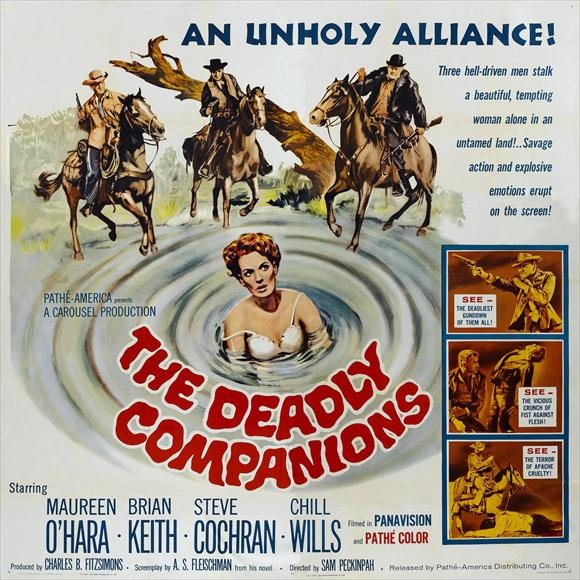
Maverick filmmaker Sam Peckinpah got his start in television, writing and directing for Westerns such as GUNSMOKE, THE RIFLEMAN, and HAVE GUN- WILL TRAVEL. In 1959, he created the series THE WESTERNER, starring Brian Keith as a drifter named Dave Blassingame, noted for its extreme (for the time) violence. When Keith was cast as the lead in THE DEADLY COMPANIONS, he suggested his friend Peckinpah as director. This was Peckinpah’s first feature film, and the result is a flawed but interesting film which has brief flourishes of the style he later perfected in THE WILD BUNCH and PAT GARRETT AND BILLY THE KID.
Keith is again a drifter, this time an ex-Union soldier known only as Yellowleg. He hooks up with a pair of Southern outlaws and they ride to Hila City to rob the bank. They get sidetracked at the saloon when it converts into a church service. Next thing you know…
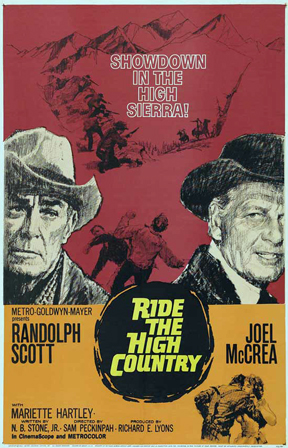
It’s the turn of the 20th century and the Old West is fading into legend. When they were younger, Steve Judd (Joel McCrea) and Gil Westrum (Randolph Scott) were tough and respect lawmen but now, time has passed them by. Judd now provides security for shady mining companies while Gil performs at county fairs under the name The Oregon Kid. When Judd is hired to guard a shipment of gold, he enlists his former partner, Gil, to help. Gil brings along his current protegé, Heck Longtree (Ron Starr).
On their way to the mining camp, they spend the night at the farm of Joshua Knudsen (R.G. Armstrong) and his daughter, Elsa (Mariette Hartley). Elsa is eager to escape her domineering father and flirts with Heck. When they leave the next morning, Elsa accompanies them, planning on meeting her fiancée, Billy Hammond (James Drury), at the mining camp.
When they reach the camp, they meet Bill and his four brothers (John Anderson, L.Q. Jones, John Davis Chandler, and the great Warren Oates). Billy is a drunk who is planning on “sharing” Elsa with his brothers. Gil, Judd, and Heck rescue Elsa and prepare for a final confrontation with the Hammond Brothers. At the same time, Gil and Heck are planning on stealing the gold, with or without Judd’s help.
Ride the High Country was actually Sam Peckinpah’s second film but it’s the first of his films to truly feel like a Sam Peckinpah film. (For his first film, The Deadly Companions, Peckinpah was largely a director-for-hire and had no say over the script or the final edit.) Peckinpah rewrote N.B. Stone’s original script and reportedly based the noble Steve Judd on his own father. All of Peckinpah’s usual themes are present in Ride the High Country, with Judd and, eventually, Gil representing the dying nobility of the old west and the Hammond brothers and the greedy mining companies representing the coming of the “modern” age. Ride The High Country‘s final shoot-out and bittersweet ending even serve as a template for Peckinpah’s later work in The Wild Bunch.
Much like the characters they were playing, Randolph Scott and Joel McCrea were two aging veterans on the verge of retirement. For these two aging stars, who had starred in countless westerns before this one, Ride The High Country would provide both fitting farewell and moving tribute. This would be the last chance that either of them would have to appear in a great movie and both of them obviously relish the opportunity. The best moments in the film are the ones where Judd and Gil just talk with the majestic mountains of California in the background.
Among the supporting cast, Ron Starr and Mariette Hartley are well-cast as the young lovers but are never as compelling as Gil or Judd. Future Peckinpah regulars R.G. Armstrong, L.Q. Jones, and Warren Oates all make early appearances. Seven years after playing brothers in Ride the High Country, L.Q. Jones and Warren Oates would both appear in Peckinpah’s most celebrated film, The Wild Bunch.
The elegiac and beautifully-shot Ride The High Country was Sam Peckinpah’s first great film and it might be his best.
Randolph Scott and Joel McCrea in Ride The High Country
Directed by the legendary Monte Hellman, China 9, Liberty 37 is a revisionist take on the western genre. Fabio Testi plays Clayton Drumm, a legendary gunslinger who is about to be hung for murder. At the last minute, men from the railroad company show up and arrange for Clayton be released. They want him to kill a rancher who is refusing to sell his land. Clayton agrees but, before he leaves for his mission, he gives a brief interview to a writer from “out East.” Cleverly, the writer is played by director Sam Peckinpah, to whose films China 9, Liberty 37 clearly owes a huge debt.
After telling the writer that his eastern readers have no idea what the west is truly like, Clayton rides out to the ranch. Along the way, he gets directions from a nude lady (Jenny Agutter) who is swimming in a nearby stream. When Clayton reaches the ranch, he meets his target. Matthew Sebanek (Warren Oates) is himself a former gunslinger who used to kill people for the railroads. From the minute they meet, Matthew knows who Clayton is and why he is there. Both Clayton and Matthew have grown weary of killing and, instead of having the expected gunfight, they instead become fast friends. Matthew allows Clayton to stay at the ranch and introduces him to his wife, Catherine, who it turns out was the same woman who Clayton talked to earlier.
Catherine loves Matthew but resents his rough ways and feels that he treats her like property. One night, she and Clayton go for a nude swim and then make love. When Matthew finds out, he strikes his wife and, in self-defense, she stabs him in the back. Believing Matthew to be dead, she and Clayton go on the run.
Matthew is not dead and, once he’s recovered from being stabbed, he and his brothers set off to track down the two lovers. While Matthew chases after Clayton, he is being pursued by Zeb (Romano Puppo), another gunslinger who has been hired by the railroad to kill both Matthew and Clayton.
As a western, China 9, Liberty 37 is more interested in its characters than in the usual gunfights. There are no traditional heroes or villains and Monte Hellman emphasizes characterization over action. Even while he is relentlessly pursuing Clayton and Catherine, Matthew admits that he does not blame Catherine for leaving him. As for Clayton and Catherine, they are both consumed by guilt over their affair. This is one of the few westerns where the main character often refuses to fire his gun.
As Clayton, Fabio Testi is stiff and inexpressive, but Jenny Agutter and Warren Oates are terrific. Though their films were never as critically or financial successful, Warren Oates and Monte Hellman had as strong of a director/actor partnership as Martin Scorsese and Robert De Niro. China 9, Liberty 37 was the fourth and final movie that Monte Hellman and Warren Oates made together. It was also Oates’s last western before his untimely death in 1982.
Director Monte Hellman is as well-known for the films he did not get to make as for the ones he actually did make. (Originally, Quentin Tarantino wanted Hellman to director Reservoir Dogs. When Tarantino changed his mind and decided to direct it himself, Hellman was relegated to serving as executive producer. A lot of recent film history would be very different if Tarantino and Hellman had stuck to the original plan.) Like a lot of the films that Hellman actually did get to make, China 9, Liberty 37 was only given a sparse theatrical release and was often shown in a heavily edited version. It has only been recently that the full version of China 9, Liberty 37 has started to show up on TCM. It is an interesting revisionist take on the western genre and must see for fans of Monte Hellman, Jenny Agutter, and Warren Oates.
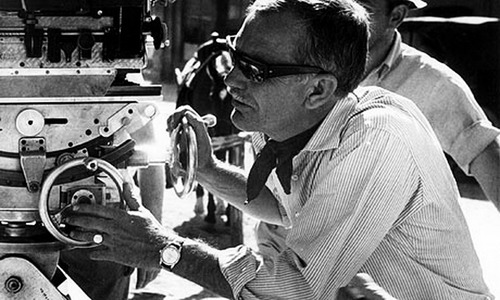
At the beginning of The Wild Bunch, William Holden says, “If they move, kill them.” That line became so associated with director Sam Peckinpah and his films that it was even used as the title of his biography. Sam Peckinpah was known for both the violence of his films and the turmoil of his private life. He fought studios and film critics and directed six classic films before destroying himself and his talent with drugs and hard living. When he died in 1984, he was could not get a job in Hollywood but his legacy as a filmmaker has lived on.
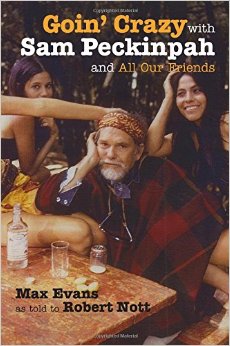
In his memoir, Goin’ Crazy With Sam Peckinpah And All Our Friends, novelist Max Evans takes a look back at his long and often contentious friendship with Peckinpah. When Sam Peckinpah first met Max Evans, it was to buy the rights to Max’s western novel, The Hi-Lo Country. Though Peckinpah never made the movie, he and Evans remained friends for the rest of Peckinpah’s life. As Evans puts it, he and actor James Coburn were the only two to stay with Peckinpah until the very end.
When talking about Peckinpah, Evans does not pull any punches. Much of the book details Peckinpah’s casual cruelty. When Peckinpah’s son David wrote a script, Sam dismissed it as a “piece of shit.” Evans interviewed Peckinpah’s girlfriend, Katy Haber, about the time that Peckinpah hit her and how actor Steve McQueen reacted when he found out. Towards the end of his life, Peckinpah was told that he would die if he did not stop drinking. Sam gave up liquor and turned to cocaine instead. At one point, a paranoid Peckinpah even asked Evans for help in hiring a hitman to “take care of” a film producer that Peckinpah disliked.
Evans also talks about the other side of Sam Peckinpah. According to Evans, the Peckinpah that visited him in New Mexico was a different human being from the Sam who threatened producers and shot guns at actors. In Hollywood, Peckinpah felt had to prove he was a madman. With Max, he could just be “Ol’ Sam.” Max even suggests that Sam may have been a mystic and includes several stories about Sam’s “supernatural” abilities.
Along with writing about Sam Peckinpah, Evans also talks about his colorful encounters with actors like Lee Marvin, Burt Lancaster, L.Q. Jones, Woody Harrelson, and Sean Penn. Evans is a natural storyteller and Goin’ Crazy With Sam Peckinpah is an engaging and breezy trip through the Hollywood of the 60s and 70s.
Just check out The Visitor, a 1979 Italian film that has recently been re-released by Drafthouse Films and occasionally shows up on TCM. In many ways, The Visitor is a total and complete mess. But, as is so often the case with Italian horror films, that very messiness — combined with some genuinely imaginative narrative and directorial choices — serves to make The Visitor into one of the most memorable films that you (possibly) have never heard of.
Like many of the Italian exploitation films released in the 70s and 80s, The Visitor is a rather blatant rip-off of a successful American film. What makes The Visitor unique is the amount of different movies that it rips off. The Visitor takes films that you would assume had no connection and mixes them together to create something wonderfully odd.
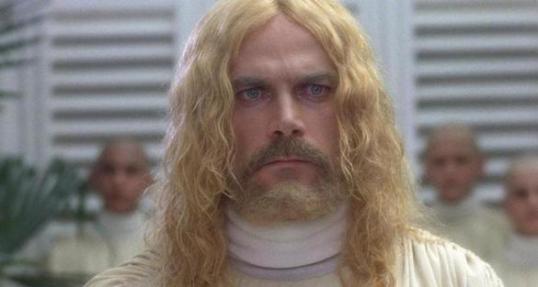
Franco Nero as Jesus in The Visitor
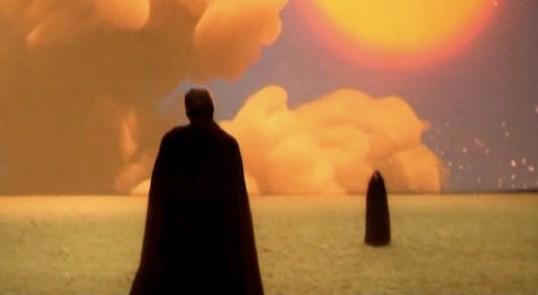
Much like Close Encounters of the Third Kind and 2001: A Space Odyssey, The Visitor opens with the idea that intergalactic beings have been visiting Earth for centuries and are subtly influencing the development of humanity. The Visitor literally opens with Jesus Christ (played by Franco Nero!) sitting on a satellite and telling a version of the creation story to a bunch of bald children. He explains that, long ago, he battled an evil intergalactic demon known as Sateen. Sateen (who, the film implies, is better known on Earth as Satan) was eventually blown up but his genes were spread throughout humanity. The bald children surrounding him are the descendants of Sateen. Whenever one of them is born, Jesus sends an old man named Jerzy Colsowicz (played by director John Huston) to Earth so that Jerzy can bring the child to the satellite. Of course, whenever Jerzy isn’t kidnapping kids for Jesus, he spends his time hanging out in a psychedelic dimension.
Yes, you did read that correctly.
This is where Jerzy lives.
Once you get past the intergalactic part of the story, The Visitor is a pretty obvious rip-off of both The Omen and Damien: Omen II, with the main difference being that the demon child here is not a cherubic little boy but instead is a rather bratty 8 year-old little girl named Katy (Paige Collins). However, Katy is not the Antichrist. Instead, her job is to mate with a male child who also has Sateen’s genes and then her baby will be the Antichrist. In order to get this male child, Katy is pressuring her mother (Joanne Nail) to have sex with businessman Raymond Armstead (Lance Henriksen, who was also in Damien II: The Omen) so that Katy can have a half-brother to mate with. (Ewwwwwwww!) Raymond is a follower of Sateen and, adding to the film’s already odd feel, he also happens to own a basketball team.
(So, along with everything else going on, The Visitor also features a lot of basketball footage, which I guess would be exciting if I knew anything about basketball.)
Despite being a pretty powerful figure in the Sateenist hierarchy Raymond is not the head Sateenist. No, the head Sateenist is played by Mel Ferrer, an actor who was once married to Audrey Hepburn and who will be familiar to anyone who has ever watched an Italian horror film. (You can spot Ferrer in Zombie Holocaust, for example.) Ferrer and the other Sateenists are all old, distinguished looking white men who spend all of their time meeting in an ornate corporate boardroom.
So, Jerzy comes down to Earth to, with the help of a nanny played Shelley Winters, try to kidnap Katy but, for some reason, he doesn’t just do that. Instead, he spends most of his time just watching Katy do destructive things.
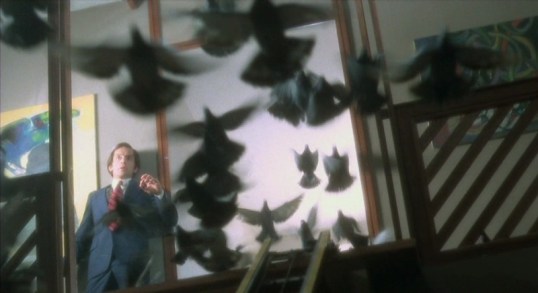
Much as in The Omen, anyone who gets too close to discovering the truth about Katy ends up dying an elaborate and bloody way. Often times, their death involves black crows, who the film suggests might actually be all of those little bald kids in animal disguise. So is Jesus sending those crows to kill people? Seriously, this movie is weird.
Beware the Crows
Meanwhile, Katy’s mom is having doubts about both Raymond and her daughter. She even goes and talks to her ex-husband, an abortionist who is played by yet another film director, in this case Sam Peckinpah. Katy gets annoyed with her mom and, after happening to come across a gun hidden away inside of a birthday presents, shoots her in the back and leaves her paralyzed.
And did I mention that Katy is telekinetic, much like Carrie? That’s right! During my favorite scene, Katy goes skating at the local mall’s ice rink and, after a group of boys bully her, she uses her powers to send those bullies flying all over the mall. Oddly enough, nobody seems to notice this chaos. Except, of course, for Jerzy who just stands off in the corner and watches without doing anything…
Seriously, I love The Visitor. Along with being surprisingly well-acted and visually inventive, the film is just so weird! In many ways, it epitomizes everything that I love about the old Italian exploitation films. While it is rather shameless about ripping off other movies, the film still brings its own unique spin to everything.
Normally, I’d say that The Visitor is a good film for Halloween but you know what? Anytime is a good time for an Italian horror film!
It’s probably a bit too early to answer that question. After all, we’ve still got 3 months left to go in the year and Roland Emmerich’s take on Shakespeare (a.k.a. Anonymous) hasn’t been released yet. So, no, Rod Lurie’s remake of Straw Dogs cannot be called the worst film of 2011 yet. Instead, it’s just the worst film so far.
Straw Dogs is a remake of the 1971 Sam Peckinpah film. In the Peckinpah film, David Sumner (played by Dustin Hoffman) is a pacifist who, upon moving to the childhood home of his wife Amy (Susan George), is repeatedly harassed by the locals until he finally takes his very brutal revenge. It’s a flawed and uneven film that still carries quite a punch. I wouldn’t say I’ve ever enjoyed watching Peckinpah’s Straw Dogs but it’s undeniably powerful film. As for the remake, Peckinpah has been replaced with Rod Lurie, Hoffman by James Marsden, and Susan George’s controversial character is now played by Kate Bosworth. None of these changes are for the better.
Lurie’s version of Straw Dogs almost slavishly follows the plot of the original. He’s made just a few changes and none of those changes are for the better. The most obvious change is that, while the first Straw Dogs took place in rural England, Lurie’s version takes place in Mississippi. It’s pretty easy to guess Lurie’s logic here. Lurie, after all, previously created the television show Commander-in-Chief in which President Geena Davis heroically struggled to save the nation from fundamentalists with Southern drawls. Lurie’s vision of Mississippi is some sort of Blue State nightmare where everyone drives a pickup truck, goes to church, cheers at football games, and makes supportive comments regarding the War in Iraq. In the original Straw Dogs, David Sumner is a truly a stranger in a strange land, an American who doesn’t realize just how out-of-place he is in rural England. In the remake, David Sumner is just a guy on vacation from the West Coast. He really has no excuse for being quite as dense as he is when it comes to not pissing off the locals. By changing the locale, Rod Lurie essentially just makes his film into yet another example of Yankee paranoia. This wouldn’t be such a problem except that Lurie seems to be taking it all so seriously. He really seems to feel that he’s making a legitimate contribution to the whole Red State/Blue State divide. Watching the film, I had to wonder if Rod Lurie truly believed that it’s impossible to get a cell phone signal in Mississippi.
The other big difference is that in Lurie’s version, David Sumner is no longer a mathematician. Instead, he’s now a Hollywood screenwriter who is apparently working on an epic screenplay about the Battle of Stalingrad. (“I figured out a way to get Khrushchev in on the action!” he says at one point.) To be honest, David’s screenplay sounds kinda boring and it’s hard not to sympathize with the “hillbilly rednecks,” (as David calls them) who ask him why anybody would want to watch his movie. (The rednecks also ask him if he thinks that God had anything do with the Battle of Stalingrad. Speaking as a nonbeliever, I have to say that this film was almost hilariously paranoid about any sort of religious belief.) Part of the power of the first Straw Dogs came from the fact that David was an academic. He was a man whose life was about theory and that made it all the more shocking to see him explode into action. It also explained his non-existent social skills, because he was, after all, the product of a very insular, intellectual existence. However, in the remake, David just becomes a condescending jerk who’s working on a screenplay for a film that most viewers would have little interest in actually sitting through. (Add to that, it was hard not to feel that this new David was just Rod Lurie’s Mary Sue.)
David is in Mississippi because it’s the childhood home of his wife, Amy. The character of Amy is problematic in both versions of Straw Dogs but, to be honest, I found her character to be even more illogical and insulting in Lurie’s remake. In the original Straw Dogs, Amy is portrayed as an idiot who flirts with every man she sees, taunts her husband to the point of violence, and (by that film’s logic) puts herself in a situation that leads to her rape. The character is, in many ways, an insulting stereotype but at least she’s a consistent insulting stereotype. The remake’s Amy is presented as being a considerably stronger character. She doesn’t openly flirt with the local rednecks, she and her husband are a lot more obnoxiously lovey dovey, and (as opposed to in the first film), it’s never suggested that she actually enjoys being raped. Kudos to Lurie for trying to make her a stronger character. Yet, at the same time, the remake’s Amy still does a lot of the same illogical things as the original Amy. The original Amy at least had the excuse of being an idiot. The remake’s Amy just comes across as being an inconsistent, poorly-concieved character. Eventually, it becomes obvious that director Lurie wasn’t trying to make Amy into a stronger character as much as he was just trying to be politically correct. (Another thing that the two Amys have in common is that neither one of them wears a bra. It made sense in the original film because the original Amy was presented as being something of a wannabe flower child. In the remake, it just comes across as Lurie’s dirty boy excuse to get a peek at Kate Bosworth’s nipples. Seriously, who goes jogging without a sports bra?)
Anyway, the remake follows the path of the original. David and Amy return to Amy’s home village where they meet Amy’s ex-boyfriend Charlie Venner (played by an amazingly hot and sexy Alexander Skarsgard). David hires Charlie and his redneck buddies to repair the roof of an old barn. Charlie, who is obviously still attracted to Amy, spends the entire first part of the movie subtly humiliating David and basically being a bully. Somebody strangles Amy’s cat. Amy says it was Charlie and his friends. David replies, “I can’t just accuse them.” Eventually, David is taken on a deer hunt by Charlie’s friends and while he’s gone, Charlie and his buddy Chris rape Amy.
(In the original it was a snipe hunt and the sight of Dustin Hoffman searching for a nonexistent creature while his wife is being raped was quite disturbing and perfectly symbolized his character’s impotence. In the remake, David is once again left alone in the woods but this time, he shoots and kills a deer and, unfortunately, James Marsden isn’t a good enough actor to let us know what that means.)
Amy never tells David that she was raped, nor does she go to the authorities. (This makes a sick sense in the original. In the remake, it just seems like an effort by Rod Lurie to degrade a previously strong woman.) The next night, David ends up sheltering the local sex pervert in his house while Charlie and his drunken friends attempt to break in. This leads to David revealing that, as opposed to being “a coward,” he’s actually as vicious a killer as everyone else in the film.
In the original version, this was a disturbing revelation if just because Sam Peckinpah emphasized not so much the killing as the fact that, as the siege progresses, David begins to enjoy the killing more and more. Once Peckinpah’s David has given into the reality that he too is an animal, you realize that it’ll be impossible for him to return to being the essentially decent man that he was before. In the original, you start out cheering David’s revenge but soon, you just want it to stop. Much like the originalTexas Chainsaw Massacre, the film is so thematically nightmarish that you end up thinking you’ve seen a lot more blood than you actually have. It sticks with you.
However, since Lurie’s remake is a film devoid of nuance or subtlety, the sudden explosion of violence on David’s part is neither surprising nor all that exciting. And since James Marsden is no Dustin Hoffman (to put it lightly), you don’t see any change in David once the violence begins. He’s not a man turning into an animal as much as he’s just a 90210 reject with a scowl on his face. He kills a lot of men but he looks oh so pretty doing it and Amy cheers him on every step of the way. (In the original, Amy was terrified of her husband’s new side. I would be too.) Since Lurie isn’t a good enough director to generate a sincere emotional response to seeing David turn into a killer, he instead lingers over all the blood and gore like a pervert struggling to catch his breath while secretly looking at a snuff website. In short, the original Straw Dogs condemned violence by pretending to celebrate it. The remake celebrates it by pretending to condemn.
Okay, you may be saying, so it’s not a great film. But is it really the worst of 2011 so far? After all, Alexander Skarsgard gives a charismatic, bad boy performance and James Woods has a few good scenes as a venomous former football coach. And director Lurie, while he may be incapable of keeping the action moving at a steady pace, does manage to make Mississippi look pretty. That’s all true but I still say that Straw Dogs is the worst movie of the year so far. Why?
Because it’s not only a remake of a film that didn’t need to be remade but it’s also a remake that was apparently made by people who don’t have a clue about what made the original an important film to begin with. It’s a film that’s gloriously unaware of its own tawdriness, a sordid mess that can’t even have fun with the possibilities inherent in being a sordid mess. Arrogantly, director Lurie invited you to compare his film to Sam Peckinpah’s by not just ripping off the film’s story (as countless other enjoyable films have done) but by claiming the title as well. It’s a film that represents Hollywood at its worst and for me, that’s why it’s earned the title of worst film of 2011 so far.
(One positive note: Perhaps this terrible, insulting remake will encourage someone to track down the original Straw Dogs and see how this story was meant to be told.)



 It’s the turn of the 20th century and the Old West is fading into legend. When they were younger, Steve Judd (Joel McCrea) and Gil Westrum (Randolph Scott) were tough and respect lawmen but now, time has passed them by. Judd now provides security for shady mining companies while Gil performs at county fairs under the name The Oregon Kid. When Judd is hired to guard a shipment of gold, he enlists his former partner, Gil, to help. Gil brings along his current protegé, Heck Longtree (Ron Starr).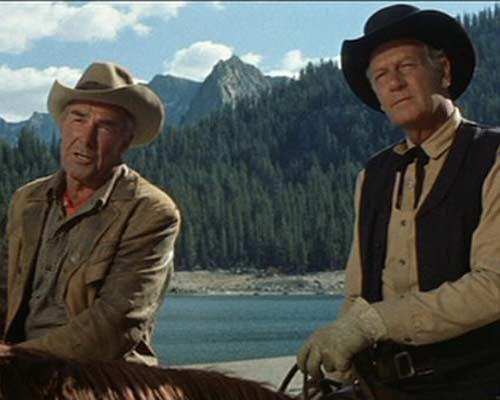
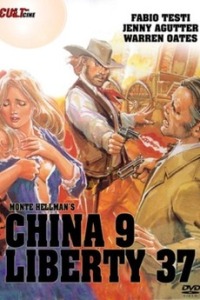 Directed by the legendary Monte Hellman, China 9, Liberty 37 is a revisionist take on the western genre. Fabio Testi plays Clayton Drumm, a legendary gunslinger who is about to be hung for murder. At the last minute, men from the railroad company show up and arrange for Clayton be released. They want him to kill a rancher who is refusing to sell his land. Clayton agrees but, before he leaves for his mission, he gives a brief interview to a writer from “out East.” Cleverly, the writer is played by director Sam Peckinpah, to whose films China 9, Liberty 37 clearly owes a huge debt.
 Catherine loves Matthew but resents his rough ways and feels that he treats her like property. One night, she and Clayton go for a nude swim and then make love. When Matthew finds out, he strikes his wife and, in self-defense, she stabs him in the back. Believing Matthew to be dead, she and Clayton go on the run.
 As a western, China 9, Liberty 37 is more interested in its characters than in the usual gunfights. There are no traditional heroes or villains and Monte Hellman emphasizes characterization over action. Even while he is relentlessly pursuing Clayton and Catherine, Matthew admits that he does not blame Catherine for leaving him. As for Clayton and Catherine, they are both consumed by guilt over their affair. This is one of the few westerns where the main character often refuses to fire his gun.
 Director Monte Hellman is as well-known for the films he did not get to make as for the ones he actually did make. (Originally, Quentin Tarantino wanted Hellman to director Reservoir Dogs. When Tarantino changed his mind and decided to direct it himself, Hellman was relegated to serving as executive producer. A lot of recent film history would be very different if Tarantino and Hellman had stuck to the original plan.) Like a lot of the films that Hellman actually did get to make, China 9, Liberty 37 was only given a sparse theatrical release and was often shown in a heavily edited version. It has only been recently that the full version of China 9, Liberty 37 has started to show up on TCM. It is an interesting revisionist take on the western genre and must see for fans of Monte Hellman, Jenny Agutter, and Warren Oates.


 Through the Shattered Lens